Choosing a video surveillance platform in 2026 is a long-term infrastructure commitment. Security directors, IT teams, and operations leaders are weighing AI capabilities, cybersecurity risk, deployment models, and vendor lock-in, while supporting distributed teams and multiple locations.
The wrong choice can create years of operational friction and hidden costs. This guide compares Avigilon, Verkada, and Coram from a buyer’s perspective. Instead of surface-level feature lists, it examines architecture, analytics, scalability, access control, and long-term flexibility.
The goal is simple: help you choose a platform that fits your environment today without limiting you tomorrow.
What Verkada is Known For
Verkada is best known for its cloud-first, AI-powered approach to physical security, built around a single, tightly integrated platform.
Its hybrid cloud model stores video locally on devices while using the cloud for centralized management, analytics, and automatic updates. This gives teams speed without sacrificing reliability.
What really sets Verkada apart is how much it unifies under one interface. Video security, access control, alarms, intercoms, environmental sensors, and workplace tools all live inside Verkada Command.
This makes it easy for security teams to pull footage in seconds, spot unusual access behavior, or respond to changes in air quality. For organizations that want an all-in-one, cloud-managed security ecosystem built to scale, Verkada’s value is clarity and control from a single platform.
What Avigilon is Known For
Avigilon is known for enterprise-grade, end-to-end security solutions that combine high-definition video surveillance with advanced AI analytics. Being a subsidiary of Motorola Solutions, the platform is built for organizations that prioritize accuracy, reliability, and situational awareness.
Avigilon supports both cloud-native and on-premise deployments, making it a strong fit for regulated industries and large enterprises with strict infrastructure or data requirements.
With features like intelligent video analytics, visitor management, and scalable access control, Avigilon focuses on automating threat detection and helping security teams respond faster and more decisively in complex environments.
What Coram is Known For
Coram is known for bringing AI-native intelligence to physical security. Its cloud-based platform is hardware-agnostic, meaning businesses can upgrade their security systems without ripping and replacing existing camera hardware.
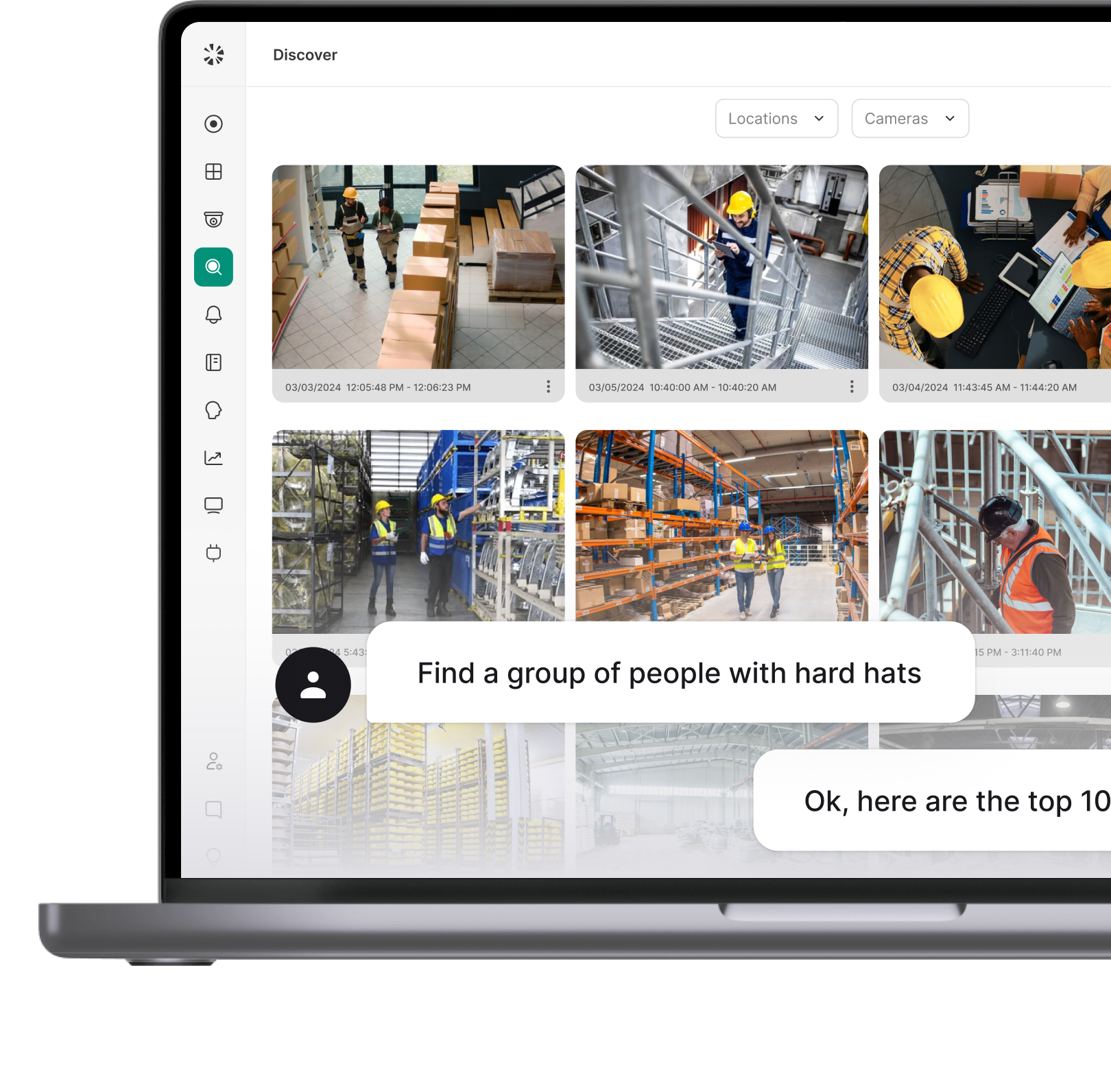
Coram stands out for its AI-powered video search and proactive alerts. Users can find specific moments across hours of footage using natural language queries, while real-time alerts flag incidents, like weapons detection, slip-and-fall incidents, or unusual activity as they happen.
Beyond security, Coram also delivers operational insights such as occupancy tracking, queue detection, and heat mapping. Combined with a unified platform and fast deployment, Coram is especially attractive to teams that want powerful AI capabilities with minimal setup and maximum flexibility.
Verkada vs Avigilon vs Coram – Video Surveillance System Table
Seeing the differences side by side makes the decision clearer. This comparison table breaks down how Verkada, Avigilon, and Coram stack up across different features, so you can identify which platform aligns best with your security goals and operating model.
Cloud-Managed vs Hybrid vs On-Prem
The difference between various video surveillance architectures directly affects cost, scalability, security, and long-term flexibility. Understanding how cloud-managed, hybrid, and on-prem systems guide security directors in choosing a platform that fits their operational needs today, without limiting them tomorrow.
Verkada Architecture
Verkada uses a cloud-managed, edge-based architecture that blends on-premise performance with cloud simplicity. Video is stored directly on each camera (with flexible retention options), eliminating bulky NVRs and single points of failure.
Whereas optional cloud backup adds an extra layer of resilience. Even during internet outages, cameras continue recording locally with minimal bandwidth usage once connectivity is restored. Everything is managed through a single, browser-based dashboard or mobile app.
Admins get real-time visibility into device health, instant alerts for issues like:
- tampering or connectivity loss
- automatic firmware updates that roll out new features
- security patches with little to no downtime
From a scalability and control standpoint, Verkada is built for modern, distributed environments. You can manage cameras, access control, alarms, environmental sensors, and visitors across all locations from one interface, while still allowing local security teams to handle site-specific needs.
Native support for SSO, MFA, SCIM, and SAML simplifies user management, and integrations with platforms like Okta and Microsoft Entra ID reduce IT overhead. For organizations thinking long-term, the architecture is designed to scale without costly infrastructure upgrades.
Plug-and-play deployment, low network impact, extended warranties, and continuous AI-powered analytics updates help future-proof your investment. Open APIs and a growing ecosystem of prebuilt integrations make it easy to connect physical security data with broader IT and business systems. This makes Verkada a centralized, intelligence-driven security platform.
Avigilon Architecture
Avigilon is known for its flexible, open architecture, giving organizations multiple deployment paths depending on how much control they want over data, infrastructure, and IT operations. Buyers can choose between Avigilon Unity (on-prem), Avigilon Alta (cloud-native), or a hybrid model that blends both.
It is built around AI-driven video analytics. Advanced capabilities like appearance search, license plate recognition, and unusual activity detection help security teams surface relevant events faster while reducing manual review. The platform also unifies video, access control, and environmental sensors into a single dashboard for better situational awareness across sites.
Avigilon Unity is designed for organizations that require maximum data ownership. Video and access control run on dedicated on-prem servers and controllers, with footage stored locally for full governance. Optional cloud services add remote access and system health monitoring without forcing a full cloud migration.
Avigilon Alta takes the opposite approach: a cloud-native architecture. Cameras and access readers connect directly to the cloud, handling analytics and storage without local servers. Automatic updates, lower infrastructure overhead, and cloud connectors for existing cameras make Alta attractive for teams prioritizing agility, scalability, and reduced IT maintenance.
Avigilon’s biggest strength is choice. Whether you need on-prem control, cloud simplicity, or a phased hybrid rollout, Avigilon’s modular architecture lets you scale and adapt without locking your organization into a single operating model.
Coram Architecture
Coram takes a hybrid, AI-first approach that combines on-prem processing with cloud-native management. Coram Point is an on-prem AI NVR that connects to your existing IP cameras and runs real-time video analytics locally, while the cloud handles centralized management, storage, and advanced AI workflows.
The architecture is camera-agnostic by design. Coram works with any ONVIF- or RTSP-compliant IP camera. This enables organizations to layer AI intelligence on top of their current infrastructure without ripping and replacing it.
Video is analyzed at the edge using AI chips, and only lightweight metadata is sent to the cloud, keeping bandwidth low and response times fast. Where Coram stands out is in its physical AI safety agents.
Using large vision and language models, IT teams can receive high-precision alerts for firearm detection, slip-and-fall, PPE violations, or create custom alerts instantly using plain English. The same natural-language interface powers advanced video search across cameras and sites, speeding up investigations.
Coram extends beyond video into access control and emergency management. Its cloud-managed access control system integrates with existing readers, links door events directly to video, and supports mobile credentials, custom lockdowns, and offline usage.
Emergency response is handled from a single app, with wireless panic buttons, real-time chat, and coordinated incident resolution. Coram’s architecture is built for scale and longevity. The separation between cameras and the AI NVR means you can upgrade analytics and compute power over time without replacing your camera fleet.
Open APIs and native integrations with platforms like Brivo and Openpath make it easy to unify video, access, and emergency workflows. This positions Coram as a flexible, future-proof alternative to closed, hardware-locked security systems.
Hardware and Ecosystem Lock-In
Vendor choice often determines how easily you can change suppliers later. Verkada sells a tightly integrated cloud-managed stack that favors simplicity and fast deployment. That design is easy to deploy but raises switching costs if you want a different vendor later.
Avigilon takes a more open path: its Alta/Unity family supports modular hardware and third-party cameras, which lowers lock-in for organizations with existing fleets.
Coram purposely separates the cameras from the Coram Point NVR, so you keep your cameras while upgrading analytics on the NVR. It’s a hybrid approach that minimizes rip-and-replace risk.
Proprietary vs Open Hardware Support
Verkada: Closed, plug-and-play hardware + cloud experience. It's fast to stand up, harder to migrate away from.
Avigilon: Supports ONVIF/third-party cameras and modular controllers; better for mixed-vendor environments and phased refreshes.
Coram: Camera-agnostic (ONVIF/RTSP). Intelligence lives in the Coram Point NVR so you can keep existing cameras and upgrade independently.
Video Quality and Analytics Capabilities
All three vendors aim to reduce investigation time, but they do it differently. Verkada focuses on edge-enabled cameras and cloud orchestration with continuous firmware/analytics updates and tools to minimize bandwidth impact.
It’s good for organizations that want turnkey AI without deep VMS complexity. Avigilon emphasizes advanced on-prem and hybrid analytics (Appearance Search, classified object detection) that scale across large sites and deliver robust forensic tools for complex investigations.
Coram’s analytics capabilities center on modern AI safety agents and machine learning (large vision/language models). It offers natural English searches, custom safety alerts, and AI feature upgrades without overhauling existing camera hardware.
How Fast Can You Find an Incident?
Avigilon: Appearance Search Technology and hybrid analytics compress hours of footage into seconds, allowing you to search for an incident by entering a description or uploading a photo. Built for forensic speed at enterprise scale.
Verkada: Find events using AI-powered search capabilities in seconds and independently verify incident-related footage via browser/mobile search without any login required. Optimized for operational teams who need quick answers without a VMS.
Coram: Natural-language video search and AI agents that can surface and summarize incidents quickly across sites. Perfect when security directors want to search incidents in plain English.
Multi-Site Management & Scalability
Verkada: Manage cameras, access, visitors, air quality, alarms, and sensors from a single dashboard; cloud-first scaling with tools like Enterprise Bandwidth Manager to control per-site network usage. Very low operational overhead as you add sites.
Avigilon: Flexible and supports large on-prem VMS deployments (Avigilon Unity) and a path to cloud services; architected for linear scalability in complex enterprise settings.
Coram: Cloud dashboard plus local Coram Point devices per site makes distributed rollouts simple; scale by adding NVRs rather than overhauling cameras.
Cybersecurity & Privacy (Must-Have in 2026)
The privacy and cybersecurity of the access security stack are non-negotiable. Look for: SSO/SCIM support, strong encryption, automated firmware/patch management, and architecture that minimizes exposed telemetry.
Verkada: Supports SAML/OIDC SSO and SCIM provisioning with Okta and Microsoft Entra. The centralized identity and automated user lifecycle reduce human error. It also emphasizes encrypted communications and managed updates.
Avigilon: Enterprise identity integrations (Okta/SAML/SCIM) and on-premise/cloud deployment options let you choose the security model that matches your IT risk tolerance.
Coram: By keeping heavy AI processing on-prem via Coram Point and sending compact metadata to the cloud, it reduces bulk data exposure while offering modern cloud controls and integrations.
For buyers: Insist on documented patch cadence, centralized identity (SSO + SCIM), encrypted storage/transit, and clear data retention controls before signing a long contract.
Top 3 Must-Have Features of Video Surveillance in 2026
In 2026, video surveillance is defined by intelligence, speed, and resilience, not just camera quality. The systems that deliver value are built around features that prevent incidents, accelerate response, and scale securely with modern environments.
- Deep Learning and Video Analytics
In 2026, video surveillance is more about real-time understanding than passive recording. Deep learning–driven video analytics allow video surveillance systems to recognize people, objects, and vehicles as events unfold, then flag anomalies based on learned behavioral patterns over time.
This results in higher detection accuracy, fewer false alarms, and faster, data-backed decisions. When integrated with alarms, access control, and sensors, AI analytics also enable automated responses. This frees security teams to focus on high-impact incidents rather than constant monitoring.
- Edge Computing for Real-Time Response
Edge computing has become essential for modern surveillance. By processing video directly at the camera or on-site device, systems reduce latency, conserve bandwidth, and trigger alerts almost instantly.
This at-device intelligence enables faster incident response, supports automated actions, and protects sensitive data, which improves privacy and resilience. For organizations that prioritize speed, reliability, and scalability, edge-based analytics are no longer optional.
- Converged Physical and Cybersecurity
As surveillance systems move to the cloud, physical security can’t exist in isolation. In 2026, the most effective platforms tightly integrate physical security with cybersecurity controls.
This convergence helps prevent camera hijacking, protects video data in transit and at rest, and ensures consistent patching and updates across all devices.
More importantly, it enables holistic threat detection, connecting physical events with cyber signals to stop risks before they cascade across systems.
Verkada vs. Avigilon vs Coram: Access Control Platform Comparison
Verkada: Native access control tightly integrated into the Command platform for unified video and door workflows, and cloud-managed credentialing. It’s quick to deploy and simple to operate.
Avigilon: Alta Access is modular and built to run in offline-failover modes (controllers/readers), making it well-suited to mission-critical door control in large enterprises. Integrates with cloud services for centralized policy.
Coram: Cloud-managed access control that supports Wiegand/OSDP readers, mobile credentials, battery backup, and linkage to video and emergency workflows. Strong for teams wanting modern door control with easy lockdown scenarios.
Final Verdict – Which Platform is Right for You?
Make the decision against three questions: Do you want plug-and-play simplicity, deep forensic power, or flexible AI upgrades without replacing cameras?
Choose Verkada if…
You want a single cloud experience that’s fast to deploy, simple to operate, and centrally managed across sites. Ideal for organizations that value low operational overhead and integrated cloud analytics out of the box.
Choose Avigilon if…
You manage large, complex sites that require enterprise-grade forensic analytics, on-premises resilience, and broad third-party camera/controller support. Best when you need powerful search, modular hardware, and tight integration with enterprise identity systems.
Choose Coram if…
You want to keep existing IP cameras, add innovative AI safety agents (including plain English alerts, weapon/PPE detection, and license plate logging), and scale analytics by upgrading the NVR rather than replacing the cameras. Great for businesses that prioritize modern AI and flexible integrations.
Final Takeaway
There is no universal “best” video surveillance platform, only the best fit for your operational reality. Verkada prioritizes speed, simplicity, and centralized cloud management. Avigilon delivers enterprise-grade control, deployment flexibility, and analytics.
Coram introduces a modern, AI-first hybrid model that reduces hardware lock-in while accelerating intelligence and response times.
For decision-makers, the real question is not which platform has more features, but which matches your risk tolerance, IT resources, and future expansion.
When you align architecture to outputs (instead of marketing claims), you can accurately pick a surveillance system that scales, adapts, and delivers value well beyond 2026.
FAQ




.png)