Camera ecosystems are impacting physical security in 2026. The real decision security leaders face today is whether to invest in an open AI security platform or commit to a closed, vertically integrated camera ecosystem.
An open security ecosystem is built for interoperability. It works with multiple camera brands, exposes APIs for integrations, and lets organizations incorporate AI, analytics, and workflows on top of existing infrastructure.
These platforms are designed for flexibility, phased migrations, and long-term adaptability, especially for multi-site organizations that don’t want to rip and replace hardware every few years. A closed security ecosystem takes the opposite approach.
Hardware, software, cloud storage, and AI are controlled by one vendor. The upside is simplicity: faster deployments, predictable operations, and fewer integration issues. The tradeoff is choice. Once you’re in, switching platforms later can be expensive and disruptive.
Coram and Verkada represent these two models clearly. This comparison explains how each approach impacts real-world deployments so you can decide what fits your organization, not what’s universally “best.”
TL;DR
- Open ecosystems (Coram) = flexibility, camera reuse, integrations, and lower lock-in
- Closed ecosystems (Verkada) = simplicity, turnkey deployments, and predictable operations
- The right choice depends on your scale, budget, compliance needs, and how much control you want over your stack
Coram vs Verkada - Explained
Coram and Verkada take two different approaches to modern physical security. One is built around openness and flexibility, while the other prioritizes integration and simplicity. Understanding this difference is key to choosing the right platform for your environment, budget, and long-term security strategy.
Verkada
Verkada offers a fully integrated, end-to-end physical security ecosystem. It is a unified platform where proprietary, AI-powered hardware (cameras, access control devices, environmental sensors, alarms, and intercoms) is natively built for its Command web-based interface.
This closed-loop platform promises a seamless, all-in-one experience managed through a single, intuitive web interface, appealing to organizations seeking a consolidated, modern security stack.
Verkada’s camera lines are intelligent endpoints featuring on-device storage and edge-based analytics. By processing video directly on the camera, they ensure continuous operation and provide advanced AI search, such as person-of-interest search or vehicle detection.
This architecture entirely reduces the need for NVRs or DVRs, simplifying deployment and IT infrastructure. Beyond surveillance, Verkada expands its ecosystem to holistically secure and manage the environment. Its access control system integrates doors and locks, enabling centralized actions like remote one-tap lockdowns across an entire campus.
Environmental sensors monitor air quality, temperature, humidity, and even detect vaping or smoke. This is complemented by cloud-managed alarms and an intercom system for visitor management and remote two-way communication through the Verkada app.
The primary operational benefit for security directors and IT teams is radical simplification. The Command platform is a unified dashboard for managing every device, searching footage with AI, viewing live feeds, and responding to alerts, all accessible from any device.
Furthermore, as a closed ecosystem, Verkada handles all firmware and security updates automatically, ensuring the entire system remains current without manual intervention from your staff.
Ultimately, Verkada’s value proposition centers on delivering a comprehensive, “out-of-the-box” solution. It minimizes integration complexity and internal IT overhead, offering a simplified path to modern security.
Coram
Coram adopts a cloud-native, infrastructure-agnostic philosophy. It is an open AI security platform designed to modernize your existing security cameras, not replace it. By connecting your current IP cameras directly to the cloud, Coram layers AI-powered intelligence on top.
This approach eliminates the dependency on traditional NVRs without needing camera replacement. This architectural philosophy translates into strategic flexibility. Coram enables phased modernizations and supports hybrid deployments seamlessly for security and IT leaders managing complex multi-site environments.
You can pilot AI-driven security in specific areas, integrate new buildings with legacy systems, and scale intelligence across the organization without disrupting daily operations. This is advantageous for enterprises with hundreds or thousands of deployed cameras that cannot be refreshed in a single cycle.
The platform’s AI is engineered for operational efficiency, aiming to reduce human effort and accelerate response times. Instead of manual review, Coram makes video searchable by person, vehicle, or attribute. It surfaces important events like a detected perimeter breach or an unauthorized door access and minimizes the hours security teams spend sifting through footage.
This intelligence is cloud-based, aggregating and analyzing data across your entire camera fleet for broader situational awareness, rather than relying solely on edge analytics. Coram further strengthens its value proposition through deep, native integration. It merges video intelligence with its own access control software, creating unified security workflows.
When a door-forced alert triggers, security personnel can instantly pull up associated camera footage, see who’s involved, and review their access history, within a single interface. This closed-loop between video and access control simplifies investigations and resolves incidents faster.
Coram offers a path to intelligent security that leverages current cameras while building for the future.
Ecosystem Architecture: Open vs Closed
Open ecosystems are designed for interoperability and choice, while closed ecosystems focus on control, consistency, and ease of management. This section explains how each model affects scalability, integrations, and future migrations.
Closed Ecosystem (Verkada)
Verkada’s architecture is an integrated, closed ecosystem. This model is built on proprietary hardware and unified cloud software, designed to deliver a swift experience. It operates on a cloud-managed, edge-based principle that combines on-premise performance with cloud-based simplicity.
Video is processed and stored on the camera, eliminating traditional NVRs and points of failure. This edge storage ensures continuous recording even during network interruptions, with minimal bandwidth consumption.
All cameras, access control, sensors, and alarms are governed through a centralized platform, accessible from any device. This closed design yields operational efficiencies for IT and security teams. Administrators gain real-time, centralized visibility into device health and receive instant alerts for tampering or offline devices.
One of its management benefits is the handling of firmware updates and new AI features, and security patches are deployed automatically across the ecosystem with minimal administrative overhead or system downtime.
Verkada is engineered for large enterprises. It allows for centralized policy management and oversight across all locations while empowering local teams with site-specific access. The architecture integrates with modern IT infrastructure, featuring native support for SSO, SAML, MFA, and SCIM, and pre-built integrations with identity providers like Okta and Microsoft Entra ID.
This simplifies user lifecycle management and hardens security postures. For long-term planning, Verkada’s model is designed to scale without the need for periodic, costly infrastructure refreshes. The plug-and-play deployment, low network impact, and extended warranties reduce operational complexity.
Verkada’s closed ecosystem architecture prioritizes simplicity, reliability, and centralized control. It is ideal for organizations seeking a fully managed, vertically integrated solution that reduces internal IT burden and provides a consolidated, intelligence-driven security platform.
Open AI Security Platform (Coram)
Coram is an open, AI-first platform designed to modernize your existing infrastructure. Its approach is hybrid, combining on-premise processing with cloud-native management to deliver intelligence.
The Coram Point is an on-premise AI NVR that connects directly to your current IP camera network, performing real-time video analytics at the edge. The cloud then serves as the command center for centralized management, storage, and more advanced AI workflows.
This architecture is camera-agnostic, working with any ONVIF- or RTSP-compliant camera. This means you can layer AI onto your deployed fleet without a disruptive rip-and-replace. Operationally, this design delivers efficiency and robust intelligence.
Video is analyzed locally by AI at the edge, with only necessary metadata sent to the cloud. This minimizes bandwidth consumption while enabling fast response. With large vision and language models, Coram creates intelligent safety agents.
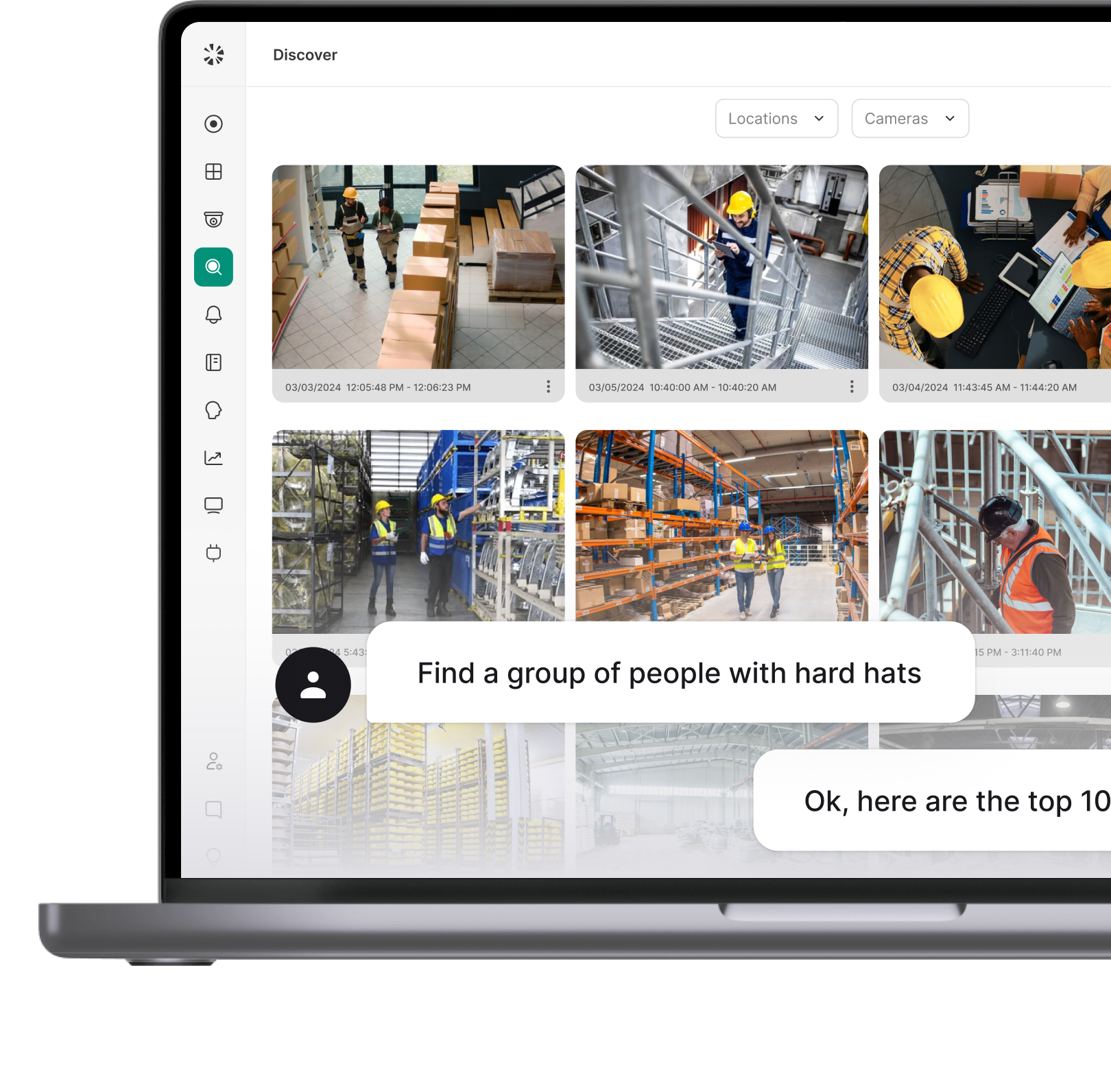
Security teams can deploy high-precision detection for threats like firearms or slip-and-fall, license plate recognition, and enforce PPE compliance, or create custom alerts using simple plain English prompts.
This natural language capability powers investigative search, allowing security personnel to find specific events across thousands of hours of footage in seconds. The platform’s openness extends beyond video. Coram integrates cloud-managed access control, capable of working with existing door readers.
Ultimately, Coram’s architecture is built for longevity and scale. It allows organizations to upgrade their AI and compute power independently over time, protecting their existing IP cameras.
Its open APIs and native integrations facilitate a unified security posture. This positions Coram as a flexible, future-proof alternative for enterprises that need to leverage existing IP cameras and require an intelligent platform that evolves independently of their hardware.
Verkada vs Coram - Quick Comparison Table
This table highlights the most important differences that impact real deployments. Use it to quickly narrow down which platform aligns with your use case.
Camera & Hardware Strategy
Start by deciding whether you want to reuse existing cameras or budget for a rip-and-replace. Open, camera-agnostic platforms let you enjoy modern AI and cloud services on top of whatever IP cameras you already own, cutting immediate capital expense and shortening rollouts.
This is useful when you’re managing many sites or older, functioning hardware. And Coram explicitly positions itself to connect to existing IP cameras and deliver cloud-based AI features without forcing camera swaps.
By contrast, closed/cloud-managed vendors typically design the software to integrate with their own camera line. Vertical integration can simplify deployment, guarantee optimized video quality and analytics out of the box, and reduce configuration complexity.
But it often means higher upfront hardware spend and replacement costs if your fleet is mixed or NDAA/compliance constraints force change. Verkada sells the camera and cloud bundle as a single managed product to remove on-prem VMS complexity, which aligns with buyers who prefer a turnkey hardware refresh.
Which to Choose: If your sites already have modern IP cameras and your priority is minimizing capital expense and preserving choice, lean open. But if you’re replacing an end-of-life system and want low-touch, unified hardware and lifecycle support, a closed, vendor-managed camera strategy may be faster to operationalize.
Integrations & Extensibility
Integration needs separate the two models more than features do. Open platforms like Coram emphasize standards (ONVIF/RTSP), open APIs, and third-party connectors, enabling you to incorporate cameras, access control, sensors, and analytics together across vendors.
That flexibility is invaluable for complex environments where site-level customization, bespoke analytics, or gradual migrations are required. Coram documents support for hybrid setups, ONVIF/RTSP, and the ability to operate in mixed environments. It’s the exact posture you need when you don’t want a forced rip-and-replace.
Closed vendors still offer integration points, but those integrations are often optimized for the vendor’s ecosystem and tested against their hardware. Verkada boasts developer APIs and partner integrations that make automation and enterprise data ingestion possible while keeping the official workflow focused on their camera/cloud stack.
Which to Choose: If you need deep customization, third-party analytics, or phased rollouts that keep legacy hardware in play, an open, API-friendly platform wins. If you need proven, validated integrations with minimal engineering overhead and vendor-backed interoperability, a closed, cloud-managed stack is attractive.
Identity & Enterprise Systems
Enterprise identity integration is non-negotiable at scale. Look for SAML/SSO support, SCIM or provisioning APIs, granular role-based access control (RBAC), and audit logging. Closed cloud vendors like Verkada typically provide built-in SSO and centralized user provisioning that’s simple to connect to Okta or similar identity providers.
This reduces admin overhead and speeds up onboarding. Verkada’s platform supports enterprise-grade integrations and centralized provisioning workflows. Open platforms may support the same protocols but expect more variability: you’ll often rely on the vendor’s published API or a combination of directory connectors and middleware to achieve the same centralized control.
If access control must be unified with doors, badging and emergency workflows, confirm whether the vendor offers native access control features or validated partner integrations.
Pricing & TCO: Open vs Closed Models
Total cost of ownership goes beyond camera price. Factor hardware CAPEX, cloud storage/licensing OPEX, integration and engineering effort, maintenance, lifecycle replacement, and indirect costs such as training and downtime during migrations.
Open platform TCO profile:
- Lower near-term CAPEX if you reuse cameras.
- Higher engineering or integrator fees up front for custom integrations, testing, and potentially on-prem middleware.
- Greater long-term flexibility and lower vendor lock-in risk, which can reduce future migration costs if standards are followed. Coram’s model markets lower hardware replacement needs by leveraging existing IP cameras and cloud AI.
Closed/cloud model TCO profile:
- Higher hardware and licensing line items initially when cameras and cloud subscriptions are bundled.
- Predictable OPEX model (device + cloud license) simplifying budgeting; Verkada explicitly packages hardware with cloud licensing and support to provide that predictability.
- Lower internal engineering cost at rollout because integrations and updates are managed by the vendor. But watch for rising renewal fees and longer-term switching costs if requirements change.
Operationally, calculate TCO over a 3–5 year span and model two scenarios: (A) phased migration using existing cameras plus integration labor (open), and (B) full hardware refresh with vendor cloud licensing and simpler operations (closed). Include realistic storage retention, analytics processing, and incident response times; they drive cloud costs and operational needs.
Use-Case Scenarios: Which Platform Fits Best?
Below are practical fits based on typical buyer priorities.
- Large multi-site organization with mixed legacy cameras and phased budgets
Best Fit: Open, camera-agnostic platform. You preserve capital, scale analytics where needed, and avoid mass hardware replacements across sites. Coram’s approach to hybrid ONVIF/RTSP settings is explicitly aimed at this problem.
- Single-vendor greenfield rollout where speed and low-touch operations are essential (schools, retail chains, office campuses)
Best Fit: Closed, cloud-managed stack. Vendor-owned hardware + cloud simplifies procurement, support, and lifecycle management. It’s ideal where uniformity, warranty, and a single support path are priorities. Verkada positions itself for this turnkey model.
- Highly regulated or NDAA/NIST compliance environments
Both can work, but validate hardware compliance and data residency: open platforms allow selective hardware choices that meet procurement requirements; closed vendors often publish compliance posture and tested configurations that simplify audits. Check vendor compliance documentation and warranty terms before selection.
Conclusion & How to Decide
The choice between Coram and Verkada ultimately comes down to a strategic decision: Do you prioritize an open, flexible platform that modernizes your existing infrastructure, or a closed, integrated ecosystem that offers a complete, plug-and-play experience?
This isn't about which technology is superior, but which architectural philosophy best aligns with your organization's current assets, operational model, and future roadmap. Your existing investments, in-house IT capabilities, and security requirements should guide your evaluation.
Consider Coram’s Open Platform If:
- You have modern IP cameras and need to protect that investment while adding advanced AI. Its agnostic approach turns your existing infrastructure into an intelligent system.
- your strategy favors phased rollouts, hybrid environments, or long-term flexibility. The ability to upgrade analytics independently of cameras provides future-proofing.
- You require deep, unified workflows between video, access control, and emergency management, but need to integrate with or leverage some existing hardware.
- your team values custom, plain English AI alerts and search to tackle operational or safety challenges.
Consider Verkada’s Closed Ecosystem If:
- You are building a new system or are ready for a full refresh and want a singular, cohesive vendor experience from hardware to software.
- operational simplicity and reduced IT overhead are top priorities. The fully managed, plug-and-play model with automatic updates minimizes internal maintenance.
- You want a consolidated, centralized view that natively combines surveillance, access control, environmental sensing, and alarms without integration projects.
- You need edge-based reliability with continuous local recording and prefer the predictability of an all-in-one subscription model.




.png)