Your district already knows where the gaps are. Unsecured entry points, aging cameras, doors that still run on keys, a notification system that doesn't reach every building. The hard part is turning that list into an application that competes with districts that have full-time grant writers.
Start with the program, not the prose. The DOJ COPS School Violence Prevention Program (SVPP) is the main federal program that pays for cameras, access control, and other physical security at public school districts. The BJA STOP School Violence Program has a nearly identical name and does not pay for any of that. Pick the wrong one and you lose a cycle.
This guide covers how to match your project to the right program, how SVPP actually scores applications, and the requirements that knock out otherwise good ones.
Match your project to a program before you write a word
Three questions sort almost every opportunity: what does the program fund, who can apply, and where does the application go? SchoolSafety.gov's Grants Finder Tool lets you filter federal programs on the first two before you build a budget.
What each program will actually buy
Federal school safety funding falls into three broad categories.
Physical security equipment. Security cameras and systems, access control and door locking hardware, lighting, fencing, panic and alarm notification systems, visitor management systems, and installation. SVPP funds these for public districts. The Nonprofit Security Grant Program (NSGP) funds similar projects for nonprofits and nonpublic schools.
Detection, reporting, and notification technology. This category splits across programs, which is where districts get tripped up. Technology that speeds notification of local law enforcement during an emergency is an SVPP purpose area. Anonymous reporting systems, such as tip lines and reporting apps, belong to BJA STOP.
Prevention programming. Behavioral threat assessment teams, staff and student training, and mental health crisis training. These are STOP and other prevention programs, not equipment grants.
Classify your project first. If it mixes categories, you may need two applications to two programs, each with its own distinct costs.
Who can apply where
Public school districts cannot apply to NSGP. It is built for eligible 501(c)(3) nonprofits, including religious and independent schools. For charter schools, check the specific program's applicant definition: SVPP explicitly includes public charter schools and explicitly excludes private charters.
Where the application goes
SVPP applications go straight to the federal government in two steps, Grants.gov first and JustGrants second. NSGP is federal money that you apply for through your state's administering agency, never directly to FEMA. In North Carolina, for example, that is NC Emergency Management within the Department of Public Safety.
Put the right agency, submission system, and deadline on your calendar before you start writing.
Which school safety grants pay for cameras, access control, and weapons detection
Match every major budget line to the solicitation's allowable-cost language before you write. If your project combines hardware, software, installation, and recurring costs, check each category separately.
The trap that kills camera requests: SVPP funds them, STOP does not
Both programs come from the same 2018 law, both sit inside DOJ, and both show up when you search for school security grants. The funding rules point in opposite directions.
SVPP's statutory purpose areas include "placement and use of metal detectors, locks, lighting, and other deterrent measures" and technology for expedited notification of local law enforcement. Its FY26 resource guide lists security cameras and systems as allowable equipment.
STOP excludes target hardening outright and funds training, threat assessment teams, and reporting technology. A camera request sent to STOP is a request the program cannot fund. Check the awarding agency and the allowable-cost section of the solicitation in front of you, not the program name.
How SVPP actually scores applications
SVPP doesn't grade one long narrative. Scoring happens in two stages, and knowing them changes where you spend your writing time.
In the first stage, COPS scores your answers to the application's survey questions:
- Improved security need: 50 percent. Your existing security infrastructure, planning, and rate of incidents.
- Program impact: 25 percent. How many schools and students the project reaches.
- Federal assistance need: 25 percent. Why you can't address the need without federal money, backed by data on your service population and fiscal health.
Applications that advance then get a comprehensive narrative review, rated Recommended or Not Recommended, on four criteria: school safety planning and assessment efforts, funding request and integration, management and implementation plan, and sustainability plan.
Half the first-stage score rides on security need. Build that evidence first.
Improved security need: make the gap measurable
Reviewers need to see what is wrong today and why it has to be fixed now. "Significant security gaps" can't be scored. A count tied to a location can.
Start with records you already have: your threat assessment, security audit, incident reports, facilities work orders, access logs, and drill findings. Look for numbers such as:
- Entry points without controlled access
- Buildings or areas without camera coverage
- Doors that still rely on keys
- Documented incidents or recurring security issues
- Emergency notification times
- Equipment past its useful life
Weak: Our district has significant security gaps that put students and staff at risk.
Strong: The district's 2026 facility assessment identified 11 exterior entry points across three buildings without camera coverage or controlled access. Six of those doors are primary entrances during arrival and dismissal.
Where your evidence already lives
Most districts don't need a new study. Each source adds a different piece:
- Incident reports give frequency, location, and type. A count tied to one building or entrance beats "ongoing security concerns."
- Visitor logs and check-in records show where entry procedures are inconsistent or undocumented.
- Work orders prove a problem is persistent. Repeated tickets for broken locks, faulty doors, or door-propping read very differently from a one-off.
- Drill after-action notes catch operational gaps, like doors that can't be secured during lockdown or buildings that never receive the alert.
- Facility or vulnerability assessments pull these together and rank the gaps. CISA's K-12 School Security Guide can help you frame the process.
National statistics explain why an issue matters. Your own records explain why this project is needed in this district, and that is what gets scored.
Turning one finding into a scored paragraph
Take a single finding and work it through four steps.
- The finding. The 2026 facility assessment identified six exterior doors in the north building without electronic access control or event logging.
- The evidence. Facilities records show 14 door-propping incidents at those entrances during the last academic year.
- The response. The district will install credential readers and compatible locking hardware at all six doors, reusing existing cabling where possible.
- The paragraph. Combine the three into a few sentences that name the location, the count, and the fix.
That paragraph gives the reviewer a place, a number, and a response. For threat assessment context, use primary research such as the National Threat Assessment Center research, which emphasizes gathering information about specific behaviors and circumstances.
Program impact: count who benefits
This quarter of the score is often answered in a sentence. Give it real numbers: how many schools, how many students, and which buildings the project touches. If a project covers three buildings serving 2,400 students, say so, and make sure those buildings match the ones in your security-need evidence.
Federal assistance need: show why local money can't cover it
The draft most districts skip is the one worth a quarter of the first-stage score. COPS asks applicants to explain why they can't address the identified needs without federal help, and to answer questions about their service population and local fiscal health.
Work with your business office on this section. Pull the figures you already report: enrollment, the share of students in poverty programs, local revenue trends, and competing capital demands. A concrete explanation of what the district can and can't fund locally is stronger than a general statement about tight budgets.
Funding request and integration: name the equipment and justify every line
This is where "improve campus security" disappears. Name the equipment, quantity, location, purpose, and how it fits the safety plan you already have. A useful pattern is equipment, then location, then the gap it closes, then how it will be installed.
Weak: The district will purchase security equipment to improve campus safety.
Strong: The district will install credential readers and electronic locks at the six exterior doors identified in the 2026 assessment. Installation will happen during summer recess, followed by testing and staff training before school opens.
Every budget line needs three things: what is being bought, how many at what unit cost, and why that quantity is needed. SVPP's budget worksheet asks for exactly that computation.
Weak: Security cameras, $50,000
Strong: 32 IP cameras at $850 = $27,200; installation, 32 at $175 = $5,600. The cameras cover 11 exterior entry points and 21 high-traffic areas identified as unmonitored in the 2026 facility assessment.
A few SVPP rules shape the budget:
- Software and prepaid maintenance are allowable for up to 36 months, paid within the award period.
- Some technology is unallowable. The FY26 list excludes license plate readers, facial recognition and other biometric technology, vape detection, and body-worn cameras.
- Covered equipment is banned. Award funds can't buy video surveillance equipment from Hikvision, Dahua, or other covered companies under Section 889 of the 2019 NDAA.
- Buy after the award. Costs incurred before the award start date aren't reimbursable.
- Plan procurement. Sole-source purchases over $350,000 need COPS approval, and the program prefers American-made products where practicable.
Also look at what you already own. If existing cameras or door hardware can be reused, the request gets smaller and the implementation plan gets easier to explain.
Management and implementation plan: show you can finish it
A detailed project the district can actually complete beats a longer equipment list with no path to installation. Name who manages the project, and lay out procurement, installation, configuration, testing, and training on a timeline that fits the 36-month award. Note any coordination with facilities, IT, or local law enforcement.
Sustainability plan: answer who pays in year four
The grant ends after 36 months. The equipment doesn't. Identify recurring costs such as software licenses, maintenance, and replacement parts, then name the budget line and the person responsible for each.
Weak: The district is committed to maintaining the security improvements after the grant ends.
Strong: Annual software licensing is estimated at $4,200 and will move into the district technology budget in year four. Hardware maintenance stays under the existing facilities contract.
Don't promise funding that hasn't been discussed. If a recurring cost needs board approval, say so and confirm who will secure it before you submit.
The local match: a requirement, not a scored section
SVPP requires a local cost share of at least 25 percent of the total project cost. It must be cash, and in-kind contributions don't count. It must be paid during the award period. A district seeking the full $500,000 federal share is committing to roughly $166,000 in local cash on a project of about $666,000.
Districts in severe fiscal distress can request a waiver. Microgrants of up to $100,000, prioritized for rural, tribal, and low-resourced districts, carry no match for selected applicants.
Get the business office involved while the project is still being scoped. A project with no confirmed source for the match isn't ready to file.
The requirements that disqualify good applications
A strong application can fail before anyone reads it. These are mechanical, and they deserve as much attention as the narrative.
The consultation assurance. SVPP applications must include an assurance that the application was prepared after consulting people beyond law enforcement, including mental health professionals, social workers, students, parents, teachers, and principals. Applicants that don't provide it are deemed ineligible. Hold the consultation early and document who took part.
Two authorized representatives. For a school district, both the programmatic official and the financial official must sign. Both need active JustGrants accounts before you submit, and failing to activate them isn't grounds for an extension.
Both submission steps. For DOJ programs, the SF-424 goes through Grants.gov and the full application through JustGrants, each with its own deadline. Finishing step one doesn't mean you've applied. Put both dates on the calendar the day you decide to apply.
State deadlines for pass-through programs. For NSGP, your state administering agency sets its own deadline ahead of the federal one. That earlier date is your real deadline.
SAM.gov registration. You need an active SAM.gov registration and Unique Entity ID. Registration and renewal can take several weeks, and COPS advises starting at least 30 days before the Grants.gov deadline. Applicants who start fewer than 10 business days out may not finish in time and won't be considered for a late-submission waiver.
Where Coram fits a school safety grant budget
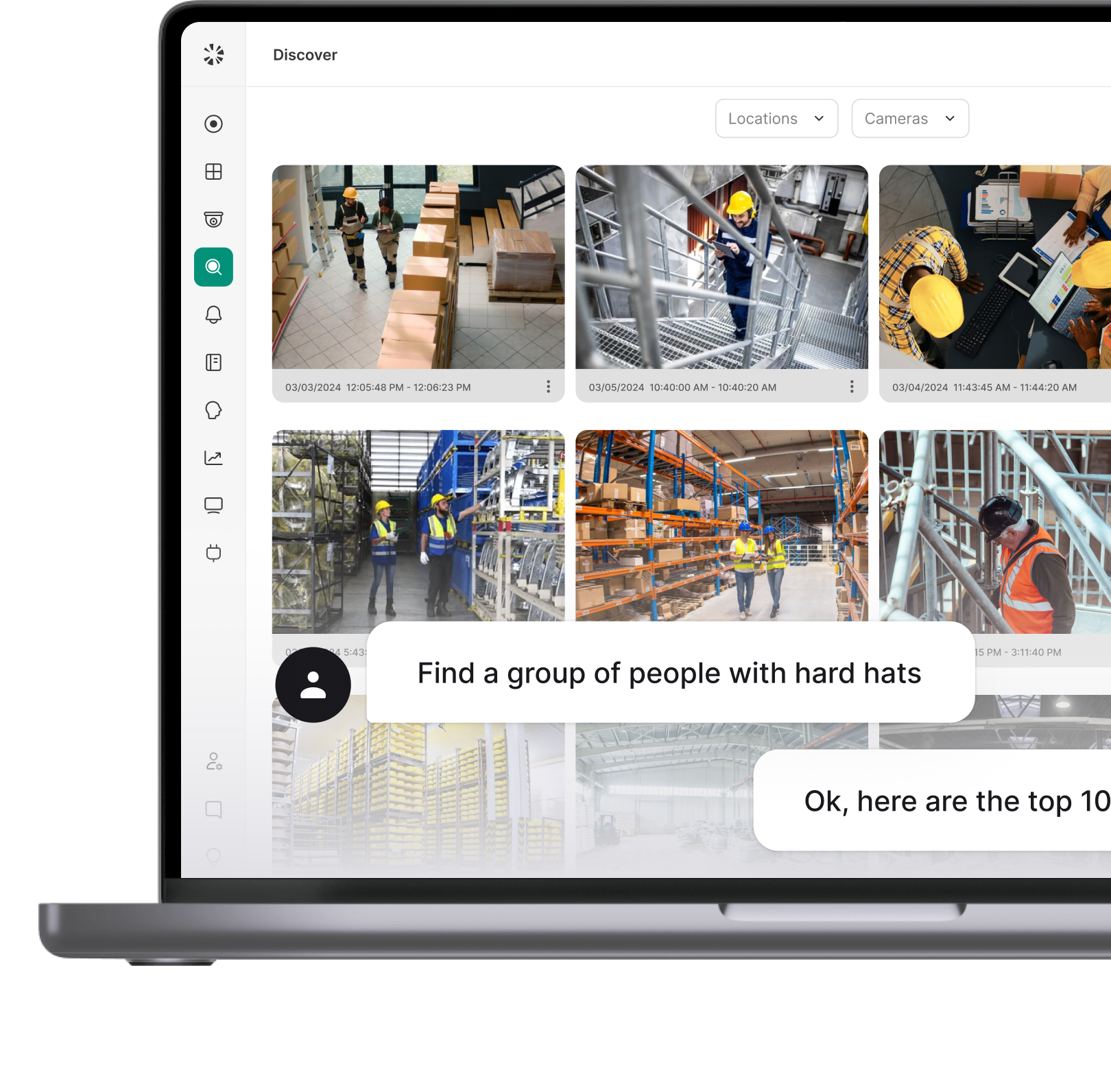
Most districts already own cameras that still work. What they lack is a fast way to find footage, a single system for doors and alerts, and a budget to replace everything. Coram is an AI physical security platform that brings Video Security, Access Control, Guest Management, and Emergency Management together, built to work with the cameras and infrastructure a district already has.
That lines up with SVPP's allowable list more closely than a single line item suggests:
- Security cameras and systems. Video Security works with 150+ camera brands over ONVIF or RTSP, so a project can modernize the recorder and management layer without replacing working cameras.
- Access control doors and locking mechanisms. Access Control pairs every door event with the video of that door.
- Panic and alarm notification systems, and expedited notification of law enforcement. Emergency Management includes wearable panic buttons, lockdown linked to Access Control, and Automatic Dispatch to 911, which is enabled per organization.
- Visitor management systems. Guest Management handles check-in with background screening and links each check-in to the entrance camera.
Firearm Detection runs on compatible existing cameras. When it spots a visible firearm, the alert goes to a responder in the Coram mobile app with live video, and one tap escalates it to an emergency and lockdown. That maps to SVPP's purpose areas for deterrent measures and for technology that speeds notification of law enforcement. Confirm eligibility for any specific item with the COPS Office before you finalize the budget.
When you scope a Coram project for a grant, budget the full deployment, not only the software:
- A Coram Point appliance. The on-site server that records video and runs detection. Firearm Detection needs a server tier that supports safety alerts, so size it with Coram before you write the budget line.
- Video feed licenses for each camera connected to the platform.
- A safety alert license for Firearm Detection, which is a separate add-on.
Building those into the quote gives reviewers the unit-cost math they expect, and it gives your sustainability plan a real recurring number for year four. Leave license plate recognition and facial recognition out of an SVPP budget, since both are unallowable. Both features are off by default in Coram. If your application needs NDAA documentation, Coram can provide a self-attestation letter.
What to do before the next grant cycle opens
The strongest applications are mostly written before the notice appears. Use the time between cycles to:
- Finish the risk assessment.
- Pull incident and facility data into counts by building.
- Hold and document the stakeholder consultation.
- Confirm the cash match with your business office.
- Check your SAM.gov expiration date.
If you're weighing BJA STOP for training or threat assessment work, its FY26 window is open now. For camera, access control, and emergency notification projects, prepare for the next SVPP cycle, and watch SchoolSafety.gov's Grants Finder Tool for release dates.
Want to see how Coram can fit a grant-funded project built on the cameras you already have? Request a demo and we'll walk through what a grant-ready scope looks like for your district.




.png)