

On a Monday morning, a member stops by the church office.
Her car window got smashed in the far lot during second service, and she wants to know if the cameras caught it. You check.
The cameras point at the front doors and the kids' wing, because that's where the money went when the system was installed, and the far lot isn't in any of the shots. You have nothing to give her, or her insurance company.
Stories like that are why we ran this survey.
Most churches have no easy way to compare their security setup with anyone else's, so between September 23 and October 12, 2026, we asked the people who actually run it: IT leads, facilities managers, executive pastors and safety team leads at 78 houses of worship, most of them churches.
In this report, we’ll cover several key church security statistics about funding, security gaps, who’s watching the cameras, and how systems are currently structured.
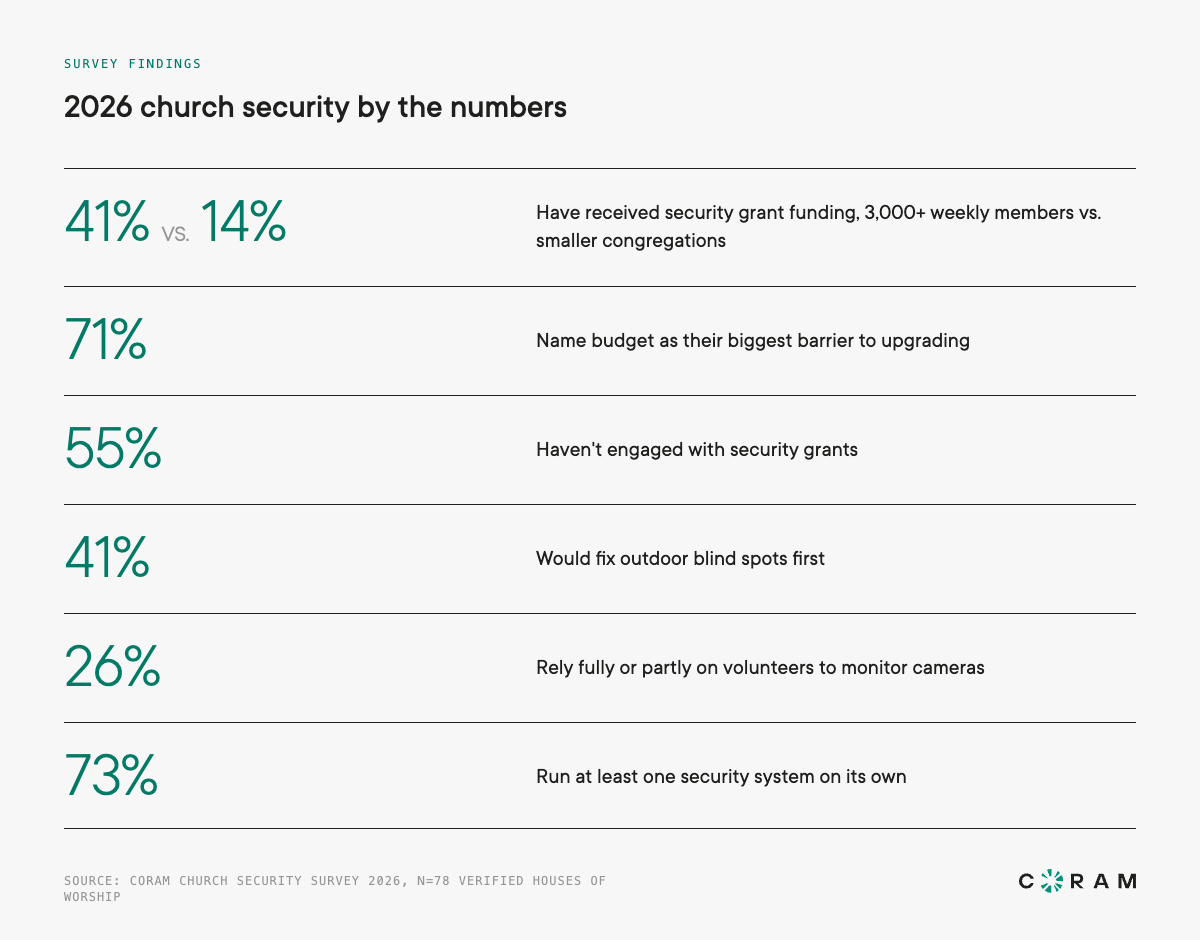
2026 church security by the numbers
Before we dig deeper into the data, here’s a breakdown of the top stats from the church physical security survey.
Top 6 Church Security Statistics Based on 78 Verified Survey Responses:
- 71% of congregations cite budget as their biggest barrier to upgrading their security systems.
- 55% of congregations have not engaged with security grant programs.
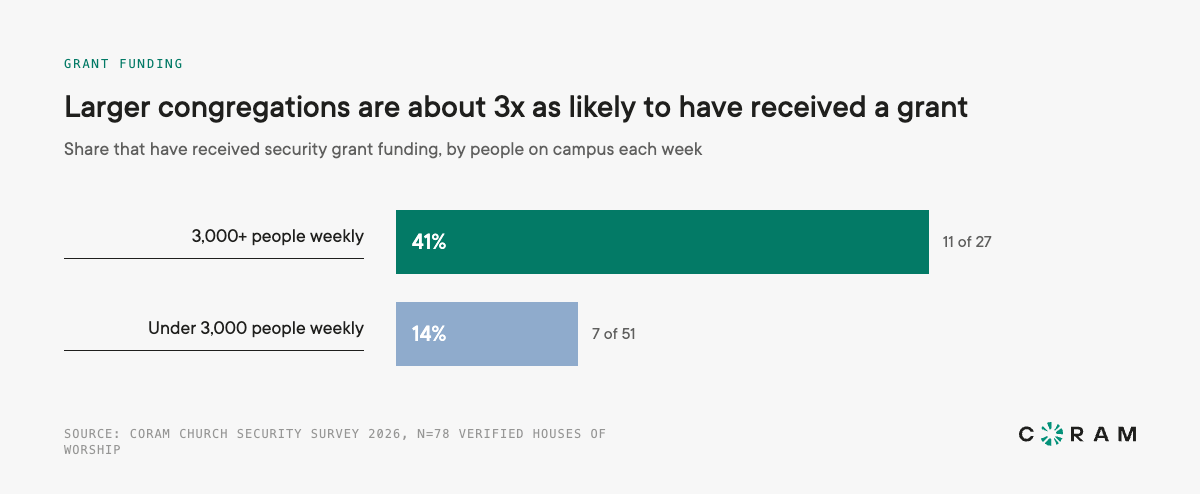
- 41% of congregations with 3,000 or more weekly attendees have received security grant funding, compared with just 14% of smaller congregations.
- 41% of congregations would prioritize fixing outdoor security blind spots, including parking lots and entrances, over any other security improvement.
- 26% of congregations rely fully or partly on volunteers to monitor their security cameras.
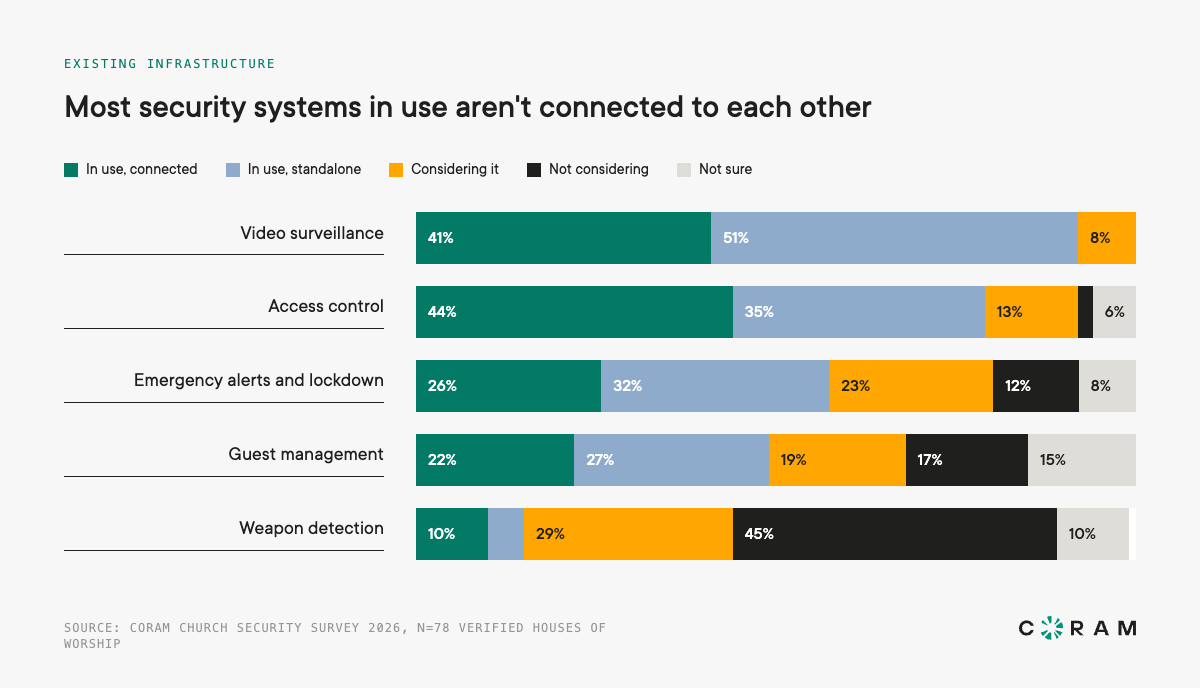
- 73% of congregations operate at least one security system independently of their other security technology.
One of the most surprising findings was about money. The survey discovered that 41% of congregations with 3,000 or more people on campus each week had received security grant funding. Among smaller congregations, it was 14%.
Budget is the barrier, and most congregations haven't touched grants
Ask a church what's stopping a security upgrade and you'll mostly hear one word. 71% named budget as their biggest barrier, and no other answer came anywhere near it.
There is money set aside for exactly this. The federal Nonprofit Security Grant Program, run by FEMA, pays for physical security improvements at nonprofits that face a heightened risk of attack, and some states run programs of their own.
Even so, 55% of the congregations we surveyed haven't engaged with security grants at all.
That's 43 of 78, and they fall into three groups:
- 20 know grants exist and haven't applied,
- 14 didn't know they existed, and
- 9 have heard of them but don't know how they work.
The data can't tell us why larger churches are so far ahead. It could be awareness, staff time, eligibility or how often applications succeed, and probably some mix of all of them. What we can see is who's missing out.
In our smallest group, congregations under 250 people a week, 8 of 14 didn't know security grants existed, and only one had received one. It's a small group, but it points the same way as everything else.
Awareness is only part of it. Of the 20 executive pastors and business administrators who answered, 8 know the grants are there and haven't applied. Our guess is that time is a big part of that.
An application means a vulnerability assessment and a written justification, and somebody has to find the hours. If you're starting from zero, we wrote up how NSGP applications get scored in a previous post.
What churches want to fix: the parking lot comes first
We asked what they'd fix first if they could only fix one thing this year. 41% chose outdoor blind spots like parking lots and entrances, and the next most popular answer got less than half that.
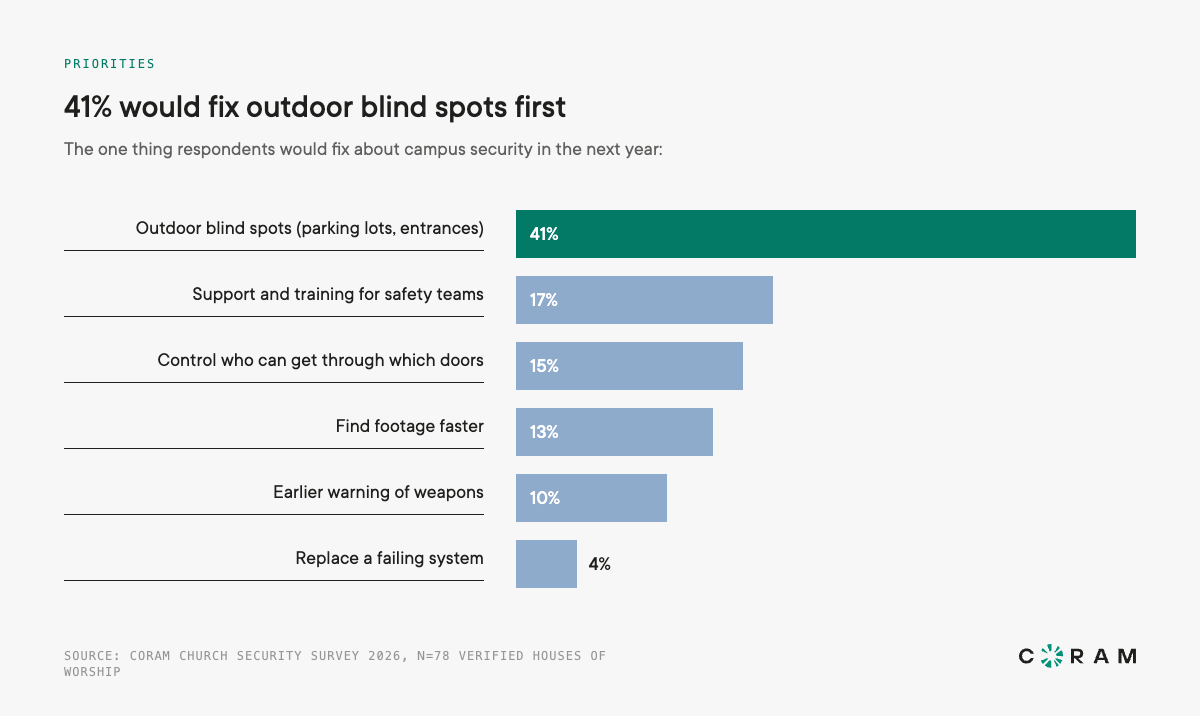
It makes sense once you think about how a campus gets used. The sanctuary is full for a few hours a week. The lot is busy every time the building is, families walk through it with kids in tow, and cars sit there unwatched for the length of a service.
Plenty of what turns into an insurance question starts outside, and when the claim shows up weeks later, the footage is either there or it isn't.
Covering the lot doesn't automatically mean buying a new system. 51% of respondents expect they could keep all or most of their cameras in an upgrade, and 27% honestly don't know.
If you're in that second group, spend an afternoon with a clipboard before you spend any money. Write down each camera's make, model and age and what it records to, then ask vendors about those exact models, not just the brand. Watch for donated all-in-one kits and consumer cameras.
A lot of them won't connect to another platform at all, and that's better to learn before the budget meeting than after.
Who's watching the cameras
About a quarter of congregations (26%) rely fully or partly on volunteers to monitor their cameras. Another 14% say nobody really watches. They look after something happens.
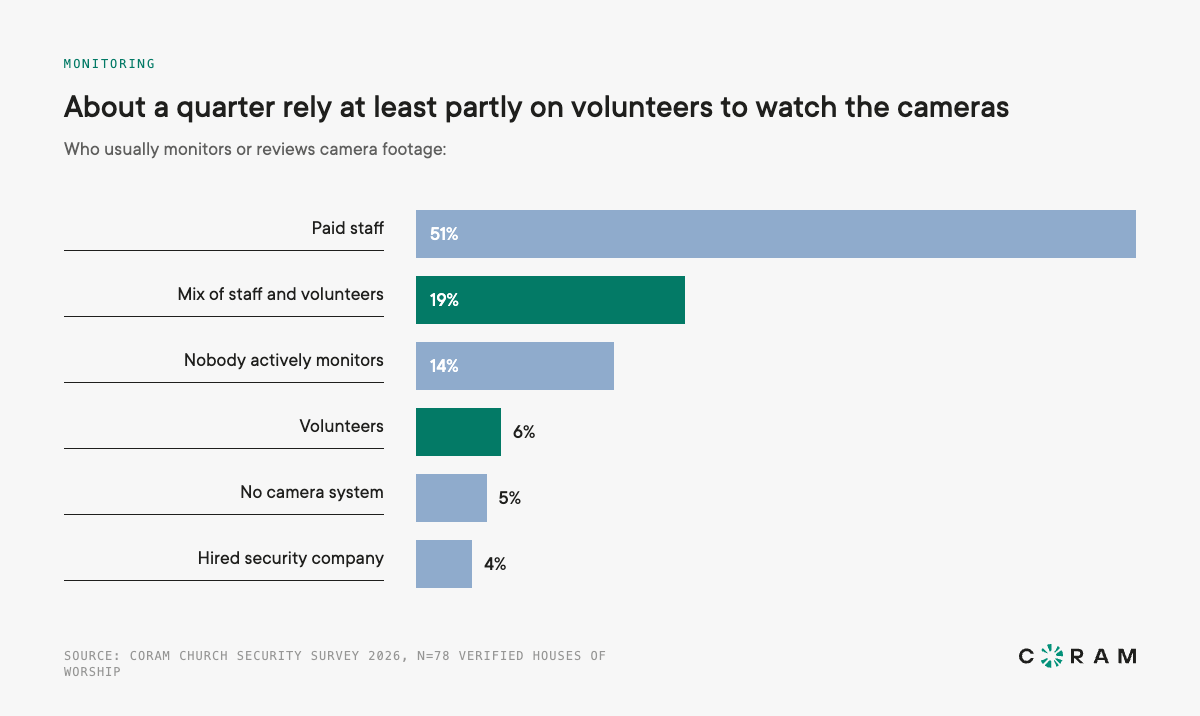
That changes what a good system looks like.
A safety team that rotates every few weeks won't remember how to pull a clip from software they open twice a quarter, no matter how good the training was. It's probably why 13 of the 78 picked better support and training for their safety people as the one thing they'd fix.
One test to run: could a volunteer who hasn't logged in for a month find last Sunday's footage of the side door at 10:15 without calling anyone?
If not, your security depends on one person remembering how it works. Our church security team guide covers roles in case you're currently building that team out.
Older systems tend to be the slow ones
Surprisingly, searching footage isn't a big complaint for most congregations. Of the 74 with cameras, 13 said it usually takes more than 30 minutes to find what they need after an incident.
However, age changes that. Seven of the 16 congregations running cameras more than five years old said a search usually takes over half an hour. Among the 27 with systems one to three years old, one did.
That's a big gap, but it's an association, not proof that age is the cause. Older setups can also differ in how they're configured, maintained and recorded. The groups are small too, so we wouldn't build a budget on them, but anyone who has dragged a timeline slider across an old recorder won't be shocked.
Disconnected systems add a different kind of friction. 73% of congregations run at least one security system on its own. That isn't automatically a problem, and a standalone system can do its one job well.
It starts to hurt when an incident crosses systems: a door system with no idea what the camera above the door recorded, or kids' check-in living in a different app from the cameras in that wing. Someone ends up piecing it together by hand, usually at the worst time, like 11:50am on a Sunday with a worried parent standing in the hallway.
Weapon detection is still mostly a maybe
15% use weapon detection today. 30% are considering it, more than any other capability we asked about, and 45% aren't considering it at all.
We understand the hesitation. In a church where members carry or the safety team is armed, an alert every time a lawfully carried gun is visible is just noise.
Before buying, ask how the system handles that, who reviews an alert before anyone acts on it, where the detection runs, and what happens to the images afterward.
If you're comparing options, here's how camera-based weapon detection works.
Limited money, limited hands, disconnected systems
Read together, these findings describe churches trying to run a fairly complex security program with three things in short supply. Money is the obvious one, and the grant gap shows that even outside funding tends to reach the churches that already have the most resources.
People are the second. A quarter of congregations lean on volunteers to watch the cameras, and the people using the system may only log in a few times a month.
The third is how the pieces fit. Most congregations run at least one system on its own, and the oldest setups are where searches drag most often.
The parking lot finding sits on top of all three. Churches know where their gaps are. Closing them means paying for coverage, finding someone to watch it, and making it work with what's already installed.
For most churches, improving security doesn't have to start with replacing everything they already own. It starts with understanding where the gaps are, whether the existing equipment can address them, and what it would take to make improvements.
That might mean adding cameras to an uncovered parking lot, making it easier for volunteers to find footage, or applying for grant funding to cover an upgrade that's been put off for years. The right investment will look different for every congregation, but the first step is the same: figure out what's working, what isn't, and where a change would make the biggest difference.
About the survey
Coram.ai surveyed security, IT, facilities and executive leaders at houses of worship, nearly all in the U.S., from September 23 to October 12, 2026. Percentages are based on all 78 responses unless a smaller group is named, and every question cited here allowed one answer. The sample leans toward larger congregations, so read this as a benchmark for engaged, mostly larger churches.
For cross-industry numbers, see The State of Physical Security 2026.
About Coram
Coram is an AI physical security platform that brings Video Security, Access Control, Guest Management and Emergency Management together, and it works with many of the cameras churches already own. See how Coram works for religious institutions, or book a demo and we'll walk through how we can help you modernize your physical security systems.





.png)