.webp)
Organizations today want two things from their security systems: faster investigations and more proactive security. They don’t want screens or footage alone but clearer answers, sooner.
Most organizations already have cameras in place. The real challenge starts after something happens. Leaders want to know what changed, where it started, and how quickly their teams can respond without slowing operations or adding more people to monitor video feeds.
That’s where AI security cameras have become the upgrade decision-makers are paying attention to in 2026. They’re not just recording what happens. They’re actively analyzing activity, surfacing important moments, and guiding response in real time.
Instead of relying on manual reviews, modern AI-powered camera systems can flag relevant events, trigger alerts, and help teams search footage in seconds across multiple locations. This shift turns video surveillance from a passive system into a tool that supports faster decisions, consistent oversight, and proactive risk management.
In this article, we’ll break down the 7 AI security camera features that matter most in 2026, focusing on how they work in real environments and why they’re becoming essential for organizations that want better visibility, faster response, and tighter control over security operations.
TL;DR
- AI security cameras shift surveillance from recording to decision-support, helping teams detect, search, and respond to events in real time.
- Faster investigations come from smart search and accurate detection, not from adding more cameras or manual monitoring.
- Real-time alerts and object awareness improve response speed and consistency across single and multi-location environments.
- Modern AI video systems scale through cloud management and integrations, giving leaders centralized visibility without added operational overhead.
- The real value of AI cameras lies in practical outcomes: clarity, control, and proactive security rather than standalone features.
How AI is Changing Video Surveillance?
AI has shifted video surveillance from something teams check to something they can rely on. Instead of cameras quietly recording in the background, modern systems now play an active role in identifying activity, surfacing risk, and guiding response in real time.
This change isn’t about adding more technology. It’s about removing friction from security operations and giving organizations clearer visibility without increasing effort.
Video That Understands What’s Happening
AI allows cameras to recognize patterns in everyday activity and understand what “normal” looks like for a specific environment. Once that baseline is established, the system can identify when something changes, whether it’s movement at the wrong time, activity in restricted areas, or behavior that doesn’t fit the usual flow.
This turns raw video into usable information. Instead of reviewing everything, teams see only what deserves attention.
Investigations Measured in Minutes, Not Hours
Finding answers used to mean scrubbing through footage manually. AI changes that by making video searchable by events, movement, or attributes instead of just time.
Teams can quickly trace how an incident unfolded, track movement across cameras, or identify when and where activity began, even across multiple locations. This dramatically reduces investigation time and helps leaders get clarity without waiting for manual reviews.
Security That Responds While Events Unfold
AI-powered surveillance brings timing forward. Important activity is flagged as it happens, not discovered later.
When the system detects something that matters, it can trigger alerts immediately and route them to the right people. This allows teams to respond in the moment, maintain control, and reduce the impact of incidents before they escalate.
Consistent Oversight Across Every Location
For organizations managing multiple sites, consistency is often the hardest part of security. AI creates a uniform layer of monitoring across locations, applying the same logic and detection standards everywhere.
This removes dependence on individual vigilance at each site and gives leadership a clearer, centralized view of activity across the organization.
Video That Works With the Rest of Your Security Stack
Modern AI surveillance systems are designed to connect with other security tools. When video data is combined with access control systems, alarms, or operational workflows, teams gain immediate context and coordinated response.
Instead of isolated alerts, security teams get a fuller picture: what happened, where, and what needs to happen next.
Clear Signals Instead of Constant Noise
One of AI’s most practical advantages is its ability to filter out irrelevant activity. By understanding context and recognizing meaningful movement, AI reduces unnecessary alerts and false positives.
Over time, this leads to calmer operations, faster decisions, and better use of security resources without adding complexity.
Why Organizations Are Prioritizing AI Security Cameras
AI security cameras are being prioritized for one simple reason: they help organizations move faster, see clearer, and stay ahead without adding operational complexity.
Leaders are no longer evaluating cameras based on how much footage they capture. They’re looking at how quickly teams can find answers, how consistently sites are monitored, and how easily security scales as the organization grows.
Below are the AI capabilities driving that shift.
Smart AI Video Search
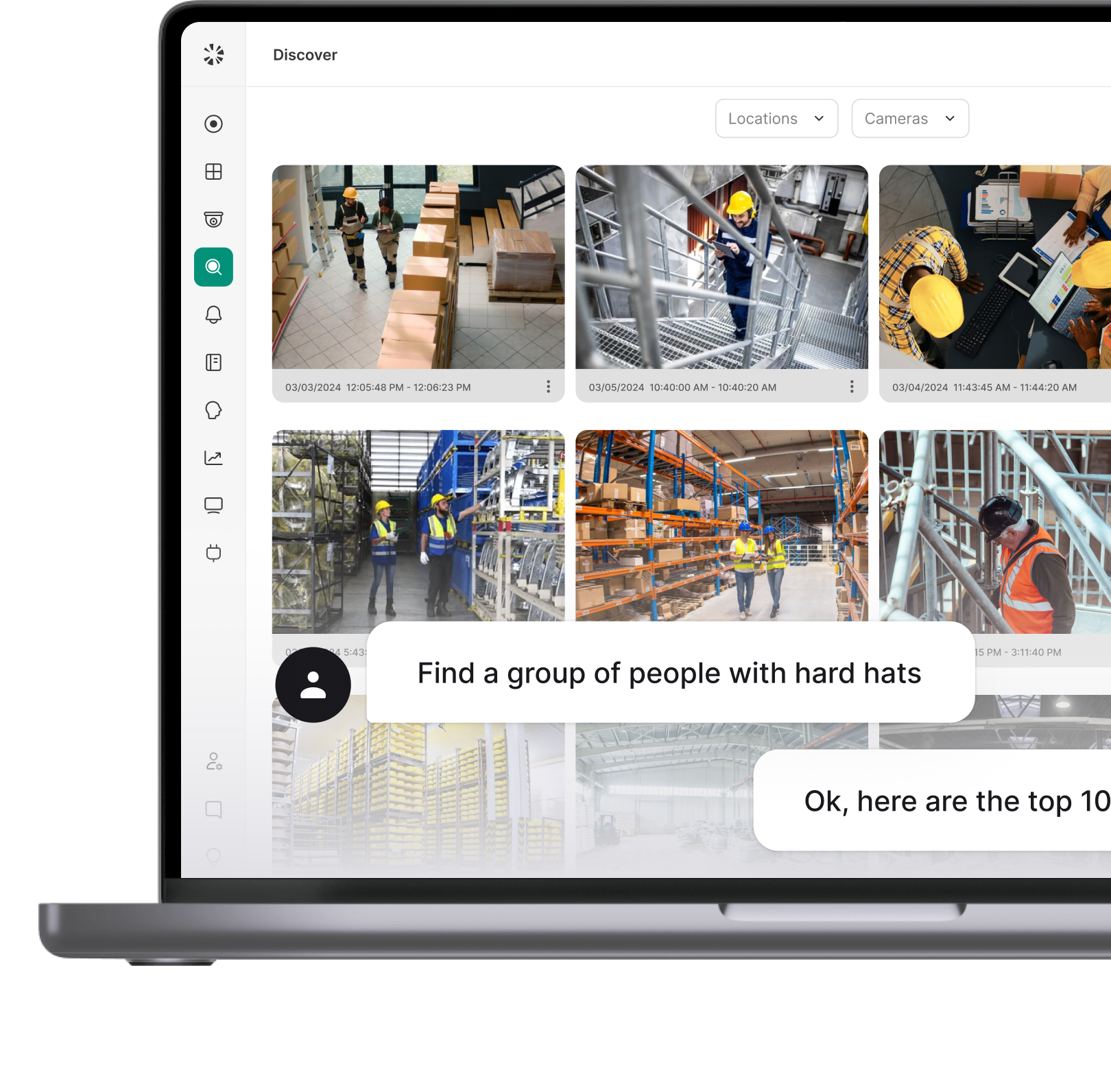
One of the most valuable upgrades AI brings is the ability to search video the way you search data.
Instead of reviewing footage manually, teams can quickly locate events based on what happened: a person entering an area, a vehicle arriving after hours, or activity during a specific window. This turns video into a usable system of record, helping leaders get clarity quickly and keep operations moving.
Real-Time Intelligent Alerts
AI enables cameras to surface important activity as it happens.
When relevant events occur, the system can notify the right teams immediately. This supports faster response, better coordination, and stronger oversight across locations. Leaders gain confidence knowing that key moments are surfaced automatically, without relying on constant monitoring.
Person, Vehicle, and Object Detection
AI-powered cameras can distinguish between people, vehicles, and objects in a scene.
This allows organizations to focus attention where it matters most. Activity is categorized clearly, helping teams understand what’s happening at a glance and respond with greater precision. Over time, this improves awareness while keeping operations smooth and predictable.
Weapon Detection
Weapon detection adds an additional layer of awareness in sensitive environments.
AI can recognize visible weapons and flag situations that require immediate attention. This capability supports early response and helps organizations reinforce safety protocols in places where preparedness and visibility are critical.
Facial Recognition
Facial recognition enables faster identification in controlled environments.
Organizations use it to support access oversight, identify people of interest, and streamline investigations. When applied thoughtfully and within policy, it helps teams move from uncertainty to confirmation quickly, with clear visual context.
License Plate Recognition
License Plate Recognition brings visibility to vehicle movement.
AI can capture and recognize license plates as vehicles enter or exit a location. This is especially useful for managing access points, tracking activity across sites, and supporting security reviews without manual checks.
Cloud-Based AI and Remote Management
Cloud-based AI allows organizations to manage video systems centrally.
Security teams can monitor activity, review footage, and receive alerts from anywhere. This supports scalability, simplifies administration, and gives leadership consistent visibility across regions without increasing local infrastructure or staffing.
Together, these capabilities explain why AI security cameras are now seen as strategic infrastructure, not just security equipment. They support faster decisions, clearer oversight, and modern operations that scale with the organization.
How to Evaluate AI Security Camera Systems?
Choosing an AI security camera system is less about feature lists and more about how reliably the system performs in your environment. The goal is simple: confidence. Confidence that alerts are accurate, investigations are fast, and the system fits cleanly into your existing operations.
These are the areas that matter most when evaluating options.
Start With AI Accuracy, Instead of Feature Volume
AI only adds value if it consistently recognizes what matters.
Focus on how well the system identifies people, vehicles, and relevant objects without confusion. High-performing systems clearly distinguish real activity from background movement and environmental noise. This directly impacts trust. When teams believe alerts are meaningful, they act faster and stay engaged.
Accuracy should also improve over time. Look for systems that adapt to your environment and get better as they observe more activity, instead of requiring constant tuning.
Evaluate How the System Behaves in Real Conditions
Lab demos rarely reflect real deployments.
Pay close attention to performance in low light, after hours, and during changing weather conditions. Image clarity matters, especially if you expect the system to support identification or investigations. Cameras with higher resolution and strong nighttime visibility provide clearer evidence and reduce ambiguity when reviewing events.
What matters most is consistency. The system should perform reliably across different times of day and across locations, not just under ideal conditions.
Make Integration a Priority, Not an Afterthought
AI cameras should fit into your security environment, not sit beside it.
Ensure the system works smoothly with your existing video management software, access systems, and operational tools. Open compatibility and well-documented integrations make it easier to scale and avoid lock-in as your needs evolve.
This also affects response speed. When video, alerts, and workflows are connected, teams get context immediately instead of chasing information across platforms.
Balance Cloud Flexibility With Operational Control
Remote access and centralized management are now expected.
Cloud-based AI allows teams to review footage, manage alerts, and monitor sites without being physically present. This is especially important for organizations with multiple locations or lean security teams.
At the same time, consider how video is stored and accessed. The right balance between cloud and local storage depends on bandwidth, compliance needs, and internal policies. What matters is having flexibility without complexity.
Look Closely at Privacy and Data Handling
AI surveillance must align with trust and governance.
Evaluate how data is processed, stored, and protected. Strong systems are transparent about privacy controls and support responsible use across regions. This is particularly important for organizations operating in regulated environments or public-facing spaces.
Clear policies and built-in safeguards reduce risk while allowing teams to use AI capabilities confidently.
Test Before You Commit
A short pilot tells you more than any spec sheet.
Running a limited deployment in a real environment reveals how the system performs day to day. It shows how accurate alerts are, how intuitive the interface feels, and how smoothly teams adopt it. This also helps leaders estimate operational impact and long-term value.
The strongest decisions are made with real data, not assumptions.
Evaluating AI security camera systems is ultimately about choosing a platform that delivers reliable intelligence, operational clarity, and long-term flexibility. When accuracy, integration, and usability align, AI stops being a feature and starts becoming part of how security actually works.
Ready to Turn Video Into Action?
You’ve seen how AI security cameras have reshaped video surveillance from simple recording into something far more useful. Faster investigations, real-time alerts, smart search, and reliable detection are no longer “advanced features.” They’re what modern security teams expect to operate efficiently across growing environments.
What stands out is how these capabilities work together. Smart search shortens investigations. Real-time alerts improve response. Accurate detection reduces noise. Cloud-based management brings consistency across locations. When combined, AI video stops being a reactive tool and becomes part of everyday operational decision-making.
This shift matters most for organizations managing multiple sites, with limited security teams or higher expectations for response time and visibility. The value isn’t in having more cameras; it’s in knowing what’s happening, when it matters, without extra effort.
That’s where Coram fits in naturally. Coram is built to apply these AI capabilities in real environments, helping teams detect critical events, search footage quickly, and manage security across locations with clarity and control, so video actually supports how your organization operates today.




.png)