
Muster Points: What They Are and How to Set Them
A muster point is where people gather after evacuating a building. Learn what the term means, how it differs from an assembly point, and how to choose one.

Stu Waters
Published


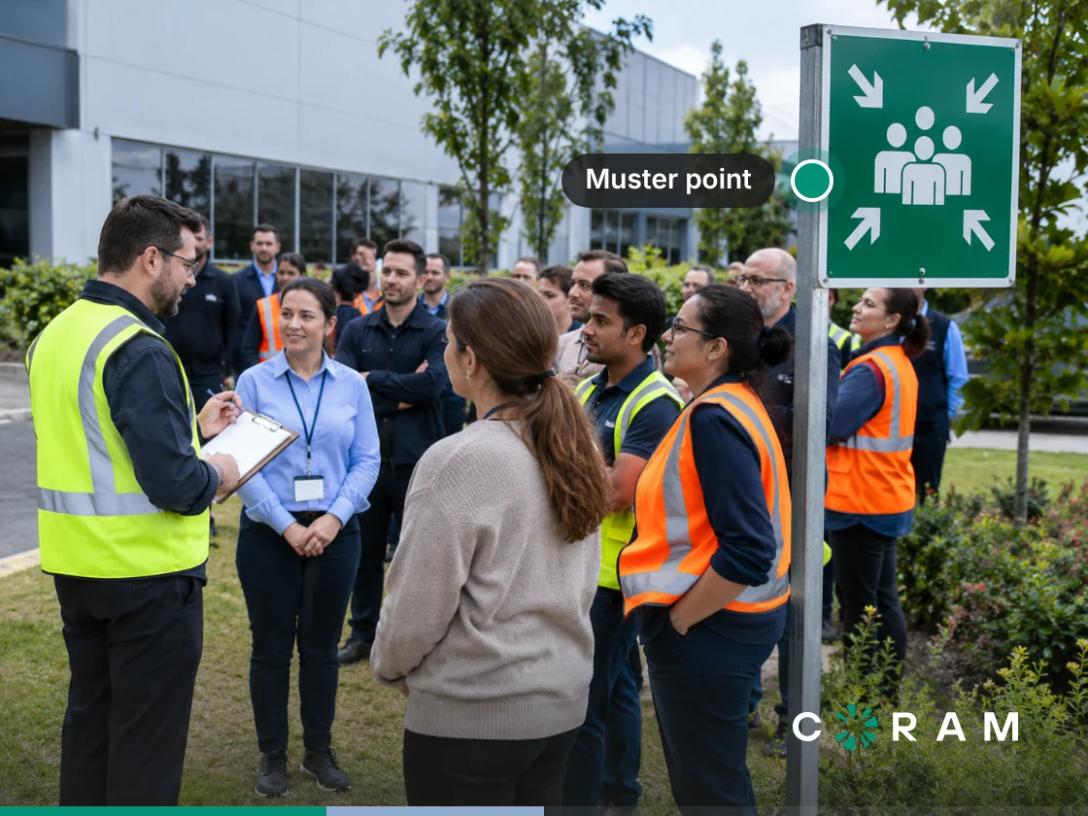
A muster point, also called an assembly point, is a pre-assigned place outside a building where employees, visitors, and contractors gather after an evacuation. Wardens use it to account for evacuees and identify anyone who may still be inside. For the muster point to work as designed, the location must be safe, and someone must be responsible for the headcount.
What a Muster Point Is
“Muster” means to gather or assemble a group of people, which is why the term turns up wherever people are formally counted. Understanding the muster point meaning also means recognizing that gathering people is only the first step. The others are:
- Getting people away from danger
- Accounting for everyone who has evacuated
- Helping emergency responders determine whether anyone may still be inside the building
OSHA’s emergency action plan standard requires employers to establish “procedures to account for all employees after evacuation” (29 CFR 1910.38(c)(4)).
The standard does not require a named muster point, but the muster point can serve as the location for this accountability procedure.
Muster Point, Assembly Point, Muster Station: Which Term Is Right
In workplace safety, muster point and assembly point mean the same thing: the place outside the building where people gather after an evacuation so they can be counted. No workplace standard assigns the two terms different meanings, and OSHA’s emergency action plan rule doesn’t require either name. It requires a way to account for employees after an evacuation.
The word you hear usually depends on the industry and the country. Oil and gas, construction, and other industrial sites, along with many Canadian workplaces, tend to say muster point. Offices, retail, and general commercial premises, especially in the UK, tend to say assembly point, and the international safety sign standard ISO 7010 labels its green evacuation sign “evacuation assembly point.”
Muster station is different, because it comes from shipping. Under the International Maritime Organization’s SOLAS convention, a muster station is a specific place on a ship where passengers and crew gather according to the ship’s muster list, usually near the lifeboat embarkation points. Even there, an IMO circular notes that “assembly station” has the same meaning as “muster station.” Offshore platforms and some industrial sites borrow the term too.
Evacuation point is the term to avoid. It’s often used for the exit itself, so writing it into a plan invites confusion about whether people should stop at the door or keep walking.
If a colleague insists that a muster point and an assembly point are different things, they’re describing a local convention, not a standard. Pick one term, use it on every sign, map, and briefing, and stick with it.
How to Choose Where Your Muster Point Goes
An open space outside the building may seem like a good emergency muster point, but its safety depends on nearby hazards, the evacuation routes leading to it, and emergency crews’ access.
When deciding what makes a good muster point for your facility, think beyond the assembly area. The location must keep evacuees away from hazards, provide safe access, and leave room for emergency crews to operate.
A good location depends on the building layout, nearby hazards, neighboring properties, and local fire safety requirements. A spot that works for a single-story warehouse may not suit a high-rise with a loading dock.
Is it far enough from the building to avoid smoke, falling glass, and collapse?
Avoid placing the muster point directly beside an exit or against the building. Smoke, falling glass, debris, and structural damage can make these areas unsafe during an emergency. Confirm the proposed location with your fire marshal or other relevant authority.
Does it keep fire apparatus access, hydrants, and the driveway clear?
Fire crews need room to pull up, park, and connect to a hydrant. You need to walk through the driveway, the fire lanes, and the hydrants, and understand where a truck would stop and turn. If evacuees would be standing in the space, change the muster point.
Is it out of parking lot traffic?
Keep the muster point away from moving traffic, reversing vehicles, drop-off lanes, and delivery routes. Check how people will reach it from each exit. If they must cross a busy driveway or vehicle route, look for a safer alternative.
Can everyone reach it, including people using wheelchairs, via an accessible route?
Check the route from each exit, looking for anything a wheelchair or walker can’t get past, like steps, narrow doors, or broken paving. Consider how people with mobility needs will reach the muster point and what assistance they may require. Include those arrangements in the emergency plan.
Is it big enough for the whole population at peak occupancy, visitors included?
Plan around your busiest realistic day, when the building is at peak occupancy. Include contractors, visitors, and temporary workers in your headcount, and ensure that they don’t take over a driveway or block a door.
Does it still work in bad weather and after dark?
A muster point that works during the day may become difficult to use after dark or in bad weather. Check lighting, ground conditions after rainfall, and whether people can wait safely while the headcount is completed. If you plan to use a sheltered area, don’t choose one that puts evacuees closer to the smoke.
Is it upwind of hazards such as chemical storage or generators?
Check nearby buildings and equipment, too. Chemical storage, fuel tanks, and generators can release fumes or smoke that wind may carry toward the muster point.
Know the prevailing wind direction at your location, and remember it may change during an incident. If you are using industrial chemicals and/or hazardous materials, consult a safety professional to choose an alternate evacuation assembly point.
No single federal distance applies to every building. The right distance depends on the building’s height and construction, falling-debris risk, nearby hazards, and local requirements. So, confirm with your fire marshal or other authority having jurisdiction. Recheck it whenever you add a building, change traffic routes, or bring in new hazards.
A sign helps people find the spot, and the green ISO 7010 evacuation assembly point sign is widely recognized. But the sign matters less than whether people were told where to go before the alarm sounded.
Why One Muster Point Is Usually Not Enough
Designate a primary muster point and an alternative in case smoke, debris, emergency vehicle access, or another hazard makes the first location unsafe. Wardens should know when to direct people to the alternative and how to communicate that change.
Evacuation is not always the safest response. Depending on the threat, people may need to shelter in place or follow lockdown procedures instead of moving outside. The emergency plan should explain which response applies to different situations.
For more on how these responses differ, see our guide to types of school emergency drills (the types of drills can apply to businesses as well).
On a large campus, a single muster point can make accountability harder. People arriving from different buildings may mix, making it hard for wardens to identify their groups and determine who is missing.
Establish muster points appropriate to your site, such as by building, department, or floor.
How to Set Up Muster Points, Step by Step
- Map the site and mark possible spots: Start with the site plan and circle the areas that look suitable. Cross off any spots with obvious problems.
- Choose a primary and a backup point: Pick a second location in case the first one becomes unsafe or blocked. If possible, choose one in a different direction, so the same problem doesn’t affect both.
- Decide who goes where: Assign people to a muster point based on where they work. Keep the groups manageable, too. One warden needs to see who’s there and check names without trying to manage a huge crowd.
- Choose a warden and a backup: OSHA’s emergency action plan standard requires the employer to designate and train employees to assist in a safe and orderly evacuation (29 CFR 1910.38). Name at least two trained people for each point, since one may be on leave or working elsewhere when the alarm goes off.
- Put up signs and update the evacuation maps: Mark each muster point on the maps near the exits, and put a sign at each location.
- Work out how to count visitors and contractors: Decide how their presence will be recorded and who will be responsible for bringing those records to the muster point.
- Explain the plan and write it down: Show new hires where to go during their first week, and make sure they know who to follow. Keep the evacuation maps, warden assignments, and backup locations together in the written plan.
What Happens at the Muster Point
Once people reach the muster point, wardens need to establish who has arrived and who may be missing.
Why headcounts fail
Headcount problems often stem from four common issues:
- The roster is out of date: The list still includes employees who have left and misses recent hires, leaving wardens with an inaccurate picture of who may be on-site.
- Visitors and contractors aren’t on it: The electrician in the server room and the candidate waiting for an interview aren’t on the payroll, so a list that draws only from current employees misses them.
- Some people weren’t in the building: Without current information about employees who are on leave, working from home, or away from the site, wardens may struggle to distinguish an expected absence from a possible emergency.
- People go to the wrong place: Someone may follow the crowd to the front parking lot instead of their assigned muster point. Although they may have evacuated safely, the warden could report them missing until their location is confirmed.
Headcount methods
The visitor problem
Whoever holds the visitor list needs it at the muster point, not at the front desk inside the building. A list left at reception does nothing once everyone has evacuated. That’s why keeping a current record of visitors and contractors on site matters: a common practice is to use the visitor and contractor sign-in list when accounting for people at the assembly area.
Name one person to carry it to the assembly point, and a backup in case that person is off that day. Make sure the list covers people who never pass reception, such as roof technicians and contractors in restricted areas.
If your sign-in is digital, confirm the person carrying it can open it on a phone with no building Wi-Fi, or keep a printed copy in the warden kit.
If a name is still missing once the count is done, give it to the fire department along with the person’s last known location. Don’t send anyone back into the building to look.
Muster Planning by Building Type
Drilling the Plan
A muster drill tests whether people can reach the designated assembly area, follow their assigned routes, and use the backup location when needed. For a school setting, see how evacuation drills are run and scored.
What to record afterward
Record how long the evacuation and headcount take, along with any delays, missing names, or gaps in visitor records. If people are unsure where to go or a step takes longer than expected, assign someone to address the problem and update the plan if needed.
When to run another drill
Review the evacuation arrangements when changes to the building, staffing, or emergency procedures could affect how people leave the site.
Under OSHA’s emergency action plan standard, the employer must review the plan with each employee when it is developed or the employee is first assigned, when the employee’s responsibilities change, and when the plan changes.
Where a Modern Emergency System Fits
During an evacuation, an emergency system’s job is to get the instruction out quickly and tell people which muster point to use, not to count heads once they arrive. A muster-point plan depends on how quickly an organization can communicate in those first minutes.
Coram Emergency Management broadcasts an emergency to the people who need it. Evacuate is one of its five default emergency types, which are designed to align with the I Love U Guys Foundation’s Standard Response Protocol: Evacuate, Lockdown, Secure, Shelter, and Hold. Staff can report an emergency from the web or mobile app or press a panic button, and alerts go out by email, SMS, and push. Administrators decide, for each emergency type, who can trigger it and who can resolve it. During a live emergency, a red banner appears in the Coram web and mobile apps, and each emergency has its own chat for coordinating the response.
For schools, Coram’s Student Reunification helps account for every student during an emergency, using a student list imported from Clever or uploaded as a CSV. The headcount at a workplace muster point itself stays with your wardens. Coram EMS runs on the same platform as Coram Video Security, Access Control, and Guest Management.
Getting People to the Right Place
A muster point’s value depends on more than its location: people need to know where to go, and wardens need a reliable way to account for everyone on site. Walk out to your own muster point and look back at the building from where evacuees would stand. If the alarm went off now, could your warden tell the fire department who is still inside?
FAQ
Is a muster point the same as an assembly point?
Yes. In workplace safety, muster point and assembly point mean the same thing: the designated place outside a building where people gather after an evacuation so wardens can account for everyone. The word usually comes down to industry and country, with industrial sites favoring muster point and offices and UK premises favoring assembly point. No standard defines them differently.
What is the difference between a muster point and a muster station?
Muster station is the maritime term. Under the International Maritime Organization’s SOLAS convention, it’s the place on a ship where passengers and crew gather according to the muster list, usually near the lifeboats. A muster point is the land-based equivalent: the place outside a building where evacuees gather to be counted. Offshore and some industrial sites use muster station too.
How far away from the building should a muster point be?
No single federal distance applies to every building. The appropriate distance depends on the building’s height and construction, falling-debris risks, nearby hazards, and local fire safety requirements. It should keep evacuees clear of smoke, falling glass, and the space fire crews need. Check the proposed location with your local fire marshal or other relevant authority.
How many muster points does a site need?
At least two: a primary point and a backup, ideally in different directions, so one hazard can’t make both unusable. Larger sites usually need more, assigned by building, floor, or department, so each warden can see who is missing from their own group instead of sorting through a mixed crowd.
Who is responsible for the headcount at a muster point?
The emergency plan should name the wardens or other trained staff responsible for checking attendance. They need access to current records and a clear way to report missing people to emergency responders. The plan should also explain how the wardens themselves will be accounted for.
What happens to visitors and contractors during a muster?
Use visitor and contractor sign-in records to identify who was on site when the evacuation began. Assign a primary person and a backup to bring those records to the muster point, and make sure they cover people who never pass reception, such as roof technicians. A list left at the front desk is no use once everyone is outside.