The physical security market is crowded and confusing. Every vendor promises AI-powered, cloud-ready, and easy-to-deploy solutions. But once implementation begins, reality often looks different: hidden costs, rigid hardware lock-ins, poor integrations, and "AI" that barely goes beyond basic motion detection.
The problem isn't just bad vendors; it's weak vendor evaluation.
Today, your infrastructure is only as strong as the vendors behind it. Yet most security reviews still rely on surface-level checklists and generic claims like "SOC 2 compliant." That's no longer enough.
A strong vendor review process should help you:
• Uncover real risks, not just stated features
• Validate how systems actually perform at scale
• Ensure alignment with your long-term security strategy
The right questions don't just filter vendors; they reveal which ones are truly built for modern, resilient security.
In this article, we break down seven essential security questions that help you cut through vendor noise and make smarter, more confident decisions.
Does Your Platform Work With My Existing Cameras, or Do I Need to Replace Them?
This is often the first and most revealing question in any vendor evaluation.
At first glance, this sounds like a simple cost question. In reality, it's a question about control, flexibility, and how future-ready your infrastructure really is.
Most vendors will say they support existing cameras. But what they often don't clarify is how well. In many cases, compatibility is limited; basic streaming might work, but advanced capabilities like analytics, alerts, or automation only unlock if you switch to their hardware. That's where hidden lock-in begins.
Some vendors answer it like this:
• "Yes, but only with our certified cameras"
• "You'll need to upgrade to unlock full features"
• Limited support for open standards
These are signs of vendor lock-in disguised as innovation.
So instead of stopping at "yes or no," go deeper. Ask:
• Do all features work on third-party cameras, or only basic streaming?
• Which standards do you support (RTSP, ONVIF)?
• Are AI capabilities consistent across camera types?
• What breaks if we don't use your hardware?
• Can we scale across sites without reconfiguring everything?
These questions expose whether the platform is truly open or selectively compatible.
Strong platforms are built to extend the value of what you already have. They integrate with existing IP cameras, deliver consistent intelligence across devices, and allow you to modernize in phases without disruption.
This is where Coram reflects a more modern philosophy. Designed as a cloud-native, hardware-agnostic platform, it works with existing IP cameras as long as they provide a standard stream. There's no forced rip-and-replace. Organizations can modernize gradually, site by site, while continuing to use their current infrastructure.
Ultimately, this question isn't about cameras. It's about whether your vendor gives you flexibility or quietly takes it away.
Is Your Platform Cloud-Native or Cloud-Enabled, and What's the Difference?
This is where many vendor conversations sound convincing but lack clarity.
Almost every vendor today says they're "cloud-based." But there's an important difference between cloud-enabled and cloud-native, and it directly affects how your system performs as you grow.
A cloud-enabled platform is usually built on an older on-premises architecture and later connected to the cloud. It still relies on local hardware for key functions, which means more maintenance, slower updates, and limited scalability.
A cloud-native platform is built differently. It's designed for the cloud from the start, so everything from storage and processing to updates and intelligence happens in a centralized, scalable environment.
Why does this distinction matter? It directly impacts how your system performs day-to-day:
• How easily you can scale across multiple sites
• How quickly you receive updates and new capabilities
• How much manual effort your team needs to manage infrastructure
• How much visibility you actually have across your environment
Coram is built cloud-native by design. The core intelligence layer (search, alerts, analytics, and access) lives in the cloud, simplifying operations and reducing reliance on fragmented, site-level setups. It allows teams to monitor, manage, and scale their security infrastructure without constantly dealing with hardware limitations.
It also means less dependence on physical infrastructure and fewer limitations as you grow, whether that's adding new cameras, new sites, or new capabilities.
In the end, this question helps you understand something fundamental: are you choosing a system built for how infrastructure works today, or one that's still adapting to it?
What AI Capabilities Are Built In, and How Were They Trained?
"AI-powered" has become one of the most overused and misunderstood terms in vendor conversations. Almost every platform claims it. Very few explain what it actually does in real-world scenarios.
So this question isn't just about features. It's about depth, accuracy, and trust.
Start by asking what the AI actually enables day to day. Does it help your team move faster? Reduce manual effort? Improve decision-making? Or is it just basic motion detection with a new label?
At Coram, AI is not an add-on; it's embedded into the system's operations.
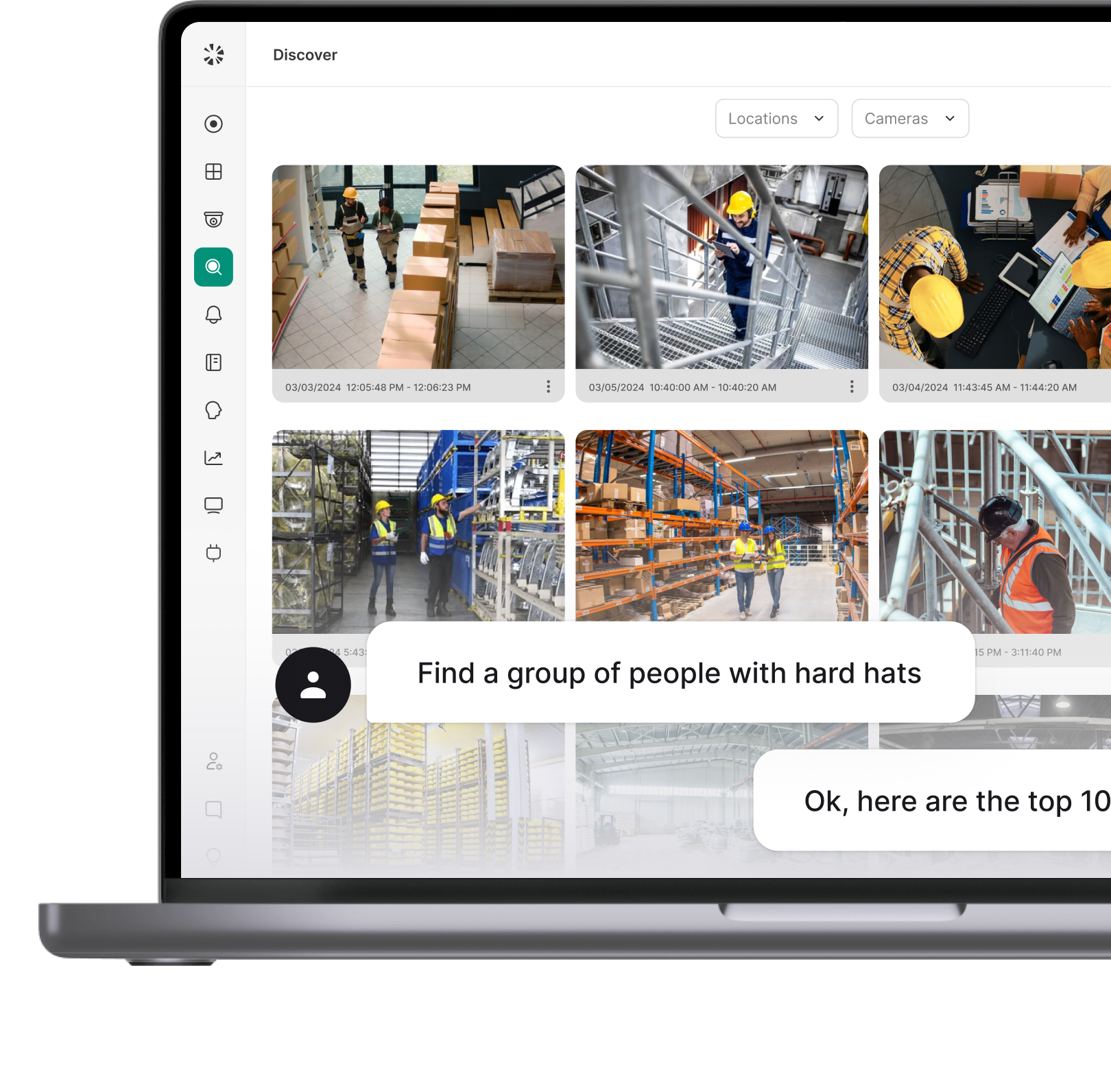
Take AI video search. Instead of manually scrubbing through hours of footage, you can simply type what you're looking for ("a person in a red hat carrying a box" or "a blue SUV") and retrieve the exact moment instantly. More importantly, tools like Journey allow you to track that person or vehicle across multiple cameras, turning what used to take hours into seconds.
Then there are real-time detection capabilities. Gun detection, for example, doesn't rely on third-party systems. It analyzes every frame using on-device foundation models and confirms alerts through the cloud, reducing false positives while ensuring speed where seconds matter.
Similarly, safety alerts (such as trespassing, loitering, crowd detection, or line crossing) help teams act proactively rather than react after incidents occur.
AI also extends beyond security into operations. Productivity alerts, like absence detection, pallet counting, or asset idle tracking, turn cameras into operational tools, helping teams identify inefficiencies and respond in real time.
On the identification side, facial recognition and license plate detection allow you to track people and vehicles across your environment, create watchlists, and receive alerts the moment someone of interest appears.
But just as important as what AI does is how it's built. Coram's models are designed to run on-device (via Coram Point), which means video data is processed locally and remains encrypted, while the cloud layer refines results and manages alerts. This hybrid approach improves both speed and privacy.
When evaluating any vendor, don't just ask "Do you have AI?" Ask:
• How accurate are the alerts?
• How are false positives handled?
• Does it work across all cameras or only specific ones?
• Is it actually reducing manual effort for your team?
In the end, real AI should feel less like a feature and more like an operational advantage built into your infrastructure.
How Long Does Deployment Take, and What Does My Team Need to Do?
This question often gets answered with timelines, but what you're really evaluating is effort, disruption, and operational impact.
Most vendors will promise quick deployment. The reality depends on how much manual work, configuration, and coordination your team is expected to handle.
Start by understanding what deployment actually involves:
• Do you need to replace hardware or reconfigure existing systems?
• How much on-site setup is required across locations?
• Will your team need specialized training just to get started?
Legacy or hardware-heavy systems often take weeks or months because they rely on physical installation, manual configuration, and ongoing troubleshooting.
Modern, cloud-native platforms are designed to reduce this friction. With solutions like Coram, deployment is far more streamlined. Aside from IP camera installation, setting up a Coram Point takes around 10 minutes. The system automatically detects IP cameras on your network and makes them available on a centralized cloud dashboard, where they can be enabled without complex configuration.
This significantly reduces the burden on internal teams: no deep technical setup, no multi-vendor coordination, and minimal downtime.
Equally important is what happens after deployment. Ask how updates are handled, how new locations are added, and how much ongoing effort is required from your team.
Deployment isn't just about installation speed; it's about how easy the system is to operate and scale long term.
Can I Manage All My Locations From a Single Dashboard?
As organizations scale, security quickly becomes harder to manage, not because of a lack of tools, but because everything is fragmented across locations, systems, and teams.
This question helps you determine whether a platform offers true centralization or only partial visibility.
Managing multiple sites shouldn't mean logging into different systems, coordinating across teams, or manually stitching together reports. A modern approach to infrastructure modernization requires a single, unified view where everything from monitoring to access control is connected.
With Coram, management is centralized through an intuitive cloud dashboard. This allows teams to:
• Monitor live activity across all locations in real time
• Set role-based permissions and access controls centrally
• Automate schedules and workflows without manual intervention
• Receive instant alerts and generate reports when needed
• Maintain audit logs that are always compliance-ready
The real advantage isn't just visibility; it's control. When everything is accessible in one place, teams can respond faster, reduce operational complexity, and maintain consistency across locations.
As you grow, the question isn't just whether you can manage multiple sites; it's how easily and effectively you can do it from one place.
What Happens to My Video Footage If the Internet Goes Down?
This is a critical question, and one that often gets overlooked until something goes wrong.
Many cloud-based systems rely heavily on constant connectivity. If the internet drops, recording may pause, footage may be lost, or access may become limited. In high-risk environments, even a few minutes of missing footage can create serious gaps during investigations.
So the real question isn't just "Is it cloud-based?" It's how the system behaves when connectivity fails.
With Coram, video processing and recording continue locally through Coram Point, even during internet outages. Every frame is captured and stored securely on-site, ensuring no loss of critical data. Once the connection is restored, the system automatically syncs footage back to the cloud without manual intervention.
This hybrid architecture (local processing with cloud intelligence) adds an important layer of reliability. It also means your team can continue recording without worrying about network dependencies at any given moment.
When evaluating vendors, always clarify:
• Does recording continue offline?
• Is footage automatically synced later?
• Are alerts delayed, or are they still triggered locally?
True reliability isn't tested when everything works; it's proven when something doesn't.
sCan I Talk to Customers in My Industry Who Are Using Your Platform Today?
On paper, many platforms look similar. Features, dashboards, and claims can all sound convincing. But real clarity comes from understanding how the system performs in environments like yours.
Speaking to existing customers helps you move beyond promises and into reality. You get to understand:
• How the platform performs day-to-day
• What challenges came up during deployment
• How responsive the vendor is post-implementation
• Whether the system actually delivers on its claims
It also reveals things vendors don't always highlight, like ease of use, reliability under pressure, and how well the system scales across locations.
Vendors who are confident in their platform won't hesitate to connect you with relevant customers. In fact, they often encourage it. Coram works across industries and use cases, making it easier to find references that closely match your operational setup.
If a vendor avoids this question or offers only generic case studies, treat that as a signal.
At the end of the day, the best validation doesn't come from a demo; it comes from someone already using the system in the real world.
Conclusion
The biggest shift in vendor security today isn't about better tools; it's about better questions.
Most organizations don't fail because they chose the wrong vendor. They fail because they didn't dig deep enough during evaluation. Surface-level claims, polished demos, and compliance badges can only tell you so much. Real risk and real capability show up in how a system performs, scales, and integrates into your day-to-day operations.
These seven questions are not just a checklist. They're a filter. They help you uncover:
• Where flexibility is real versus restricted
• Where AI is meaningful versus superficial
• Where systems are built to scale versus patched together
And more importantly, they shift security due diligence from a procurement step to a strategic decision-making process.
Vendors that are confident in their architecture, transparency, and performance won't hesitate to answer these questions clearly. In fact, they'll welcome them, because strong systems stand up to scrutiny.
As infrastructure becomes more connected and critical to operations, the cost of getting this wrong only increases.
The goal is to find a vendor that holds up under real-world complexity and continues to do so as you grow.




.png)