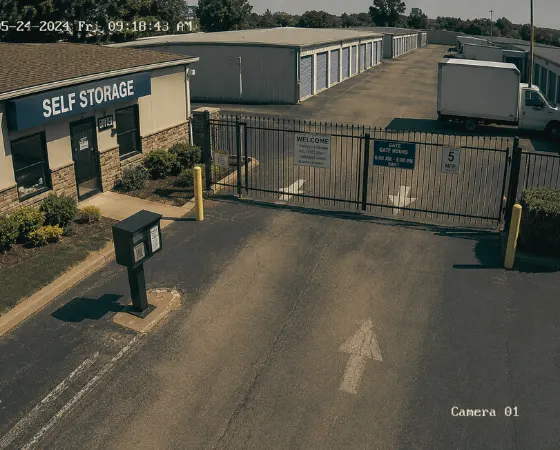
A tenant arrives after work to grab a few boxes. A vendor shows up for scheduled maintenance. Someone follows a car through the gate without scanning credentials. Your team isn't on-site for any of it.
Access control is what determines whether each of those situations goes smoothly — or becomes a problem you find out about later. It covers far more than a gate: physical barriers, credentialed readers, AI-driven video, and the software connecting all of it govern how every person moves through your facility, from the perimeter to the individual unit.
Mobile app gate access grew 45% over the last three years, and roughly 80% of tenants now expect contactless rentals and 24/7 entry on their own schedule. Facilities still issuing shared PINs face a credibility gap with prospects who expect individual, app-based credentials as standard. At the same time, operators integrating mobile access, smart locks, and automated payment systems are cutting labor costs by as much as 25%. For a lean operation, that's the difference between access control as a security checkbox and access control as an operational tool.
This guide covers how modern systems work, what they cost, and what to look for when evaluating options in 2026.
TL;DR
- Access control for self storage spans gate entry, building access, hallway monitoring, and individual unit security.
- Mobile credentials and license plate recognition are replacing shared PINs as the baseline expectation for new and upgraded facilities.
- Unmanned self-storage operations depend on access control and AI video working together.
- Costs range from a few hundred dollars per door for basic setups to several thousand for biometric or fully automated configurations.
- The right system connects access events to video, supports remote management, and integrates with your property management software.
What Is Access Control for Self Storage?
Access control for self storage is the system that controls who can enter your property, when, and which spaces they can access. It typically covers the main gate, building entrances, elevators, hallways, and in some facilities, individual storage units.
Instead of relying on locks and keys, modern systems use digital credentials: PIN codes, keycards, mobile apps, Bluetooth, or license plate recognition. Permissions adjust instantly based on tenant status, payment history, staff role, or operating hours — and every entry logs automatically. A tenant can enter the gate during approved hours. A delinquent account can be restricted automatically. A vendor can receive time-limited access for a maintenance window. Staff can unlock a door remotely while helping a tenant over the phone.
A well-configured system reduces unauthorized entry, improves tenant convenience, and gives operators more control without adding headcount.
Types of Self-Storage Access Control Systems
Self-storage access control spans a range of technologies, from basic PIN keypads to cloud-managed platforms with AI video integration. The right fit depends on facility size, staffing model, and how much automation the operation requires.
Most modern facilities use a combination. A cloud platform handles gate and building access, while smart locks cover individual units for tenants who want that level of control.
Gate Access: The Highest-Leverage Point in Your Security Setup
The perimeter gate governs more than entry. Every tenant, vendor, and unauthorized vehicle has to pass through it, which means getting this layer right has downstream effects on everything else.
What Gate Access Actually Controls
A well-configured gate system ties each entry event to a specific tenant profile, timestamps it, and logs it automatically. If something happens inside the facility later, the gate log is often where the investigation starts.
Modern gate systems support individual PIN codes per tenant (replacing shared facility-wide codes), mobile app credentials via Bluetooth or cloud authentication, license plate recognition for registered vehicles, time-window restrictions tied to lease terms or operating hours, and automatic lockout when a tenant account becomes delinquent.
Delinquency Automation: Where Gate Access Pays for Itself
When a tenant misses a payment, a well-integrated system restricts gate access automatically, often within minutes of a payment failure. When the tenant pays online, access restores just as quickly, with no staff involvement. One operator reported that when a delinquent tenant pays at the gate through their website, the access code updates within 30 seconds.
That kind of automation removes one of the most time-consuming parts of storage management and eliminates the confrontational dynamic of manual lockouts.
Unit-Level Security: The Layer Most Self-Storage Facilities Skip
Gate access controls who enters the facility. Unit-level access controls who opens a specific door. These are distinct layers, and most facilities only have the first one.
The gap matters. A tenant with an active account can walk in, pass the gate, and access any unlocked or poorly secured unit in the building. Without unit-level protection, the gate is the only barrier between a determined bad actor and another tenant's belongings.
Smart Locks vs. Electronic Keypads
Two main technologies cover unit-level access. Smart locks use Bluetooth or Wi-Fi to let tenants unlock their unit via a smartphone app. The operator can grant or revoke access remotely, and every unlock event is logged. Over 40% of businesses now use mobile devices for access control, and smart locks bring that same model to the individual unit door.
Electronic keypads at the unit door use a unique code per tenant. They're less flexible — code changes require manual updates during tenant turnover — but they're more affordable and familiar to older tenant demographics.
Where Unit-Level Access Makes Commercial Sense
Full smart lock deployment across a large facility is a significant investment. The approach that works for most operators: smart locks on climate-controlled units, high-value sections, or premium storage tiers, with standard hardware on the rest. That lets operators charge a premium for secured units without converting the entire facility.
Video Surveillance and AI: What's Changed in 2026
AI video is now the differentiator between facilities that find out about incidents and facilities that prevent them. Eighty-five percent of self-storage facilities already have cameras installed; what separates 2026 from prior years is what those cameras can do with the footage.
A camera captures what happened. An AI-enabled camera identifies it in real time and alerts you before you find out the hard way.
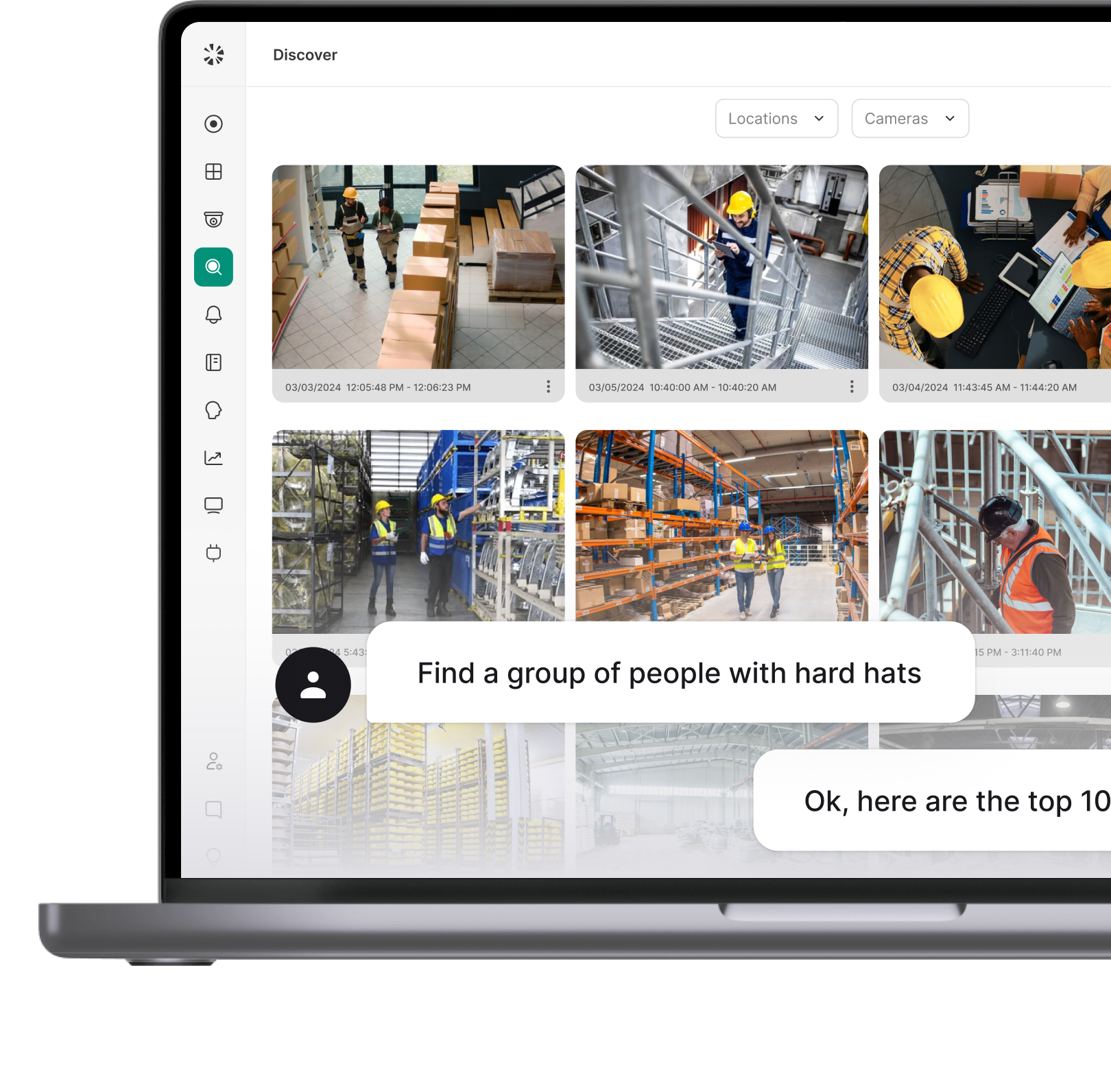
For self-storage operators, the practical difference shows up in a few specific scenarios. A camera with motion-based AI alerting can flag activity in a restricted area at 2am and push a notification to your phone, without anyone watching a live feed. When a vehicle follows another through the gate without scanning credentials, the system flags it as a potential unauthorized entry. License plate recognition cameras cross-reference plates against the registered vehicle list and can automatically open or deny gate access based on that match. When a break-in is reported, AI-powered video search surfaces footage from a specific corridor, camera, or time window in seconds, rather than requiring someone to scrub through hours of raw recording.
Linking access events to video is what closes the visibility gap. An access log tells you that credential 4421 opened the east gate at 11:47pm. The paired video shows you what happened after that.
Unmanned and Automated Self-Storage Facilities
Administrative costs for unmanned facilities run 40% lower than traditional facilities. The economics are compelling, but removing on-site staff only works when the access control and monitoring layers are strong enough to replace human presence.
An unmanned facility requires: cloud-managed access control with remote override capability; automated tenant onboarding that creates credentials when a new lease is signed, without manual intervention; AI video monitoring to detect after-hours activity, forced entry, or tailgating in real time; integrated delinquency management that restricts and restores access based on payment status automatically; and reliable offline mode so gate and building access continue functioning during network outages.
Unmanned works well for standard unit facilities where tenants are comfortable with app-based access. It works less reliably in facilities with high foot traffic, complex layouts, or tenant demographics that need regular in-person assistance. Be honest about which category your facility falls into before committing to a fully automated model.
Managing Self-Storage Access Across Multiple Locations
Multi-site management is where operators with growing portfolios run into friction: different hardware standards per site, no cross-site visibility into security incidents, and new location setup that requires replicating an entire configuration from scratch.
A centralized, cloud-based platform addresses this with a single dashboard for all doors, all users, and all events across every location. Access rules can be templated and pushed to new sites. Alerts from any location surface in the same place.
The question to ask vendors directly: can a single admin add a new site, configure access rules, and onboard tenants at that location without touching local hardware or calling IT? If the answer requires on-site setup or manual replication, the platform is not built for scale.
Access Control by Facility Type
Access control requirements vary by what you're storing and who your tenants are.
Climate-controlled and high-value unit storage. The expectation of security is higher, and unit-level smart locks are easier to justify commercially as a premium feature. Tenants storing wine, art, instruments, or business inventory actively value the additional layer and will pay for it.
RV and boat storage. LPR is the strongest fit. A boat owner driving a truck with a trailer can pass the gate on plate recognition without stopping to scan a phone or enter a PIN. Access scheduling matters too, since RV and boat storage often involves seasonal patterns that differ from standard unit rentals.
Commercial and business tenant storage. Business tenants typically need 24-hour access, multiple authorized users on a single unit, and exportable audit trails for their own internal records. Systems that can't accommodate multiple credentials per unit, or that don't log at a granular enough level, will create friction with this segment.
Cost and Sizing: What a Self-Storage Access Control System Actually Costs
Costs vary significantly based on facility size, system type, and how many layers of access control are deployed.
Hardware costs:
Software and licensing. Cloud-based platforms typically charge per door per month, with subscription fees ranging from $3.50 to $15 per door. For a 50-door facility at the mid-range, that's $250–$500/month covering updates, data storage, and maintenance.
Installation. Basic installations in modern buildings with existing power and cabling run $500–$1,200 per door. Complex retrofits in older sites can reach $2,500 or more per door due to additional wiring and electrical work.
Total cost of ownership. Budget 10–15% of the total system cost annually for maintenance and licensing. Mobile credential systems reduce ongoing credential replacement costs to near zero. LPR reduces per-transaction labor at the gate. Most facilities report payback periods of 12–18 months on smart access control investments, with immediate operational benefits including a 70% average reduction in staff time on access management.
How to Choose an Access Control System for Your Facility
Three variables determine the right system: how you staff the facility, how many sites you manage, and how tightly your access control needs to connect to your property management software.
Start with your staffing model. A fully staffed facility can absorb a system that requires some manual steps. An unmanned or remotely managed facility cannot. If staff are not on-site, the access control system needs to handle lockouts, credential management, tenant onboarding, and incident response automatically.
Match the credential type to your tenant base. Mobile app access is the most operationally efficient option, but it requires tenants who are comfortable using a smartphone for entry. Facilities serving older demographics or infrequent users often keep PIN keypads as a fallback, even when mobile is the primary method.
Verify PMS integration depth before committing. Ask specifically: Does a payment in the PMS update gate access in real time? Does a new lease automatically create a credential? Are access events written back to the tenant's record? Shallow integrations that require manual sync or have a delay are not suitable for unmanned operations.
Evaluate the video layer separately. Vendors typically sell access control and video surveillance as separate products. Systems that unify them, linking each access event to recorded footage, reduce investigation time dramatically and close the visibility gap between systems running independently.
Assess multi-site readiness if you have more than one location. A system that works at one site but requires separate logins, separate configuration, and separate reporting at each location will not scale. Centralized management across all sites is a baseline requirement for any operator with a portfolio view.
How Coram Handles Self-Storage Access Control
Coram is an AI-native physical security platform that connects to existing readers, locks, gate hardware, and IP cameras without requiring hardware replacement. That matters in self storage, where most facilities already have camera infrastructure and gate equipment in place. Coram adds AI and cloud management on top of what's already there.
Access events link to live and recorded footage automatically. When a credential scans at the gate, the corresponding video is immediately available — no switching tools, no pulling logs from a separate system, no manually correlating timestamps. For unmanned facilities, every entry is documented with both a credential record and visual confirmation.
Capabilities relevant to self-storage operations include: access events linked to camera footage in real time, searchable by door, credential, or timestamp; AI-powered detection for tailgating, forced entry, and after-hours activity with instant alerts; cloud-managed access rules and schedules configurable remotely across single or multiple sites; offline mode that maintains gate and door operation during network disruptions; and license plate detection for vehicle-based access management at facility perimeters.
Coram is particularly relevant for unmanned and lightly staffed facilities where access events need immediate video context, and for multi-site operators who need unified visibility without maintaining separate systems at each location. When a tenant reports a break-in at 11pm on a Saturday, Coram's video search surfaces the relevant footage in seconds, and the access log shows exactly who was in that corridor and when.
Ready to see how Coram handles access control and video across your facility? Book a demo or start a free trial.
Make Every Entry Count
Access control in self storage has moved well past the keypad era. Tenants expect individual credentials, mobile access, and 24/7 availability. Unmanned facilities need automation that reliably replaces human presence. Multi-site portfolios need centralized visibility instead of logging into a different system for every location.
The facilities that handle this well treat access control and video as a single layer — one where every credential scan produces both a log entry and a video record. That combination is what makes incidents investigable, delinquencies manageable, and unmanned operations actually viable. The technology to do this exists and is affordable at the scale most operators work at. The question is whether your current setup takes advantage of it.




.png)