.webp)
For years, physical security relied heavily on traditional CCTV systems. Cameras recorded footage, security teams monitored live feeds, and if something happened, the video was reviewed later. With this setup, incidents were investigated after the incident had already taken place.
Moreover, it depended on manual monitoring, which isn’t really always practical. It might miss critical events, and most footage usually gets stored without ever being actively analyzed unless an incident occurs. That’s where AI security cameras made things easier, as they can analyze footage in real time, detect specific events, and trigger alerts automatically.
In this blog, we’ll explain how AI security cameras actually work, key features to look for, how they differ from traditional surveillance systems, and what you should evaluate before adopting them.
What Are AI Security Cameras?
An AI security camera, also called a smart CCTV camera, is basically a surveillance camera that uses artificial intelligence to interpret the captured footage. They can detect unusual movement, recognize vehicle license plates, monitor temperature variations, or classify objects such as people, vehicles, or other items within a frame.
This ability to categorize and filter events significantly reduces false alerts when compared to motion-based systems. So essentially, a standard CCTV camera records everything, while an AI-powered camera evaluates what it sees and flags what matters. This added layer of analysis makes them more efficient and far more useful for quick response and accurate detection.
How AI Security Camera Systems Work
At a basic level, AI security camera systems still rely on IP cameras to capture video, just like traditional CCTV setups. The cameras continuously record footage and send that data to a recording system. The difference comes after what happens after the video is captured.
For example, with Coram AI, the footage is streamed to a cloud-based NVR. Once the video reaches the cloud layer, AI models process each frame. These models are trained to recognize patterns such as people entering restricted zones, vehicles approaching entry points, or objects that match specific risk categories.
So, instead of triggering alerts for every movement, the system evaluates context.
For instance, motion in a parking lot during business hours may be ignored, while motion near a restricted entrance after hours may trigger an alert. Similarly, the system can log license plates at entry gates, flag specific vehicles, or detect visible weapons based on trained detection models. The key point is that the system filters activity before notifying security teams.
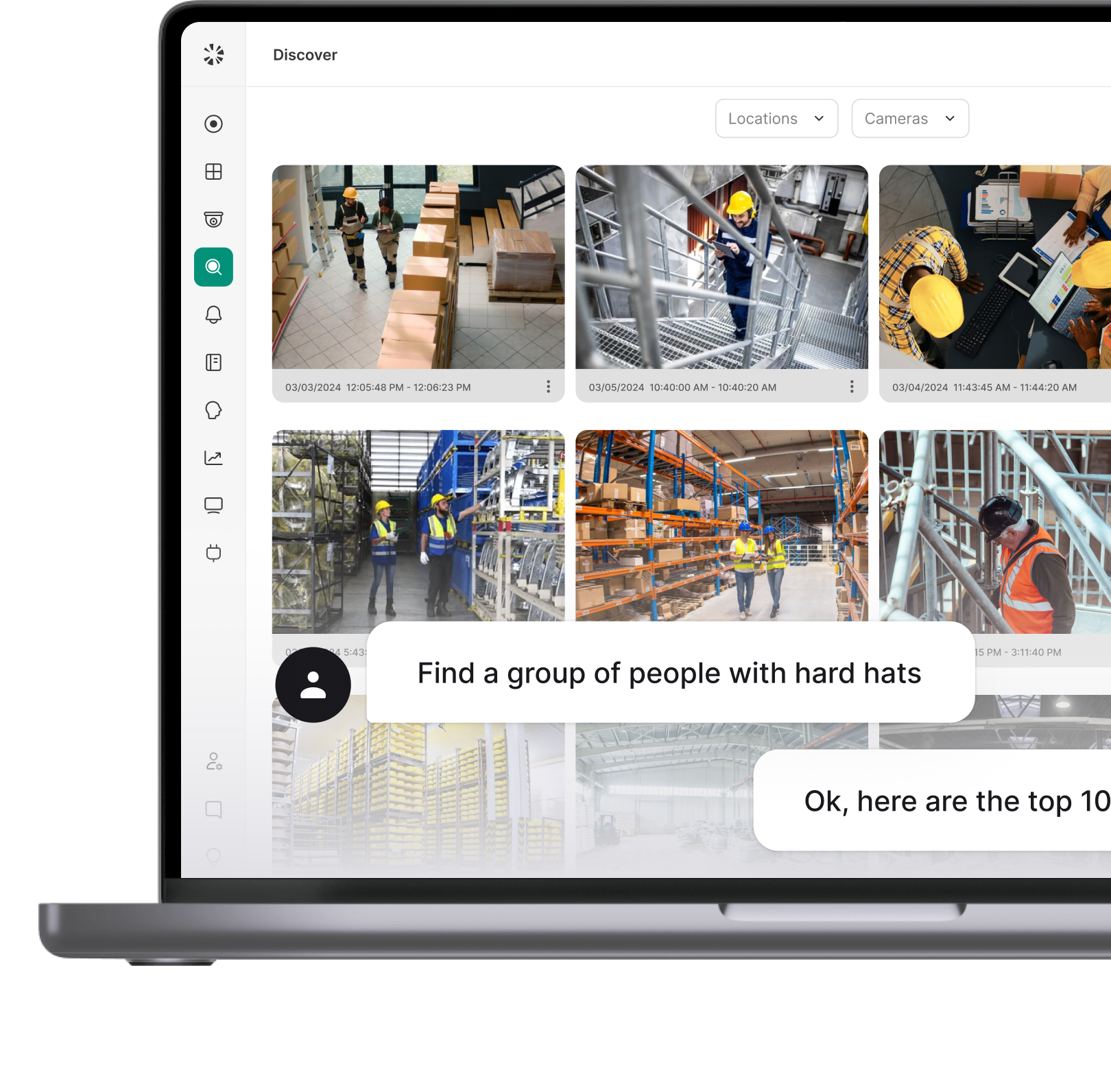
After analysis, the footage is indexed based on what the AI has identified. This allows users to search events directly rather than manually reviewing long recordings. This way, the workflow becomes structured. The system captures videos, analyzes them using AI models, applies detection rules, generates relevant alerts, and makes footage searchable for fast retrieval.
Key Features to Look For in an AI Security Camera System
The AI security setup you choose directly affects the effectiveness of critical elements during the security checkups. This can be about how quickly incidents are detected, how many false alerts your team handles, and how easily the system fits into your existing infrastructure. So, here are some key features you should ideally look for while evaluating your options:
1. Smart AI Video Search
In real situations, you rarely know the exact time something happened. Without AI, that means manually reviewing long stretches of video. A good system organizes footage around activities such as a person entering a specific area or a vehicle stopping at a gate. This allows you to filter your search by object type, area, etc., and go straight to the relevant clips.
2. Real-Time Intelligent Alerts
A reliable AI system evaluates what is happening before sending an alert. It checks whether the activity involves a person or vehicle, whether it occurred in a restricted zone, and whether it violates predefined rules. Only then does it notify the appropriate team. This way, you’d get fewer unnecessary alerts and stronger trust in the ones you receive.
3. Person, Vehicle & Object Detection
On-premise security heavily depends on detection accuracy. If the system cannot consistently distinguish between a person, a vehicle, and background movement, search and alerts will not be dependable either.
You should expect the system to classify activity clearly and maintain that accuracy across different lighting conditions and busy environments. This allows you to set specific rules, for example, focusing on pedestrian activity in secure areas rather than general motion.
4. Weapon Detection
In higher-risk environments, weapon detection can always provide early awareness. The system analyzes video in real time and flags objects that match visible weapon patterns.
However, this feature must be carefully configured. It should escalate alerts through defined workflows without creating unnecessary disruption from false triggers. When that’s taken care of, weapon detection can easily shorten the time between identification and response.
AI Security Cameras vs. Traditional Security Cameras
Let us now take a look at the key differences between AI security cameras and traditional security cameras based on several critical aspects:
Where Are AI Security Cameras Used?
AI security cameras are designed to handle high-traffic areas, restricted zones, and multi-location operations with greater efficiency than traditional CCTV setups. As a result, they are widely adopted across industries where quick detection, operational control, and reduced false alerts are essential. Here are 4 most prominent industries where they are used:
1. Retail
In retail, security involves controlling access to stockrooms, cash offices, and delivery entrances. With solutions like Coram AI, retailers can manage role-based access, grant or revoke permissions remotely, and maintain detailed entry logs. This improves accountability, reduces internal shrinkage, and gives multi-location retailers centralized visibility across stores.
2. Banking and Financial Services
Banks operate in controlled environments where monitoring needs to be consistent across branch floors, ATM areas, vault corridors, and restricted staff zones. With a smart surveillance system, branches can continue using their existing cameras while adding real-time alerts for suspicious activity, ATM loitering, and unusual access patterns.
3. Manufacturing and Warehousing
Factories and warehouses usually operate across large physical spaces with limited on-ground security staff. Here, AI security cameras help monitor loading docks, inventory storage zones, machinery areas, and perimeter fencing. They also detect activity in restricted sections, track vehicle entry and exit, and alert teams if movement occurs outside operational hours.
4. Hospitals and Healthcare Facilities
Hospitals require continuous monitoring across entrances, emergency rooms, pharmacies, and sensitive areas such as data centers and medication storage. Since this monitoring must align with HIPAA requirements and internal privacy policies, Coram AI supports this by working with existing IP cameras while offering compliant data handling and flexible retention settings.
At the same time, real-time alerts for unauthorized access, suspicious activity, or firearm detection help security teams respond quickly within active care environments. Because the system integrates with access control and supports multi-camera tracking, facilities can review how an incident moved across different zones without manually stitching footage together.
How to Add AI to Your Existing Security Camera System?
For this, the first thing to understand is that you usually do not need to replace your cameras, especially if they are IP (network) cameras. AI works as an added intelligence layer on top of your current video feeds. So, instead of changing the cameras themselves, you can simply connect their live streams to an AI platform that analyzes the footage in real time.
The next step is deciding where the AI processing will happen. It can run:
- In the cloud
- On a local AI device installed at your site (often called an edge device)
- Or in a hybrid setup that combines both.
While cloud systems are easier to manage across multiple locations, local devices reduce dependence on internet connectivity and support faster on-site processing. Here, the right choice depends on your bandwidth, security requirements, and operational scale.
Once connected, configure what you want the AI to look for. This can be defining alert rules, setting monitoring zones, and deciding how notifications should be delivered. Lastly, test the setup on a small group of cameras before rolling it out fully. This allows you to adjust sensitivity levels, reduce false alerts, and ensure performance is stable.
Challenges & Considerations
While AI security cameras add intelligence to surveillance, they also come with several operational responsibilities. If not planned properly, the same features that improve monitoring can create compliance gaps, operational friction, or unexpected costs. That’s why it’s important to evaluate the following aspects very carefully:
1. Privacy and Regulatory Compliance
AI cameras can often log faces, vehicle numbers, behavioral patterns, and entry timelines. This creates a data responsibility layer that traditional CCTV did not always trigger. That’s exactly why it gets critical to define:
- Who has access to the footage and analytics?
- How long is the data stored?
- Is the system compliant with local privacy laws?
If these controls are not clearly structured, the risk can also affect employee trust and public perception.
2. Detection Accuracy and False Alerts
AI reduces unnecessary alerts compared to basic motion detection, but performance also depends heavily on configuration. Here, the camera placement, lighting conditions, crowd density, and environmental factors all influence how well models perform.
For instance,
- Poor camera angles can affect object recognition.
- Low lighting may reduce detection confidence.
- Overly strict rules may generate excessive alerts.
So, if these are not calibrated correctly, the system may either overwhelm teams or fail to flag important events.
3. Long-Term Cost and Scalability
AI systems often integrate with existing IP cameras, which reduces upfront hardware replacement costs. However, there are ongoing expenses tied to cloud storage, software licensing, advanced analytics modules, and expansion across locations. So, always consider:
- Can the system scale as the organization grows?
- Are subscription costs predictable or not?
- Does the long-term value justify the recurring expense?
This way, you will be able to evaluate the total cost of ownership and not just the initial setup cost, which ultimately ensures the system works right for your premises.
Conclusion
AI security cameras bring a layer of intelligence to surveillance that changes how teams manage day-to-day monitoring. That said, successful implementation depends on clarity regarding clear detection rules, defined privacy policies, reliable network infrastructure, and a realistic understanding of long-term costs.
When these elements are planned properly, AI systems integrate smoothly into existing operations. Coram AI gives you that smooth edge by working with existing IP cameras while adding cloud-based analytics and real-time detection. This makes adoption more practical for organizations that want improved monitoring without replacing their entire setup.




.png)