At enterprise scale, access control is rarely just about doors. It's about maintaining consistent security policy across dozens of locations, integrating with existing infrastructure that took years to build, satisfying compliance requirements that carry real legal exposure, and giving security teams visibility without burying them in administration. The enterprise access control systems that work for a single office often fall apart under that weight.
This guide covers seven cloud-based access control and on-premises platforms built for the complexity that comes with scale: what each one does well, where it falls short, and who it's actually built to serve.
What Changes with Enterprise Access Control at Scale
The access control considerations that matter most for a single office (ease of deployment, cost per door, mobile credentials) are still relevant at enterprise scale, and our access control systems buyer's guide covers them in depth. But they're not the primary filters. considerations dominate at this level.
Compliance depth. HIPAA, GDPR, NDAA, SOC 2, and sector-specific frameworks create hard requirements that not every platform meets. At enterprise scale, a compliance gap isn't an inconvenience. It's a procurement blocker or a legal liability. Confirm certifications before shortlisting, not after.
Integration with existing infrastructure. Most enterprise organizations aren't starting from scratch. They have IP cameras from multiple manufacturers, identity providers like Okta or Azure AD, HR systems handling automated provisioning, and in some cases legacy on-premises VMS infrastructure that isn't going anywhere. Platforms that require a clean-slate deployment or a full hardware refresh carry a cost that compounds across every site.
Centralized management across distributed sites. Managing twenty locations from one dashboard is a fundamentally different operational requirement than managing one. Platforms need to support centralized policy enforcement, remote access management, and consistent audit trails across every site, without requiring on-site IT staff at each location.
The 7 Best Enterprise Access Control Systems
The platforms below represent different positions in the enterprise market. Some are built for organizations with dedicated security engineering teams managing complex on-premises infrastructure. Others are designed for distributed organizations that need enterprise-grade security without enterprise-grade IT overhead.
1. Coram
Coram is an AI-native physical security platform that unifies access control, video surveillance, and emergency management across multiple sites from a single cloud dashboard, without requiring hardware replacement.
At enterprise scale, the no-rip-and-replace argument carries more weight than it does for a single office. Avoiding a hardware refresh across twenty or fifty sites is not just a convenience. It's a capital expenditure decision that can determine whether a modernization project gets budget approval. Coram connects to more than 1,000 IP camera models via ONVIF compatibility, which means existing camera infrastructure at every location becomes part of the system rather than a line item to replace.
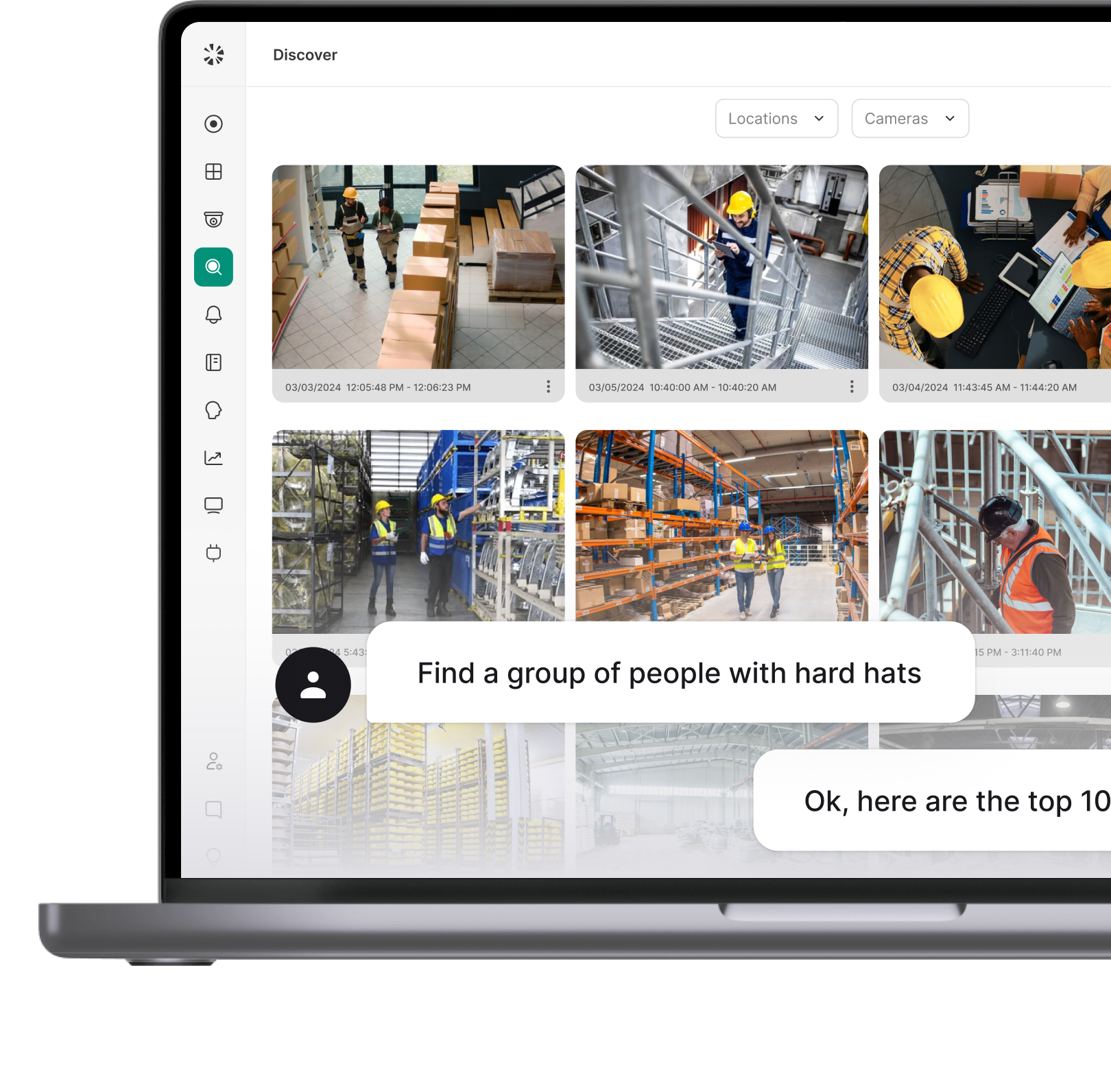
The AI layer is native rather than bolted on. Natural language video search, real-time gun detection, facial recognition, and custom alerts configured in plain English are available across every site from the same dashboard. For security teams managing incidents across distributed locations, the ability to search footage descriptively rather than scrubbing through hours of recordings is a meaningful operational difference. The Journey feature tracks a person's movement across cameras at a facility, producing a visual route in seconds, which is useful for investigations that would otherwise require pulling footage from multiple systems manually.
Coram holds SOC 2 Type II and HIPAA certifications and supports on-premises AI processing through Coram Point for environments with strict data residency requirements. It deploys in roughly 10 minutes per site and is designed to be managed without dedicated security engineering staff at each location, which matters when a security team is responsible for thirty sites but physically present at one.
[EMBED VIDEO: https://youtu.be/FZKT61mtXUM?si=evyJq07VnxARtFIB]
Best for: Multi-site organizations that want to unify access control, video, and AI detection across existing camera infrastructure without replacing hardware or adding per-site IT overhead.
Limitations:
- Newer platform (founded 2022) with less of a track record at the largest enterprise scale than Genetec or Johnson Controls
- Pricing is not publicly listed
- Organizations with very large on-premises infrastructure investments may find the migration path requires planning
2. Genetec
Genetec is an enterprise physical security platform whose Security Center unifies access control, video surveillance, license plate recognition, and communications for large, complex environments.
Genetec is the platform most enterprise security leaders already know. Security Center is the incumbent choice in government, critical infrastructure, and large enterprise. It's the system dedicated security teams use when they need deep customization, thousands of device integrations, and the flexibility to build a security operation around specific requirements rather than adapt to a vendor's standard configuration. The open architecture supports a broad range of third-party hardware and software integrations, which matters for enterprises that have spent years building infrastructure and aren't prepared to replace it.
The tradeoff is operational complexity. Genetec is built for organizations with dedicated security engineers who configure and maintain it as a full-time responsibility. Deployment requires significant on-premises server infrastructure, administration requires specialized expertise, and AI capabilities are added on top of the platform rather than built into it natively. For enterprises with the staff and budget to support it, that depth is exactly what makes Genetec the right choice. For organizations without a dedicated security team, it creates more overhead than it eliminates.
Best for: Large enterprises, government agencies, and critical infrastructure operators with dedicated security engineering teams that need deep customization and a broad third-party integration ecosystem.
Limitations:
- Infrastructure-heavy: requires significant on-premises server investment and dedicated security engineering staff
- AI capabilities are add-ons rather than native to the platform
- High total cost of ownership; not suited to organizations without dedicated security staff
- Complexity makes it a poor fit for distributed organizations without on-site IT at each location
3. Johnson Controls
Johnson Controls is a global building technology company whose C•CURE 9000 platform unifies access control, video surveillance, and identity management for large enterprise and government environments.
C•CURE 9000 is built for organizations where access control needs to function as part of a broader building infrastructure, integrating with HVAC, energy management, visitor management, and building automation alongside physical security. For large corporate campuses and complex facilities where a single platform managing building operations and security is the goal, Johnson Controls has the depth and the track record to support it. The platform supports both on-premises and cloud-based configurations, which gives larger enterprises a migration path without forcing an immediate infrastructure replacement.
The enterprise positioning also means enterprise complexity. C•CURE 9000 requires professional implementation, ongoing administration, and in many cases dedicated Johnson Controls professional services for major configuration changes. Organizations evaluating it should factor professional services costs into the total cost of ownership calculation.
Best for: Large corporate campuses and enterprise headquarters where access control needs to integrate with building automation, energy management, and broader facility operations.
Limitations:
- Complex to deploy and administer; requires professional services for major implementations
- User interface feels dated compared to cloud-native platforms
- Some advanced modules require separate licensing
- Higher total cost of ownership than cloud-native alternatives for organizations that don't need full building automation integration
4. Brivo
Brivo is a cloud-native physical security platform covering access control, video surveillance, visitor management, and intrusion detection across distributed locations, managed directly without a managed service provider.
Brivo's late 2025 merger with Eagle Eye Networks added a full cloud video layer to what was built as an access control platform, creating a more complete physical security offering under the Brivo Security Suite. At enterprise scale, the direct ownership model matters: Brivo is designed for organizations that want to operate their security stack internally rather than depend on a managed service provider or integrator to sit between them and their own data. The open API integrates with HR systems, identity providers, and property management software, which supports automated provisioning and deprovisioning across large user populations.
For enterprises managing access control across many locations, Brivo's cloud-native architecture means consistent policy enforcement and remote management without on-site infrastructure at each site. The post-merger AI capabilities (gun detection, face match, and license plate recognition) extend the platform beyond basic door management for organizations with more active security requirements.
Best for: Multi-location enterprises that want cloud-managed access control and video under direct internal ownership, without managed service dependency or on-premises infrastructure.
Limitations:
- Cloud-only architecture; functionality degrades during internet outages with no offline fallback
- Works best with Brivo/Eagle Eye compatible hardware; less camera-agnostic than Coram at scale
- Natural language video search and emergency management are not part of the platform
- AI depth is narrower than Coram's native capabilities
5. Avigilon (Motorola Solutions)
Avigilon, a Motorola Solutions company, is an AI-powered video surveillance and access control platform with strong appearance search and self-learning video analytics, built around its own camera hardware.
Avigilon's access control earns its place in enterprise evaluations through its video integration. Access events link natively to camera footage: a credential failure at a door surfaces the corresponding video clip automatically, and appearance search lets security teams trace a person across access logs and camera footage without switching systems. For large facilities with high-security requirements and an existing Avigilon camera installation, that integration is a genuine operational advantage. The platform is backed by Motorola Solutions with enterprise support infrastructure that matters at scale.
The limitation is hardware dependency, and at enterprise scale that dependency compounds. The AI features are optimized for Avigilon cameras. Organizations running third-party hardware across dozens of sites see meaningfully reduced analytics performance. Avigilon tends to steer customers toward its own hardware over time, and the switching costs across a large installation are substantial. Organizations considering Avigilon should evaluate the total hardware commitment across every site before committing.
Best for: Large enterprises and high-security environments already running Avigilon cameras across their locations, or those willing to commit to a full Avigilon hardware-and-software deployment.
Limitations:
- Top AI features require Avigilon cameras; multi-site deployments with mixed hardware see limited analytics performance
- Hardware lock-in compounds at enterprise scale; switching costs across many sites are significant
- Higher price point than alternatives; proprietary ecosystem steers toward continued Avigilon hardware investment
- More complex to administer than cloud-native platforms for organizations without dedicated security staff
6. Openpath (Avigilon Alta)
Openpath, now part of the Avigilon Alta security suite by Motorola Solutions, is a cloud-native access control platform with mobile-first credentials, AI-powered video intelligence, and strong HR and identity system integrations.
Openpath sits in a different position than the Avigilon hardware ecosystem. It's cloud-native, designed for fast deployment, and built around the operational requirements of distributed organizations managing access across many locations. Mobile and touchless credentials, cloud management without on-site servers, and integrations with Workday, Okta, and other enterprise HR and identity platforms make it a practical choice for organizations that need enterprise-grade access control without the infrastructure overhead of Genetec or Johnson Controls. Real-time alerts and remote lockdown capabilities are managed from a single interface across every location.
The relevant consideration for enterprise evaluations: Openpath and Avigilon now share a parent company in Motorola Solutions, but they serve different buyer profiles. Openpath is the cloud-native path; Avigilon is the hardware-integrated path. Organizations evaluating Motorola Solutions' portfolio should be clear about which they're actually buying.
Best for: Distributed enterprises that need cloud-native access control with strong identity system integrations and mobile credentials, without committing to proprietary camera hardware.
Limitations:
- Requires internet connectivity for full functionality; no meaningful offline mode
- Some firmware updates have caused temporary configuration delays in multi-site deployments
- AI capabilities are less developed than Coram's native detection depth
- Lower-tier plans offer limited customization for large, complex deployments
7. Allegion
Allegion is a global physical security company whose electronic access control systems span smart locks, readers, credential management, and building access hardware across more than 30 brands operating in 120 countries.
Allegion's enterprise position is different from the other platforms on this list. It's primarily a hardware and credential management company. Schlage, one of its most recognized brands, is the lock on many enterprise doors already. For organizations evaluating access control as a hardware decision first and a software decision second, Allegion's depth of hardware compatibility, durability standards, and global support network are the primary arguments. The software layer integrates with third-party access control platforms rather than competing with them directly, which makes Allegion a component in an enterprise security architecture rather than a platform that replaces one.
Organizations building or refreshing access control infrastructure at scale should evaluate Allegion as a hardware partner rather than a full platform replacement. It works alongside the software platforms on this list rather than instead of them.
Best for: Enterprises evaluating access control hardware (smart locks, readers, and credential management) as a component of a broader security architecture, particularly across global or multi-region deployments.
Limitations:
- Software layer is less developed than dedicated access control platforms; functions best as a hardware component
- Cloud capabilities are still evolving compared to cloud-native alternatives
- Full platform functionality requires integration with third-party access control software
- Higher initial hardware investment for enterprise-scale deployment
How to Evaluate Enterprise Access Control Systems
Four filters narrow the field for enterprise and multi-site deployments. Most platforms will look similar in a demo. These are the questions that reveal the differences.
What does deployment look like across every site? A platform that deploys in 10 minutes at a single location may require weeks of professional services at an enterprise with 50 sites and mixed infrastructure. Ask vendors specifically how deployment works at your scale, what professional services are required, and what happens when a site has legacy hardware that doesn't fit the standard configuration.
What is the real total cost of ownership? Per-door or per-site licensing is only part of the picture. Hardware refresh costs, professional services for major changes, and the ongoing cost of dedicated administration staff are often larger than the software subscription. Platforms like Coram that work with existing hardware change the TCO calculation significantly for enterprises with camera infrastructure already in place.
How does compliance work at scale? HIPAA, GDPR, NDAA, and SOC 2 certifications need to apply across every site, not just the primary location. Ask vendors specifically about data residency options, how audit trails are maintained across distributed sites, and what happens to compliance posture when a location goes offline.
What breaks the integration? Every vendor will tell you their platform integrates with your existing systems. The real question is what the integration actually requires (custom development, professional services, or a certified connector) and what happens when the third-party system updates and the integration breaks. Ask for references from organizations running the same integration stack you need.




.png)