Everbridge is the category leader in critical event management for a reason. It handles large-scale notification across complex organizations, integrates with enterprise systems, and has the market presence that makes it easy to justify in a procurement conversation. The problem most teams run into isn't whether Everbridge works. It's whether it's worth what it costs and what it takes to run.
Two issues come up consistently. The first is price: at $25K to $100K+ annually, Everbridge is priced for the full scope of what it does, and most organizations use a fraction of that scope. The second is operational overhead: the platform requires clean, structured contact data, configured workflows, and in many cases a dedicated administrator before it delivers its core value. For organizations that don't need enterprise-scale CEM, that overhead is hard to justify.
This guide covers 9 strong Everbridge alternatives, from simpler mass notification tools to platforms that add detection and physical security capabilities Everbridge doesn't offer. A decision framework at the end helps you match the right tool to your actual situation.
Why Teams Look for Everbridge Alternatives
The most common pattern isn't dissatisfaction with Everbridge's capabilities. It's a mismatch between what the platform is built for and what the organization actually needs. Everbridge is designed for enterprise-scale critical event management: global populations, complex escalation paths, regulatory compliance across regions. When an organization's real requirement is reliable emergency notification with manageable overhead, they're paying for architecture they're not using.
The operational cost compounds the pricing problem. Before Everbridge delivers value, it needs clean contact data, configured escalation paths, and maintained workflows. Making small changes (updating alert logic, adjusting groups) isn't always fast. New users need training before they can operate it confidently. In urgent situations, that complexity works against the platform's core purpose.
Neither issue is a product flaw. They're signals that the requirement has outgrown (or never reached) what Everbridge is designed for.
Everbridge Alternatives: Quick Comparison
9 Best Everbridge Alternatives in 2026
The alternatives below split into two broad categories. Some are simpler notification platforms, doing what Everbridge does with less overhead and lower cost. Others cover ground Everbridge doesn't: physical security detection, on-site infrastructure alerting, or IT incident management. The right choice depends on which category matches what you're actually missing.
1. Coram
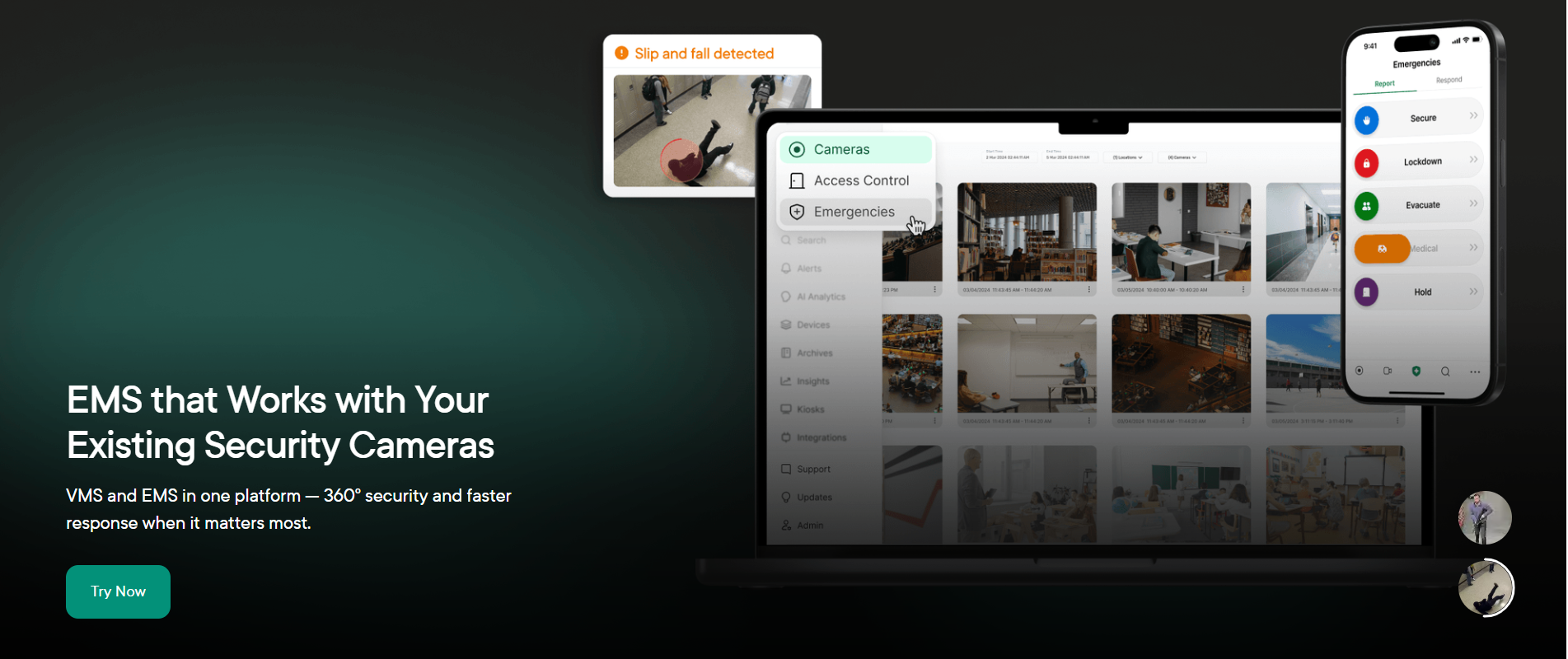
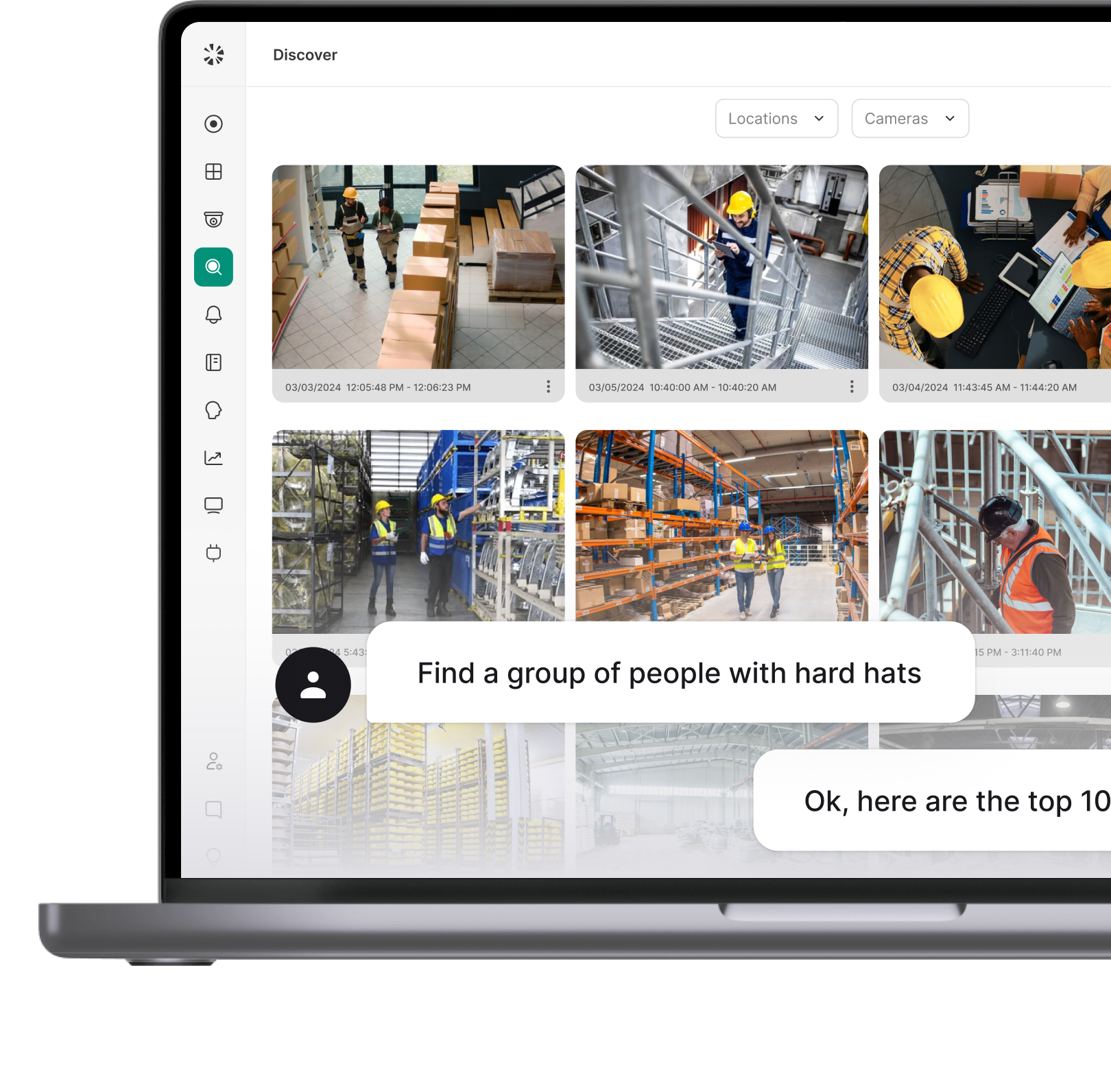
Coram is an AI-native emergency management platform that detects physical security incidents from existing camera feeds and triggers alerts automatically, without waiting for a person to notice first. It works with 1,000+ ONVIF-compatible IP camera models, so organizations add detection and alerting capability on top of the cameras they already own. No hardware replacement required.
The comparison to Everbridge is a category question as much as a feature question. Everbridge starts working after someone identifies an incident and initiates the notification process. Coram identifies the incident directly (an intrusion, a weapon, a slip-and-fall) from camera feeds, and triggers the alert without human initiation. When an event is detected, it embeds a live video clip into the alert and opens a dedicated response channel, giving the team receiving the notification immediate visual context rather than a text description. It can bypass Do Not Disturb on mobile devices and escalate to 911 through pre-configured emergency workflows.
For organizations leaving Everbridge because of cost, the no-hardware-replacement point matters directly: Coram's TCO is lower than Everbridge's in any environment where existing camera infrastructure is already in place. It also doesn't require a dedicated administrator to keep it running. That's a meaningful difference for security leaders whose teams are managing multiple responsibilities across distributed sites. For organizations leaving because Everbridge doesn't address the detection gap, where incidents are being reported rather than caught, Coram closes that gap where Everbridge doesn't try to.
The fit is specific. Coram is built for physical locations: schools, campuses, warehouses, healthcare facilities, multi-site operations. If your alerting requirement is primarily about reaching a distributed or remote workforce, travel risk, weather events, IT outages, Everbridge or AlertMedia remains the better fit.
Best for: Schools, campuses, warehouses, and multi-site operations with existing camera infrastructure that want detection-driven alerting without replacing hardware.
Strengths:
- Detects incidents from existing camera feeds and triggers alerts automatically, no manual initiation required
- Works with 1,000+ ONVIF-compatible IP camera models, no hardware replacement required
- Embeds live video clips into alerts so responders have immediate visual context
- Bypasses Do Not Disturb; supports 911 escalation through pre-configured workflows
- SOC 2 Type II and HIPAA certified
- G2: 4.9/5 rating, 9.5/10 ease of use, 9.6/10 ease of administration
Limitations:
- Requires existing camera infrastructure; not a fit for distributed workforce or travel risk scenarios
- Complex workflow automation requires upfront configuration and a structured rollout
- Newer platform than Everbridge; shorter track record may affect enterprise procurement decisions
Pricing: Quote-based.
Everbridge vs Coram
Choose Coram when your incidents are physical (intrusions, weapons, slip-and-falls, access violations) and your current setup depends on someone noticing before an alert goes out. It closes the detection gap Everbridge doesn't address, at a lower TCO for any organization with existing camera infrastructure. Everbridge remains the better fit for distributed workforce communication, travel risk management, or regulatory compliance scenarios that don't involve on-site physical security detection.
2. AlertMedia
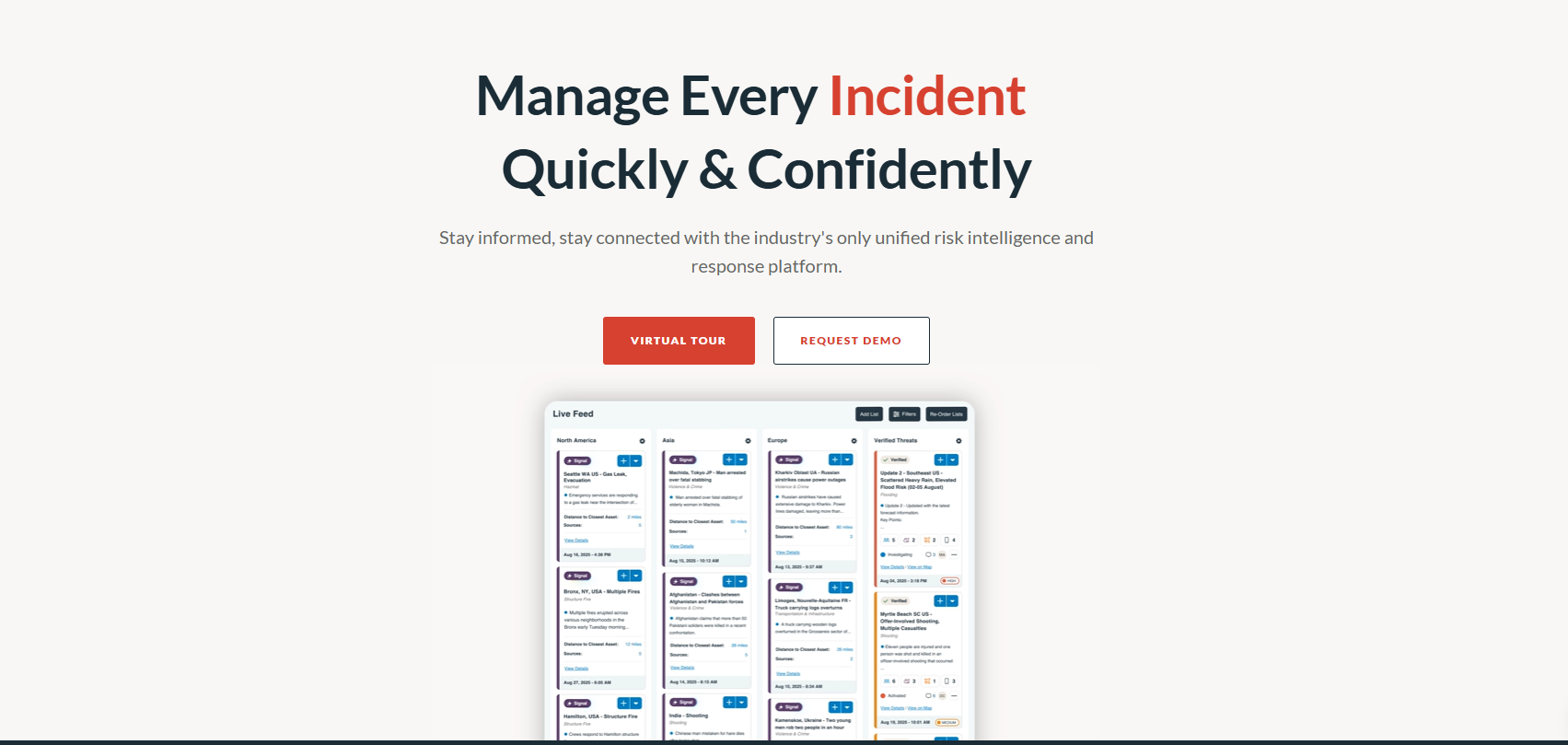
AlertMedia is a mass notification and risk intelligence platform that monitors global threats, assesses impact, and sends alerts from a single system. It offers real-time threat feeds with analyst-verified intelligence, distinguishing it from platforms that pass raw signal data to users without filtering.
Against Everbridge, AlertMedia's practical advantage is in threat intelligence depth combined with lower operational overhead. Everbridge handles large-scale notification well but requires significant configuration investment before that notification machinery works correctly. AlertMedia delivers threat monitoring and multi-channel alerting with less setup friction, which makes it a realistic replacement for organizations whose primary Everbridge use case is reaching employees during travel risk events or weather emergencies. The limitation is incident management depth: AlertMedia handles notification and threat intelligence well; it stops short of the structured coordination workflows Everbridge supports in complex, multi-agency scenarios.
Best for: Organizations with distributed teams, global operations, or employees traveling across regions who need threat intelligence alongside notification.
Strengths:
- AI-vetted and analyst-verified threat signals rather than raw, unfiltered data
- Impact radius and location-based risk assessment to identify which sites and employees are affected
- 24/7 analyst support and strategic situation reports for ongoing risk monitoring
- Lower operational overhead than Everbridge for organizations with straightforward notification needs
Limitations:
- Notification controls can generate noise; users report too many automated alerts without tuning
- Verification workflows and data imports require time to configure and maintain
- Less incident coordination depth than Everbridge for complex, multi-team response scenarios
Pricing: Quote-based.
Everbridge vs AlertMedia
Choose AlertMedia when your primary Everbridge use case is reaching employees during travel risk events, weather emergencies, or global disruptions. It delivers the same multi-channel notification with less operational overhead and adds analyst-verified threat intelligence Everbridge doesn't include. Everbridge remains the better fit when your incidents require structured coordination workflows, multi-agency response, or enterprise-scale contact management across a large global population.
3. OnSolve
OnSolve, now part of Crisis24, is a critical event management platform built around location-based alerting and automated response workflows. It consolidates products including CodeRED, MIR3, and Send Word Now into a single platform for emergency communication, IT disruption response, and operational incident coordination.
The practical difference from Everbridge is audience scope. Everbridge is optimized for internal communication: reaching employees, tracking personnel, coordinating response across organizational teams. OnSolve is designed to reach both internal teams and external audiences, residents, customers, and field teams in public safety and infrastructure scenarios. CodeRED in particular is widely used by local governments for community alerting, which is a use case Everbridge doesn't serve as well. The tradeoff is similar to Everbridge's: OnSolve carries meaningful configuration complexity, and navigation and onboarding draw consistent user complaints.
Best for: Government, public sector, and infrastructure organizations that need to alert both internal teams and external communities.
Strengths:
- Location-based alerting across multiple channels for targeted emergency and public safety messaging
- CodeRED community alerting capability for reaching residents and external audiences, not just employees
- Automated response workflows for crisis, IT disruption, and workforce communication in one platform
- One-click conference bridges and real-time dashboards for faster incident coordination
Limitations:
- Navigation can feel complex, especially when using advanced features
- Documentation and onboarding support inconsistent; steeper learning curve than simpler alternatives
- Better suited to public sector and large infrastructure organizations than mid-market teams
Pricing: Quote-based.
Everbridge vs OnSolve
Choose OnSolve when your alerting requirement extends beyond your own employees to external audiences: residents, customers, or field teams across public safety or infrastructure scenarios. CodeRED gives it community alerting reach Everbridge doesn't match. Everbridge remains the better fit for pure internal communication with structured enterprise workflows and deeper integration into existing IT and HR systems.
4. Rave Mobile Safety
Rave Mobile Safety is a mass notification and emergency communication platform built for schools, universities, and public safety organizations. It sends alerts across multiple channels: SMS, email, voice, social media, IPAWS, and public address systems, while keeping contact databases current through automatic syncs with HR and student information systems.
Rave's edge over Everbridge is vertical depth in education and public safety. It integrates with the specific data systems those organizations run (student information systems, safety databases) and includes features like anonymous tip reporting and geo-targeted polling built specifically for campus security workflows. Everbridge handles these environments but isn't optimized for them; Rave is. For a school district or university evaluating Everbridge, Rave offers a tighter fit with less configuration overhead. The limitation is scale: Rave is built for education and public safety, and organizations outside those verticals will find less value in its vertical-specific feature set.
Best for: K-12 schools, higher education institutions, and public safety agencies.
Strengths:
- Automatic contact sync with HR, SIS, and safety management systems
- Geo-targeted alerts and audience segmentation for campus-specific notification
- Anonymous tip reporting and geo-polling built for campus security workflows
- Multi-channel reach: SMS, email, voice, social media, IPAWS, and public address systems
- Available in US, UK, and Canada; 10,000+ customers including AstraZeneca, GE, and Duke University
Limitations:
- Occasional session timeouts reported during active use
- Reporting and data visibility limited for organizations needing detailed post-incident analysis
- Primarily a fit for education and public safety; less relevant outside those verticals
Pricing: Quote-based.
Everbridge vs Rave Mobile Safety
Choose Rave when your environment is education or public safety and you need a platform built for that vertical's specific data systems and workflows. It integrates where Everbridge doesn't, at lower configuration overhead. Everbridge is the better fit when your communication requirement spans a broader organizational population, involves global risk intelligence, or needs enterprise-grade workflow automation beyond what campus alerting requires.
5. BlackBerry AtHoc
BlackBerry AtHoc is a critical event management platform built for government agencies, defense organizations, and large enterprises where alert reliability, audit trails, and structured incident workflows are non-negotiable. It consolidates alerts, personnel status, field reports, and operational updates into a single view, running incidents through predefined workflows rather than relying on manual coordination.
The comparison to Everbridge is closest in category: both are enterprise CEM platforms with structured workflows and multi-channel notification. AtHoc's distinction is compliance depth and mission-scale resilience. It's built specifically for environments that need to demonstrate compliance with FedRAMP, CJIS, or FISMA, and for incidents where performance under pressure, large-scale simultaneous events, is the design requirement rather than the edge case. Organizations leaving Everbridge for cost or complexity reasons won't find relief in AtHoc; it's at least as complex and similarly priced. The right use case is an organization that needs Everbridge-level capability with stronger compliance credentials and defense-sector hardening.
Best for: Government agencies, defense organizations, and large enterprises with mission-critical compliance requirements.
Strengths:
- Federated situational awareness: alerts, personnel status, maps, and system data in one operational view
- Structured workflows guide detection, notification, coordination, and recovery at each step
- Mission-scale resilience; built to maintain performance during large-scale, high-demand incidents
- FedRAMP, CJIS, and FISMA compliant; integrates with Microsoft Teams, ServiceNow, and CylanceGUARD
Limitations:
- Setup and configuration complex, especially for large-scale deployments; similar overhead to Everbridge
- Higher cost than most alternatives on this list
- Not a fit for organizations looking to reduce CEM complexity; better for those upgrading compliance posture
Pricing: Quote-based.
Everbridge vs BlackBerry AtHoc
Choose AtHoc when your requirement is Everbridge-level capability with stronger compliance credentials (FedRAMP, CJIS, FISMA) or defense-sector hardening that Everbridge doesn't provide. It's not a cost or complexity reduction; it's a compliance upgrade. Everbridge is the better fit for enterprise organizations that need broad CEM capability without defense-specific requirements, or for teams looking to reduce operational overhead rather than increase it.
6. InformaCast (Singlewire)
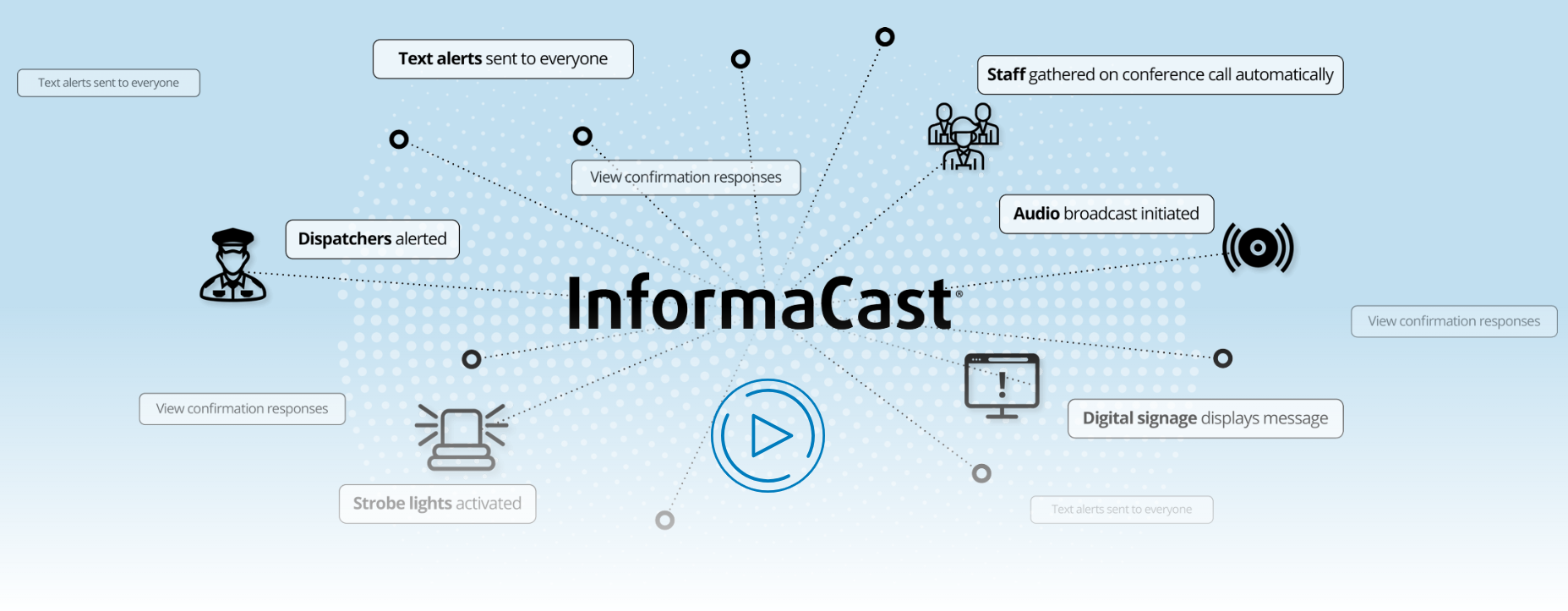
InformaCast is a mass notification platform that sends alerts across the physical infrastructure organizations already have: IP phones, overhead speakers, desktops, digital signage, and mobile devices. Alerts can be triggered manually or automatically from connected systems (fire alarms, surveillance inputs, or emergency calls) without manual initiation.
The contrast with Everbridge is infrastructure orientation. Everbridge is cloud-based and employee-focused: it reaches people on their phones and computers through digital channels. InformaCast is facility-focused: it reaches people wherever they are in a building, including environments where mobile coverage is unreliable or where overhead audio is the operational requirement. Its Wearable Alert Badge adds a wireless panic button with room-level location accuracy, a capability Everbridge doesn't offer. For manufacturing facilities, large campuses, or operations that depend heavily on on-premises infrastructure, InformaCast covers ground Everbridge doesn't reach. For organizations with distributed, mobile-first workforces, Everbridge remains the better fit.
Best for: Manufacturing facilities and large corporate offices with significant on-premises device infrastructure.
Strengths:
- Alerts across IP phones, PA systems, desktops, digital signage, and mobile from one platform
- Automatic alert triggering from fire alarms, surveillance inputs, and emergency calls
- Wearable Alert Badge with room-level location accuracy and silent alerting
- 5,000+ customers across 81 countries; 99.99% uptime
Limitations:
- Heavily dependent on existing on-premises infrastructure quality and setup
- Configuration to connect multiple systems and automate triggers requires meaningful effort
- Not suited to distributed or mobile-first workforces; limited cloud-first capability
Pricing: Quote-based.
Everbridge vs InformaCast
Choose InformaCast when your alerting requirement is physical coverage inside a facility, reaching people through overhead speakers, IP phones, and PA systems in environments where mobile coverage is unreliable or insufficient. It reaches places Everbridge doesn't. Everbridge is the better fit when your requirement is reaching a distributed, mobile-first workforce across multiple locations or regions through digital channels.
7. Regroup Mass Notification
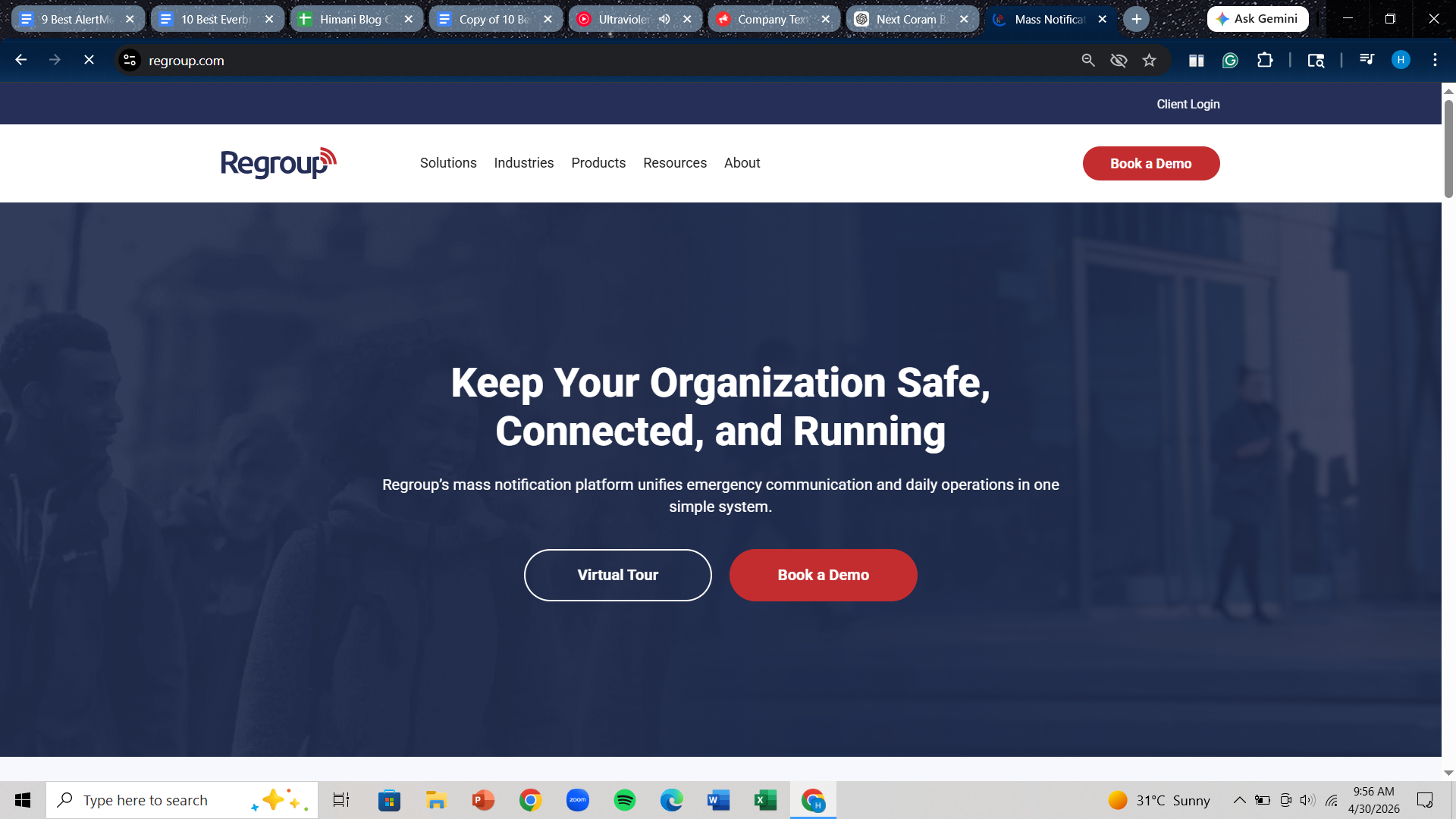
Regroup is a mass notification platform for organizations that need reliable multi-channel alerting without the configuration overhead of enterprise CEM platforms. It sends alerts across SMS, email, voice, mobile app, and desktop, with built-in geofencing for location-based triggers and two-way communication for response tracking.
Against Everbridge, Regroup's argument is simplicity and cost. It won't replace the incident management depth, global risk intelligence, or enterprise integration ecosystem that Everbridge offers. What it does is deliver the core alerting function, reaching people quickly across channels, without the dedicated administrator, the structured data requirements, or the configuration investment Everbridge needs before it works well. For organizations whose Everbridge usage is primarily "send an alert to our employees when something happens," Regroup covers that use case at a fraction of the cost and complexity.
Best for: SMBs, education, and healthcare organizations that need straightforward multi-channel notification without enterprise overhead.
Strengths:
- Multi-channel alerts across SMS, email, voice, mobile app, and desktop from one platform
- Built-in geofencing and automated weather alerts for location-based triggering
- Two-way communication for response confirmation and status tracking
- Low configuration overhead; accessible to non-technical administrators
Limitations:
- Pricing can increase with additional features in ways that aren't always clear upfront
- Initial setup more complex than the platform's simple positioning implies
- No meaningful incident management depth; notification-only
Pricing: Quote-based.
Everbridge vs Regroup Mass Notification
Choose Regroup when your Everbridge usage is primarily basic employee notification and the platform's cost and configuration overhead isn't justified by what you're actually using. Regroup delivers the core alerting function with far less friction and at significantly lower cost. Everbridge is the better fit when your incidents involve structured coordination workflows, global risk intelligence, enterprise integrations, or large-scale contact management that Regroup isn't designed to handle.
8. RedFlag

RedFlag is an SMS-first mass notification platform built for fast internal employee communication during disruptions. Its primary differentiator is native Microsoft 365 integration: alerts can be triggered directly from Outlook and Teams, which reduces friction for organizations already running Microsoft workflows.
The Everbridge comparison is a scope question. Everbridge is a full CEM platform with risk intelligence, global reach, and enterprise coordination workflows. RedFlag is a focused internal alerting tool, effective for IT outages, facility closures, and employee communications, less so for anything requiring external alerting, geographic targeting, or structured incident coordination. For organizations leaving Everbridge because most of their actual usage is "send a text to employees when the building is closed," RedFlag covers that use case simply and at a lower price point. Built-in analytics provide delivery and engagement visibility that some notification-only tools skip.
Best for: Organizations handling IT outages, facility closures, and internal employee communications.
Strengths:
- Native Microsoft 365 integration; alerts triggered directly from Outlook and Teams
- Two-way SMS communication with real-time acknowledgment and status tracking
- Built-in analytics: delivery rates, engagement, and response visibility
- Simple contact management; fast to deploy for internal communication use cases
Limitations:
- Pricing increases with usage in ways that may not be clear upfront
- Contact and data management workflows less intuitive than AlertMedia or Everbridge
- Limited to internal communication; not suited for external, public, or large-scale emergency alerting
Pricing: From $378/month (billed annually at $4,536/year).
Everbridge vs RedFlag
Choose RedFlag when your requirement is fast internal employee notification through SMS and Microsoft 365 tools, with minimal setup and a known price point. It's the simplest option on this list for organizations whose Everbridge usage never justified the platform's scope or cost. Everbridge is the better fit when incidents involve external audiences, global populations, regulatory compliance requirements, or coordination workflows that go beyond sending a text to your staff.
9. PagerDuty
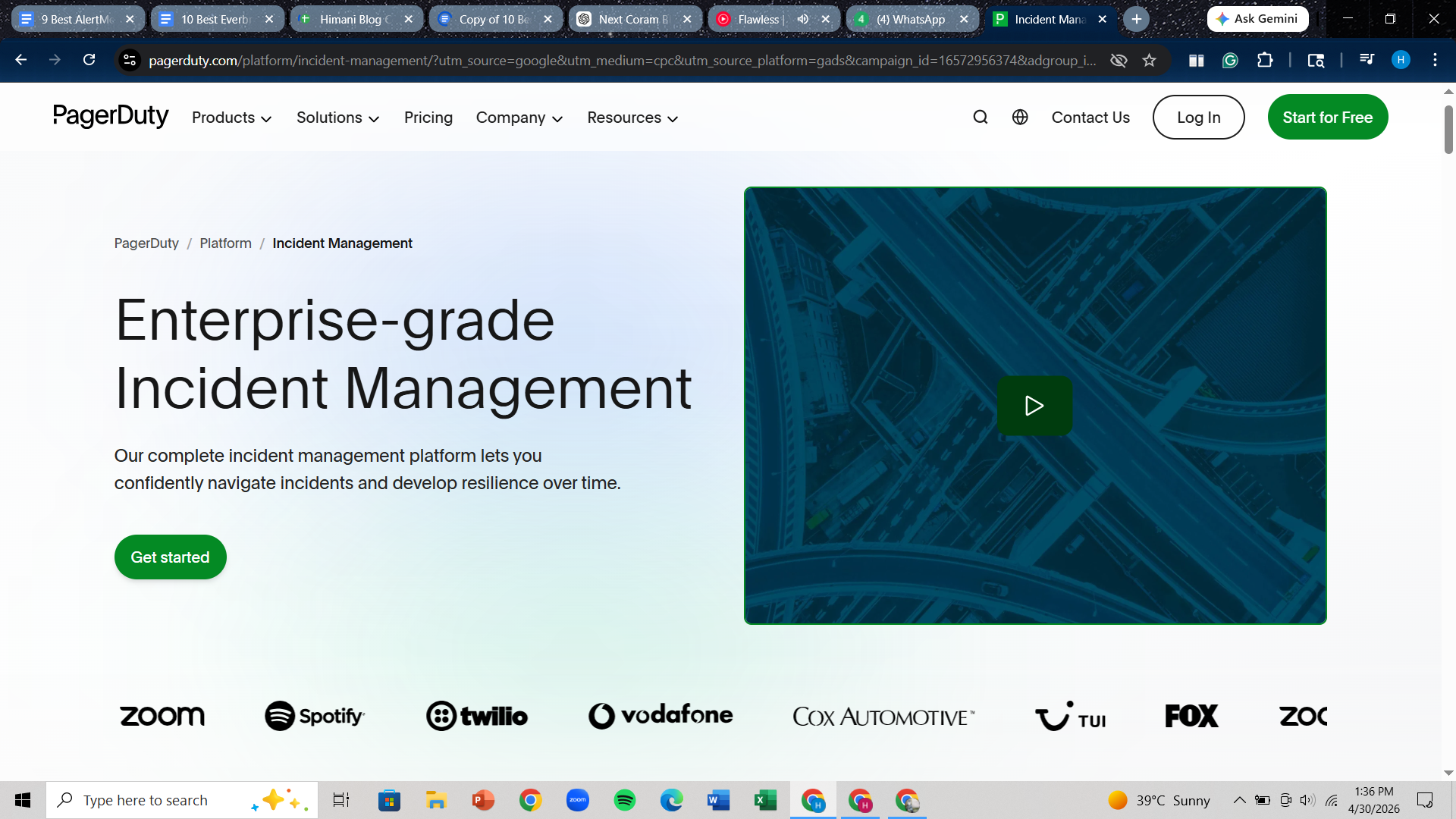
PagerDuty is an incident management and response platform built for IT, DevOps, and engineering teams. It connects with monitoring tools, automatically triggers alerts when systems breach thresholds, and routes incidents to the right on-call responders based on predefined escalation policies, without requiring manual initiation at any step.
The comparison to Everbridge is a category distinction. Everbridge is built for physical and organizational emergency management: reaching people during natural disasters, security events, or operational disruptions. PagerDuty is built for digital incident management: detecting system failures, routing alerts to engineers, and managing resolution workflows. There's minimal overlap in use case. Organizations evaluating Everbridge alternatives for IT incident management are solving a different problem than organizations evaluating it for emergency communication. PagerDuty is the right answer to the IT problem. Its AI-driven noise reduction and automated escalation make it genuinely useful for high-volume engineering environments where Everbridge would be the wrong tool entirely.
Best for: IT, DevOps, and engineering teams managing high-volume, time-sensitive system incidents.
Strengths:
- Automated alert routing and escalation from monitoring tools, no manual initiation required
- AI-driven noise reduction and prioritization across multiple monitoring integrations
- Standardized incident workflows for consistent resolution under pressure
- Free plan available; paid plans from $21/user/month
Limitations:
- Limited flexibility in alert integrations for non-standard or custom workflows
- Interface complexity for new users unfamiliar with on-call management tooling
- Not designed for physical emergency management or mass notification to non-technical audiences
Pricing: Free plan available; Professional plan from $21/user/month.
Everbridge vs PagerDuty
Choose PagerDuty when your incidents are system failures, service outages, and engineering problems that originate in monitoring tools and need automated routing to on-call engineers. It's a genuinely different category from what Everbridge does, and it does that category better. Everbridge is the right tool when your alerting requirement is organizational and human-focused: reaching employees, coordinating physical emergency response, or managing communication during external events.
How to Choose the Right Everbridge Alternative
The right alternative depends on what part of your current setup is actually broken. Most organizations evaluating Everbridge alternatives are dealing with one of three distinct problems. Each points to a different category of solution.
The Problem Is Cost and Complexity, But the Use Case Is the Same
AlertMedia, Regroup, or RedFlag are the right alternatives when the use case is the same but Everbridge feels overbuilt. If your primary usage is multi-channel employee notification, sending alerts when something happens, tracking responses, managing contact lists, these tools cover that job with less overhead and lower cost. The tradeoff is losing Everbridge's enterprise integration depth and global risk intelligence, which may or may not matter depending on how much of that you were actually using.
The Problem Is That Everbridge Doesn't Cover Physical Security
Coram is the right category when the gap is detection, not notification. Everbridge is a notification platform. It doesn't detect incidents, it distributes information about incidents that have already been identified and reported to it. If your gaps are in detection (incidents not being caught in time, reliance on manual monitoring, delays before alerts are triggered), a notification platform replacement won't fix them. Coram detects incidents from existing camera feeds and triggers alerts automatically. InformaCast covers a related gap for organizations where the issue is reaching people inside physical facilities through on-site infrastructure rather than phones.
The Problem Is That Your Incidents Are IT, Not Physical
PagerDuty is the right tool when the incidents are IT, not physical. System failures, service outages, and engineering incidents are a different problem than emergency communication or workforce notification. Everbridge was the wrong tool for them from the start. PagerDuty provides automated routing from monitoring tools, AI-driven prioritization, and resolution workflows that Everbridge doesn't offer.
Check Where Your Last Three Incidents Actually Slowed Down
The most reliable diagnostic is reviewing your last three incidents before evaluating any platform. Where did things break, in detecting the incident, in triggering the alert, in reaching the right people, or in coordinating the response after the alert went out? Each breakdown maps to a different capability gap, and each capability gap maps to a different category of tool. That answer is more useful than any feature comparison.
Finding the Right Everbridge Alternative
Everbridge is a strong platform for organizations that need enterprise-scale critical event management. The teams that leave it aren't usually finding something better in the same category. They're finding that the category was wrong for their actual requirement.
Map what you're using Everbridge for today against what you actually need it to do. If the overlap is high and cost is the issue, a simpler notification tool will close the gap. If the overlap is low, if you're using a fraction of what you're paying for or if your real problem is detection rather than notification, the right answer is a platform built for the specific problem you're solving, not a cheaper version of the one you're replacing.




.png)