Flock Safety answers one question well: which vehicle was here, and when. For organizations that need exactly that and nothing more, it works. The problem most security teams run into is that incidents don't stop at the entry point. Once a vehicle is on site, you need to understand what happened next: where people moved, what took place inside the facility, how the situation developed across cameras and locations.
Flock doesn't do that. Its shared network model also raises questions about data control that are increasingly difficult to ignore, particularly for municipalities, schools, and organizations operating under privacy regulations.
If you're evaluating Flock Safety alternatives, this guide covers the 9 strongest options in 2026: what each platform does well, where it falls short, and which type of organization it actually fits.
Why Organizations Are Moving Away from Flock Safety
Most teams don't leave Flock over a single issue. The reasons tend to cluster around three structural limitations that become harder to work around as security requirements grow.
Privacy and Data Control
Flock operates on a shared network, which means vehicle data collected at one deployment can be accessible beyond a single jurisdiction. For many organizations, that's acceptable. For municipalities, schools, and regulated industries, it's increasingly not.
The pressure isn't theoretical. In Norfolk, Virginia, a court ruling questioned the use of automated license plate readers under the Fourth Amendment. The ACLU has challenged the broader implications of large-scale license plate data collection at the national level. Richmond and Saratoga in California have already moved to replace Flock deployments through new RFPs. For organizations that need clear boundaries around data access and sharing, the shared network model is a structural limitation.
Hardware Lock-In
Flock requires its own cameras. Organizations with existing IP camera infrastructure can't reuse it. Adopting Flock means installing new hardware alongside what's already there. For single-site deployments starting from scratch, that's manageable. For multi-site organizations with established infrastructure, it adds cost and deployment complexity that's hard to justify.
LPR Covers the Entry Point, Not the Site
Flock tells you which vehicles arrived and when. It doesn't tell you what happened after. For security teams managing schools, warehouses, healthcare facilities, or enterprise campuses, an incident that starts at the parking lot usually needs to be understood across the full site: inside buildings, across multiple cameras, in the context of access control events and personnel movement. A system built exclusively around vehicle recognition leaves that picture incomplete.
Pricing at Scale
Flock's per-camera subscription model starts predictably but scales directly with camera count. At around $2,500 per camera per year, organizations adding coverage across multiple entry points or sites find the total cost climbing quickly relative to what the system delivers.
Quick Comparison: Flock Safety vs Top Alternatives
9 Best Flock Safety Alternatives in 2026
These nine platforms serve different buyers. A few are built for law enforcement, others for commercial security, and some for both. The reviews below make the distinctions clear.
1. Coram
Best for: Schools and school districts, healthcare facilities, warehouses, multi-site enterprises, and any organization that wants AI-grade security beyond LPR without replacing existing camera infrastructure.

Coram is an AI-native physical security platform that connects to any existing IP camera and unifies video surveillance, access control, LPR, and emergency management in a single cloud-managed system.
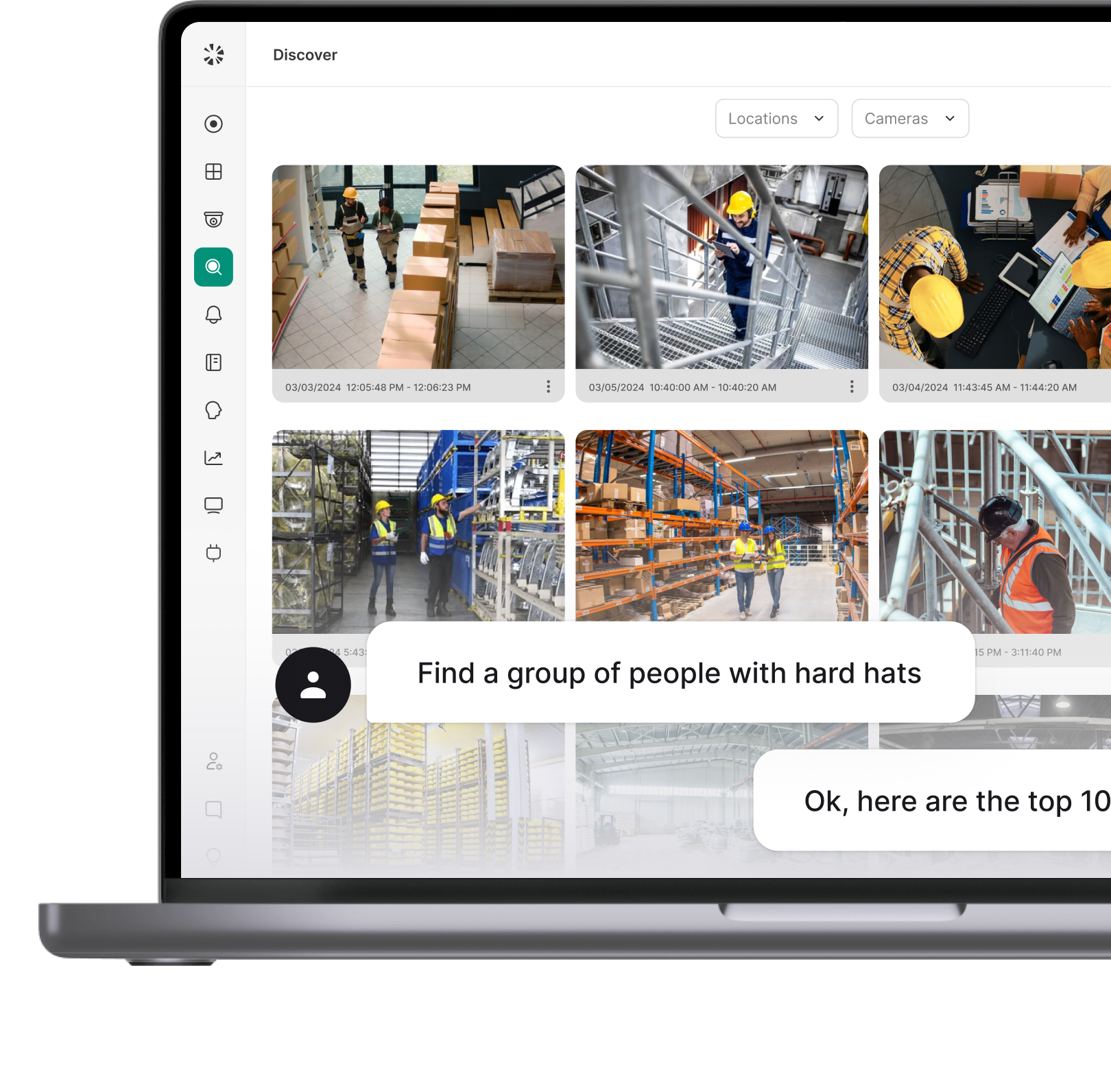
The contrast with Flock is direct. Flock identifies vehicles at entry points. Coram tracks vehicles, connects that data to video footage across the site, searches it with natural language, and triggers real-time alerts when something specific happens: a firearm, a fall, a vehicle on a watch list. It does this on the cameras already installed, without new hardware.
For organizations that adopted Flock to answer one question and now need to answer more, that's the core argument. The no-rip-and-replace model means the switch doesn't require a capital investment in new cameras. The subscription includes AI capabilities Flock doesn't offer.
Key Strengths
- Works with 1,000+ IP camera models — existing infrastructure carries forward
- LPR connects to full-site video search, access control, and emergency management in one system
- Natural language video search: find any vehicle, person, or incident by describing it
- Real-time AI detection for firearms, PPE violations, fall incidents, and custom events
- SOC 2 Type II and HIPAA certified
- G2: 4.9/5 rating, 9.5/10 ease of use
Limitations
- Newer platform — less integration ecosystem depth than established enterprise VMS
- Initial environment tuning required for AI detection accuracy in complex deployments
Pricing
Per-camera subscription including AI features and cloud management. Quote-based.
2. Motorola Solutions (Vigilant)
Best for: Law enforcement investigations, stolen vehicle recovery, and parking enforcement at scale.
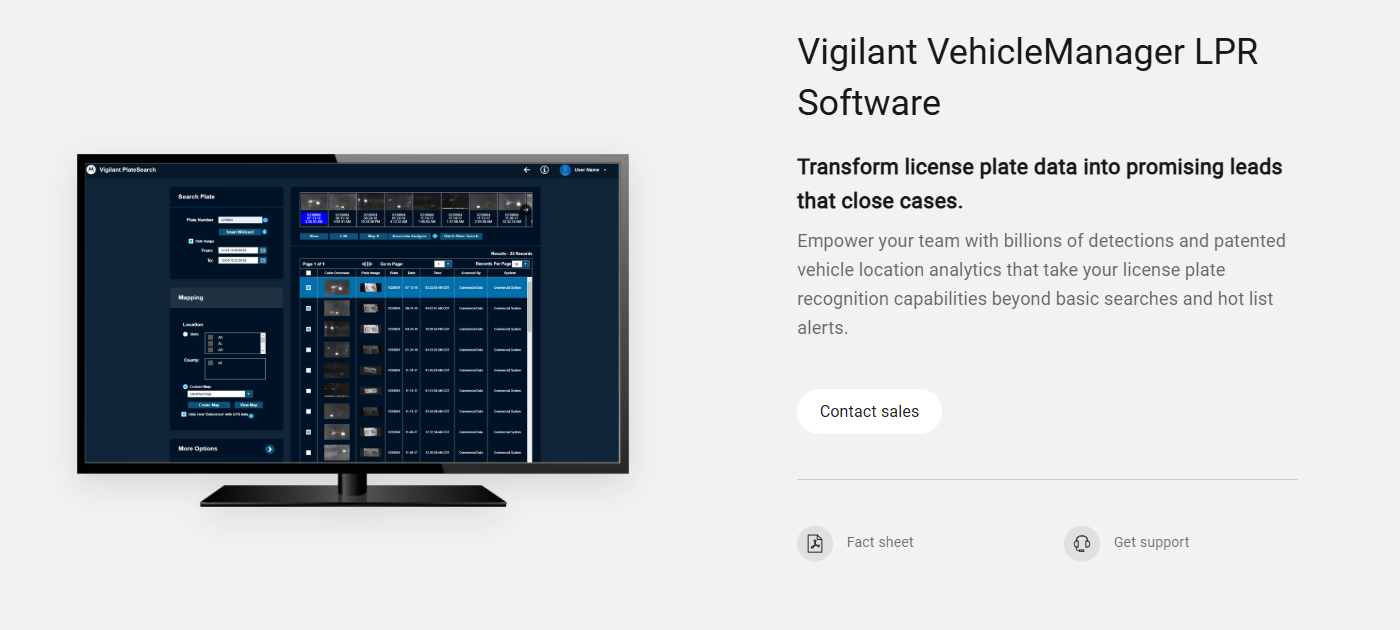
Motorola Solutions (Vigilant) is a large-scale LPR and vehicle intelligence system built primarily for law enforcement and public safety teams. It aggregates vehicle data across deployments, supports convoy and pattern analysis, and gives agencies control over data sharing and retention policies.
For law enforcement agencies moving away from Flock specifically because of data governance concerns, Vigilant is the natural comparator. It offers a controlled, agency-managed data environment instead of a shared network. The platform covers vehicle data. On-site video management, access control, and incident response beyond plate reads are outside its scope. For commercial or institutional security teams looking for a Flock replacement with broader capabilities, it's the wrong tool.
Key Strengths
- Partial plate search, location-based queries, and vehicle attribute filtering
- Convoy analysis and repeated association detection for investigative use
- AI-assisted search by vehicle attributes when plate data isn't available
- Agency-level control over data sharing and retention
Limitations
- Vehicle data only — no on-site video management or broader security coverage
- Complex to deploy without trained personnel or existing enforcement workflows
Pricing
Quote-based, varies by hardware, data access, and deployment scale.
3. Axon
Best for: Law enforcement agencies and public safety teams that need connected vehicle intelligence, real-time coordination, and integrated evidence workflows.

Axon is a public safety ecosystem that connects cameras, sensors, and software into a unified operational layer. Its fixed systems (Outpost and Lightpost) capture license plates alongside vehicle attributes and live video, while Axon Fusus brings that data together with other sensors for a real-time view of incidents.
Where Flock gives law enforcement a vehicle log, Axon gives them a full operational picture: plates connected to live video, evidence workflows, and multi-agency coordination. For agencies that need that level of integration, Axon covers substantially more ground than Flock does. For commercial security teams, that complexity is rarely necessary. Axon is strongest where public safety infrastructure and investigative rigor are the primary requirements.
Key Strengths
- Combines ALPR, live video, and vehicle attribute recognition in one system
- Real-time operations platform (Fusus) connects cameras and sensors into a single live view
- Flexible installation: poles, buildings, vehicles, streetlights
- Works with third-party cameras through its partner ecosystem
- Strong evidence workflow directly feeding into case-building systems
Limitations
- Multiple components required to unlock full value — increases deployment complexity
- More capability than most commercial or institutional deployments need
Pricing
Quote-based.
4. Verkada
Best for: Enterprises, schools, and multi-site organizations that want a unified cloud-managed security platform and are willing to standardize on proprietary hardware.

Verkada is a cloud-managed physical security platform that integrates cameras, access control, and analytics through a single interface with minimal IT overhead. Like Flock, it requires proprietary hardware: existing cameras cannot be reused. The platform extends well beyond vehicle tracking to cover full-site video, access control, environmental monitoring, and visitor management.
For organizations replacing Flock because they need more than LPR and are starting fresh (or replacing end-of-life hardware), Verkada is a natural consideration. For organizations that want to build on existing infrastructure, the hardware requirement is the same obstacle it was with Flock.
Key Strengths
- Centralized management across multiple locations with role-based access and audit logs
- Event search using filters across door activity, visitor logs, and environmental changes
- Simple device setup via QR codes or bulk uploads
- Enterprise identity system support (Okta, Azure AD)
Limitations
- Proprietary hardware only: existing cameras cannot be reused
- Cost scales with device count and can become significant for budget-sensitive organizations
- Users report network-level access and software update issues
Pricing
30-day free trial. Full pricing is quote-based.
5. Rekor (OpenALPR)
Best for: Organizations that want flexible, affordable LPR on existing cameras across parking, retail, QSR, or multi-location access points.
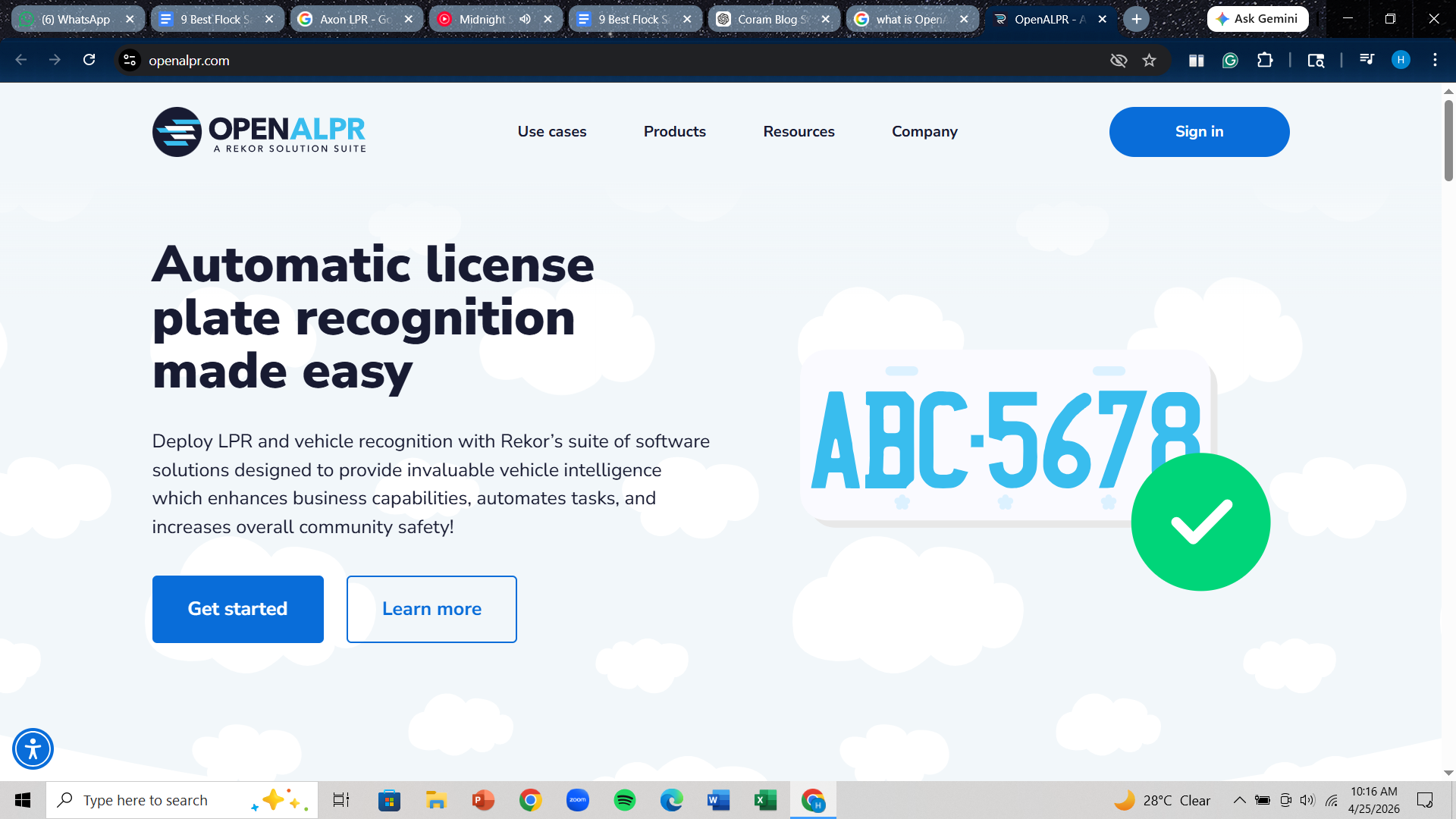
OpenALPR by Rekor is a license plate recognition system that converts existing IP or traffic cameras into LPR-enabled devices. It supports a range of deployment environments and offers both a dashboard-based monitoring product (Scout) and an API-based integration layer (CarCheck), depending on how you want to use the data.
Rekor's strength is accessibility. It's one of the lowest-cost options on this list and works with cameras already in place. The platform is focused on LPR. For organizations whose primary requirement is vehicle tracking at specific points without broader security platform ambitions, it fits. For those that need access control, video management, or AI detection beyond plates, additional tools are required.
Key Strengths
- Works with most IP cameras — LPR without replacing existing infrastructure
- Captures make, model, color, and direction of travel alongside plate data
- Covers parking, law enforcement, QSR, and property security use cases
- Dashboard monitoring (Scout) and API integration (CarCheck) available
Limitations
- LPR-focused: access control and video management require separate tools
- Performance depends on camera quality and network conditions
Pricing
Rekor Scout starts at approximately $12/month per camera. CarCheck API starts at $40/month, scaling with usage.
6. Genetec AutoVu
Best for: Law enforcement agencies, cities, transportation hubs, and enterprises that need high-accuracy vehicle tracking and investigation capabilities at scale.
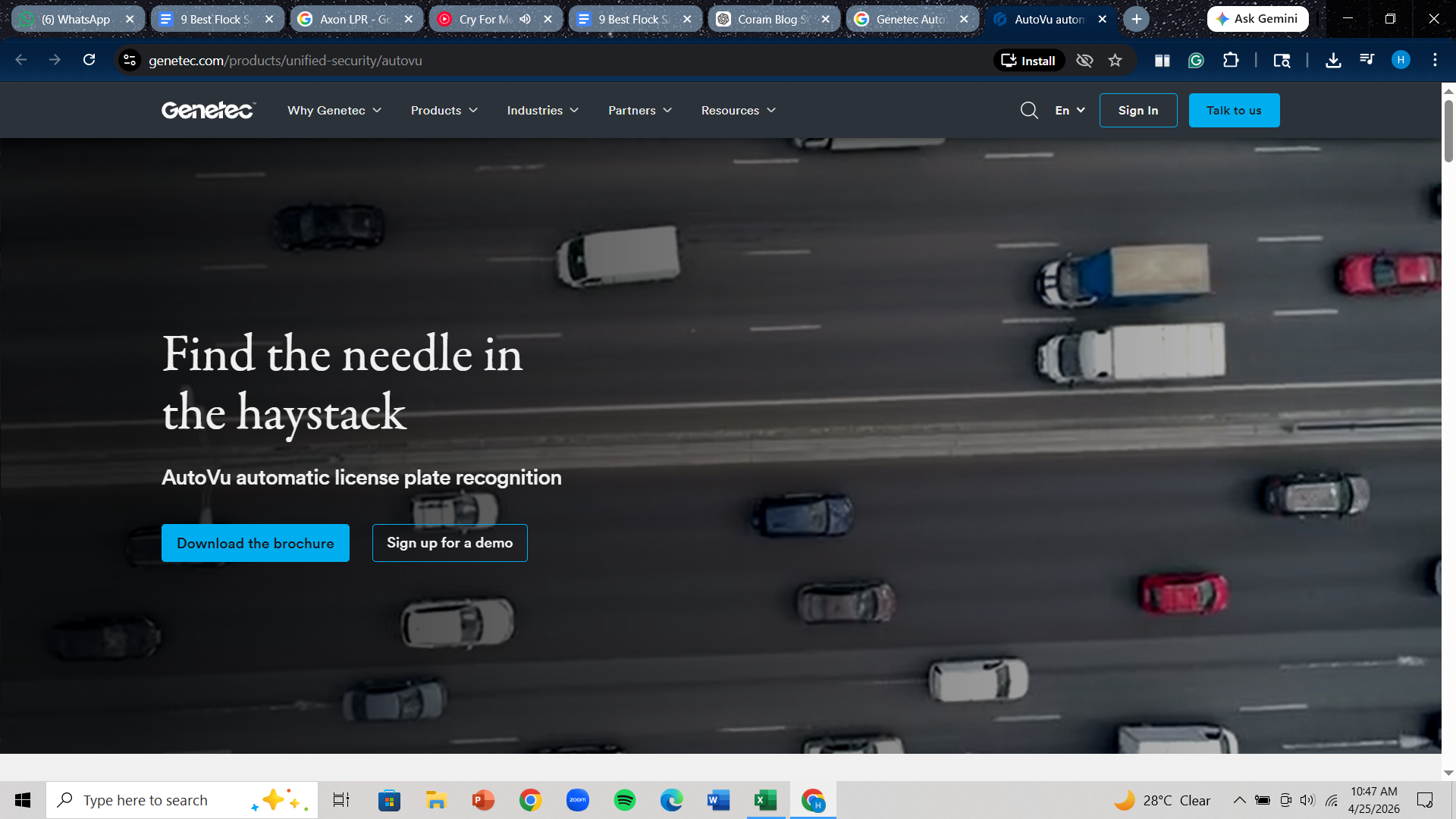
Genetec AutoVu is an ALPR platform that combines fixed and mobile cameras with the broader Genetec Security Center system, connecting license plate data with video, access control, and forensic investigation workflows. It maintains high accuracy in demanding conditions (night, bad weather, high-speed traffic) and supports both highway-scale and campus deployments.
AutoVu handles scale well, but it carries Genetec's infrastructure weight. Deployment requires specialized hardware and trained operators. For organizations already running Genetec Security Center, it integrates naturally. For everyone else, the investment in setup and ongoing management is substantial.
Key Strengths
- Fixed and mobile ALPR across highways, parking lots, and patrol vehicles
- High accuracy in adverse conditions: night, weather, high-speed scenarios
- Full integration with Genetec Security Center: ALPR data connects to video, access, and investigations
- Forensic search by partial plate, time, location, and vehicle attributes
Limitations
- Specialized hardware and setup required — deployment complexity is high
- Resource-intensive: needs trained operators for full utilization
Pricing
Quote-based.
7. SoundThinking PlateRanger (powered by Rekor)
Best for: Law enforcement agencies and public safety teams expanding ALPR coverage using existing infrastructure.

PlateRanger is an AI-powered ALPR platform that converts existing ONVIF cameras into license plate readers and connects vehicle data to broader law enforcement investigative systems. It supports both fixed deployments and mobile ALPR through smartphone and tablet apps, and processes video locally using edge AI for faster real-time alerts.
The platform is built for investigative depth in law enforcement contexts. On-site video management, access control, and general incident response are outside its scope.
Key Strengths
- Converts existing IP/ONVIF cameras into ALPR systems — no hardware replacement
- Edge AI processing for real-time vehicle intelligence and faster alerts
- Integrates with NCIC, Amber alerts, ShotSpotter, and CrimeTracer
- Mobile ALPR support via smartphone and tablet apps
Limitations
- Full functionality requires integration work and technical alignment
- Investigative features have a learning curve for smaller teams
Pricing
Bundled capabilities including hosting and connectivity. Exact pricing varies by deployment.
8. Avigilon (Motorola)
Best for: Commercial sites, schools, retail environments, and law enforcement setups that need high-speed vehicle capture, automated access control, and real-time alerting.

Avigilon is an enterprise-grade LPR and video surveillance platform that pairs dedicated hardware with AI-driven video software to deliver plate recognition and contextual vehicle insights. It integrates with Unity Video and Alta Aware, connecting vehicle tracking to access control and full-site video management in one system. The platform captures plates at speeds up to 100 mph across multiple lanes, which is a genuine differentiator for highway and high-volume environments.
The platform's best performance comes from Avigilon's own hardware. Third-party camera integration is possible but limits AI depth. Organizations that can commit to the hardware ecosystem get a capable, tightly integrated platform. Those looking to reuse existing infrastructure will find the same constraints here as with Verkada.
Key Strengths
- Plate capture at speeds up to 100 mph with multi-lane detection
- AI vehicle attribute identification: make, model, color, movement patterns
- Automated access control using license plates as entry credentials
- LPR plus video context through dual-lens systems
Limitations
- Best performance tied to Avigilon hardware — third-party cameras reduce AI effectiveness
- Advanced features require setup time and configuration planning
Pricing
Quote-based.
9. PlateSmart
Best for: Organizations that want high-accuracy, AI-driven LPR on existing camera infrastructure without proprietary hardware.

PlateSmart is a software-only ALPR platform that identifies plates and vehicle attributes (state, make, color, direction) in real time through its ARES software. It supports on-prem, cloud, and hybrid deployments, giving organizations control over where data lives, which matters for compliance-sensitive environments. It's a software-first approach: no proprietary hardware required, flexible deployment, strong data control.
The trade-off is scope. PlateSmart covers vehicle recognition well. Access control and broader security management require separate systems.
Key Strengths
- Software-only ALPR: works on existing cameras, no proprietary hardware
- Flexible deployment: on-prem, cloud, or hybrid
- Vehicle attribute recognition beyond plates: state, make, color, direction
- CJIS compliance, audit trails, and configurable data retention
- Advanced analytics for vehicle movement patterns and detection
Limitations
- Performance depends on camera quality and placement
- Third-party system integration requires initial configuration work
Pricing
Quote-based, varies by deployment size and features.
How to Choose: Matching a Flock Alternative to Your Use Case
The right alternative depends on why you're leaving Flock and what you need it to do. These five situations cover the most common ones.
Replacing Flock over Privacy Concerns (Municipalities and Public Agencies)
The core issue with Flock for public agencies is data governance: the shared network means vehicle data can extend beyond a single jurisdiction. Platforms that offer controlled, non-shared data environments are the natural replacement. Axon, Motorola Solutions (Vigilant), and Genetec AutoVu all support configurable data-sharing policies that make it easier to align with local regulations and community expectations.
Businesses That Need LPR Plus Full-Site Security on Existing Cameras
Tracking vehicles at entry points is useful. Understanding what happened across the site after a vehicle arrives is a different problem. For organizations that need both and want to reuse existing camera infrastructure, Coram is the most direct fit. It layers LPR alongside video search, AI detection, access control, and emergency management on cameras already installed.
HOAs and Smaller Deployments Where Flock Feels Expensive or Invasive
For communities that want vehicle tracking without Flock's shared network model, Rekor Systems offers camera-agnostic LPR at a fraction of the cost. Coram is also an option here, with the same existing-camera model and broader capabilities for sites that need full-site visibility alongside plate reading.
Highway and Transit Environments
High-speed, high-volume vehicle detection is a specialized requirement. Rekor and Genetec AutoVu are built for it. General-purpose platforms typically aren't optimized for the scale and accuracy demands of roadway environments.
School Districts Evaluating Options
Schools need full-campus visibility. Incidents happen inside buildings, across common areas, in hallways. Entry point vehicle tracking covers none of that. A system that only logs which vehicles arrived doesn't help when something happens 200 yards from the parking lot. Coram and Verkada are both used widely in K-12 environments and cover full-campus monitoring. Coram has the additional advantage of working with existing cameras, which matters in districts where replacing hardware isn't in the budget.
Flock Safety vs Coram AI: A Direct Comparison
Flock works well for the specific question it was built to answer. If that's the only question your team needs answered, it may still be the right tool. For organizations that need to understand what happens beyond the entry point (faster investigations, broader detection, full-site visibility), the gap between what Flock offers and what they need is real and growing.
For a closer look at how Coram handles LPR alongside full-site security, Coram's cloud security platform covers the details.
Choosing the right Flock Safety Alternative
Flock Safety is a focused tool. It does vehicle tracking at entry points, and it does it well. The organizations moving away from it are mostly doing so for one of two reasons: the shared network model creates data governance problems they can't work around, or their security requirements have grown beyond what a vehicle-focused system can cover.
The alternatives split roughly into two categories. LPR-focused platforms like Rekor and PlateSmart cover the vehicle tracking use case on existing hardware at a lower cost, without the shared network. Full-platform alternatives like Coram extend that to full-site visibility, AI detection, and access control, on the cameras already installed. Which category fits depends on whether your team's question is still "which vehicle was here" or whether it's become "what actually happened."




.png)