The decision to use a particular video surveillance software depends on the platform's architecture that powers storage, analytics, and system management.
Should you adopt a cloud-managed system that simplifies deployment? A hybrid platform that balances on-premise control with remote access? Or an integrated enterprise solution designed for large-scale security operations?
These choices directly affect scalability, AI capabilities, compliance, and long-term costs.
In this comparison guide between Rhombus, Avigilon, and Coram, we'll break down how each platform approaches modern video surveillance.
By the end of this article, you can determine which solution best fits your organization's infrastructure, security priorities, and operations.
Quick Comparison: Rhombus vs Avigilon vs Coram
Rhombus vs Avigilon vs Coram - Platform Overview
Before comparing features in detail, it helps to understand how each platform is positioned, what it prioritizes, and the kind of security environment it is built to serve.
Rhombus Systems
Rhombus is a cloud-native video surveillance and IoT platform launched in 2016 to simplify security. Here are some key points to note about Rhombus:
Key Points
- No NVRs or DVRs; footage records locally on each camera first, then syncs to the cloud when bandwidth allows.
- Cameras keep recording even during internet outages, then upload once connectivity returns.
- The Rhombus Console unifies security cameras, access control, door sensors, and environmental monitors in one cloud-based interface.
- Deployment takes up to 30 minutes, and cameras connect via PoE. It does not require complex wiring or dedicated IT resources.
- The system auto-updates, and cameras deliver 4K resolution with built-in AI analytics. Face detection, vehicle recognition, and custom alerts are all processed at the edge.
- Bandwidth efficiency for regular operation uses 10–30 Kbps per camera, while active streaming jumps to 120–1400 Kbps.
Avigilon
Avigilon is the video security arm of Motorola Solutions and is known for high-resolution cameras and self-learning analytics.
The platform offers two deployment models under separate product lines.
Avigilon Unity
Avigilon Unity is the on-premise option that runs on local servers you control. Video stays on your network unless you configure remote access. Unity scales up to 10,000 cameras per site and supports 4,000 access doors.
The VMS processes analytics at the edge and on servers. You choose where computing happens based on camera capabilities and your network design.
Data sovereignty is critical here. Everything stays on-premise: you control encryption keys, retention policies, and who accesses what footage. This makes Unity suitable for large-scale deployments and highly regulated industries and government facilities.
Avigilon Alta
Avigilon Alta is a cloud-first, serverless platform that runs entirely in the cloud. Alta came from Avigilon's acquisition of Ava Security and Openpath, both cloud-native companies.
It works with Avigilon's cloud-enabled cameras or existing third-party cameras through Cloud connectors. The latter adds AI capabilities to legacy hardware without replacement.
Alta updates automatically, meaning features improve without IT intervention. Scale happens through licensing, not hardware procurement.
The platform is designed for multi-site management. With Alta, regional retail chains, school districts, and distributed enterprises manage hundreds of locations through a single web interface.
Both Unity and Alta support license plate recognition, facial detection, crowd analytics, and PPE compliance monitoring. The difference is where those capabilities run and who maintains the infrastructure.
Coram
Coram is a cloud-based video surveillance platform that uses advanced AI to enhance security and operations.
Key Points
- This physical security solution is hardware-agnostic and integrates with your existing IP cameras, reducing replacement costs.
- Because of its hybrid AI-native approach, AI processing happens on-premise through Coram Point, so video does not stream to external servers for analysis.
- Facial recognition, object detection, and all computer vision tasks run locally; only metadata and alerts go to the cloud. This helps preserve privacy and reduce bandwidth consumption.
- Emergency Management System integrates with panic buttons, door controls, and communication tools.
- Coram is SOC 2 Type II audited and HIPAA compliant, making it suitable for enterprise security requirements.
Camera Hardware and Device Ecosystem
The strength of each platform's hardware ecosystem influences image quality and how easily it scales, integrates, and supports long-term deployment needs.
Rhombus
Rhombus manufactures its own cameras, so the hardware is part of the ecosystem. The portfolio includes:
- Dome cameras
- Bullet cameras
- Compact/specialty cameras
- Fisheye cameras
- Multisensor cameras
All Rhombus cameras include:
- Onboard storage
- Edge AI processing
- Cloud connectivity
They're designed as integrated systems, so you get consistency across your deployments. Camera prices differ based on your organization's needs, so you'll have to request a custom quote.
Rhombus cameras work exclusively with the Rhombus platform, which creates a locked-in ecosystem.
Avigilon
Avigilon produces an extensive camera line, with high-resolution options up to 5K (16MP) for critical areas requiring extreme detail. It's available in:
- Dome
- Bullet
- Box
- PTZ
- Fisheye
- Multi-sensor configurations
Unity works with Avigilon cameras and any ONVIF-compliant device. While this gives you flexibility, you get the best results with native Avigilon hardware where analytics are embedded directly in the camera firmware.
Avigilon Alta takes the opposite approach. It adds cloud capabilities to any IP camera through the Cloud connector. You keep existing hardware, add the connector, and gain access to cloud management and AI features.
Coram
Coram is built around its hardware compatibility rather than camera replacement. Though it has its own camera line, it supports all leading access control systems, including:
- Mercury board
- Openpath
- Brivo
The Coram Point device handles AI processing on-site, utilizing the most powerful and latest AI chips from Nvidia. It's a small unit that connects to your network and analyzes video feeds from your cameras.
You typically need one Point device per site or per group of cameras, depending on processing requirements.
AI and Video Analytics Capabilities
Beyond basic recording, the real difference is in how intelligently each platform can detect, interpret, and surface events from video data.
Rhombus
AI capabilities are built into Rhombus' cameras. The cloud console provides search functionality across all cameras and sites, and real-time alerts are triggered when suspicious events are detected. The system then notifies designated personnel immediately.
Rhombus recently (2025) added natural language search capabilities, allowing security teams to describe what they're looking for, and the AI finds relevant footage. It's not as sophisticated as Coram's implementation but covers common search scenarios.
The analytics focus on security events and operational visibility. Examples include:
- People counting for occupancy tracking
- Dwell time analysis for queue management
- Traffic pattern recognition for facility optimization
Avigilon
Avigilon pioneered self-learning analytics before deep learning became ubiquitous. The teach-by-example technology lets IT infrastructure leaders provide feedback on alert accuracy. Using your input, the system learns which events are important and which are not.
Unusual motion detection automatically identifies anomalous activity. The AI learns normal patterns for each camera scene. When something deviates, the event is flagged.
Appearance Search represents Avigilon's flagship AI feature. Security operations teams can describe a person, vehicle, or scenario in natural language, and the system searches all recorded footage for matches.
You can equally create custom alerts by describing scenarios, such as: "Alert me when someone enters the server room wearing a non-company uniform during evening hours." The AI processes your description and alerts you accordingly.
Avigilon supports other analytics categories:
- License plate recognition
- Facial recognition
- Object classification
- PPE detection for workplace safety compliance
Coram
Coram built AI into its entire platform, with Coram Point processing video feeds locally to provide real-time AI capabilities.
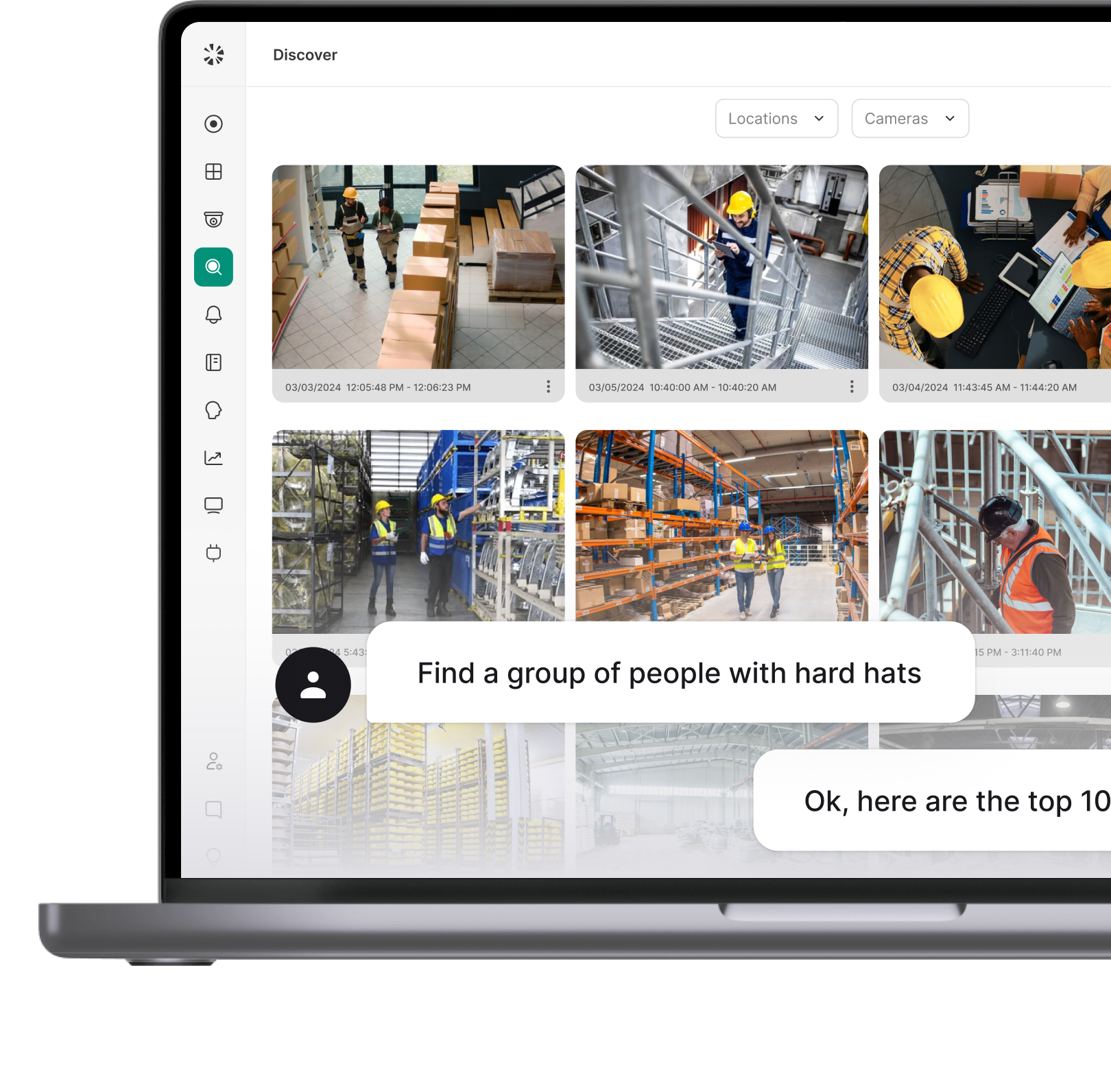
The Discover feature lets you search through video feeds using simple English descriptions, eliminating manual video scrubbing.
Journey tracking follows people or vehicles across multiple cameras automatically. The system identifies the same individual or asset across different angles and locations. You see their complete path through your facility without manually switching between camera views. This capability is useful for investigations.
Coram also includes specific detection capabilities essential for real-world operations:
- Firearm detection
- Slip-and-fall detection
- PPE compliance
- Tailgating
- Loitering
- After-hours intrusion
Ultimately, Coram emphasizes speed. Search results return in seconds, even across hundreds of cameras and months of footage. This approach indexes video at the frame level, making retrieval nearly instantaneous compared to traditional metadata-based search.
Deployment Architecture: Cloud vs On-Prem
Where the system lives (on the cloud, on-premises, or in a hybrid setup) affects flexibility, control, maintenance, and IT overhead.
Rhombus
Rhombus commits fully to cloud architecture. There are no on-premise servers, no NVRs/DVRs, and no local storage arrays beyond what's built into each camera.
Cameras capture footage and store it on internal solid-state drives first, then transmit it to AWS cloud infrastructure when connectivity is restored, so the cloud becomes your permanent archive. This eliminates hardware refresh cycles and redundancy configuration. Cloud services handle availability, backup, and disaster recovery.
The trade-off is dependency on internet connectivity for remote access. If your internet fails, cameras still record locally, but remote viewing is unavailable until connectivity returns. This isn't a challenge for organizations with reliable internet. But for remote sites with unstable connections, the lack of connectivity creates blind spots during outages.
Avigilon
Avigilon Unity maintains a traditional on-premise architecture. This gives you total data control, but hardware refresh and maintenance becomes your responsibility.
The benefit is independence from internet connectivity, as your surveillance system remains functional even without the internet.
User management, remote access, clip sharing, and mobile notifications run in the cloud, while video processing and storage stay local. This hybrid approach suits organizations that want local data control but need some cloud conveniences.
Avigilon Alta removes on-premise infrastructure because it's 100% cloud-based. Cameras stream directly to cloud infrastructure, and processing and storage happen in cloud servers. Security directors access everything through a web browser or the mobile app, creating the simplest deployment model.
Alta depends completely on internet connectivity for remote access and cloud features. Some Alta cameras, however, include onboard storage that continues recording during network outages and syncs when there's connectivity.
Coram
Coram implements an open, cloud-based, hybrid-native architecture built to modernize video surveillance by using advanced AI with existing hardware infrastructure.
The platform supports ONVIF and RTSP standards, and works with cameras from:
- Axis
- Hanwha
- Bosch
- Other manufacturers
Compared to closed systems that require camera replacement, Coram, through its edge device (Coram Point), connects to your current IP cameras to manage security.
Best Use Cases for Each Platform
Each solution fits a different use case, so the best choice depends on whether you prioritize simplicity, control, scalability, or advanced analytics.
When Rhombus Makes Sense
Multi-site retail operations and growing companies benefit most from Rhombus's cloud-first architecture.
Organizations with limited IT resources appreciate the automatic updates and minimal maintenance. Small security teams can manage large deployments without dedicated video surveillance specialists.
Schools, universities, and commercial real estate properties also find Rhombus suitable. Unlimited camera scalability suits sprawling campuses where security teams need to monitor from anywhere.
When Avigilon Is the Right Choice
Large enterprises with on-premise data requirements choose Avigilon Unity. Financial institutions, healthcare systems, and government agencies subject to data residency regulations find Unity suitable because it stores all footage on local servers.
Unity's massive scale capacity also serves major corporate campuses, large manufacturing facilities, airport terminals, and stadium complexes.
When Coram Is a Strong Fit
Coram's platform is a strong fit for organizations with existing camera infrastructure that want solid security without replacing hardware.
If you want to protect past camera investments while modernizing security, Coram is the right choice.
How to Choose Between Rhombus, Avigilon, and Coram
The right platform comes down to balancing operational needs, security goals, infrastructure preferences, and the level of intelligence you actually need.
Start with Your Infrastructure
How much IP camera hardware do you already own? If you're building new, compare Rhombus for simplicity and cloud benefits versus Avigilon for maximum control and advanced AI. If you already have hundreds of working cameras, Coram lets you extract more value without replacement costs.
Check Data Sovereignty Requirements
If regulations or policies require local control, consider Avigilon Unity or hybrid Coram with local storage. If they don't, Rhombus, Avigilon Alta, or Coram still works.
Review IT Resources
Do you have staff who can manage on-premise servers, storage, and networking for video surveillance? If you have a strong IT team, Avigilon Unity becomes viable. But if you have limited IT resources, Rhombus or Avigilon Alta eliminates infrastructure management burden.
Consider Scale and Growth Trajectory
Are you managing 10 cameras or 1,000? Will you double the camera count in two years? Cloud platforms (Rhombus, Alta, Coram) scale effortlessly through licensing. On-premise systems require hardware capacity planning and periodic infrastructure refresh.
Define Specific AI Needs
Do you need natural language search? Firearm detection? PPE compliance monitoring? Coram leads in natural language search and Journey tracking, and other detection capabilities. Rhombus also provides solid detection features.
Assess Budget Constraints
What's your capital versus operational expense preference? Cloud platforms lower upfront costs but raise ongoing subscription costs. On-premise requires a larger initial investment but lower recurring costs once deployed.
Look at Investigation Workflows
How does the security team currently find and review footage? If they spend hours scrubbing through video, Coram's search capabilities or Avigilon's Appearance Search deliver immediate productivity gains. If monitoring focuses on live alerts, any platform's real-time detection works.
Final Takeaway
Modern video surveillance platforms have moved beyond the traditional NVR model. Today, the biggest differences are in architecture, and those choices affect deployment, scalability, search capabilities, and long-term costs.
When comparing platforms like Rhombus, Avigilon, and Coram, the best option is not the one with the longest feature list. It is the one that matches your infrastructure, security priorities, and compliance requirements.
Start with the realities of your environment: how you deploy, manage, and secure video data. Once the architecture fits, advanced AI and analytics become much easier to use at scale.




.png)