.webp)
Most organizations treat safety compliance management as something they prepare for right before an audit. Incident logs live in spreadsheets. Camera footage sits on local servers with no easy way to search it. PPE enforcement records come from clipboards that may or may not get digitized. The policies exist, but the systems underneath them were never built to keep you audit-ready by default.
That is starting to change. Teams that are shifting from periodic, manual safety checks to real-time, AI-powered video monitoring are finding that compliance stops being something you scramble for and starts becoming something your systems handle automatically. This article breaks down how that shift works and what to look for if you are evaluating your own setup.
Why Safety Compliance Still Breaks Down (Even When Teams Try Hard)
Most safety programs are not failing because of a lack of effort. They are failing because the tools they rely on have fundamental limitations that effort alone cannot fix.
The typical approach looks something like this. A safety officer walks the floor once or twice per shift, checks a set of conditions against a clipboard or a tablet, notes any observations, and files a report. Between walkthroughs, the team relies on employees to self-report hazards, near-misses, and incidents. Cameras record footage in the background, but nobody reviews that footage unless something goes wrong and someone needs to investigate.
The gap here is not in the rules or the policies. It is in the visibility. Organizations set clear requirements for PPE usage, restricted zone access, hazard reporting, and incident response. But they have very limited ability to verify whether those requirements are being met consistently, across every shift, at every location, on every day.
When an incident does happen, the investigation starts from scratch. Someone reviews hours of footage manually, trying to match a reported time with the right camera angle. Witnesses are interviewed. Timelines are reconstructed from memory and fragmented records. The whole process takes days, sometimes weeks, and the quality of the investigation depends heavily on how much information survived the gap between the event and the review.
The result is that compliance becomes reactive. Organizations spend more time preparing for audits than they spend maintaining the standards those audits are designed to check. And for multi-site operations, where consistency across locations is nearly impossible to enforce through manual walkthroughs alone, the problem compounds quickly.
This does not mean teams are doing a bad job. It means the infrastructure underneath their work was not built for continuous compliance. It was built for periodic checking, and periodic checking has blind spots.
What Does "Audit-Ready" Actually Mean?
Being audit-ready is one of those phrases that sounds simple but means very different things depending on how your systems are set up.
For most organizations, it means a stretch of intense preparation before an inspection. Someone pulls together documentation, tracks down footage, organizes incident reports, and fills in the gaps that accumulated since the last audit. It works, but it is stressful, time-consuming, and often reveals that certain records were never created in the first place.
A better definition of audit-ready is this: your systems are continuously generating the documentation you would need if an auditor walked in tomorrow. There is nothing to scramble for because the evidence was created and organized as events happened, not after the fact.
At its core, this requires three things working together. First, proof that safety policies are being followed on an ongoing basis, not just during scheduled walkthroughs. Second, documentation of incidents and how they were handled, including response time and resolution. Third, evidence that can be retrieved quickly when needed, without requiring someone to know which camera to check or which timestamp to scrub to.
Traditional setups struggle with all three. The monitoring is periodic, so there are gaps. The documentation is manual, so things get missed or recorded inconsistently. And the evidence retrieval depends on a person spending hours reviewing footage to find the right clip.
A compliance monitoring system that runs continuously and logs events automatically changes the dynamic entirely. Instead of building your audit trail after the fact, the trail builds itself as part of normal operations.
How Video Surveillance Becomes a Compliance Tool (Not Just a Security Camera)
Most facilities already have cameras installed. They are typically part of the security setup, positioned at entry points, parking lots, hallways, and high-traffic areas. They record footage. That footage sits on a local server or in the cloud. And unless something happens that triggers a manual review, it stays there untouched.
For compliance purposes, this setup is like having a filing cabinet full of unsorted documents. The information exists, but finding what you need takes significant effort, and there is no guarantee that what you are looking for was captured in the first place.
The shift happens when cameras move from passive recording to active monitoring. AI-powered video surveillance can detect specific safety events in real time. A worker entering a restricted zone without clearance. A slip-and-fall on a wet surface. Someone on the warehouse floor without the required hard hat. Overcrowding near heavy equipment that exceeds safe density limits.
Each of these detections gets logged automatically. The log includes a timestamp, the camera location, the type of event, and a linked video clip. No one had to be watching the feed. No one had to file a report. The system captured the event, documented it, and made it searchable.
This is different from traditional safety monitoring in a meaningful way. It does not require a dedicated person watching feeds all day. The AI handles the detection. The system handles the documentation. The safety team handles the response and the follow-up, which is where their time should be going anyway.
In practical terms, cameras go from being a "look back after something went wrong" tool to a "know what is happening right now" tool. And that distinction is what turns a video surveillance system into a compliance monitoring system.
Real-Time Detection: Catching Safety Events as They Happen
The compliance value of AI-powered cameras comes down to what they can detect and how that detection is recorded. Here are the specific capabilities that matter most for safety compliance management.
PPE detection is one of the most straightforward applications. AI can identify when workers are not wearing required protective equipment in designated zones, whether that is hard hats, high-visibility vests, gloves, or safety goggles. Instead of relying on supervisor walkthroughs that happen once or twice a shift, the system monitors continuously and flags violations as they occur. Each violation is logged with video, so there is a record that can be used for training, enforcement, or audit documentation.
Slip and fall detection addresses one of the most common and costly workplace incidents. When a fall happens, the system detects it in real time, generates an alert for the safety team, and logs the event with video evidence attached. This matters for two reasons. First, it speeds up the response, which can reduce the severity of an injury. Second, it creates an incident record that includes exactly what happened, where, and when, which is critical for workplace accident investigations and insurance claims.
Restricted zone monitoring flags when unauthorized individuals enter hazardous or off-limits areas. Every breach is documented automatically, creating a running record of zone compliance. Over time, this data reveals patterns, like whether certain zones are breached more often during shift changes, which helps the team address root causes rather than just individual violations.
Overcrowding and proximity alerts help in environments where spacing matters for safety or regulatory reasons. The system monitors density in specific areas and triggers alerts when thresholds are exceeded. This is relevant in manufacturing, construction, and logistics settings where too many people in one area can create real hazards.
The common thread across all of these is that each detection is not just an alert that someone sees and dismisses. It is a documented, timestamped, video-linked event that becomes part of the compliance record automatically. Over weeks and months, this creates a body of evidence that shows exactly how safety standards were maintained, or where they were not.
Video as Evidence: Building an Audit Trail That Holds Up
When an auditor, investigator, or insurer asks "what happened," the answer needs to be specific, verifiable, and retrievable. Written incident reports based on witness accounts and memory are a starting point, but they are inherently limited. People remember things differently. Details get lost. Timelines are approximate.
Video evidence removes most of that ambiguity. It shows exactly what happened, in what sequence, and under what conditions. For a workplace accident investigation, this is the difference between reconstructing events from secondhand accounts and having a clear, objective record of what took place.
This has direct implications for liability. When a slip-and-fall claim is filed, video footage can confirm or challenge the reported circumstances. It can show whether a wet floor sign was posted, whether the area was properly lit, and whether the employee was following established safety procedures. This protects the organization from inflated claims, and it protects employees by ensuring that investigations are grounded in what actually happened rather than what someone assumes happened.
For OSHA compliance specifically, the ability to show that safety protocols were being actively monitored, and that incidents were documented with video evidence, demonstrates a level of due diligence that periodic checklists cannot match. It is one thing to show an auditor a completed safety checklist. It is a very different thing to show them a system that flagged 47 PPE violations last quarter, documented each one with video, and generated a report showing how response times improved month over month.
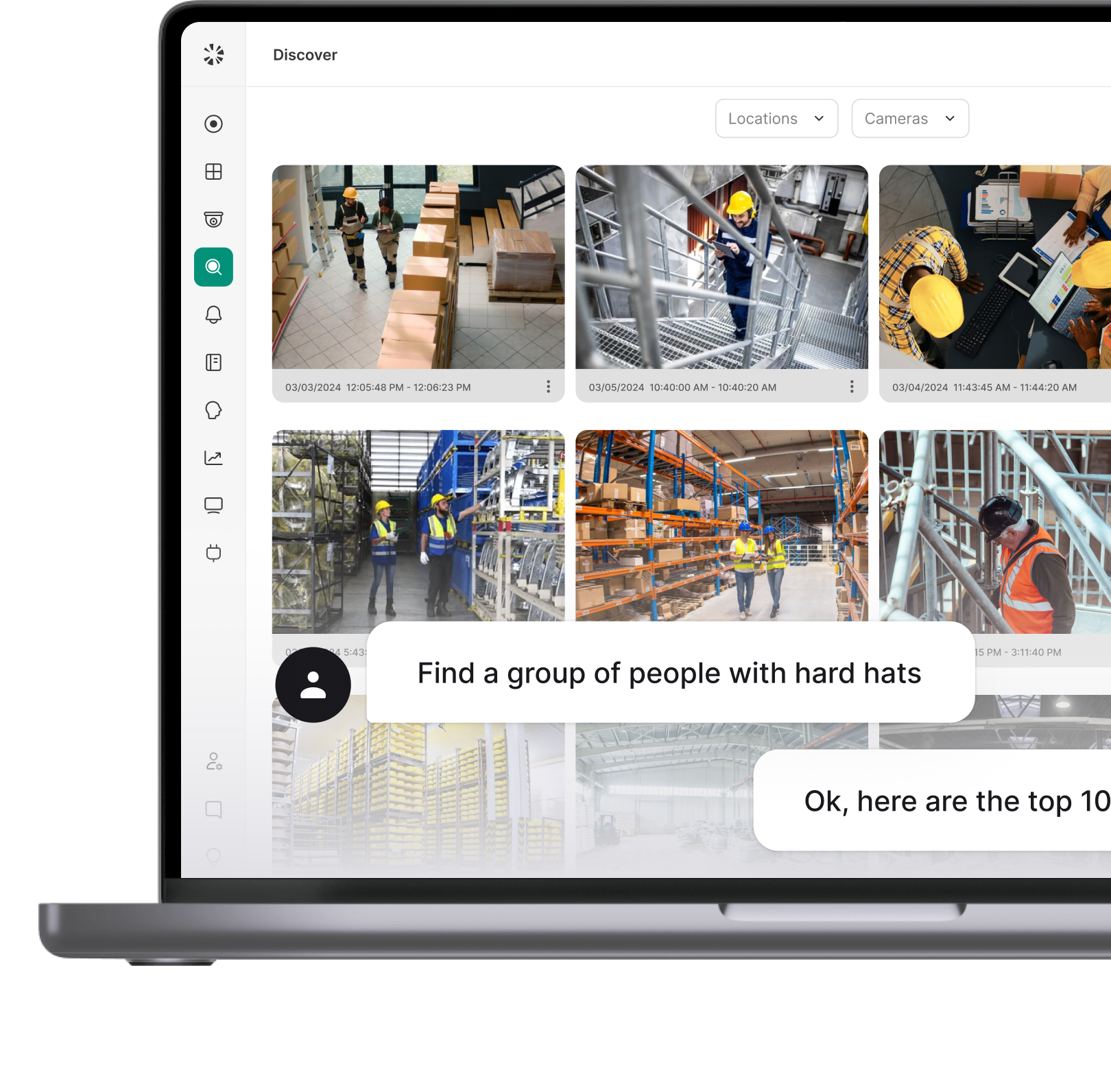
Modern platforms also make evidence retrieval simple. Instead of scrubbing through hours of footage trying to find a specific event, natural language search lets you type something like "show me all hard hat violations in Building C, last 30 days" and get the results in seconds. That kind of search capability turns a safety audit from a multi-day exercise into something that takes an hour.
Every event logged by the system, whether it is an AI alert, a door access event, or a manual flag, can be exported as part of a compliance report. The report includes timestamps, locations, event types, and linked footage. For standards like SOC 2 and HIPAA, where demonstrating continuous monitoring and access control documentation is required, this level of detail matters.
From Manual Walkthroughs to Continuous Compliance Monitoring
The traditional model of safety compliance monitoring at most facilities works on a simple loop. A safety officer walks the floor, checks conditions, logs observations, and files a report. The next shift, someone else does the same thing. If something happens between walkthroughs, it goes unnoticed until someone reports it or until it surfaces during an investigation after the fact.
This approach has two fundamental weaknesses.
First, it is sampling-based. You are checking compliance at specific moments in time, not continuously. A walkthrough at 10 AM might show full PPE compliance. A violation at 10:15 AM goes unrecorded. The audit trail shows compliance, but the reality was different.
Second, it is human-dependent. The quality of the check depends on who is doing it, how thorough they are, how much time they have, and what they happen to notice. Across multiple shifts and multiple sites, the level of consistency varies significantly.
Continuous compliance monitoring through AI-powered cameras addresses both of these weaknesses. The system does not take breaks, skip shifts, or miss events in the corner of a room. It monitors every zone that has camera coverage, every hour, and flags deviations from the defined standard automatically.
This does not mean replacing the safety team. Far from it. What it means is giving the safety team better information to work with. Instead of spending their time on walkthroughs, which are necessary but limited, they can focus on responding to flagged events, investigating patterns, updating policies based on real data, and driving improvements. That is higher-value work, and it is the kind of work that actually makes a facility safer over time.
For organizations with multiple sites, this is where the benefit becomes especially clear. You cannot station a dedicated safety officer at every location around the clock. But you can have a system that monitors every site with the same rules, the same detection capabilities, and the same documentation standards. When all of that data flows into one dashboard, safety leadership gets a view of compliance across the entire operation, not just the site they happen to be visiting that day.
What to Look for in a Compliance-Ready Video Surveillance System
If you are evaluating platforms with compliance in mind, there are a few things worth checking before making a decision.
Start with the detection capabilities. The system should be able to identify specific safety events, like falls, PPE violations, and zone breaches, natively. If the AI detection requires a separate analytics subscription or a third-party integration, you are adding complexity and potential gaps to the workflow.
Look at how events are logged. Every flagged event should be recorded automatically with a timestamp, camera location, event type, and a linked video clip. If the system requires manual input from an operator to create the log, the documentation will have gaps, because people get busy, and manual logging is the first thing that falls behind.
Test the search and retrieval. When someone asks for footage of a specific event or a summary of all violations in a given area over a given period, how long does it take? If the answer is "hours" because someone has to scrub through recordings manually, the system is not built for audit-readiness. Natural language search or filter-based search should return results in seconds.
Check hardware compatibility. The system should work with your existing IP cameras. If compliance monitoring requires replacing your entire camera infrastructure with proprietary hardware, the cost and deployment effort may not justify the investment, especially when platforms exist that can add these capabilities on top of what you already have.
Evaluate access control integration. Door events should be automatically linked to video. This way, access compliance can be verified visually, not just through badge logs. If someone tailgates through a secured door, the system should flag it and attach the footage without any manual intervention.
Look at the reporting. Compliance reports should combine event logs, video evidence, access records, and response documentation in formats that align with OSHA, SOC 2, HIPAA, and whatever other standards apply to your operation. If generating a report requires pulling data from multiple systems and assembling it manually, the platform is not doing enough of the work.
And consider multi-site consistency. For organizations operating across multiple locations, the platform should enforce the same monitoring rules, detection policies, and documentation standards everywhere, managed from a single interface. This is the only realistic way to maintain compliance consistency at scale.
Compliance Is Not a One-Time Project. It Is How You Operate.
The organizations that consistently pass safety audits are not the ones that prepare the hardest in the two weeks before an inspection. They are the ones whose daily operations naturally produce the documentation that auditors want to see.
That shift, from reactive audit preparation to continuous compliance monitoring, is exactly what AI-powered video surveillance makes possible. It is not about adding more process to an already overloaded safety team. It is about replacing manual, periodic checks with always-on visibility that documents itself.
Platforms like Coram are already being used across schools, warehouses, and enterprise facilities to bring this approach together. AI safety alerts, access control logging, and video evidence run on one system that works with existing cameras, so the compliance infrastructure does not require a hardware overhaul to get started.
If your team is still spending more time preparing for safety audits than actually improving safety, the issue is probably not effort. It is infrastructure. The right system makes compliance a byproduct of how you operate every day, not a separate workstream that competes for attention every time an audit is on the calendar.




.png)