.webp)
Picture this. A security operator is sitting in front of four screens. One shows the video management system. Another runs the access control dashboard. A third handles alarm notifications. And the fourth is a spreadsheet where incidents are manually logged. An alert fires on screen two, but the video context is on screen one. By the time the operator cross-references and confirms, minutes have passed. And in security, minutes matter.
This is not an unusual setup. Most physical security operations today still look like this, with multiple tools from multiple vendors, each doing one thing reasonably well but none of them talking to each other in a meaningful way.
That is starting to change. Across industries, from schools and warehouses to large enterprise campuses, organizations are moving toward a unified security platform, a single system that brings detection, prevention, and response together. Not through integrations or middleware, but through one architecture built to handle everything from one place.
This article breaks down why this shift is happening, what a unified approach actually looks like, and how to think about it if you are evaluating your own security setup.
The Problem With Fragmented Physical Security
The typical mid-to-large organization runs somewhere between four and six disconnected security tools. A video management system from one vendor. Access control from another. An alarm panel from a third. Maybe a visitor management tool layered on top. And increasingly, some form of AI analytics bolted onto the video feed through a separate subscription.
Each of these tools generates its own alerts, stores its own data, and comes with its own interface. To get the full picture of an incident, an operator needs to jump between systems, correlate timestamps, cross-reference badge data with camera feeds, and manually document everything.
This kind of fragmentation creates a few problems that compound over time.
First, there is the response delay. When your detection system does not directly connect to your response workflow, the gap between "something happened" and "someone acted on it" widens. That gap is where incidents escalate.
Second, there is alert fatigue. Every system has its own notification logic. When tools are not aware of each other, the same event can trigger multiple alerts from different sources, and operators start tuning them out. At that point, the alerts stop being useful.
Third, there is the compliance burden. Auditors want logs that show exactly what happened, who responded, and how quickly. When your data lives across five systems with five different formats, pulling together a clean audit trail becomes a manual project every time.
And finally, there is the cost. It is not just the licensing. It is the integration maintenance, the training on each tool, the vendor management overhead, and the opportunity cost of having your security team spend time on system management instead of actual security work.
This is not a theoretical concern. According to industry research, roughly 75% of organizations have already started consolidating their security vendors, not for cost savings alone, but because the complexity has become unmanageable.
What Is a Unified Security Platform?
A unified security platform is a single, typically cloud-based system that natively combines video surveillance, access control, emergency management, and AI analytics. The key word here is "natively." This is not about connecting separate tools through APIs or middleware. It is about having all of these capabilities built into one architecture from the start.
The distinction matters because integration and unification are not the same thing. Integration means you have two or more systems that exchange data, usually through an API layer that someone needs to build, maintain, and update every time one of the systems changes. Unification means the data was never separated in the first place. One database. One interface. One set of rules.
In practical terms, a unified security management platform typically includes a few core components working together.
Video management with AI analytics, where cameras do not just record footage but actively detect events in real time. Access control that governs who enters where and when, with every door event automatically linked to video. Emergency management that coordinates responses, from lockdowns to mass notifications, without switching to a different tool. And a single dashboard that gives operators everything they need in one view, what some in the industry call a "single pane of glass" approach.
When all of these run on the same system, the data flows naturally. A door forced open triggers an alert, the nearest camera automatically queues the relevant footage, and the response protocol activates, all within seconds, without anyone needing to copy a timestamp from one screen into another.
Detection: See Every Threat in Real Time With AI Video Analytics
Traditional video surveillance systems are fundamentally passive. Cameras record. Operators watch, or more realistically, they do not watch most of the time because no one can stare at 200 feeds simultaneously. The footage gets reviewed after an incident, which means the system only helps you understand what happened, not prevent what is about to happen.
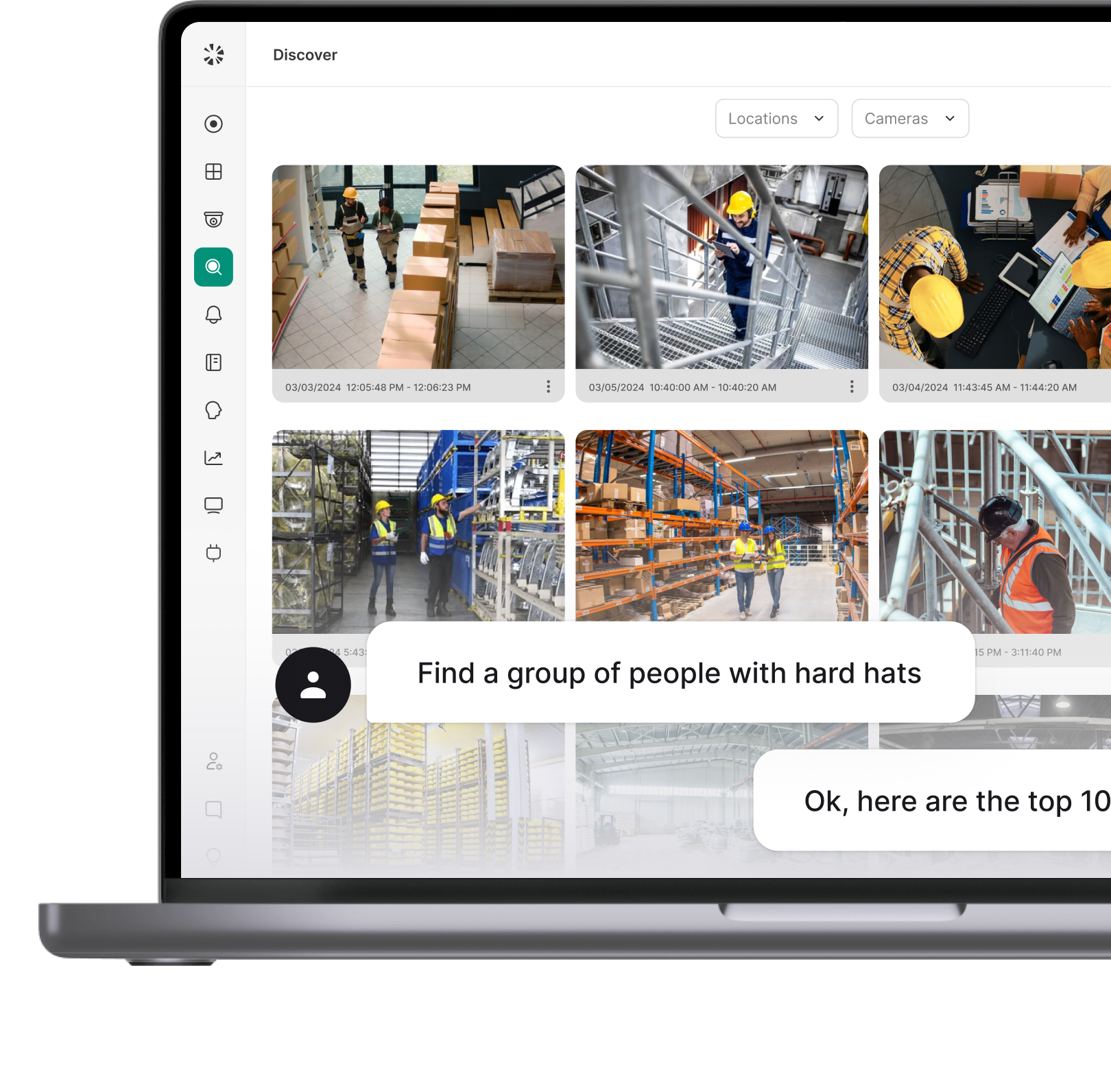
AI video analytics change this equation. When intelligence is embedded directly into the video layer, cameras become active sensors. They can detect weapons, identify tailgating at access points, recognize loitering in restricted areas, read license plates, and even allow natural language search through video history.
But the real difference shows up in how alerts work. In a fragmented setup, AI analytics often run as a separate layer on top of the video system. The analytics tool detects something, sends a notification, and then someone has to go find the corresponding footage in a different system to confirm. That handoff introduces delay and friction.
In a unified platform, there is no handoff. The detection and the footage exist in the same system. When the AI flags an event, the relevant video clip is attached to the alert automatically. Multiple AI models can cross-verify before dispatching, which dramatically reduces false alarms, a problem that has historically plagued security teams into ignoring their own tools.
This is what the shift from reactive to proactive security actually looks like in practice. It is not about having more cameras or more analytics. It is about having detection that is directly connected to the context needed to act on it.
Prevention: Stop Incidents Before They Happen With Integrated Access Control
If detection is about knowing what happened, prevention is about controlling the conditions that let incidents happen in the first place. And in physical security, access control is the primary prevention layer.
A modern access control system does significantly more than manage badge readers at doors. It handles mobile credentials, biometrics, role-based scheduling, visitor management, and anti-tailgating detection. It can enforce who enters which zone, at what time, and under what conditions, all from a central console.
But access control only reaches its full potential when it is connected to video. This is where the concept of access control and video surveillance integration becomes critical.
In a unified setup, every door event is automatically paired with video context. A denied entry attempt is not just a log line; it comes with footage of who was standing at the door. A door held open for too long triggers both an access alert and a camera pop-up showing what is happening in that area. The operator does not need to look anything up. The system presents the full picture.
This integration also simplifies compliance in a meaningful way. When every access event is logged alongside video evidence and timestamps, audit preparation stops being a multi-week exercise. Reports for SOC 2, HIPAA, and similar standards can be generated from the same system, because the data was always connected.
For multi-site organizations, this benefit multiplies. Instead of configuring separate access policies for each location and hoping they stay consistent, a cloud-based unified platform lets administrators enforce the same rules across 10 locations or 1,000 from a single interface. This is particularly relevant for enterprises, school districts, and distributed retail operations where consistency across sites is a real challenge.
Response: Close the Loop From Alert to Action on a Single Platform
Detection and prevention are important, but they only matter if the response is fast enough to make a difference. And this is where fragmented security setups tend to break down the most.
In a typical multi-vendor environment, the workflow after an alert looks something like this. An operator sees a notification from the analytics tool. They switch to the video system to verify. Then they open the access control dashboard to check door logs. If the situation requires escalation, they call someone, send an email, or walk to a different part of the facility. The incident gets documented later, often manually.
Every one of those transitions costs time. And in a security context, time is the one thing you cannot afford to waste.
A unified security management platform removes these transitions entirely. The entire workflow, from detection to verification to response to documentation, happens in one place.
When a threat is detected, the operator sees the alert with video context already attached. They can verify in seconds. If escalation is needed, the platform can trigger lockdowns, send mass notifications, activate panic buttons, and coordinate response teams, all without switching tools. Every action is logged automatically, creating a complete incident record that is ready for review or audit without any manual effort.
This is especially important for emergency management. Organizations that handle active threats, evacuations, or medical emergencies need coordination that happens in seconds, not minutes. When the emergency response workflow lives in the same system as the cameras and the doors, the response can be faster and more coordinated than anything a disconnected setup can deliver.
The result is a measurable reduction in incident response time. Not because people are working harder, but because the system is not working against them.
Why "One Vendor" Beats "Best of Breed" for Physical Security
For years, the standard advice in security was to pick the best tool for each job. Best camera system. Best access control. Best analytics. Then connect them all together and hope the integrations held.
That approach served its purpose during a period when no single vendor could credibly cover the full stack. But the landscape has changed. The cost of maintaining disconnected tools, both in money and in operational overhead, now outweighs whatever marginal feature advantage a standalone product might offer.
This is not just a physical security trend. Across the broader security industry, vendor consolidation has become one of the defining movements of 2025 and 2026. Analysts at Gartner and Forrester have both noted the accelerating shift toward platform-based approaches, driven by the reality that complexity itself has become a security risk. When your tools do not share context, your team is slower. When your team is slower, threats have more room to escalate.
The practical benefits of consolidation are fairly straightforward. Fewer vendor relationships to manage. Less training required for operators. Faster deployment when expanding to new sites. And most importantly, native data sharing across capabilities, which means AI can correlate events across cameras, doors, and sensors in ways that bolt-on integrations simply cannot replicate.
That said, the "one vendor" approach does come with a valid concern: vendor lock-in. If everything runs on one platform, switching becomes harder. The way to evaluate this is to look at how the platform handles hardware compatibility. Platforms that work with any IP camera and support standard protocols like Wiegand and OSDP give you the flexibility to keep your existing infrastructure and avoid being locked into proprietary hardware. This is an important differentiator, because some "unified" platforms still require you to buy their cameras, which trades one form of lock-in for another.
What to Look for in a Unified Security Platform
If you are evaluating options, there are a few things worth checking before committing to a platform.
Start with architecture. The platform should be AI-native, meaning the intelligence is built into the core system, not added as an afterthought through a third-party integration. Bolted-on analytics tend to come with latency, limited data sharing, and maintenance overhead that undermines the whole point of unification.
Check hardware compatibility. A good unified platform should work with the cameras and access control readers you already have. If the platform requires you to replace all your existing IP cameras, you are essentially paying twice, once for the platform and once for the hardware.
Look at the deployment model. Cloud-based platforms with on-premise processing options give you the best of both worlds. The cloud handles centralized management, remote access, and scaling. On-premise processing handles real-time AI analysis close to the camera, which matters for both speed and data privacy.
Evaluate the access control integration specifically. This is where many platforms fall short. Every door event should automatically link to video. Policies should be manageable across all sites from one interface. And the system should support mobile credentials, biometrics, and traditional card readers without needing separate configurations.
Test the emergency management capabilities. Panic buttons, lockdown protocols, mass notifications, and real-time response coordination should all be part of the same platform. If emergency response requires a separate tool, the gap between detection and action will still exist.
Confirm compliance support. The platform should generate audit-ready reports that combine access logs, video evidence, and incident documentation. Look for SOC 2 and HIPAA readiness as a baseline.
And finally, think about scale. The platform should handle growth without requiring significant hardware changes. Whether you are managing one building today or expanding to hundreds of sites in the future, the system should accommodate that without adding complexity at every step.
The Future Is Unified, and It Is Already Here
2026 is shaping up to be a turning point for physical security. The convergence of AI maturity, cloud infrastructure, and industry-wide vendor consolidation has created the conditions for a real shift in how organizations approach safety.
The organizations that are ahead of this curve are not the ones with the most tools. They are the ones with the fewest, because they chose a platform that handles everything from detection to prevention to response without requiring a patchwork of systems to fill the gaps.
This is not about following a trend. It is about recognizing that the way physical security has been done for the past 15 years, with separate vendors for cameras, doors, alarms, and analytics, was a reflection of the technology limitations of that era. Those limitations no longer apply.
Platforms like Coram are already demonstrating what this unified approach looks like in practice, combining AI video security, cloud access control, and emergency management on one system that works with existing cameras. For schools, warehouses, enterprises, and multi-site operations, this model is proving to be both more effective and simpler to operate.
If you are currently managing three, four, or five security tools and spending more time on system administration than actual security work, it is worth asking whether that setup is still serving you, or whether it is time to consolidate.




.png)