
Workplace Violence Prevention in Healthcare: What Security Leaders Need to Know in 2026
What the Joint Commission, OSHA, and state laws require for healthcare workplace violence prevention in 2026, and the program pieces security teams own.

Stu Waters
Published


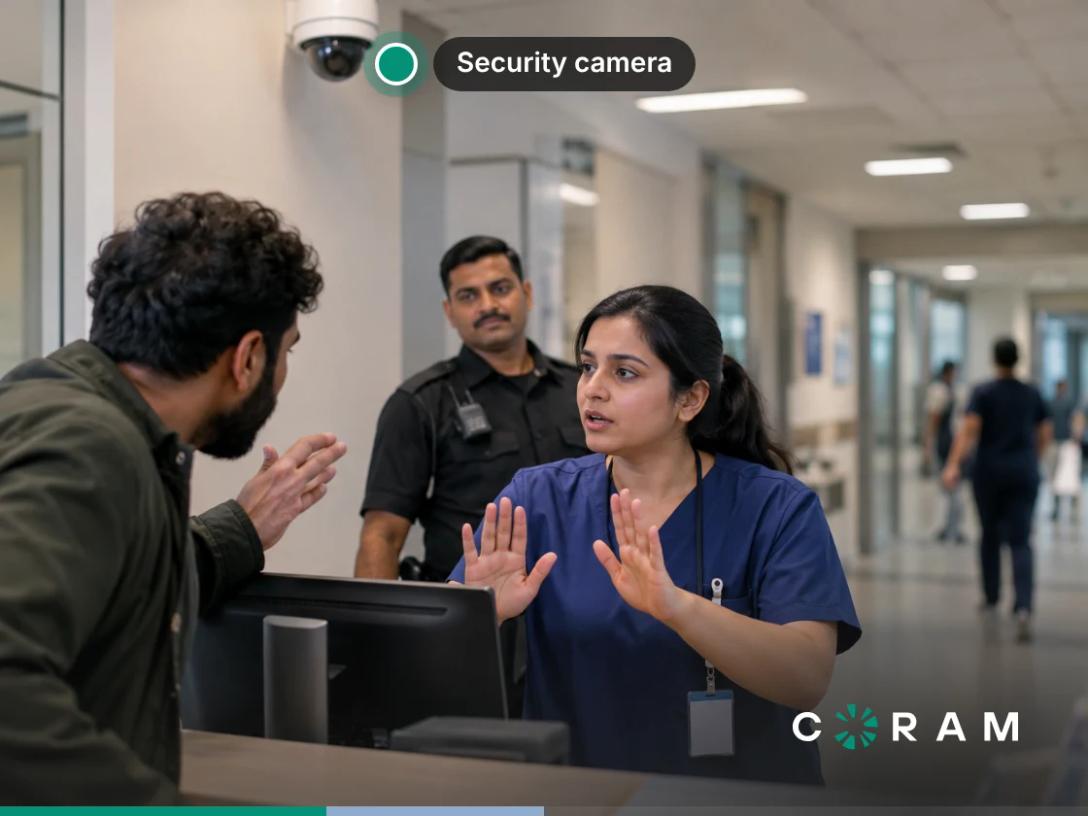
A workplace violence prevention program in healthcare needs a named leader, risk identification, clear reporting and response procedures, staff training, and post-incident review. Security owns much of the evidence, such as incident patterns, access, response, and documentation.
The evidence carries more weight in 2026. The Joint Commission’s new National Performance Goals keep the 2022 workplace violence standards but emphasize showing results over time; OSHA enforces through the General Duty Clause; and states keep writing their own rules.
Over 2021 and 2022 combined, healthcare and social assistance recorded 41,960 nonfatal workplace violence cases requiring days away from work, job restriction, or transfer, or 72.8% of all private-industry cases, according to the Bureau of Labor Statistics.
The challenge is making sure these activities lead to action. If reports reveal recurring threats at an entrance, for example, the hospital needs to investigate the cause, assign a corrective measure, and check whether it has reduced the risk.
Without that follow-through, the same problems can continue despite a written policy and completed incident reports.
The Four Types of Workplace Violence in Healthcare, and Where Security Fits In
Violence in healthcare falls into four types, based on the offender’s relationship to the workplace. Type II is the dominant one, so most of your program is built around patients and visitors.
What a Workplace Violence Prevention Program Includes
A real program answers a simple question: when someone says “I don’t feel safe,” what happens next, and whose job is it? How to prevent workplace violence in healthcare comes down to seven connected elements:
- Leadership and ownership: Put one person in charge, and make sure they answer for results.
- Worksite analysis: Combine incident reports, staff feedback, and physical assessments to identify where and why violence occurs.
- Policies and procedures: Write down how people report threats and how the hospital responds.
- Reporting and data: Good records show repeat problems and weak spots. Sloppy ones hide them.
- Incident response: Decide in advance how security, clinicians, and other responders will work together.
- Post-incident support and review: Care for those who were hurt or shaken, investigate what happened, and document the fixes.
- Training and education: Prepare staff to recognize warning signs, report concerns, and follow role-specific procedures.
Reporting identifies patterns, worksite analysis helps determine their causes, corrective actions address those causes, and follow-up checks whether the changes helped.
What the Joint Commission Expects in 2026
In January 2026, The Joint Commission introduced its National Performance Goals (NPGs), replacing the National Patient Safety Goals chapter. The framework covers 14 critical patient safety and quality topics, including workplace violence prevention.
The NPG framework reorganizes existing accreditation requirements rather than introducing new workplace violence standards beyond those established in 2022. For hospital security leaders, the practical priority remains demonstrating how you identify workplace violence risks, act on the findings, and follow corrective actions through to reassessment.
During a survey, expect scrutiny of three areas:
- Risk assessment: Does the annual worksite analysis consider incident reports, staff feedback, and workplace conditions?
- Corrective action: Are identified risks assigned to someone with a clear plan and timeframe?
- Follow-through: Have you checked whether corrective actions reduced the risk?
For example, if incidents keep occurring at the same entrance, documenting them is not enough. Your team must investigate the cause, implement a fix, and reassess whether it worked. If the risk remains, you need to take further action.
Leadership accountability matters, too. Recurring incidents, unresolved risks, and overdue corrective actions should reach the Environment of Care (EOC) committee and governing body.
What happens when a program falls short?
If surveyors find a program falls short, they record the gap as a Requirement for Improvement (RFI). You must then address the deficiency and submit evidence of compliance within the required timeframe. Findings inform the accreditation decision, but a single deficiency does not automatically result in loss of accreditation.
OSHA and State Requirements
OSHA has no dedicated workplace violence standard in force for healthcare, but employers still have obligations.
The General Duty Clause remains particularly important for healthcare employers. In February 2026, the U.S. Court of Appeals for the Tenth Circuit upheld OSHA’s authority to cite Cedar Springs Hospital over recognized workplace violence hazards, reinforcing that the absence of a dedicated federal standard does not remove an employer’s obligations.
OSHA’s voluntary Guidelines for Preventing Workplace Violence for Healthcare and Social Service Workers remain the benchmark most programs measure themselves against. California also has a separate general-industry rule under SB 553; our guide to California workplace violence prevention plans covers it.
This article provides general information, not legal advice. Requirements vary by jurisdiction and facility. Work with qualified counsel to determine which rules apply to your organization.
Where Security Owns the Program
Security owns several operational parts of a workplace violence prevention program:
- Identifying incident patterns
- Managing physical access
- Coordinating emergency response
- Documenting what happens during an incident
But that evidence only leads to improvement when the right departments act on it.
Nursing and clinical leadership can address care-related risks, HR can handle employee conduct, and risk management can assess organizational exposure. Security’s role is to surface the evidence, coordinate the response within its remit, and ensure unresolved security risks reach the people who can address them.
Worksite analysis
Bring incident reports together and review them by unit, shift, and location. A pattern may emerge around the ED waiting room at 2 a.m., the behavioral health unit during shift change, or an entrance where threats repeatedly occur. These patterns are hard to see when reports sit in separate systems.
Good looks like: One combined view by unit, shift, and location, reviewed on a set schedule, with findings going to the EOC committee.
Access and visitor control
Prioritize access controls at high-risk locations, including the ED, behavioral health units, labor and delivery, and entrances that remain open after hours.
Visitor and family escalation in the ED builds tension fastest, so screen visitors when waits are long and emotions are high. When a visitor has previously threatened staff, authorized personnel should receive relevant information on later visits, with clear procedures for acting on it. Limit access to those records to staff who need them. For patients who need constant observation, a sitter or a Code Gray plan should state when security joins.
Good looks like: Defined controls at after-hours entrances and high-risk units, and flagged-visitor information reaching only authorized staff.
For more on securing entrances and restricting access to sensitive areas, see our guide to access control for hospital units.
Calling for help
When a nurse is being threatened, they cannot stop to dial a number and explain their location. Staff need a fast, discreet way to summon help and share their location. A button that sends an alert without escalating the situation beats a phone call in most situations.
Learn more about wearable panic buttons for staff and how they can help staff call for assistance.
Response
An alert only matters if the right people receive it and know what to do next. Define who gets notified for different incidents, who takes the lead, and when to escalate. Responders should get usable location information, plus camera footage where your system supports it.
Test the process with realistic scenarios to find out whether alerts reach the right responders, location information is useful, and handoffs are clear.
Document any delays or failures, assign responsibility for correcting them, and repeat the test to see whether the changes have improved the response.
Good looks like: Responders getting a location with every alert, and the last drill’s failures having named owners.
For more on how hospitals respond to an active threat, see our Code Silver guide.
Documentation and post-incident review
When an incident happens, the record matters. Reconstruct the incident while memories are fresh: what was reported, when responders arrived, what they saw, what was done, and how it ended. Pull in video, alert logs, and timestamps to fill gaps as memories fade.
The review should identify what needs to change, who owns each corrective action, and when it is due. Feed recurring patterns to the EOC committee and governing body so unresolved risks do not stay inside the security department. If incidents continue, revisit the assessment and response plan rather than closing the issue because an action was completed.
Why Staff Don’t Report, and How to Make It Easier
Staff don’t skip reports because they don’t care. They skip them for predictable reasons.
- It feels like part of the job: A swat from a confused patient or a threat from a frustrated visitor gets shrugged off. If nobody was hurt, why make a fuss? Over time, “minor” becomes “normal,” and normal stops getting written down.
- Reporting takes too long: After a rough shift, nobody wants to open a clunky form with a dozen required fields. The report would take time they don’t have. So no one files it.
- Nothing visibly happens afterward: This one does the most damage. Someone files a report, hears nothing back, and sees the same patient or the same hallway problem the next week. They stop reporting and tell their coworkers why.
You can use these fixes to ensure reporting is easy and effective for your staff:
- Cut the friction: Make the first report short: what happened, where, when. Let people finish the details later. Make mobile reporting easy to access and collect only the information needed to act.
- Say out loud that small incidents count: Tell staff directly that a verbal threat or an attempted hit belongs in the system, even if no one was hurt. Those minor reports are often the early pattern you’re trying to catch.
- Close the loop where people can see it: Follow up with the person who reported. Share what changed at unit meetings or huddles: a door fixed, a flag added to a patient’s record, a staffing adjustment. Even “we reviewed this and here’s why we’re not changing anything” is better than silence.
If staff are unsure how panic buttons work, show them, and tell them when it’s right to press one.
How Coram Supports a Workplace Violence Prevention Program
A workplace violence prevention program depends on more than having the right policies. When an incident occurs, staff need a reliable way to request help, responders need actionable information, and security teams need records to review what happened.
Coram’s tools support the response and documentation parts of your program. What you get depends on the products you deploy and how you configure them.
- Emergency Management: Staff can press a small, battery-powered panic button they carry, or report from the web or mobile app. The alert carries the location assigned to that button, and the button’s name appears in the alert, so naming buttons by area tells responders where help is needed. With Coram Video Security, the emergency chat can include video clips from cameras at your locations, and users with camera access can open live video. Learn more about the Emergency Management system.
- Access Control: Response Plans lock or unlock selected doors and door groups from one place, and can start automatically when a linked emergency is reported. The plan stays in place after the emergency is resolved until someone ends it.
- Guest Management: Check visitors in at the entrance and log who came in and when. A visitor on your blacklist, matched by email, phone number, or ID document number, is held at check-in and administrators are notified. Only Site Admins see the reason for the flag.
- Video Security: Review footage to understand what happened before, during, and after an incident. Journey Path helps security teams follow one person or vehicle across cameras at the same location.
- Firearm Detection: Runs on your existing IP cameras connected to a Coram Point and alerts your team immediately. An authorized user confirms the firearm before an emergency is declared.
FAQ
What changed for workplace violence prevention in the Joint Commission’s 2026 National Performance Goals?
Accredited and critical access hospitals have met the Joint Commission’s workplace violence prevention standards since January 1, 2022. In January 2026, those requirements moved into the new National Performance Goals framework without adding new standards. The core ask is still a prevention program with a designated leader, built by a multidisciplinary team, with an annual worksite analysis, incident reporting, staff training, and evidence that identified risks were acted on and reassessed.
Does OSHA have a workplace violence standard for healthcare?
No. OSHA has no dedicated workplace violence standard for healthcare, so it relies on the General Duty Clause of the OSH Act to cite employers that don’t protect workers from recognized violence hazards. The agency publishes voluntary guidelines. Several states, including California and Oregon, have their own enforceable requirements for healthcare employers, so check your state’s rules.
What is a worksite analysis for workplace violence?
A worksite analysis is a structured assessment of where workplace violence risks exist and what contributes to them. It draws on incident reports, staff feedback, and workplace assessments to identify patterns by unit, shift, and location, and to determine what corrective actions are needed and who owns them.
Who should lead a hospital’s workplace violence prevention program?
The Joint Commission requires one designated leader, supported by a multidisciplinary team. It doesn’t name a job title, so the person could come from security, nursing, risk management, or safety. They should have the authority to assign corrective actions and report unresolved risks to the Environment of Care committee and governing body.
How can hospitals improve workplace violence reporting?
Make reporting fast and simple, and show staff that reports lead to action. Staff stop reporting when forms are long or nothing visibly changes, so share what was done in response. A unit with very few reports isn’t necessarily safer, so compare report counts against staff feedback to spot underreporting.