.webp)
Running 20, 50, or 200 cinema locations means managing a security setup most operators inherited rather than designed. Cameras were installed years ago for loss prevention and incident review. They record footage, but they rarely help with operations in real time, and when something happens, someone ends up reviewing DVR footage after the fact.
The threat profile in 2026 is wider than the active shooter conversation that dominates industry discussions. Parking lot assaults, after-hours intrusion, lobby altercations, closing-shift employee exposure, ticket fraud, and slip-and-fall incidents are compounding quietly across locations every week. Movie theater security technology has matured: the same AI platforms already deployed in schools, hospitals, and warehouses now run on existing IP cameras, adding real-time detection, natural-language search, and alert routing without a hardware refresh.
The question for a multi-site operator is which capabilities actually pay back in cinema economics. This article walks through the real risk profile, the technology categories that map to each risk, what to evaluate before buying, and where Coram fits.
The Actual Risk Profile of a Multi-Site Cinema Operation
Security conversations in cinema tend to collapse into two categories: active shooter scenarios and everything else lumped together as "general safety." That framing isn't operationally useful. The risks look very different depending on frequency, consequences, and the technology that actually addresses them. Running 50 locations means carrying all three tiers simultaneously, and the one that makes the news is rarely the one draining your margins week to week.
Day-to-Day Operational Risks (High Frequency)
These are the incidents happening across your locations almost consistently.
Slip-and-fall liability shows up on every renewal conversation and gets underweighted in every security budget discussion. A moviegoer slipping on a spilled drink in a dimly lit theater aisle (fractured tailbone, moderate bruising) can settle against a $1 million general liability policy before trial. Multiply that across a 50-location chain, a handful of incidents per year per region, and the cumulative GL exposure is significant. Dark auditoriums, wet concession floors, and uneven transitions between lobby and corridor create conditions your staff can't continuously monitor.
Lobby altercations and crowd incidents spike on opening weekends and late-night screenings. The challenge is getting staff positioned before a confrontation escalates into something that ends up in a police report and a news alert. A system that flags unusual crowd density or sudden movement in a lobby 30 seconds earlier than a staff member notices it makes a real operational difference.
Concession and ticket fraud run quietly across chains that aren't watching closely. The gap in most setups is investigation speed. POS-linked video evidence changes the math: pulling footage for a specific transaction takes seconds when the systems are connected, compared to hours of manual timeline scrubbing.
Closing-shift employee safety is the window that gets the least attention and carries the greatest exposure. After the last screening, one or two staff members are handling cash in a large, largely empty building, with no reliable way to verify that closing procedures were followed or alert anyone if something goes wrong. OSHA identifies working alone, handling cash, and late-night operations as the specific combination that most elevates both theft and workplace violence risk. The mid-week closing shift (Tuesday night, three staff, no foot traffic) is the higher-risk window than Friday opening weekend, when the building is full and visible.
After-Hours and Perimeter Risks (Medium Frequency, High Consequence)
These incidents don't happen every week. When they do, the cost is real, and the footage gap is usually the most embarrassing part.
After-hours break-ins are documented and recurring. In one Baltimore County case, two burglars were caught on camera after hours at Flagship Cinemas Eastpoint, making themselves snacks at the concession stand, stealing candy and electronics, and spraying fire extinguishers inside the auditoriums. In Tulsa, two suspects were caught attempting to steal six projector lenses and furniture from a closed theater, equipment valued at more than $160,000. In both cases, cameras recorded everything, and nobody saw it until the next morning.
Cinema buildings are large, unoccupied after closing, and hold equipment that isn't obvious from the outside. An intrusion detection system that distinguishes a cleaning crew from an unauthorized entry and pushes an alert within seconds changes that response window from eight hours to minutes.
Parking lot incidents are the perimeter risk that drives the most sustained customer concern. In a documented Memphis case, six vehicles were burglarized at a Malco theater parking lot in a single evening, with security present but unable to intervene. Someone who comes back to a broken window after a movie doesn't call your customer service line. They post about it, and they don't come back. Commercial parking facilities tend to be poorly lit, with significant blind spots and inadequate camera coverage, which concentrates theft risk during the low-traffic window between screenings.
Active Shooter and Weapon Incidents
This is the risk that shapes public perception, drives underwriting conversations, and sits at the back of every VP of Ops's mind on opening weekend.
Aurora, July 2012: 12 killed, 70 injured at a midnight screening of The Dark Knight Rises. Lafayette, July 2015: a gunman opened fire 20 minutes into a Trainwreck screening, killing two and injuring nine. Antioch, August 2015: a hatchet-and-pepper-spray attack at Carmike Hickory 8, two weeks after Lafayette. Three incidents in three years. Fourteen people killed, more than 80 injured. Cinema operators were left facing an uncomfortable fact: the big screen remains one of the last large-venue gathering spaces in America without meaningful entry screening.
Entering an NFL, NBA, or MLB arena bearing arms is significantly harder: metal detectors, wand searches, bag checks, and pat-downs are standard. Cinema remains largely unscreened.
The Aurora post-incident review found no alarms on emergency exits, no voice communication systems to guide patrons, and no crisis protocols for staff. The Emergency Operations Center was never activated. These weren't exotic failures; they were the baseline gaps that still exist in most cinema operations today.
How AI Technology Maps to Cinema Risk
Not every AI security capability addresses every cinema risk equally well. Before committing to a vendor, the table below maps the most common cinema threats to the technology that addresses them, with an honest read on how well each actually performs in a live cinema environment.
1. AI Weapon Detection on Existing Cameras
Most cinema locations have no detection layer between a weapon being drawn and a patron calling 911 after the first shot. Camera-based AI closes that window, running continuously on existing IP cameras and generating an alert in under a second when a brandished firearm is identified. No entry screening infrastructure, no hardware replacement.
The false positive problem is where platforms actually differ. Better architectures run initial detection on-device, then route flagged events through a secondary verification layer before the alert fires, filtering noise without adding meaningful delay. Once confirmed, alerts can notify security staff, trigger door controls, or contact emergency services directly.
Camera quality and placement matter more than any spec sheet will tell you. A low-resolution camera at the wrong angle in a dark lobby won't perform like the demo. Get deployment specifics against your actual locations, in writing, before you commit.
2. Real-Time Alert Routing and Emergency Management
The operational problem isn't detection. Most cinema locations have cameras. Some have motion sensors. A few have panic buttons somewhere near the manager's office. The problem is what happens after something is detected.
At most locations today, the answer is: someone calls someone, who calls someone else, who may or may not know where the incident is or what resources are available. That chain has a latency measured in minutes.
Alert routing collapses it. When a trigger fires (staff panic button, weapon detection, perimeter breach, door alarm), the notification goes directly to the right person, with location data attached. Regional ops manager, on-site supervisor, monitoring center, emergency services: whoever is configured to receive it gets it immediately.
The multi-site economics matter here. A chain running 50 locations can't staff a security operations center at each one. Alert routing lets a small central team, or a single regional manager, maintain meaningful awareness across multiple locations simultaneously. An after-hours intrusion at a closed Tuesday-night location gets the same immediate response as a Friday opening-weekend incident, without requiring staff to be physically present at both.
3. License Plate Reading and Parking Lot Intelligence
Parking lots run a specific operational pattern that makes them hard to monitor with traditional camera setups. Peak load hits at showtime, then drops sharply as the lot empties during the screening and fills again at the credits. That in-between window (lot partially occupied, staff attention inside the building) is when most vehicle incidents happen.
License plate recognition doesn't require staff presence to be useful. Cameras at entry and exit points build a continuous vehicle record automatically: every plate, every timestamp, in and out. When an incident gets reported, that record is already there. No relying on patron recollection, no pulling hours of footage hoping a camera caught the right angle at the right moment.
The insurance conversation is where LPR data pays back in ways that don't show up in a security budget line. Most GL carriers price parking lot exposure based on claims history. Documented vehicle intelligence, incident patterns, and evidence of active monitoring across your locations is a different underwriting conversation than showing them that cameras exist somewhere in the lot.
4. Person-of-Interest Matching
The demo will show you a clean enrollment photo, good lighting, and a confident match. Your Saturday night lobby at changeover looks nothing like that, and the gap between those two environments is where this technology either earns its place in your stack or doesn't.
The realistic cinema use case is narrower than vendors present it. A known banned patron walking through a well-lit main entrance with a current enrollment photo works, and delivers real operational value for loss prevention. Sneak-in detection across multiple auditorium entrances during an opening weekend rush is a genuinely hard problem this technology doesn't solve reliably at scale.
Cross-camera tracking after initial identification is more consistently useful. Once someone is flagged, following their path through the building without losing them in a crowd supports investigations and gives staff time to respond before a situation escalates.
5. Natural-Language Video Search
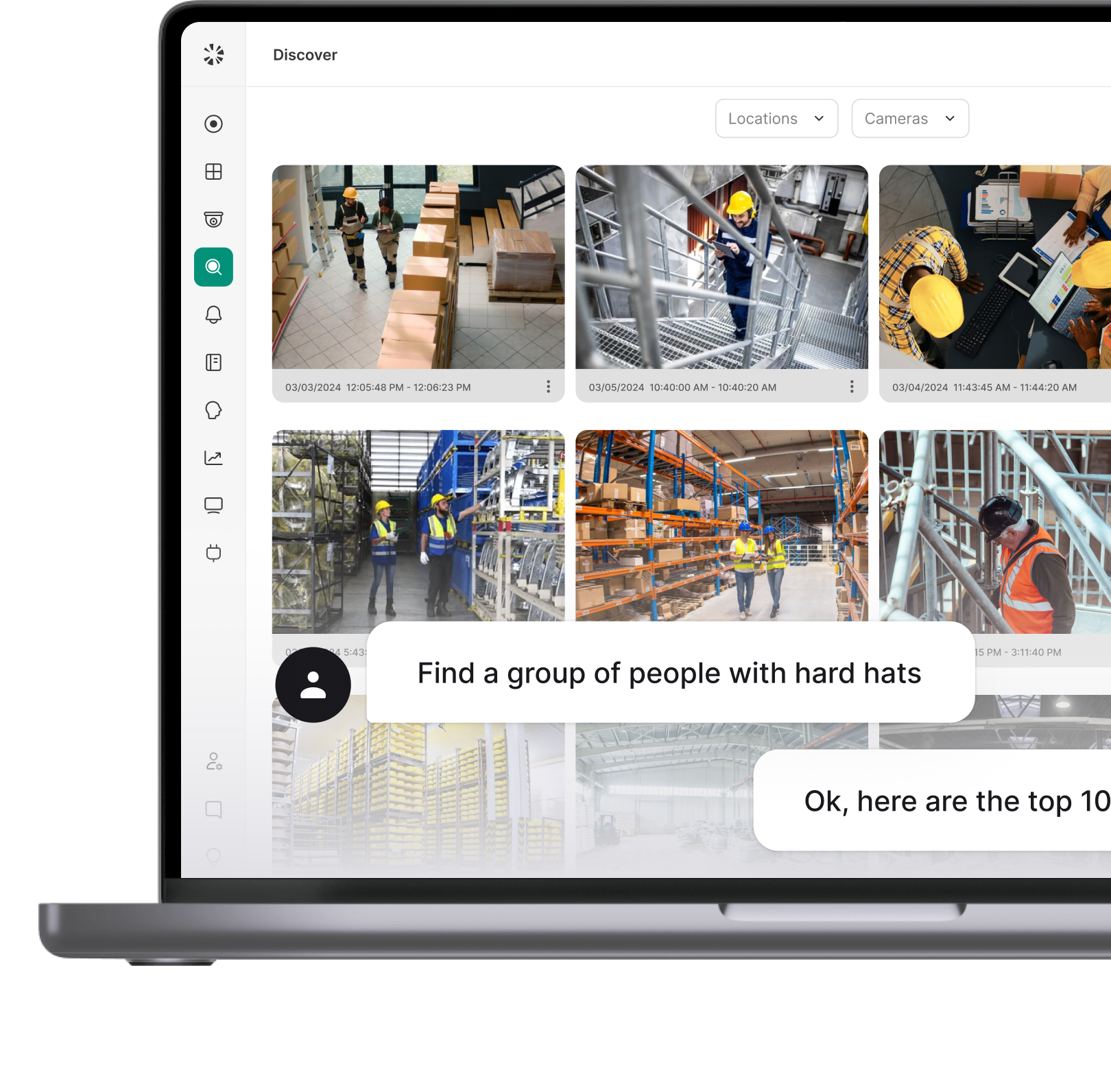
Natural-language video search lets staff type a plain-language query and pull relevant clips in seconds: "a person in a red jacket near concessions after 9 pm," or "vehicle entering the north lot between 11 pm and close." An investigation that used to take three hours takes minutes.
The applications across a cinema chain are immediate: claims documentation, loss-prevention case building, and incident footage for law enforcement. All three currently depend on someone knowing roughly when something happened and scrubbing footage manually until they find it. Natural-language search removes that bottleneck and the labor cost associated with it.
For a regional manager covering eight locations, that's not a marginal efficiency gain. It's meaningfully less time on footage and more time on operations. The main issue with most cinema operations is that existing camera systems were designed to record, not to be searched, which makes an AI platform that adds search capability to existing cameras, without requiring a hardware refresh, the practical path for most operators.
6. Integration with Existing Camera Systems
Every cinema chain VP evaluating AI security eventually hits the same wall. The technology looks right, the demo lands well, and then someone pulls up the camera inventory spreadsheet: mixed manufacturers, varying ages, firmware versions nobody remembers updating.
The question stops being "which platform" and becomes "which platform actually works with what we already have." That's the right question to lead with, not land on after the contract is signed.
"ONVIF compatible" gets used loosely in vendor conversations. It typically means the platform can pull a basic video stream from your cameras. It doesn't mean AI inference, alert routing, and natural-language search are fully functional on your specific models. Those are different things, and the difference shows up during deployment.
What to Evaluate Before Buying
The security technology sales cycle for a multi-site operator runs a predictable pattern: conference demos, vendor follow-ups, three months later you're managing four separate vendor relationships, and the total cost looks nothing like the per-camera number that opened the conversation. For most cinema chains in 2026, the higher-leverage move is consolidating all the above categories onto a single AI platform running on cameras you already own. A single platform reduces vendor management and total cost; existing-camera deployment reduces capex and rollout time.
Before any vendor makes your shortlist, these are the questions that matter:
- Does it actually work with your cameras? Not ONVIF-compatible — fully supported at the AI feature level on your specific models. Submit your camera list in writing and get a written response.
- What do real-world false positive rates look like? Ask for performance data from live deployments at comparable venues. A vendor who can't produce that number is telling you something.
- How does alert routing get configured? Your closing-shift protocol at a suburban location shouldn't look the same as your opening-weekend protocol downtown. If the system can't reflect that, it won't get used.
- What does the full cost look like across your location count? Per-camera licensing, implementation, hardware requirements, and annual fees. Model the five-year number before the conversation reaches contract terms.
- Have you cleared the legal requirements for your state? Biometric features, data retention policies, and privacy obligations vary. Get jurisdiction-specific legal review before deployment.
Where Coram Fits
Coram is an AI-native physical security platform that works with existing IP cameras — no rip-and-replace. It connects to cameras already deployed across a chain, including Axis, Hanwha, and other IP systems across more than 1,000 supported models, and covers weapon detection, intrusion monitoring, license plate reading, person-of-interest tracking, natural-language video search, and emergency management through a single interface rather than separate systems.
At some point in every multi-site security evaluation, the conversation shifts from "which technology" to "how many vendors are we actually willing to manage." Weapon detection from one provider, LPR from another, video search through a third integration, emergency alerting through a fourth system that may or may not work cleanly with the rest. Individually, each tool makes sense. Operationally, it becomes difficult to manage across dozens of locations.
For cinema operations teams, the practical value is operational simplicity. One contract, one platform, per-camera economics that scale with the infrastructure you already have. The Emergency Management module handles silent panic, alert routing, and direct 911 location sharing for after-hours and active-shooter scenarios without adding a separate vendor. Natural-language search turns DVR-scrubbing afternoons into seconds-long queries when claims and incidents come up.
The honest caveat: Coram does not have a large public base of major cinema-chain deployments. If procurement requires long-established multiplex references, that matters. What makes it relevant here is that Coram's architecture closely maps to the existing-camera, multi-site operational problems that cinema operators are trying to solve in 2026.
What the Evaluation Usually Comes Down To
Most VP of Ops evaluations start with the capability list and end with the integration and consolidation question. The technology to address the full cinema risk profile exists today and runs on cameras you already own. The question isn't whether to deploy it. It's whether you deploy it as five separate vendor relationships or one platform your regional ops managers will actually use consistently across every location.
That's the right place to end up. If the single-platform argument makes sense for your operation, Coram is worth a serious evaluation: not a quick demo, but a proper assessment against your actual camera inventory, your location count, and your current vendor stack. Book a demo to start that conversation.




.png)