You can leave Verkada without replacing every camera. Your third-party ONVIF and RTSP cameras move to a new platform as-is. Your Verkada-branded hardware phases out on your refresh cycle instead of all at once. The migration starts now, with whatever is already portable.
The pattern that keeps teams from starting is familiar enough to be predictable. The platform stops fitting somewhere around the third site or the second renewal. The quote comes in higher than last year. Someone runs the math on ripping out and re-mounting every camera across every building, decides that is not this year's project, and signs anyway. Two renewals later the fleet is bigger and the same math looks worse.
That math is usually wrong, because it treats the fleet as one thing. The cameras on your ceiling are not all the same problem. Some move with no hardware spend at all. Others are Verkada-branded and will eventually need replacing. Sorting them takes about twenty minutes, and the ratio between the two is your entire business case.
Here is how to find that ratio, what the phased path looks like, and what it actually costs.
What Actually Locks You In to Verkada (And What Doesn't)
The cameras you keep are the ones that were never really Verkada's to begin with.
Third-party ONVIF and RTSP cameras from Axis, Hanwha, Bosch and similar manufacturers, the ones you brought into Command through Verkada Command Connector, are yours outright. ONVIF (Open Network Video Interface Forum) is the interoperability standard that lets an IP camera be discovered, configured and managed by any conformant platform, which is why these cameras move.
RTSP-only cameras that never passed ONVIF Profile S conformance usually move too, since a platform that can ingest the stream can record it. The two protocols do different jobs, and how ONVIF and RTSP work together is what decides which column a camera lands in when you build the inventory.
One caveat worth building into your plan: compatibility is model by model, not brand by brand. Check each model against the new platform's supported device list rather than assuming the whole third-party group travels together. The longer-term version of the same question, whether to standardize on open IP cameras or one vendor's ecosystem, is what decides whether you run this project again in five years.
Verkada-branded cameras are a different category. They are cloud-managed through Command and do not support ONVIF, so a third-party VMS cannot discover, configure or manage them the way it would a standards-based camera. Verkada does expose a local-network RTSP stream on most of its current models, documented in its own help center, and that is genuinely useful for pulling a feed into an analytics tool during a transition.
It is not a migration path. You get two concurrent streams per camera, no control over resolution or bitrate, no ONVIF layer to configure anything, and a feature that exists at Verkada's discretion rather than as a standard. Plan to replace these on your refresh cycle.
That is the whole picture, and it is less dramatic than the usual framing. Command Connector helps you start a migration into Verkada; an open recording platform helps you avoid the next one. What you are left with is two groups of cameras on two different timelines, and only the smaller group needs budget.
Inventory Your Cameras Before You Switch (The 20-Minute Audit)
Everything you need to size this migration is already in Verkada Command. Twenty minutes gets you the number.
Open Command and work through your active feeds. For each one, check the make and model. Command Connector feeds show a third-party manufacturer such as Axis, Hanwha or Bosch, and those are your standards-based cameras. Verkada-branded feeds are the ones you will phase out.
Two columns people leave out and then regret. Note whether each camera is ONVIF Profile S or RTSP, not just ONVIF, because an RTSP-only camera is still portable and marking it "no" understates the number your business case depends on. And count lenses, not just cameras.
A four-lens multisensor head typically consumes four channels and four licenses rather than one, so a fleet with a dozen multisensor positions sizes very differently than its camera count suggests. Ask any platform you shortlist how it counts a multi-lens camera before you take a quote seriously.
When it is populated, work out what share of your fleet is standards-based. A high number means this migration is mostly a configuration exercise. A low number means the hardware phase needs a longer runway, and nothing else changes: you can still move the standards-based layer this quarter.
That percentage is also the slide you take to whoever signs the renewal. It converts an abstract fear (we would have to replace everything) into a specific number (we replace this fraction, on this schedule).
The Phased Verkada Migration Path
Every step below keeps Command fully operational while your Verkada footprint shrinks. There is no single high-risk cutover.
One honest limit before the steps. Retention on most edge-recording platforms is set per recorder rather than per camera, so if you need ninety days on dock doors and thirty on interior aisles you usually cannot mix them on one appliance. That constrains how finely you can slice the phases. Plan appliance boundaries around retention groups rather than just around buildings, and confirm the rule with whoever you shortlist, because it varies.
Step 1: Deploy the New Platform in Parallel
Stand up the new platform alongside Verkada before you move a single feed. Running both keeps Command fully operational while your team validates performance, configures settings and trains users. It also means the parallel run doubles as your proof of concept: you are evaluating on your own cameras, in your own buildings, with nothing decommissioned.
Physical setup is usually the fast part. An appliance-based platform needs power, a network drop, and cameras reachable on the same VLAN, where they are found over ONVIF. Sizing is what deserves the planning. Appliances carry a per-unit ceiling on video feeds, and a higher-resolution or H.264 stream consumes more than one feed, so a 5MP camera at H.264 and 15fps can count as two.
A hundred-camera site often needs more than one appliance, and your codec mix decides how many. Get that number confirmed against your actual camera specs before anyone quotes you, because it moves the hardware line further than the camera count does.
Step 2: Migrate Standards-Based Cameras First
Once the new platform is live, start repointing your ONVIF and RTSP cameras. These already speak open standards, so migration means updating camera configuration, not buying hardware.
Budget a little per-camera time rather than none: date and time have to be in sync, ONVIF needs an admin profile, and some manufacturers ship with settings that block discovery until you change them. Axis cameras in particular need replay attack protection turned off.
Move the highest-priority locations first. Progress here is what makes the rest of the project easy to fund.
Step 3: Plan Replacement of Proprietary Verkada Hardware
With the portable layer migrated, turn to the Verkada-branded devices. Match each one to the refresh or replacement cycle it already sits in. The output is a schedule, not a purchase order, and that is the point: locked hardware ages out on the timeline you already budgeted for instead of becoming an unplanned capital request.
Step 4: Reduce Verkada Licensing as Migration Progresses
As feeds move and hardware hits its replacement milestones, decommission the Command licenses attached to them. Licensing declines in steps alongside adoption rather than ending in one lump. Check your renewal date before you start, because the cleanest version of this project finishes a phase just before a term ends rather than just after.
What It Costs to Switch From Verkada
The common assumption about leaving Verkada is that it means rebuying every camera. It does not, and the cost concentrates almost entirely in the Verkada-branded portion of your fleet.
Most of what you already own carries over: standards-based cameras, cabling, network infrastructure, PoE switches, mounting hardware. That reuse matters more than it sounds like it should, because in most deployments the camera is not the expensive part. Installation is.
Pulling new cable, getting a lift into position, and paying a crew to stand by while it happens can cost several times the hardware itself, and in unionized or heavy-industrial environments the gap is wider still. Every camera that stays on its existing mount and cable run is a truck roll you do not pay for.
One line item is usually new rather than reused, and it is better to know about it now than at the quote stage. Most platforms in this category, cloud-managed and hybrid alike, record to an appliance at the site rather than streaming everything to a data center. That appliance is a capital line, priced per site and sized by the feed math above.
A platform that stores all video in the cloud instead trades the hardware line for bandwidth and a recurring storage bill. The question is which shape you would rather carry, not whether there is a cost.
Where footage actually lives is worth asking about directly, because the answer decides what your security team will sign off on. Recording on site keeps video on your own network and lets cameras sit on an isolated VLAN with no route to the internet, which is not possible when every camera has to reach a vendor's cloud itself.
It also means recording continues through an internet outage. Ask each vendor on your list where video is written, what still works when the connection drops, and whether anything has to be opened inbound through your firewall.
So the financial shape of the project is reuse of standards-based cameras and the infrastructure around them, avoided Command renewals as feeds migrate, whatever recording hardware the new platform requires, and camera replacement spread across refresh cycles you already planned. Recurring platform cost falls as feeds move off Verkada, while the infrastructure you have already paid for keeps earning.
Comparing Verkada Migration Support by Platform
Migration friction comes down to which cameras carry over, how licensing is structured, and whether the new platform recreates the problem you are leaving. The table below is scoped to that question.
If you are still building a shortlist rather than planning a move, the rundown of Verkada competitors and alternatives compares the platforms themselves in more depth, and Coram AI vs Verkada is the head-to-head if Coram is already on your list.
Two notes on scope, since an honest table is worth more than a flattering one. Brivo Eagle Eye records locally on its CMVR appliances, so it is not a cloud-only platform and outage behavior is not a differentiator against it; the difference is product breadth, since there is no emergency management module. And Milestone is best described as architected on-premises first rather than on-premises only, since it now offers cloud hosting and a hybrid option alongside its Husky appliances.
Migrating to Coram from Verkada
Coram is an AI native unified physical security platform. Video Security, Access Control, Guest Management and Emergency Management run in one system, which matters here for a specific reason: a migration that starts with your cameras does not have to turn into three more procurements later.
Your standards-based cameras, the portable layer from your audit, connect to Coram over ONVIF or RTSP (H.264 or H.265) without replacement, re-cabling or new camera budget. If most of your fleet is portable, most of this project is configuration.
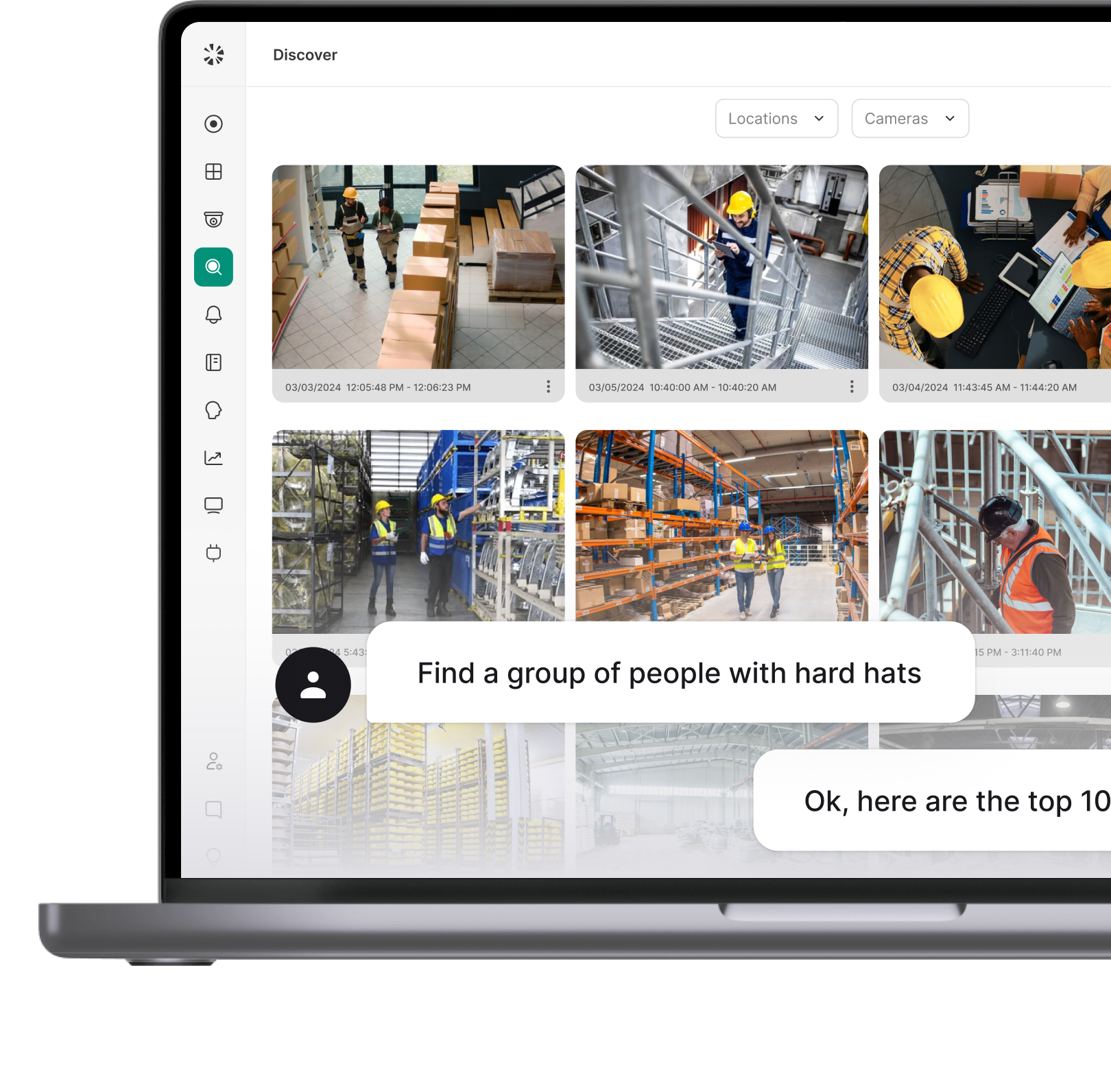
AI search and cross-camera investigation run on those existing cameras, so the reason to switch shows up on hardware you already own rather than on hardware you have to buy first. How Poster House added AI and cloud access to its existing cameras is the same route, and its CTO put the appeal plainly: the strength is the ability to add advanced features to the tech you are already using.
For the Verkada-branded cameras that cannot be repointed, Coram sells its own NDAA-compliant camera line as a replacement path when your refresh cycle allows, managed through the same platform. Size those positions model by model rather than one for one, since multisensor, panoramic and specialty mounts do not always have a direct equivalent.
If you also run Verkada on your doors, that is a parallel decision with its own timeline rather than a reason to delay this one. The tradeoffs there are covered in Verkada access control versus open integrations.
A 30/60/90-Day Verkada Switch Checklist
Three phases: know your fleet, move what is portable, schedule what is not.
Days 1 to 30: Know Your Fleet, Stand Up the New Platform
- Open Verkada Command. Check the make and model behind every active feed.
- Tag each camera as standards-based (ONVIF Profile S or RTSP) or Verkada-branded.
- Log it: camera name, make and model, ONVIF or RTSP, lens count, location, refresh window.
- Work out your standards-based share. This is your migration scope and your budget case.
- Note your Command renewal date. It is the deadline the rest of the plan works backward from.
- Deploy Coram alongside Verkada and confirm camera detection. Move nothing yet.
Days 31 to 60: Move the Portable Layer, Start Retiring Licenses
- Repoint standards-based cameras to Coram in batches, highest-priority locations first.
- Confirm each batch is live in Coram before removing it from Command.
- Flag each migrated feed's Command license for non-renewal.
- Onboard your team. Configure alerts and AI search on the migrated cameras.
Days 61 to 90: Complete the Transition, Schedule the Hardware Phase
- All standards-based cameras on Coram. Verify no monitoring gaps.
- Whatever remains in Command is Verkada-branded hardware only.
- Match each remaining device to its refresh window. That list is your phase-out timeline.
- Reduce your Command license count to the feeds still running on it.
- Align replacement orders with refresh cycles. Decommission Command on the last exit.
If you want this sized against your own fleet, book a demo and bring your camera list. We will tell you which models come over and which ones do not.




.png)