OpenEye is a hybrid video management system (VMS) that combines local recording with cloud-based management for multi-site commercial deployments. It holds a legitimate position in the market: solid ONVIF support, hybrid architecture, and a cloud management layer built for distributed sites. But buyers evaluating OpenEye and its competitors in 2026 consistently hit the same three walls: AI capabilities that lag behind newer platforms, NDAA hardware documentation that requires product-by-product verification, and a mobile experience that feels dated compared to cloud-native systems.
The best OpenEye alternatives in 2026 are Coram (camera-agnostic, natural language AI search), Verkada (fully proprietary, cloud-native with built-in AI), Eagle Eye Networks (open VSaaS, works with any existing camera fleet), Avigilon Alta (enterprise hybrid, Motorola ecosystem, verified NDAA), and Rhombus (mid-market cloud with hybrid storage). Each involves a different trade-off in price, openness, and AI capability. The right one depends on whether you're keeping your cameras, how much AI your team will actually use, and what compliance requirements you're working against.
This guide covers all 12, with features, limitations, and honest guidance on where each platform actually fits.
Why Teams Move On from OpenEye
The complaints are consistent across segments and company sizes. Six issues come up repeatedly.
Local-First Architecture Is Becoming Overhead
OpenEye built Apex VMS around a hybrid model specifically because pure cloud recording couldn't handle high-megapixel, high-camera-count deployments. That was a real differentiator in 2019. For organizations with stable infrastructure today, maintaining on-prem NVR hardware looks more like overhead than advantage. Cloud-native platforms now deliver similar reliability without local servers to manage.
The AI Gap Is Widening
OpenEye is actively developing AI-driven search and vision capabilities, but competing platforms already deliver natural language search, weapons detection, and cross-camera tracking in production. Once teams experience those workflows, scrubbing timelines manually feels like a step backward.
POS and Business System Integration Is Limited
OpenEye includes reporting tools for loss prevention and operational visibility. Compared to platforms that sync POS events with video in real time, though, investigations still require more manual timeline matching than most retail teams now expect.
The Mobile Experience Lags
G2 reviewers consistently flag the mobile app as a friction point, particularly when loading live video remotely. In a market where several competitors are built around mobile-first access, slower load times become apparent during evaluations.
Pricing Gets Expensive at Scale
OWS runs on per-channel subscription licensing billed monthly or annually. That works for smaller deployments. Across multiple sites, costs rise quickly, and buyers comparing total cost of ownership often find camera-agnostic platforms more cost-effective: they keep existing hardware and pay only for software.
The Platform Feels Like It's Catching Up
The VMS market has moved toward AI, cloud, and compliance-driven workflows. OpenEye is moving in that direction, but buyers evaluating in 2026 are comparing roadmaps against platforms that have those capabilities deployed and operational today.
What to Look for in an OpenEye Alternative
Eight factors separate a good evaluation from one that creates problems after you sign.
Camera Compatibility
Vendors market ONVIF support aggressively; real-world compatibility is uneven. Before shortlisting any alternative, submit your exact camera models and firmware versions and request written confirmation of full feature support: not just basic recording, but PTZ control, two-way audio, and edge analytics retrieval. The difference between "records from this camera" and "fully supports this camera" is significant.
Total Cost of Ownership
The per-channel license price is usually the first number vendors show. It's rarely the real cost. Account for proprietary cameras, gateway appliances, NVR replacement, implementation, and ongoing maintenance agreements. Some platforms require certified integrators for deployment and support. A platform that looks cheaper upfront can easily become the more expensive option over five years once hardware, support, and upgrades are included.
Compliance Documentation
If NDAA, SOC 2, HIPAA, FERPA, or TAA matters to your organization, request written documentation early. Some platforms vary by hardware model or deployment type, which creates procurement risk. A vendor that can't quickly provide compliance documents usually creates more friction during security reviews and approvals.
AI That Matches Your Actual Workflow
Every platform claims AI capabilities. The question is whether those capabilities solve your actual workflow problems. If your team spends hours investigating incidents, natural language search matters. If the priority is real-time response, edge detection and instant alerts matter more. Paying for AI your team never uses adds cost without operational value.
Cloud Architecture and Outage Behavior
Cloud and hybrid architecture mean different things on different platforms. Ask vendors exactly what happens during an internet outage: does it keep recording locally, does it fail over automatically, and does remote access reconnect when connectivity is restored? OpenEye built its hybrid model around this argument. Verify whether the alternative you're evaluating has actually solved it or just rebranded the same limitation.
Multi-Site Management at Real Scale
Every platform demos well with three cameras across two sites. Ask to see the management interface at the scale you'll actually deploy, your number of sites, your camera count, your mix of user roles and permissions. Test how long it takes to add a new site, how user permissions propagate across locations, and whether health monitoring is genuinely proactive or just a dashboard you have to remember to check.
Integration Quality
Most VMS platforms publish an integrations list. That list is not the same as a working integration. If you need video data to flow into a PSIM, SIEM, POS system, or access control platform you already run, test that specific integration in a proof of concept before signing. An open API is the baseline. What matters is whether the integration handles bidirectional data, event triggers, and the edge cases your environment will actually generate.
Vendor Stability
Security platforms are long-term operational decisions. Evaluate ownership structure, funding, support maturity, and enterprise presence. A newer startup and an established enterprise vendor carry very different risk profiles, especially when signing multi-year contracts tied to critical infrastructure.
12 Best OpenEye Alternatives in 2026
A quick comparison across all 12 platforms covered below.
Coram
Coram is an AI-native physical security platform that works with any existing IP camera — no hardware replacement required.
For organizations running OpenEye on an existing camera fleet, this is the most direct migration path. Coram connects to existing cameras through a local Coram Point appliance, adds cloud management, and layers AI on top of the infrastructure already in place. The core reason buyers choose it over OpenEye is that they get modern AI capabilities without triggering a hardware refresh.
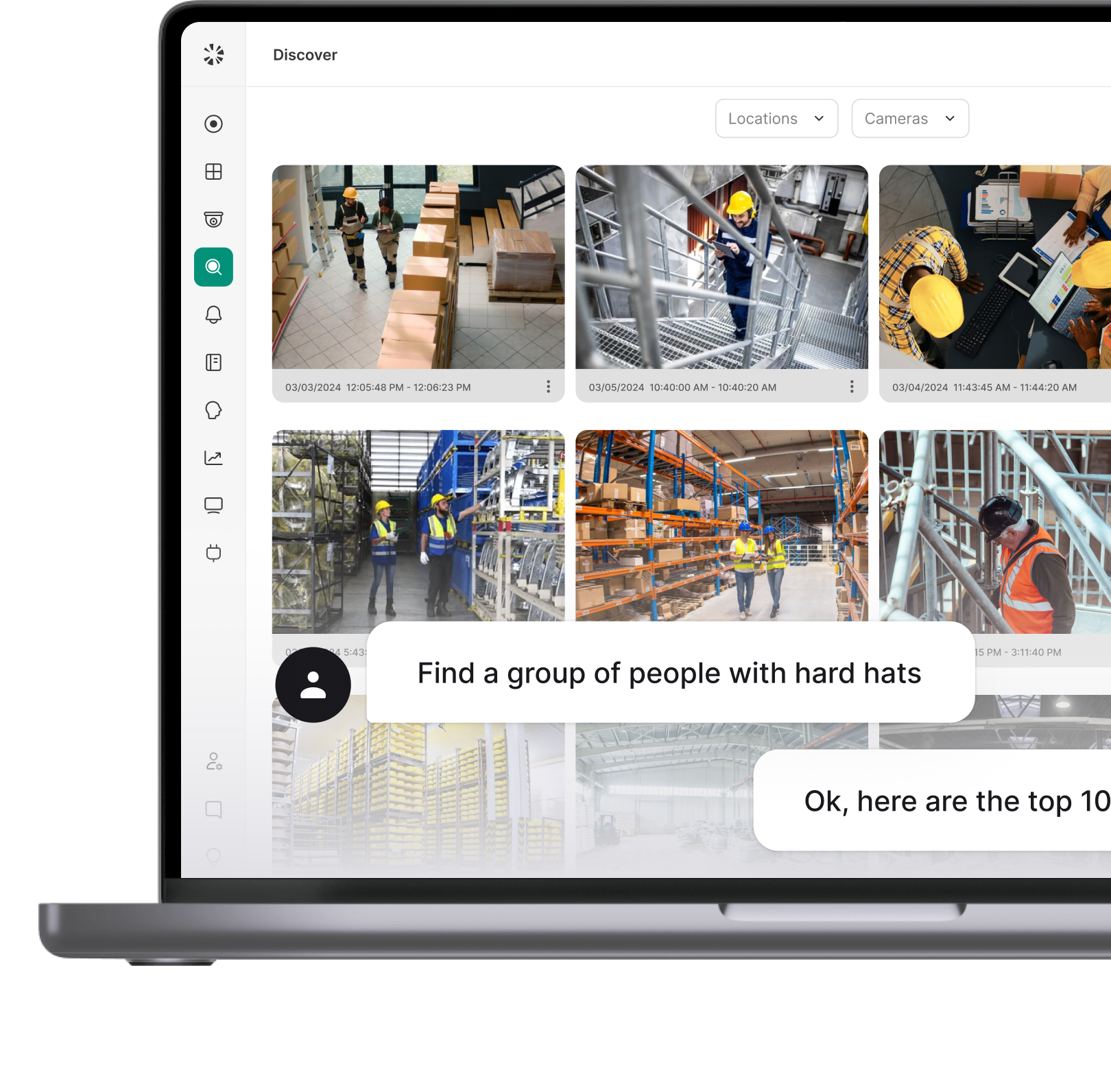
The standout capability is natural language video search. Instead of scrubbing timelines, teams describe what they're looking for: a person in a red jacket, a vehicle near the loading dock, and pull relevant footage in seconds. Cross-camera tracking, license plate recognition, face detection, and real-time alerts, including weapons detection, build on that workflow. For environments that have lived with manual timeline review, the operational difference is significant.
Coram also covers the compliance stack that regulated buyers need: SOC 2 Type II, HIPAA, and NDAA alignment. It supports 1,000+ IP camera models and deploys quickly: one customer cited going live with 100+ cameras in under 10 minutes.
Best for: Organizations with existing IP camera infrastructure that want modern AI investigation and detection capabilities without replacing what they already own.
Strengths:
- Works with any existing IP camera, including Axis, Hikvision, and Dahua, with no rip-and-replace required
- Natural language video search across any camera in the fleet
- Real-time AI detection: weapons, license plates, faces, and custom plain-English alert creation
- Unified platform covering video, access control, and emergency management in one login
- SOC 2 Type II and HIPAA certified; NDAA compliant
- G2: 4.9/5 rating, 9.5/10 ease of use
Limitations:
- Newer platform than legacy incumbents like Genetec or Milestone, and the enterprise reference list is still growing
- Requires the Coram Point local appliance per site, adding a hardware component to an otherwise cloud-managed setup
- Pricing is not publicly listed; requires a quote
Pricing: Not publicly listed. Contact Coram for a quote.
Verkada
Verkada is a cloud-native physical security platform built around a fully integrated proprietary hardware ecosystem.
Cameras, storage, AI, and cloud management all live within one system, eliminating the NVR, gateway hardware, and integration complexity that come with open-architecture platforms. For teams without dedicated VMS administrators, that simplicity has real operational value. AI features work out of the box without additional licensing or configuration: person detection, license plate recognition, occupancy analytics, and real-time alerts.
The trade-off is flexibility. Verkada requires proprietary cameras; existing hardware cannot be reused. Per-camera licensing under a 10-year lifecycle model means costs increase quickly at scale, and buyers locked into the ecosystem have limited leverage at renewal.
Compared to OpenEye, Verkada delivers a more polished cloud experience and stronger out-of-the-box AI, but at the cost of hardware lock-in that OpenEye's ONVIF support avoids.
Best for: New deployments where there is no existing camera investment to preserve and minimal IT overhead is a priority.
Strengths:
- Fully managed cloud system with no NVR or on-site server required
- Strong out-of-the-box AI: person detection, LPR, occupancy analytics, real-time alerts
- Clean multi-site management through the Command platform
- SSO, SAML, and SCIM support for enterprise identity management
- Low day-to-day IT overhead
Limitations:
- Fully proprietary hardware, meaning existing cameras cannot be reused
- Higher upfront camera costs than most alternatives
- Per-camera licensing across a 10-year lifecycle becomes expensive at scale
- No flexibility to mix third-party hardware if needs change
Pricing: Not publicly listed. Contact Verkada for a quote.
Eagle Eye Networks
Eagle Eye Networks is a cloud video management system that works with a wide range of ONVIF-compatible cameras and requires no hardware replacement.
Note: Eagle Eye Networks merged with Brivo in 2024. The combined platform now covers video surveillance, access control, visitor management, and AI analytics under one roof. Content published before mid-2025 may describe Eagle Eye as a standalone platform; that's no longer accurate. The capabilities described here reflect the merged platform.
For organizations leaving OpenEye with a mixed or aging camera fleet, Eagle Eye provides a practical path to cloud management without a hardware refresh. Its API ecosystem integrates with POS systems, access control platforms, and third-party analytics tools, making it particularly useful for retail, logistics, and franchise operations where video needs to connect with broader workflows.
Compared to OpenEye, Eagle Eye offers stronger cloud management and more flexible third-party integrations. AI capabilities are more limited than Coram or Verkada and depend largely on partner integrations rather than native detection.
Best for: Multi-site organizations with mixed camera fleets that need a proven cloud VMS and strong third-party integrations.
Strengths:
- Works with a wide range of ONVIF cameras across mixed and aging fleets
- Strong API ecosystem for POS, access control, and analytics integrations
- Mature cloud infrastructure with multi-site management designed for larger deployments
- Combined Brivo platform now covers access control and visitor management natively
- NDAA compliant
Limitations:
- AI capabilities depend largely on partner integrations rather than native detection
- Functionality can degrade during internet outages (cloud-only architecture)
- Works best with Brivo/Eagle Eye compatible hardware; not as camera-agnostic in practice as Coram
- No native natural language search or weapons detection
Pricing: Not publicly listed. Contact Eagle Eye Networks for a quote.
Avigilon Alta (Motorola Solutions)
Avigilon Alta is Motorola Solutions' cloud-native physical security platform combining video surveillance, access control, and cloud analytics.
Its primary advantage for buyers coming from OpenEye is enterprise credibility and compliance clarity. NDAA compliance is clearly documented by model, which matters for government, education, and regulated industry procurement. Organizations already running Motorola radios, infrastructure, or public safety systems get a unified operational picture by adding Alta video.
The platform runs fully cloud-native or connects with existing cameras for hybrid deployments, giving larger organizations more migration flexibility than a pure proprietary system. AI capabilities focus on real-time alerts, anomaly detection, and operational visibility.
Compared to OpenEye, Alta offers stronger compliance documentation, deeper enterprise integrations, and a clearer cloud roadmap. It's a larger operational commitment — better suited to organizations with dedicated security staff than to lean IT teams managing security as one of many responsibilities.
Best for: Enterprise deployments where NDAA compliance is a hard procurement requirement, or organizations already running Motorola infrastructure.
Strengths:
- Clear NDAA compliance documentation by hardware model
- Hybrid deployment flexibility: cloud-native or integrated with existing cameras
- Backed by Motorola Solutions; unified with radios, public safety, and communications infrastructure
- Strong AI for real-time alerts and operational analytics
Limitations:
- Top AI analytics are optimized for Avigilon cameras, and third-party hardware limits some capabilities
- Higher price point; complex for lean IT teams without dedicated security staff
- Motorola ecosystem tends to steer toward proprietary hardware combinations over time
Pricing: Not publicly listed. Contact Motorola Solutions for a quote.
Rhombus
Rhombus is a cloud-managed video security platform with onboard AI, hybrid storage, and a clean multi-site dashboard.
Its most meaningful differentiator for OpenEye buyers is the hybrid recording model: video stores locally and in the cloud simultaneously, reducing dependence on internet connectivity while keeping remote access straightforward. That addresses one of OpenEye's core architectural arguments: that pure cloud can't handle outages. Rhombus solves it without the on-prem NVR overhead that OpenEye's model carries.
Camera hardware ranges from $299 to $1,699, running 15–25% below Verkada's price point. The annual enterprise cloud license is $199 per camera, with a professional tier at $149. Environmental sensors for air quality, temperature, and motion add a safety layer relevant to schools, warehouses, and manufacturing environments.
Third-party camera support exists but is limited compared to truly open platforms like Coram or Eagle Eye. Rhombus works best as a net-new deployment rather than a camera reuse scenario.
Best for: Mid-market organizations evaluating Verkada that want cloud-managed simplicity with local backup at a lower hardware price point.
Strengths:
- Hybrid storage: local and cloud simultaneously, reducing outage risk
- Camera hardware 15–25% below Verkada pricing
- Clean multi-site dashboard designed for lean IT teams
- Environmental sensors for air quality, temperature, and motion
- NDAA compliant
Limitations:
- Third-party camera support is limited, and Rhombus is not a camera-agnostic platform
- Smaller ecosystem and integration library than Milestone or Genetec
- Less AI depth than Coram or Verkada for investigation workflows
- Newer platform with a smaller enterprise reference base
Pricing: Professional tier at $149/camera/year; enterprise at $199/camera/year. Hardware from $299 to $1,699 per camera.
Milestone XProtect
Milestone XProtect is the world's most widely deployed open-platform VMS, built for organizations that need maximum hardware flexibility and aren't ready to move fully to the cloud.
XProtect integrates with 13,000+ camera and device models — no other platform in this list comes close — and scales from XProtect Essential+ for small deployments up to XProtect Corporate with unlimited cameras, servers, and users under perpetual licensing. For organizations with complex, multi-vendor camera environments and strong on-prem infrastructure preferences, it remains the most flexible option available.
The trade-off is complexity and ongoing cost. Advanced AI analytics require additional integrations and licensing through BriefCam. The Care Plus annual maintenance agreement is effectively required for updates and support. Compared to OpenEye, Milestone offers far broader hardware compatibility and deeper on-prem control, but demands more infrastructure investment and administration overhead.
Best for: Large-scale on-prem deployments requiring maximum hardware compatibility and deep customization.
Strengths:
- 13,000+ compatible camera and device models (broadest in the market)
- Scales from small business to unlimited cameras under perpetual licensing
- Massive third-party integration ecosystem: 1,000+ partner applications
- Strong on-prem control for organizations not moving to the cloud
- NDAA compliant
Limitations:
- Server-heavy infrastructure, not designed for lean IT or fast deployment
- Advanced AI analytics require additional integrations and licensing (BriefCam)
- Care Plus annual maintenance is effectively required for updates and support
- Not built for centralized remote management across distributed sites
- High total cost of ownership at scale
Pricing: Perpetual per-device licensing. Care Plus annual maintenance required for updates. Contact a Milestone partner for a quote.
Genetec Security Center
Genetec Security Center is a unified physical security platform built for large, complex deployments where video, access control, and license plate recognition need to operate natively under one interface.
Its unified approach gives enterprises centralized control across cameras, doors, credentials, alerts, and investigations, a meaningful advantage for airports, campuses, law enforcement, and critical infrastructure where fragmented security tools create operational gaps. The open architecture supports a wide range of camera hardware and a deep integration ecosystem.
Compared to OpenEye, Genetec is built for organizations with dedicated security engineering staff and larger IT budgets. The complexity and infrastructure investment it requires are appropriate for the environments it's designed for; they're the wrong fit for mid-market multi-site deployments where operational simplicity matters more than depth.
Best for: Large enterprise and government deployments requiring deep integration across physical security systems at scale.
Strengths:
- Unified video, access control, and LPR under one interface
- Deep integration ecosystem with broad hardware and third-party support
- Highly customizable for complex, large-scale security programs
- Strong presence in government, law enforcement, and critical infrastructure
- NDAA compliant
Limitations:
- Requires significant on-prem server infrastructure
- Complex to deploy and administer, requiring dedicated security engineers
- High total cost of ownership; not viable for mid-market without dedicated IT
- AI capabilities are add-on rather than native (primarily via third-party integrations)
- Not designed for fast rollouts or distributed lean-IT environments
Pricing: Contact Genetec or an authorized partner for a quote.
Hanwha Wisenet WAVE
Wisenet WAVE is Hanwha Vision's native VMS, available at no additional cost with Hanwha cameras and ONVIF-compatible with third-party devices.
It supports up to 128 video streams per server and integrates fully with Wisenet NVRs and IP cameras through the SUNAPI protocol. For organizations with existing Hanwha camera deployments, it's a practical OpenEye alternative that eliminates the VMS licensing cost entirely. WAVE 6.0, released February 2025, added stronger user management, SSL/TLS certificate pinning, and session-based bearer token authentication.
Compliance is a genuine strength. Hanwha Vision cameras are manufactured in South Korea and Vietnam for NDAA compliance, with select South Korea-manufactured products also meeting TAA requirements for GSA sales (relevant for government and SLED procurement).
The platform makes the most sense when the camera fleet is already Hanwha. With third-party cameras, the native feature advantage diminishes, and platforms with stronger multi-vendor track records become more competitive.
Best for: Organizations with existing Hanwha camera deployments looking for a no-extra-cost VMS with strong compliance support.
Strengths:
- No additional VMS licensing cost when running Hanwha cameras
- NDAA compliant; select products meet TAA requirements for GSA sales
- Strong cybersecurity posture: SSL/TLS certificate pinning, session-based bearer tokens (WAVE 6.0)
- Supports up to 128 video streams per server
- Regular software updates without mandatory maintenance fees
Limitations:
- Native feature advantage is tied to Hanwha hardware, and third-party camera performance is more limited
- AI analytics are less developed than Coram, Verkada, or Avigilon Alta
- On-prem server model carries the same overhead as other legacy VMS platforms
- Less suited for lean IT teams managing distributed multi-site environments
Pricing: No additional VMS licensing cost with Hanwha cameras. Third-party device support may carry additional licensing. Contact a Hanwha reseller for a quote.
Solink
Solink is a cloud video security and analytics platform built around one core capability: linking video footage directly to transaction data in real time.
It integrates with retail POS systems, pairing transactional records with video so teams can verify sales, voids, refunds, and unusual activity without scrubbing footage manually. For loss prevention teams that spend significant time matching video to transaction logs, that workflow change is the reason to evaluate it. The platform works with existing camera infrastructure and integrates with 300+ business tools, including access control, labor management, and business intelligence platforms.
Compared to OpenEye, Solink is a narrower platform: its AI is retail-focused rather than general-purpose, and it doesn't offer access control or emergency management. For retail and food service operations, that focus is an advantage. For organizations that need a full physical security platform, it's a limitation.
Best for: Multi-location retail, restaurant, or cannabis operations that need video tied directly to transactional data for loss prevention.
Strengths:
- Native POS integration: video paired with transactional data in real time
- Works with existing camera infrastructure; no hardware replacement required
- 300+ business tool integrations including access control and labor management
- Purpose-built for retail loss prevention workflows
Limitations:
- Retail-focused AI; not a general-purpose physical security platform
- No access control, emergency management, or broader physical security coverage
- Less relevant outside retail, food service, and cannabis verticals
- AI depth limited compared to Coram or Verkada for non-retail use cases
Pricing: Not publicly listed. Contact Solink for a quote.
Kastle Video
Kastle is a fully managed physical security service — not a self-managed platform. That distinction matters before evaluating it as an OpenEye alternative.
With Kastle, you're not operating the system internally. Kastle handles monitoring, maintenance, hardware, and software. The service includes 24/7 remote video and access monitoring, live remote alarm verification (which Kastle reports reduces false dispatches and gets police response five times faster), and storage backup across multiple operations centers. For commercial real estate owners and property managers who don't want to run internal security operations, that fully outsourced model is exactly what they're looking for.
For organizations that want internal control (visibility, configurability, flexibility), Kastle is the wrong category entirely. You subscribe to it the way you subscribe to a security guard service, not the way you license software.
Best for: Commercial real estate portfolios where physical security is fully outsourced, including monitoring, maintenance, and incident response.
Strengths:
- Fully managed service: monitoring, maintenance, hardware, and software included
- 24/7 remote video and access monitoring with live alarm verification
- 5x faster police response through live remote verification (per Kastle)
- Storage backup at multiple operations centers
Limitations:
- Not a self-managed platform, with limited internal visibility and configurability
- Locked into Kastle's hardware ecosystem
- Higher ongoing cost than software-only platforms managed internally
- Not appropriate for organizations that need operational control of their security
Pricing: Not publicly listed. Contact Kastle for a quote.
Arcules
Arcules is a cloud VSaaS platform built within the Milestone ecosystem, making it a natural migration path for XProtect users moving to the cloud without replacing cameras or rebuilding their VMS.
It supports multiple deployment modes: pure cloud, edge cloud with a small on-site gateway, camera-to-cloud, or hybrid configurations adjustable per camera for bandwidth and storage optimization. That flexibility makes it easier to migrate gradually rather than all at once. Arcules is SOC 2 Type II, HIPAA, GDPR, NDAA, and TAA compliant, covering the full stack for healthcare, government, and enterprise procurement.
Recent updates added Multi-Camera Forensic Video Search for tracking movement across multiple angles and External Case Sharing for secure, time-limited sharing with law enforcement, with no Arcules account required for recipients.
Compared to OpenEye, Arcules is more flexible on deployment model and covers a stronger compliance stack. The Milestone alignment is a meaningful advantage for current XProtect users and a largely neutral factor for everyone else.
Best for: Existing Milestone XProtect users moving to the cloud without replacing cameras or rebuilding their VMS.
Strengths:
- Natural migration path for XProtect users: Milestone ecosystem alignment
- Flexible deployment: pure cloud, edge cloud, camera-to-cloud, or hybrid per camera
- Full compliance stack: SOC 2 Type II, HIPAA, GDPR, NDAA, and TAA
- Multi-Camera Forensic Video Search across angles
- External Case Sharing with law enforcement (no Arcules account required for recipients)
Limitations:
- Milestone alignment is an advantage primarily for existing XProtect shops
- AI capabilities are less developed than Coram, Verkada, or Avigilon Alta
- Smaller market presence and integration ecosystem than Milestone itself
- Less differentiated for organizations without existing Milestone infrastructure
Pricing: Not publicly listed. Contact Arcules for a quote.
Hikvision HikCentral
HikCentral is one of the highest-capacity VMS platforms available, supporting up to 10,000 cameras per server and up to 100,000 through Remote Site Management federation.
For U.S. buyers, it's effectively off the table. FCC rulings issued in 2025 made it illegal to import or sell Hikvision equipment in the U.S., extending beyond the NDAA restrictions that previously applied mainly to federal procurement. For commercial deployments outside regulated North American or EU markets, HikCentral remains a mature, cost-effective option: AcuSeek AI search, perpetual per-channel licensing, and free software updates without mandatory maintenance fees.
Best for: Large-scale deployments outside the U.S. and regulated EU environments where NDAA and FCC compliance are not procurement concerns.
Strengths:
- Up to 10,000 cameras per server; up to 100,000 through federation
- AcuSeek AI search included
- Perpetual per-channel licensing with free software updates
- No mandatory annual maintenance fees
Limitations:
- Illegal to import or sell in the U.S. as of 2025 FCC rulings
- Not NDAA compliant, disqualifying it for U.S. government or regulated procurement
- Not viable for EU deployments subject to security hardware restrictions
Pricing: Perpetual per-channel licensing. Contact a Hikvision reseller for international pricing.
How to Choose the Right OpenEye Alternative
OpenEye is a capable hybrid VMS. Its limitations — lagging AI, NDAA documentation complexity, and mobile friction — are real, but they point to specific needs rather than a universal verdict. The right alternative depends on whether you're keeping your cameras, how much AI your team will actually use, and what compliance requirements you're working against.
The right alternative isn't the most feature-rich one. It's the one that fits how your team actually operates.




.png)