5 Best Providers of Mobile Surveillance Units in 2026
Compare 5 mobile surveillance unit providers in 2026 on AI, monitoring model, and platform fit, with pricing and a decision framework for construction teams.
Stu Waters
Published
Jun 26, 2026
Construction site theft costs the US construction industry between $300 million and $1 billion annually — most of it equipment, copper wiring, fuel, and staged materials left outdoors and unattended overnight. A facilities or security manager responsible for a jobsite isn't deciding whether to deploy surveillance. They're deciding which provider actually fits the site.
That decision is harder than it looks. The mobile surveillance unit (MSU) market has fractured into four distinct categories, and most "best of" lists collapse them together. A rental contract built for a fixed retail parking lot looks very different from a platform-first unit designed for rotating construction crews. Mandatory monitoring bundled into a monthly rate solves a different problem than self-monitoring on a platform you already run.
This guide separates those categories clearly for construction site security managers and facilities teams: four provider types, six evaluation criteria, five mobile surveillance unit vendor entries, and a decision framework based on whether your operation is single-site-fixed or multi-site-rotating.
TL;DR
The MSU market splits on three axes: rent vs. own vs. retrofit, mandatory monitoring vs. self-monitor, and hardware-first vs. platform-first. Most vendors optimize for only one of these.
For construction sites with rotating crews, the rent-and-monitor model often becomes expensive fast. Ownership or a platform approach usually wins after 12 to 18 months.
False alarm rate is the biggest day-2 complaint with any MSU. Ask every provider for field-deployment data before signing.
Coram's CRU brings the full Coram platform to any temporary site, no wiring or networking required, and appears in the same dashboard as your permanent cameras.
LVT and WCCTV/LotGuard are strong for long-duration fixed sites with bundled managed monitoring. Mobile Pro Systems is the right chassis for buyers who want to own ruggedized hardware outright.
How to Evaluate Mobile Surveillance Unit Providers
Most facilities managers shopping for an MSU know the category. What they often don't know is how meaningfully the providers differ, and why the wrong fit shows up quickly once the unit is on site.
The market breaks into four categories:
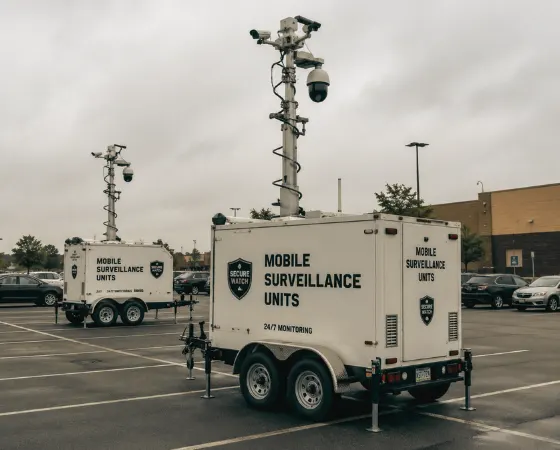
Hardware-first rental with managed monitoring. The provider owns the trailer, deploys it, monitors the feed from their SOC, and bills monthly. You're buying coverage as a service: strong fit when you want to outsource the whole problem. Examples: LVT (LiveView Technologies), WCCTV/LotGuard, ECAMSECURE, Pro-Vigil.
Hardware-first purchase or long-term lease. You buy or rent-to-own the unit and run whatever software the vendor provides. Monitoring is your responsibility, or something you arrange separately. Examples: Mobile Pro Systems, 2M Technology, Backstreet Surveillance, TrueLook.
Platform-first MSUs. The trailer is one form factor inside a broader cloud video platform. The same AI models, the same alerts, and the same dashboard cover your mobile units and your permanent cameras across every site.
Retrofit / BYO trailer. You already own a solar trailer or are buying a generic chassis, and you bolt on AI software and cellular connectivity. Lower upfront cost, more flexibility, and you keep the hardware you already know.
A facilities manager running five construction sites in a single metro area is solving a different problem than a retail chain securing 30 fixed parking lots. The first buyer needs portability, platform continuity, and fast redeployment. The second needs managed deterrence at scale over a long horizon. The same vendor rarely optimizes for both.
Six Things a Facilities Manager Should Evaluate
These criteria separate vendors who fit your operation from those who look good in a demo and create problems after deployment.
1. Site Fit: Fixed vs. Rotating
A retail parking lot may run on the same unit for three years. A construction site runs for 6 to 18 months, then the crew moves on. The economics of renting plus bundled managed monitoring work cleanly when a deployment is long and single-site.
For rotating crews, you're paying setup, teardown, and redeployment fees repeatedly, on top of a monthly rate priced for volume. After 12 to 18 months across multiple sites, ownership or a platform model is almost always cheaper.
2. Monitoring Model
Managed monitoring is bundled into most rental contracts, and for some buyers, that's exactly what they want. For others, it's a cost they're paying twice — because they already have an SOC or an internal security team handling after-hours response.
Ask clearly: is monitoring mandatory, optional, or can you self-monitor using your own VMS? Platform-first vendors give you a choice. Managed-service vendors typically don't.
3. AI Quality and False Alarm Rate
This is the single biggest day-2 complaint with MSUs across the category. A unit that fires an alert every time a stray dog or a tumbleweed passes through gets unplugged or muted within a week. After that, it's a deterrent prop, not a detection tool.
Ask any provider: does the AI distinguish people, vehicles, and weapons? Where does verification happen, on-device or in the cloud? What is the false positive rate in field deployments, and can they show you reference data?
4. Power and Connectivity
Solar plus battery is the standard now. The real questions are more specific: how many days of battery reserve does the unit hold through heavy cloud cover? Which cellular carriers does it support, and is there satellite backup for remote sites with no coverage? What's the actual time to go live after the trailer arrives?
These details separate vendors who have deployed at scale from those who have deployed in ideal conditions.
5. Deterrent Stack
Camera presence alone deters opportunistic theft. It does less against organized crews who have scoped a site over multiple nights and already know the camera positions.
Active deterrence — speakers, strobes, and audible warnings triggered on detection — raises the cost of a hit substantially. If the unit doesn't have an active deterrent integration, or if deterrent response requires manual activation from a SOC, that gap matters on a jobsite operating overnight with no personnel on site.
6. Platform Integration
If you already run permanent cameras at a yard, a headquarters, or other facilities, the question worth asking before you sign: will the MSU feed into the same platform, or live on a separate island with a separate login, separate alert channel, and a separate vendor relationship to manage?
An island MSU isn't wrong. It's just a second system. Know that going in.
Quick Comparison: 5 Best Mobile Surveillance Unit Providers
Provider
Best for
Category
Monitoring required
AI detection
Solar / off-grid
Active deterrent
Platform integration
The 5 Best Mobile Surveillance Unit Providers
Each entry below covers what the platform does, who it's built for, and when it beats the alternatives.
1. Coram (CRU): Best for Multi-Site or Rotating Construction Operations That Want One Platform for Trailers and Permanent Cameras
Coram's CRU (Coram Remote Unit) is a mobile surveillance unit that brings the full Coram AI platform to any construction site or temporary deployment without trenching, networking, or permanent installation. Where managed-service alternatives charge setup, teardown, and redeployment fees every time a project wraps, the CRU moves with the crew. Every unit, fixed or mobile, appears in the same Coram dashboard your team already uses for permanent cameras. For operations running multiple active sites simultaneously, that platform continuity is the difference between one security workflow and several disconnected ones.
The CRU works with existing IP camera infrastructure through the Coram Point Mini for buyers who already own a solar trailer chassis, which brings the same AI stack as a retrofit on any compatible setup. Both options connect to the same cloud platform: people and vehicle detection, cloud-verified alerts that cut false alarms before they reach your team, and EMS integration that triggers the same emergency response workflows used across permanent sites.
Best for: Facilities or physical security managers running construction operations across multiple sites or rotating crews, who want mobile and permanent deployments on the same platform.
Strengths:
Supports up to four camera streams per unit for full perimeter coverage, with built-in LTE handling streaming, storage, and alerting without on-site networking.
AI detects people, vehicles, and suspicious activity; cloud verification confirms detections before alerts reach your team, which keeps false alarm rates low even on remote sites with variable traffic patterns.
Integrated speakers and strobes activate on detection (automatically or via the EMS playbook) without requiring a separate managed monitoring contract or manual operator intervention.
CRU detections trigger the same emergency response workflows used across your permanent Coram sites, so your team doesn't need to manage a separate alert channel or incident workflow for mobile deployments.
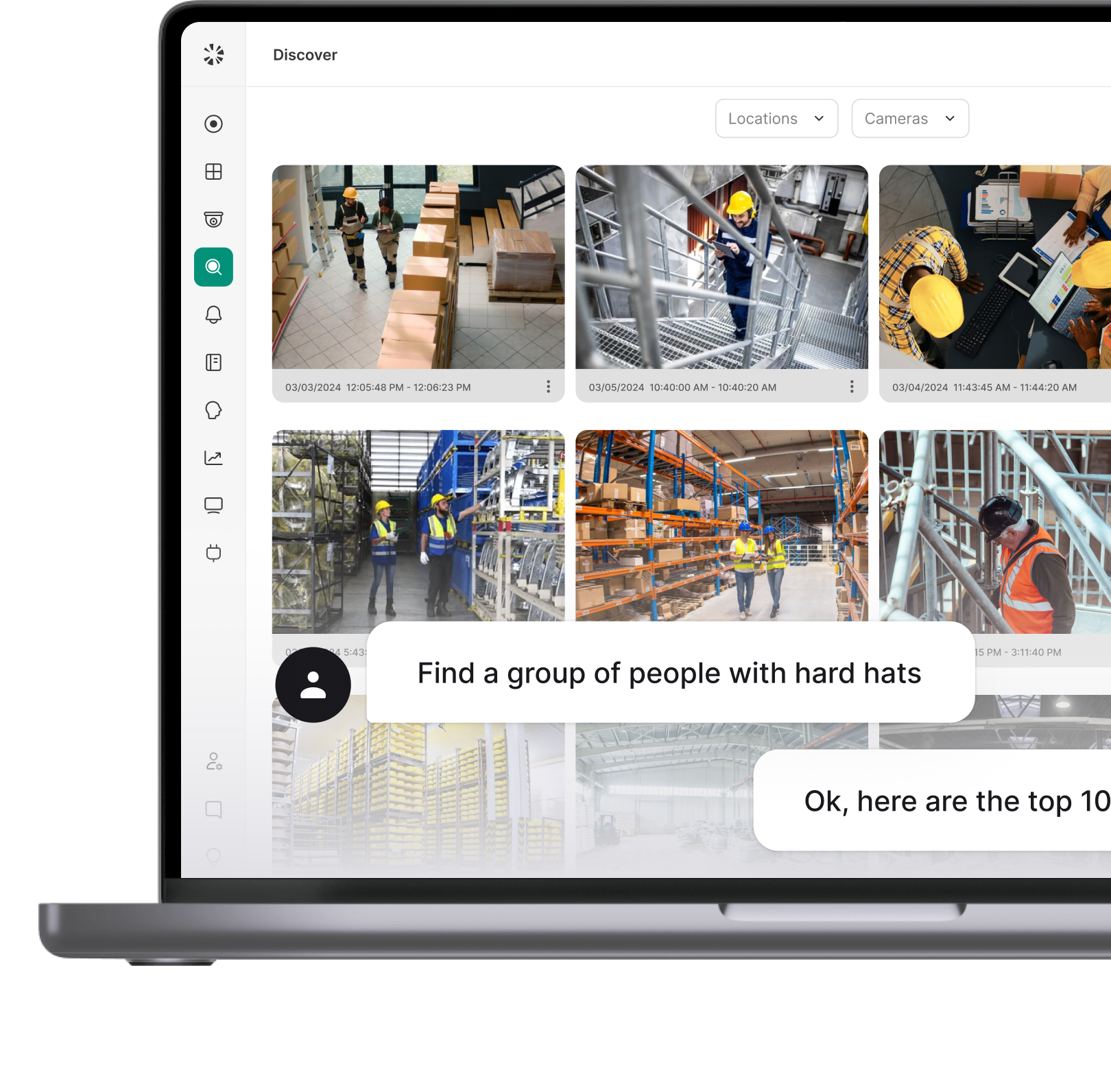
All CRUs and fixed Coram cameras appear in one dashboard with no separate login, no separate vendor relationship, and no replatforming cost when a site wraps.
Limitations:
As a newer platform, Coram has a shorter track record in the field than LVT or ECAMSECURE, which have decade-long managed monitoring histories. Buyers evaluating on vendor longevity alone should factor that in.
The CRU's value scales with the number of sites you're running. Buyers with a single long-term fixed deployment may not see the platform integration advantage as clearly as multi-site operations.
Pricing is not publicly listed; requires a demo request to get a quote.
2. LiveView Technologies (LVT): Best for Retail and Parking-Lot Deployments Wanting a Hands-Off Managed Service
LiveView Technologies is the most-deployed MSU brand in the US, built around long-duration fixed sites with bundled managed monitoring and a strong physical deterrent presence. The platform is optimized for retail loss prevention, parking lot operators, and municipalities where a unit stays in place for years and the buyer wants to hand off the monitoring problem entirely.
Best for: Retail loss prevention, large parking lot operators, and municipalities wanting a high-visibility, hands-off managed deployment at a fixed, long-term site.
Strengths:
Solar plus battery with optional smart generators for extended off-grid operation, with multi-carrier cellular and optional satellite backup for sites with limited coverage.
22-foot mast, blue flashing lights, and two-way audio give the unit a high-visibility deterrent presence that passive camera deployments don't match.
Remote activation of lights and speakers from the LVT app, without requiring a call to a monitoring center.
Forensic search across recorded footage via the LVT platform for post-incident investigation.
Limitations:
Contract structure is built for long-duration fixed sites. Setup, teardown, and redeployment costs stack up quickly for 6-to-9-month projects that move.
The LVT platform is closed. It does not integrate with outside VMS or permanent camera systems, so LVT deployments are always a separate security island.
Managed monitoring is typically bundled and required, not optional. Buyers with an existing SOC are paying for coverage twice.
Pricing: Subscription model, quoted per site. One public reference point: Oroville, CA, reportedly pays approximately $45,000/year per unit, though actual pricing varies by contract size and deployment type.
3. WCCTV / LotGuard: Best for Parking Lots and Vacant Property with a Fully Managed Service
WCCTV is the US arm of a UK-origin vendor with a parking-lot-focused product line and a fully managed service covering installation, monitoring, and monthly impact reporting. The LotGuard PRO is the primary unit for commercial property and parking applications.
Best for: Parking lot operators and commercial property managers wanting a single vendor to handle the full managed-service stack on long-term fixed deployments.
Strengths:
Up to four cameras per LotGuard PRO unit, including IR PTZ, thermal, LPR, and multi-sensor options, offering more camera configuration flexibility than most managed-service competitors.
4G/5G cellular, solar-powered, with a purchase option available for longer-term deployments.
Fully managed service includes monthly impact reporting, which gives property managers documentation for stakeholders and insurance.
Limitations:
Managed-service economics favor long single-site deployments. For rotating construction operations, the same redeployment cost problems apply as with LVT.
The platform is closed and does not connect to outside camera systems or VMS.
Pricing: Rental model by default; purchase available for longer-term needs. Quoted per deployment.
4. ECAMSECURE (ECAM): Best for Long-Tenured Deployments Wanting an Established Managed-Service Provider
ECAMSECURE is one of the original mobile surveillance tower companies, operating in this category for over 20 years. The platform offers AI-enhanced detection with proactive operator response across both solar and powered configurations, suited for buyers who weigh vendor longevity heavily in their evaluation.
Best for: Organizations with stable, long-tenured deployments at a small number of fixed sites, who value vendor track record over platform flexibility.
Strengths:
HD cameras with integrated lighting and AI-enhanced detection with operator intervention tools.
Managed service across solar and powered configurations, with an established monitoring operation and a 20-plus-year field deployment track record.
Suited for buyers whose procurement process weights vendor longevity as a significant factor.
Limitations:
Same structural economics as LVT and LotGuard: the model favors duration and single-site stability. For rotating or multi-site deployments, costs compound.
Limited integration with outside camera systems.
Less AI detection depth than platform-first alternatives; no natural language search, no EMS integration.
Pricing: Quoted per deployment.
5. Mobile Pro Systems: Best for Buyers Who Want to Own Ruggedized Trailers
Mobile Pro Systems manufactures ruggedized mobile surveillance trailers for law enforcement, DOT, emergency management, and enterprise security teams that want to own hardware outright. This is a hardware play: you're buying a chassis and configuring it with your own software stack.
Best for: Law enforcement, DOT, emergency management, and large enterprise security operations that need rugged field-grade hardware they own outright and will configure with their own software stack.
Strengths:
Purpose-built chassis for long deployment life in demanding field environments, configurable for security, network, and communications payloads.
Purchase model with no mandatory software or monitoring contract, giving full flexibility over the platform and monitoring setup.
Solar options available; suited for remote or off-grid deployments requiring ruggedized hardware that less hardened trailers can't handle.
Limitations:
Mobile Pro is a hardware manufacturer, not a platform. Buyers are responsible for sourcing and integrating their own VMS, AI detection, monitoring operation, and operator workflows. Without an existing video platform to pair it with, the integration burden is real.
No managed monitoring, no bundled AI, and no cloud dashboard out of the box.
Pricing: Purchase model; quoted per configuration.
How to Choose the Right Mobile Surveillance Unit Provider
The decision comes down to four scenarios.
Multiple construction sites or rotating crews. Coram's CRU is the strongest fit. The unit deploys without on-site infrastructure, AI verifies alerts in the cloud so detection quality doesn't degrade on remote sites, and every CRU appears in the same Coram dashboard alongside your permanent cameras. When a site wraps, the unit moves without replatforming costs. For buyers who already own trailer hardware, the Coram Point Mini delivers the same AI stack as a retrofit.
A fixed retail or parking lot deployment for the long term. LVT or WCCTV/LotGuard. Managed monitoring is bundled, deterrent presence is strong, and the long single-site duration absorbs the rental economics. LVT has more brand recognition and a larger retail track record. WCCTV/LotGuard has more flexibility in camera configurations and serves parking operations specifically.
Buying hardware outright with your own software. Mobile Pro Systems for the chassis. Come in knowing exactly what VMS and AI platform you're pairing with it; the trailer does not include detection software.
Undecided between an MSU and a permanent camera. For sites active for more than two to three years, permanent solar-powered cameras with cloud AI are typically more cost-effective per month and easier to maintain. The Coram platform runs both: deploy CRUs when the site opens, transition some to permanent installs as the operation stabilizes, without changing platforms or retraining your team.
The Right MSU for Your Operation
The wrong MSU is the one that was built for someone else's operation. Signing the most-marketed brand without checking site duration, monitoring model, and platform fit is how security managers end up locked into contracts that don't match how their sites actually run.
For construction security managers running rotating crews across multiple sites, the platform-first approach wins on every variable that matters after day one: faster redeployment, fewer vendor relationships, and one dashboard for every camera your organization runs.
The Coram CRU is built for that model, and the Coram Point Mini covers buyers who already have the trailer hardware.Book a demo with Coram to see how the CRU fits your site configuration.
FAQ
What Does a Mobile Surveillance Unit Typically Cost?
Do I Need a Monitoring Service Contract with My MSU?
What's the Difference Between an MSU and a Permanent Solar-Powered Camera?
Can MSUs Operate Fully Off-Grid?
How Fast Can an MSU Be Deployed?
Can I Use My Own Video Management Software with an MSU?
What's the Typical AI False Alarm Rate?
Should I Rent, Buy, or Retrofit an Existing Trailer?






.png)