CENTEGIX is a campus safety platform built around wearable panic badges. Staff carry a device throughout the facility, press it when they recognize a threat, and the system responds through a proprietary wireless network, activating strobes, intercoms, and alerts across the building. It's a well-deployed system with a proven track record. It also has a structural limitation that no hardware upgrade fixes: detection still depends on a human. Someone has to see the threat first.
That limitation is what drives most districts to evaluate CENTEGIX alternatives. Some are looking for a better version of the same model: lower per-badge cost, stronger coverage, or a system that runs on smartphones rather than proprietary hardware. Others want to move detection upstream entirely, using AI on existing IP cameras to identify firearms, unauthorized access, or other threats automatically before anyone in the building reacts. And some districts have a different exposure point altogether: the entry door, not the hallway.
This guide covers all three approaches, compares the leading platforms in each category, and explains which situations each one actually fits.
Understanding the Four Categories
The platforms in this guide fall into four distinct categories of campus safety platform.
Wearable Staff Panic Buttons — the category CENTEGIX belongs to. Staff wear a device, press it when they recognize a threat, and the system triggers a response. Other vendors in this category, such as Rave Mobile Safety and CrisisGo, differ from CENTEGIX primarily in network architecture, app-based deployment options, and pricing structure. The tradeoff that doesn't change regardless of vendor: detection still depends on a human.
AI Camera-Based Threat Detection — platforms in this category run computer vision on existing IP camera feeds to detect visible threats automatically, without waiting for someone to press a button. For districts that already have a modern IP camera infrastructure, platforms like Coram and IntelliSee can deliver faster response outcomes without adding new hardware or a parallel proprietary network. The same camera-first approach applies outside schools too, including weapons detection in hospitals.
Mass Entry Weapons Screening — a different exposure point entirely: the moment someone enters a building, before they reach staff or students. Evolv Technology uses sensor arrays at entry points to flag concealed weapons without requiring individuals to stop or empty their pockets. It doesn't replace an in-building response system, but it moves the detection window earlier in the threat timeline than any camera or wearable system can.
Mobile App Panic Buttons — the lightest-weight category in terms of infrastructure. Staff use an app on existing smartphones to trigger alerts to administrators, staff, or law enforcement. Deployment is fast and hardware costs are minimal. The limitation is the same as wearables: someone has to recognize the threat and act, and response depends on staff having their phone accessible at the moment it matters.
Quick Comparison: Detection Model and Fit
Every platform on this list solves a different part of the threat timeline. This table shows where each one sits on detection model, infrastructure requirements, and operational fit before the detailed entries. Several of these vendors also sell beyond education, and we cover retail gun detection technology separately.
7 Best CENTEGIX Competitors
Each entry below covers what the platform does, where it fits, and what to weigh before committing to it.
1. Coram

Coram is an AI-native physical security platform that runs on existing IP cameras with no proprietary hardware and no new network required.
That's the most important thing to understand before evaluating it against CENTEGIX. Where CENTEGIX requires deploying badges, gateways, strobes, and a private wireless network across every campus, Coram connects to the IP cameras already mounted on your walls and adds AI detection on top. A Coram Point device at each site processes video locally, analyzing every frame in real time without sending footage to the cloud for analysis. Once a threat is detected, the Emergency Management System sends alerts across the organization immediately from the same platform.
The detection scope goes well beyond what a wearable system covers. Gun detection, unauthorized access, slip-and-fall, smoke, fire, overcrowding, and collision risk all run through the same cameras and the same platform. And because detection is camera-based rather than badge-based, the response workflow starts automatically. It doesn't wait for someone in the room to recognize the threat and react.
For districts that already have IP camera infrastructure deployed across campuses, Coram adds a meaningful detection capability without the per-badge, per-staff recurring cost that scales with headcount.
Best for: K-12 districts and multi-campus school systems with existing IP cameras that want to automate threat detection without deploying new hardware or a parallel proprietary network.
Strengths:
- Works with 1,000+ IP camera models — no rip-and-replace, no proprietary hardware purchase required to get started.
- Covers multiple threat types through a single platform: gun detection, unauthorized access, smoke, fire, slip-and-fall, overcrowding, and collision risk.
- The Emergency Management module continues working during internet outages with local processing and backup power support for access control systems.
- Camera-agnostic, NDAA-compliant, and deploys on existing infrastructure with per-camera pricing and no long-term contract lock-in.
- Natural language video search lets staff find any incident across hours of footage by describing it in plain English.
Limitations:
- Detection quality depends on existing camera placement and coverage — some areas may need infrastructure adjustments for full visibility before all detection models perform well.
- Districts that want staff-worn panic devices can add Coram wearable panic buttons to the same Emergency Management system.
Pricing: Quote-based.
2. ZeroEyes

ZeroEyes is an AI-powered visual gun detection platform that layers onto existing IP cameras to identify brandished firearms in real time. After detection, images route immediately to the ZeroEyes Operations Center (ZOC), where former military and law enforcement personnel verify the threat before dispatching alerts to onsite staff and 911 dispatch (typically within 3 to 5 seconds of detection).
The human verification step is the defining characteristic of the platform. Every alert is reviewed before anything fires, which reduces false positives and adds a layer of accountability that fully automated systems don't provide. ZeroLink allows the platform to operate fully off-network, making it usable in portable classrooms, athletic facilities, and other locations with inconsistent connectivity.
Where ZeroEyes diverges from CENTEGIX most sharply is on detection timing: a wearable badge requires a staff member to recognize a drawn weapon and press a button; ZeroEyes detects the weapon at the camera level and routes a verified alert to dispatch before anyone in the building has necessarily registered what happened. The tradeoff is scope. ZeroEyes is narrowly focused on visible firearms. Concealed or holstered weapons, unauthorized access, environmental hazards, and other threat types sit outside the detection window.
Best for: Higher education, healthcare facilities, government campuses, corporate environments, and districts whose primary board-level mandate is active shooter prevention with human-verified alerts before any response triggers.
Strengths:
- Every alert is reviewed in-house by former military and law enforcement personnel, reducing false positives and adding accountability to the response chain.
- ZeroLink enables off-network operation, covering portable classrooms, athletic facilities, and other locations with intermittent connectivity.
- Includes active shooter drills, deployment consulting, and installation support, giving districts a tested response framework alongside the software.
- Active in over 1,000 locations across education, healthcare, and government.
Limitations:
- Only detects visibly brandished firearms — concealed or holstered weapons remain outside the detection window until drawn.
- Narrowly focused on gun detection; does not cover unauthorized access, environmental hazards, slip-and-fall, or other threat types.
Pricing: Per-camera, quote-based. A camera assessment is required to submit a pricing request.
3. Omnilert

Omnilert is an AI gun detection and emergency response platform that integrates with existing VMS, access control, and SOC infrastructure rather than replacing it.
The platform trains its AI on real-world footage rather than synthetic datasets, which the company attributes to lower false positive rates. It holds a DHS SAFETY Act designation covering both gun detection and emergency response workflows, which can carry weight for districts navigating liability discussions or insurance requirements.
Like ZeroEyes, Omnilert moves detection earlier in the threat timeline than any staff-initiated system. Unlike ZeroEyes, it routes alerts through human verification, with escalation set by district policy, and its integration with access control and VMS systems allows it to trigger lockdown responses directly alongside emergency notifications. The tradeoff is the same as ZeroEyes: the platform is heavily optimized around visible firearm detection. Camera placement, coverage quality, and line-of-sight visibility determine how much of the campus it can actually protect.
Best for: Healthcare systems and public sector organizations with modern IP camera infrastructure that want automated gun detection without deploying wearable panic hardware or rebuilding their existing security stack.
Strengths:
- AI trained on real-world footage rather than synthetic data, which the company cites as a factor in lowering false positive rates.
- Integrates with major VMS, access control, command center, and monitoring systems, enabling deployment without replacing existing infrastructure.
- DHS SAFETY Act Designation covers both gun detection and emergency response workflows — relevant for districts managing liability and risk exposure.
Limitations:
- Heavily optimized around visible firearm detection — value depends on camera placement, coverage quality, and line-of-sight visibility.
- Scope is limited to gun violence prevention and automated response; it is not a full-spectrum campus security platform.
Pricing: Quote-based.
4. Rave Mobile Safety (Motorola Solutions)

Rave Mobile Safety is an emergency communication and coordination platform focused on mass notification, real-time collaboration, and multi-agency response during crisis events. It spans schools, universities, hospitals, corporations, and public safety agencies, covering emergency alerts, incident collaboration, business continuity communication, and operational notifications.
Rave sits in a different part of the threat response workflow than most platforms on this list. It doesn't detect threats. It coordinates response once a threat has been identified. That makes it most useful for districts with established detection infrastructure that need to improve how notifications reach staff, how administrators coordinate during an incident, and how multiple agencies communicate in real time. The platform's multi-agency coordination workflows connect school staff, administrators, emergency responders, and 911 teams inside the same incident communication environment, which is where it does its best work.
The limitation relative to CENTEGIX is structural: Rave still depends on someone reporting or recognizing the threat before emergency workflows begin. It improves response coordination, not detection timing. For smaller districts, the platform's module depth can also create more configuration complexity than a single-purpose tool requires.
Best for: Universities, healthcare systems, and public sector organizations with established security infrastructure that need stronger emergency communication and coordination across multiple teams and agencies.
Strengths:
- Multi-agency coordination connects school staff, administrators, emergency responders, and 911 teams inside a shared incident communication environment.
- Covers the full emergency lifecycle: preparedness, mitigation, response, recovery, and operational continuity beyond active threat notification.
- Deploys through existing mobile devices and communication systems without requiring a dedicated wearable network rollout.
Limitations:
- Detection is still reactive — the platform depends on someone reporting or recognizing the threat before emergency workflows start.
- The number of modules, workflows, and communication configurations can create operational complexity for smaller districts without dedicated staff to manage them.
Pricing: Quote-based. Final cost depends on district size, user count, communication volume, and the specific modules deployed.
5. CrisisGo
CrisisGo is a school and business safety platform built around communication, coordination, and response across every phase of an emergency. On the hardware side, it offers ECHO, a wearable panic badge, and CrisisGo Connect, a cross-agency coordination layer that bridges schools with PSAPs, police, fire, and EMS on a shared real-time platform.
The defining feature is CrisisGo Connect's ability to send geo-targeted alerts across connected schools in a specific area without relying on separate communication chains. For multi-campus districts, this means first responders can receive location-specific alerts that span schools without needing to coordinate through multiple systems. The platform also supports student reunification and accountability workflows after an incident, which few other platforms in this category address.
CrisisGo is explicitly infrastructure-agnostic on the detection side. It can integrate with CENTEGIX, Rave, and AI camera platforms rather than replacing them. That makes it most useful as a coordination and lifecycle management layer rather than a detection-to-response replacement. Districts evaluating it as a direct CENTEGIX alternative should note that CrisisGo doesn't offer native AI camera-based threat detection; integration with camera platforms requires a third-party AI security partner.
Best for: K-12 school districts and multi-campus organizations that need cross-agency coordination and a full emergency management lifecycle platform spanning preparedness through post-incident recovery.
Strengths:
- CrisisGo Connect sends geo-targeted alerts across connected schools to first responders on a shared real-time platform, without separate communication chains.
- Covers preparedness, prevention, response, and recovery workflows, including student reunification and accountability after an incident.
- Agnostic to existing emergency management systems — integrates with platforms like CENTEGIX or Rave without requiring a full infrastructure replacement.
Limitations:
- No native AI camera-based threat detection; integration with AI detection platforms requires dedicated security partners, not the camera hardware itself.
- The platform's feature breadth means configuration and rollout can be more involved than single-purpose tools, particularly for districts with limited IT resources.
Pricing: Custom, quote-based.
6. IntelliSee
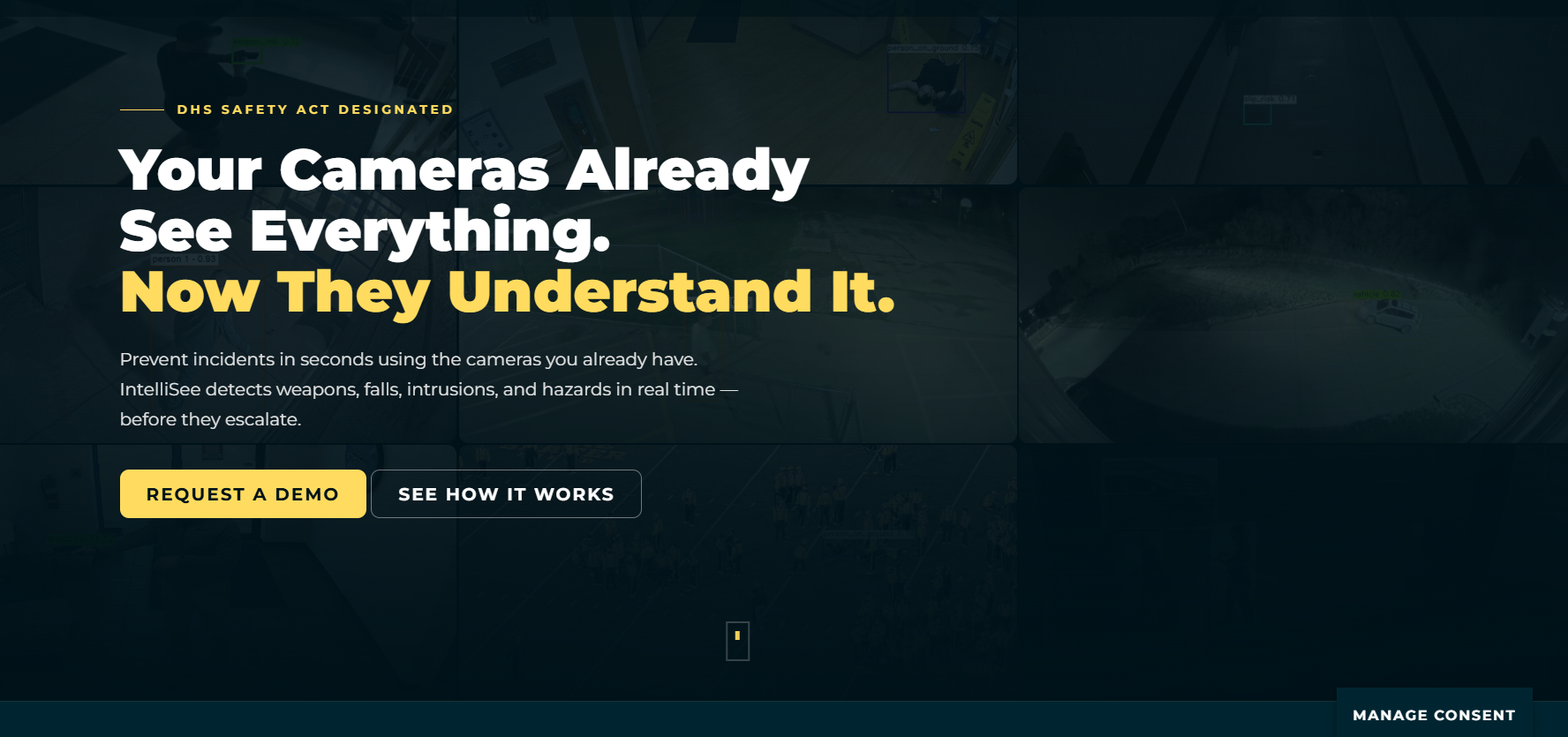
IntelliSee is an AI-powered computer vision platform that runs multiple threat detection models on existing IP cameras through a single secure 1U on-premises appliance. Verified alerts route in under five seconds through existing notification infrastructure: mass notification, PA lockdown, or directly to 911 via RapidSOS, configured at the zone level with custom escalation paths per facility.
The platform's breadth distinguishes it from narrowly focused gun-detection tools. Gun detection, unauthorized access, behavioral anomalies, and other threat types all run through the same appliance and the same alert infrastructure. New detection capabilities deploy automatically without requiring new hardware or reinstallation. All video processing stays inside the local network perimeter, which supports districts with stricter student privacy and data governance requirements. The platform also supports Alyssa's Law compliance directly.
Relative to CENTEGIX, IntelliSee represents a full shift in the detection model: camera-based and automatic rather than wearable and staff-initiated. The setup requires an on-premises appliance and zone-level configuration, which adds more initial overhead than plugging in a cloud-native platform. For districts whose threat profile extends beyond firearms, IntelliSee's multi-detection approach covers more of the campus safety picture than ZeroEyes or Omnilert.
Best for: K-12 and higher education, healthcare, senior living, manufacturing, and municipalities that need multi-threat detection across existing cameras with strong privacy controls and Alyssa's Law compliance.
Strengths:
- Runs multiple detection models simultaneously through a single on-premises appliance — gun detection, unauthorized access, behavioral anomalies, and more from the same infrastructure.
- All video processing stays inside the local network perimeter, supporting districts with strict student privacy and data governance requirements.
- Supports Alyssa's Law compliance and integrates directly with lockdown, mass notification, and 911 systems to trigger response channels from a single detection event.
- New detection capabilities deploy automatically without requiring new hardware or reinstallation.
Limitations:
- Broader safety coverage means it is less specialized than ZeroEyes or Omnilert for districts whose only mandate is active shooter detection.
- Deployment requires an on-premises appliance and zone-level configuration, which adds more setup overhead than cloud-native alternatives.
Pricing: Quoted based on camera count and the specific detection types required.
7. Evolv Technology
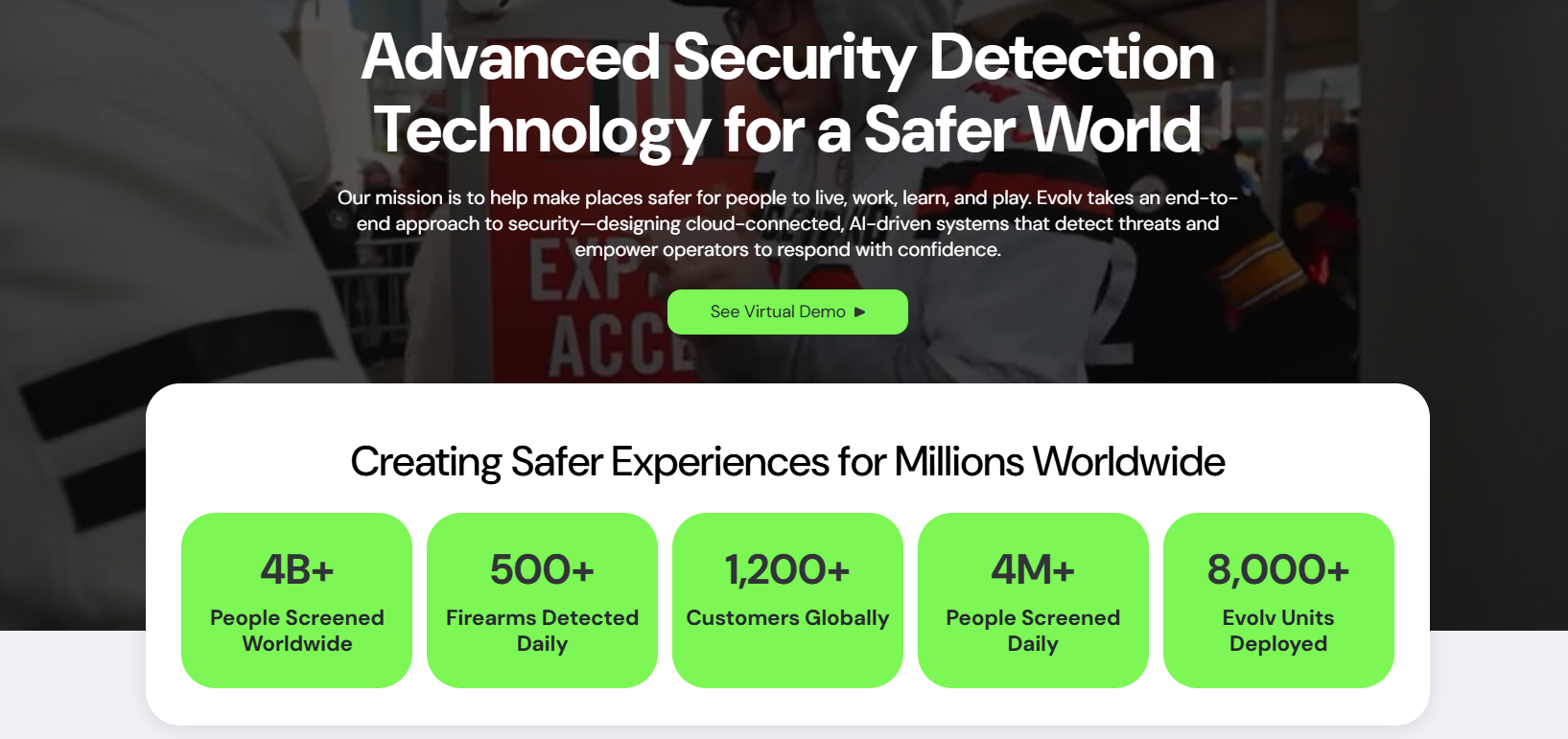
Evolv Technology is a weapons-screening platform that uses sensor arrays at building entrances to detect concealed weapons before people enter, without stopping individuals or requiring bag checks. It integrates with access control, VMS, and mass notification systems through an open API, and is currently deployed across more than 1,500 school buildings in the US.
The operational profile is defined by throughput: Evolv can screen up to 1,000 people in 15 minutes, making it suited for school arrivals, athletic events, and assemblies where individually screening every person would create bottlenecks. When a threat is detected, the platform identifies the exact location on the body, which reduces manual searches and improves consistency during secondary screening.
Evolv doesn't replace an in-building response system. Once someone is inside the facility, a separate detection or response layer is still required. The platform also carries a notable disclosure: in 2024, Evolv settled FTC allegations related to K-12 marketing claims and updated its marketing practices, which some districts may need to consider as part of the evaluation.
Best for: Stadiums and arenas, athletic events, houses of worship, college campuses, and healthcare facilities where high-volume entry screening is the primary security exposure.
Strengths:
- Screens up to 1,000 people in 15 minutes — purpose-built for high-volume entry points like school arrivals, athletic events, and assemblies.
- Pinpoints the exact location of a detected threat on the body, reducing manual searches and improving secondary screening consistency.
- Holds DHS SAFETY Act Designation and publishes third-party testing results, giving districts documented performance data for board and insurance discussions.
- Deployed across more than 1,500 school buildings in the US.
Limitations:
- Only screens at entry points — districts still need a separate in-building detection or response system once someone is inside the facility.
- In 2024, Evolv settled FTC allegations related to K-12 marketing claims and updated its marketing practices, which some districts may need to factor into their evaluation.
Pricing: Quote-based.
How to Choose Among CENTEGIX Alternatives
Start with your infrastructure and your threat profile: those two factors narrow the field faster than any feature comparison.
If your district already has modern IP camera infrastructure deployed across campuses, the most direct path to automated detection is Coram or IntelliSee. Coram covers the broadest threat range with a fully automated detection-to-response workflow. IntelliSee is the stronger fit if privacy controls and on-premises processing are requirements, or if Alyssa's Law compliance is a factor in your state. For a camera-focused shortlist with K-12 buying criteria, see our guide to gun detection systems for schools.
If your district has a board-level mandate specifically around active shooter prevention and wants human-verified alerts before any response fires, ZeroEyes is the most purpose-built option. For the same mandate without the human verification layer, Omnilert's integration depth with existing VMS and access control infrastructure makes it worth evaluating.
If your district has a board-level requirement for staff-worn hardware, CrisisGo is the most flexible option. It runs off existing smartphones rather than proprietary badges, which reduces hardware cost and simplifies rollout. It also integrates with existing systems rather than replacing them.
If your district's biggest exposure is high-volume entry points (athletic events, school arrivals, assemblies), Evolv addresses a different threat window than every other platform on this list. It doesn't replace an in-building response system, but it moves detection earlier than any camera or wearable can.
No Single Platform Fits Every District
The structural limitation of any staff-initiated system — badge, app, or wearable — is that detection depends on a human recognizing the threat and acting before the situation escalates. That's not a criticism of CENTEGIX specifically. It's the defining constraint of the entire category.
The more useful question for most districts is what detection model actually fits the infrastructure and threat profile you're working with. If IP cameras are already deployed across your campuses, AI-native platforms like Coram can add automatic detection and emergency response without new hardware or recurring per-badge costs. If the primary board mandate is entry-point security, Evolv addresses a window that cameras and wearables don't reach. If the mandate is improved coordination rather than earlier detection, CrisisGo or Rave may be the right fit alongside whatever detection system you already run.
No single platform on this list is the right answer for every district. The right one depends on where your current infrastructure ends and where your threat timeline actually starts.





.png)