The architecture decision you make today determines your negotiating position in year five. With open IP cameras running on ONVIF and RTSP standards, you can swap your video management system (VMS), change analytics vendors, or expand your camera fleet without replacing hardware. With Verkada, you get a tightly integrated system where one vendor owns every layer, but migrating off means replacing cameras, not just software.
Neither architecture is wrong. But they have different failure modes, and the one that matters most is the one that shows up when your requirements change.
This guide compares open IP cameras and Verkada on TCO, lock-in, deployment overhead, and long-term flexibility. It also covers a third option that captures the operational simplicity of a closed platform without the hardware commitment.
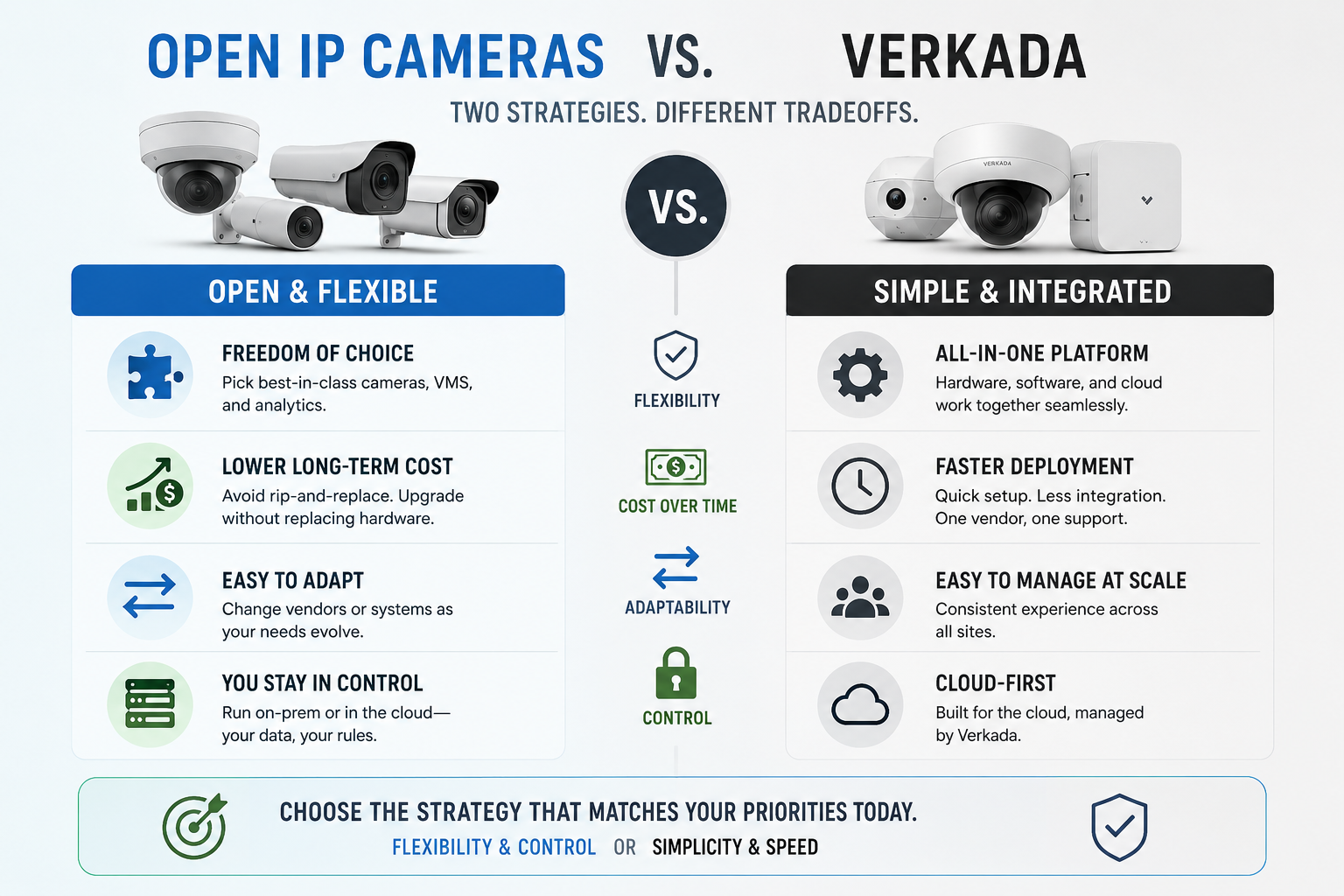
Open IP Cameras vs. Verkada: Two Strategies, Two Tradeoffs
The distinction between open and proprietary security camera architectures isn't primarily about features. It's about what your hardware commitment actually is.
An open IP camera strategy is a surveillance architecture where cameras communicate over ONVIF and RTSP standards and the VMS is selected independently from the hardware. That separation lets you choose cameras and your video management system independently, from different vendors, at different price points, on different replacement cycles. The architecture optimizes for freedom: you're not bound to a single vendor's hardware roadmap, licensing model, or cloud infrastructure.
Verkada is a closed ecosystem: a cloud-managed physical security platform where cameras, storage, analytics, and management are sold and operated as a single integrated stack. Cameras, storage, analytics, and management are tightly coupled inside a single cloud operating system: Verkada Command. There's no integration work between layers because there are no discrete layers to integrate. You deploy Verkada hardware, it connects to Verkada's cloud, and everything is managed from one place. The architecture optimizes for operational simplicity: one vendor, one support path, one upgrade cycle.
The real tradeoff isn't features. It's how much integration freedom you're willing to exchange for turnkey consistency. That tradeoff is embedded in the hardware from day one.
Where Open IP Cameras Win
The primary advantage of an open architecture is that hardware decisions and software decisions stay decoupled. That has direct TCO implications.
When you upgrade or change your VMS, your cameras stay. When you want to add AI analytics, you add a layer above the camera rather than replacing the camera. When a manufacturer releases a better sensor at a lower price point, you can buy it and add it to the same management platform. Cameras, cabling, PoE infrastructure, and mounts can often remain in service across multiple platform generations, which is where the long-term cost advantage accumulates.
Open architectures also give you real procurement leverage. You can evaluate VMS vendors on AI capability, support quality, and pricing independently of your camera hardware choices. If your current VMS raises prices or stops meeting your needs, switching doesn't require a hardware refresh.
The honest cost is upfront integration work. You select cameras, a VMS, and storage architecture separately, and you own the interoperability between those layers. For a lean IT team without a capable integrator, that's a real consideration. For organizations with existing camera infrastructure and budget sensitivity around capex, the math still tends to favor open architecture by year three.
Where Verkada’s Closed Strategy Wins
Open architectures optimize for flexibility. Verkada optimizes for operational simplicity. For some environments, that's the right trade.
When every layer (hardware, firmware, analytics, cloud management) is designed by the same vendor, integration troubleshooting largely disappears. There's no question of whether a camera model is fully supported by the VMS, or whether a firmware update on one layer breaks something on another. When something doesn't work, there's one support call. That accountability model has real value for IT teams managing security alongside a full stack of other infrastructure.
Verkada also makes multi-site standardization easier to execute. Rolling out consistent hardware, policies, and management workflows across dozens of locations is simpler when every site runs identical equipment on a common platform. Verkada's enterprise scaling is a recognized strength: the platform supports SSO, SAML, and SCIM, and is used across large multi-site deployments where IT needs centralized control without site-by-site configuration. For greenfield deployments where no existing cameras are in place, the TCO gap between open and closed narrows considerably: you're not preserving existing hardware value either way, and the operational overhead savings start immediately.
The tradeoff is that you're making a long-term commitment to a single vendor's roadmap and pricing at the moment you install the first camera.
Long-Term TCO: Where the Math Diverges
Real cost differences between these architectures tend to surface at year three, year five, and year seven, particularly when you start modeling the cost of change.
Subscription Dependency
Verkada's core functionality is tied to active cloud licenses. When licenses expire, there's a 30-day grace period before access to Verkada Command is cut off (including device configuration and management). There's no right to continue using the software after the subscription term ends. For organizations that treat security infrastructure as long-lived capital, this is worth modeling explicitly: the annual subscription is a permanent operational cost, not a one-time purchase.
Lock-In at the Hardware Layer
Vendor lock-in with Verkada starts in the camera, not the contract. Verkada cameras don't output ONVIF or RTSP streams that a competing VMS can consume. A platform migration means replacing camera hardware, not just software. That switching cost is embedded in the architecture from the day the first camera goes on the wall.
Verkada can ingest third-party cameras through its Command Connector, but those cameras operate with reduced feature parity, not full access to Verkada's AI analytics or management capabilities.
Open Architecture Math
An open camera strategy carries more integration effort upfront. Over time, the economics look different. Cameras and physical infrastructure can stay in place through platform changes. If a different VMS offers better AI, better pricing, or better support in year four, you migrate the software layer — not the hardware. That's the structural TCO advantage of a decoupled architecture, and it compounds over longer hold periods.
The question worth asking before choosing an architecture: what's your acceptable cost if this platform stops meeting your needs in year five? If the answer is low, that constraint should drive the decision before anything else.
Open IP Cameras vs. Verkada: Side-by-Side
A Third Option: Open Architecture with Turnkey AI
The appeal of Verkada's closed platform is real: single-pane management, no integration work, one support relationship. The problem is that Verkada bundles that simplicity with proprietary hardware you can't exit without a full replacement cycle.
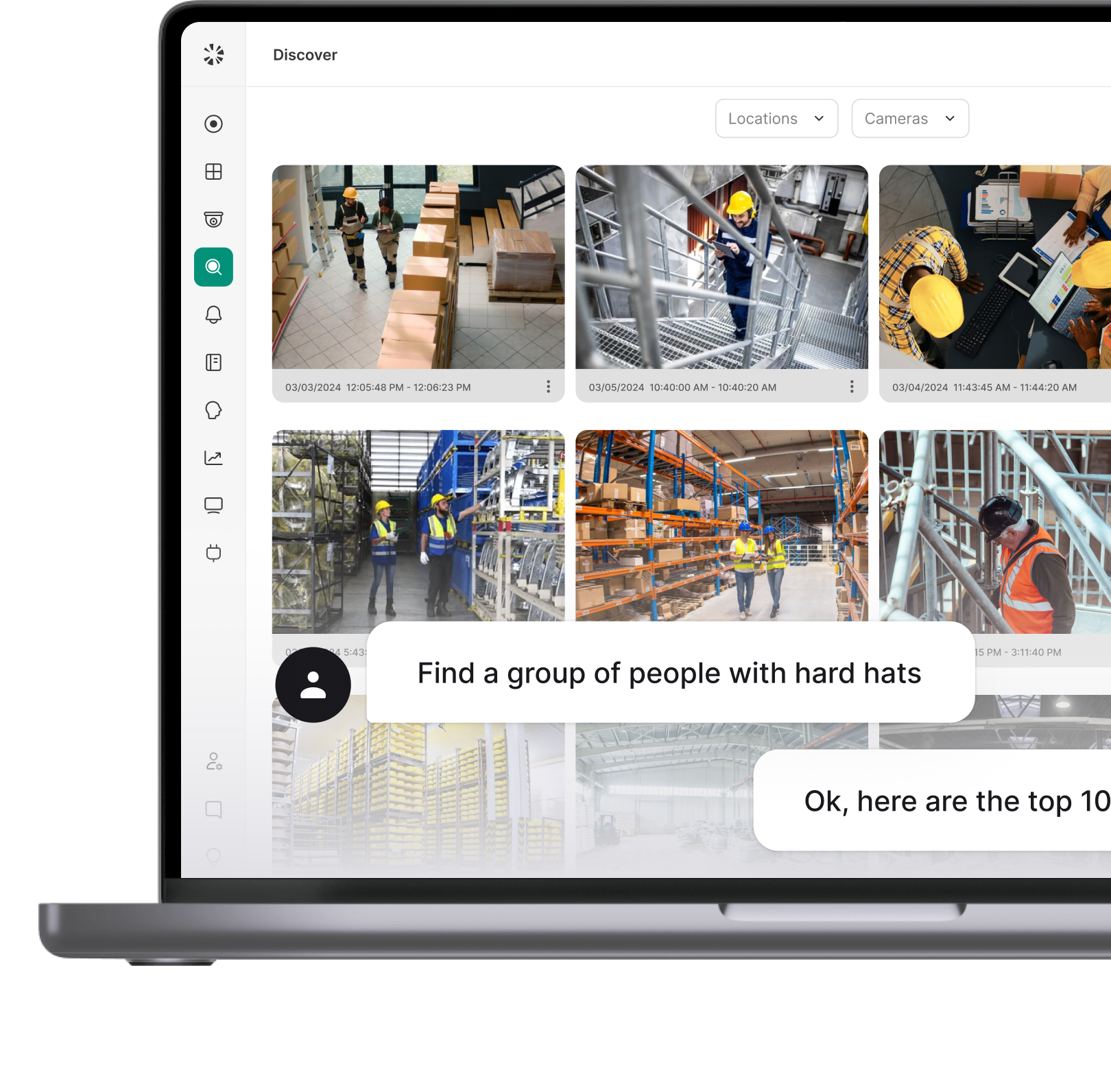
Coram is a camera-agnostic AI security platform that works with any existing IP camera (no hardware swap required). Organizations running Axis, Hikvision, Dahua, or a mixed fleet from a previous system can connect those cameras to Coram and get AI analytics, natural language video search, real-time detection, and centralized management without replacing the hardware that's already on the wall.
The Coram Point on-prem AI NVR runs AI processing at the site level, so local video access, alert generation, and device management continue functioning if the cloud connection is interrupted. The broader platform covers video surveillance, access control, emergency management, and visitor management from a single dashboard: the unified experience that makes closed platforms attractive, without the lock-in embedded in Verkada's architecture.
One honest note: ONVIF feature behavior varies by camera model and manufacturer, and specific capabilities should be verified per device before deployment.
For a full architectural comparison, see Closed vs. Open Ecosystems in Security Systems.
How to Choose for Your Environment
The right architecture depends on your existing infrastructure, IT bandwidth, and how much flexibility you need to preserve. Three scenarios where the decision is clear:
You have existing IP cameras and want to control capex. A camera-agnostic platform lets you keep that investment and add AI and centralized management on top. You avoid a full hardware replacement and preserve vendor choice for future refreshes. The open or hybrid path is the obvious call.
You're replacing an end-of-life system and want one vendor to own the stack. If you're doing a full hardware replacement anyway and internal IT bandwidth is the primary constraint, a closed platform like Verkada may operationalize faster. The TCO gap narrows when there's no existing camera value to preserve, and the operational simplicity is real. If that's your situation, it's worth evaluating the full set of Verkada competitors and alternatives rather than defaulting to one name.
You want to keep existing cameras and still get turnkey AI. If neither a full replacement nor a DIY open stack fits, a camera-agnostic platform with on-prem AI gives you both. You keep the hardware, avoid lock-in, and get a single-pane experience without building the integration yourself.
A 5-Question Architecture Self-Assessment
These are the questions worth working through before finalizing your surveillance architecture:
How much of your existing camera fleet is ONVIF or RTSP-compliant? If most of it is, a camera-agnostic platform preserves that hardware value. If you're starting from scratch, a closed platform loses less by comparison.
What happens to your operation if your surveillance vendor raises subscription pricing 30% at renewal? Open architecture gives you the option to migrate software without replacing hardware. Proprietary hardware eliminates that leverage from the negotiation.
How much internal IT bandwidth do you have for integration and ongoing support? Limited bandwidth favors a closed turnkey stack. Sufficient bandwidth — or a capable integrator — makes open architecture viable and lower cost over time.
Are you doing a full end-of-life hardware replacement, or adding capability to an existing fleet? Full replacement narrows the TCO gap between open and closed. An existing fleet tilts the math heavily toward camera-agnostic.
What is your acceptable exit cost if this platform stops meeting your needs in year five? If the exit cost is a hard constraint, open or camera-agnostic architecture should drive the decision before anything else does.
The architecture that wins long-term is the one that keeps your options open when requirements change, and in most multi-site environments with existing camera infrastructure, that means decoupling hardware from software from day one.




.png)