Most schools already own the pieces. A locked front entrance. Cameras in the hallways. A binder with the emergency plan in it. A sign-in sheet at the front desk.
What most schools do not have is those pieces talking to each other.
That is usually the first thing a district technology director runs into. The camera system is one login. The door controller is another. Mass notification is a third, the visitor log is paper, and the drill records live in someone's inbox. When something happens, one person has to work four systems at once. When something has to be reviewed afterward, someone spends an hour finding one clip.
School safety measures fall into four layers:
- Physical security controls who gets into the building and what gets seen.
- Emergency preparedness determines what staff and students actually do when an alert goes out.
- School climate decides whether a concern gets raised before it becomes an incident.
- Cybersecurity protects the systems the other three layers run on.
The gaps are rarely inside a layer. They are in the handoffs between them: the alert that goes out but not to the substitute teacher, the camera that recorded the incident but took an hour to search, the drill that was documented in a system nobody opens during a real emergency.
This guide walks through all four layers, the measures inside each one, how to pay for them, and how to audit what you already have.
School Safety Measures at a Glance
Secure Building Access and Entry Control
Entry control is the layer schools have invested in most and the one that fails in the most ordinary ways: a propped side door, a substitute who does not know the badge procedure, a visitor who signed a sheet nobody read.
The measures themselves are well established. One monitored public entrance during school hours, with every other exterior door secured from the outside. A security vestibule where visitors can be identified before they reach students. Visitor management that verifies identity, prints a time-stamped badge, and notifies the host. Electronic locks and credential readers that can be managed and overridden centrally rather than door by door.
Coram is an AI native unified physical security platform that works with existing IP cameras and unifies Video Security, Access Control, Guest Management, and Emergency Management in one platform. Coram Access Control runs on on-site controllers wired to the door hardware a school already has, and it supports standard Wiegand and OSDP readers. A district can modernize doors without replacing what it already paid for.
For hardware selection, credential types, controller topology, and what to ask an integrator, start with our guide to access control systems for schools, or see how Coram access control systems handle multi-building districts.
Video Surveillance and AI Monitoring
Cameras are the measure schools buy first and get the least out of. Coverage is not the variable that matters most. Retrieval speed is.
Coverage still has to be right: entrances and exits, hallways, common areas, parking lots, playgrounds, and bus loading zones, audited on a schedule so blind spots get found before an incident finds them. But almost every district that already has cameras has a different problem. A fight in a stairwell gets reported Tuesday morning, and someone loses the rest of the day scrubbing timelines.
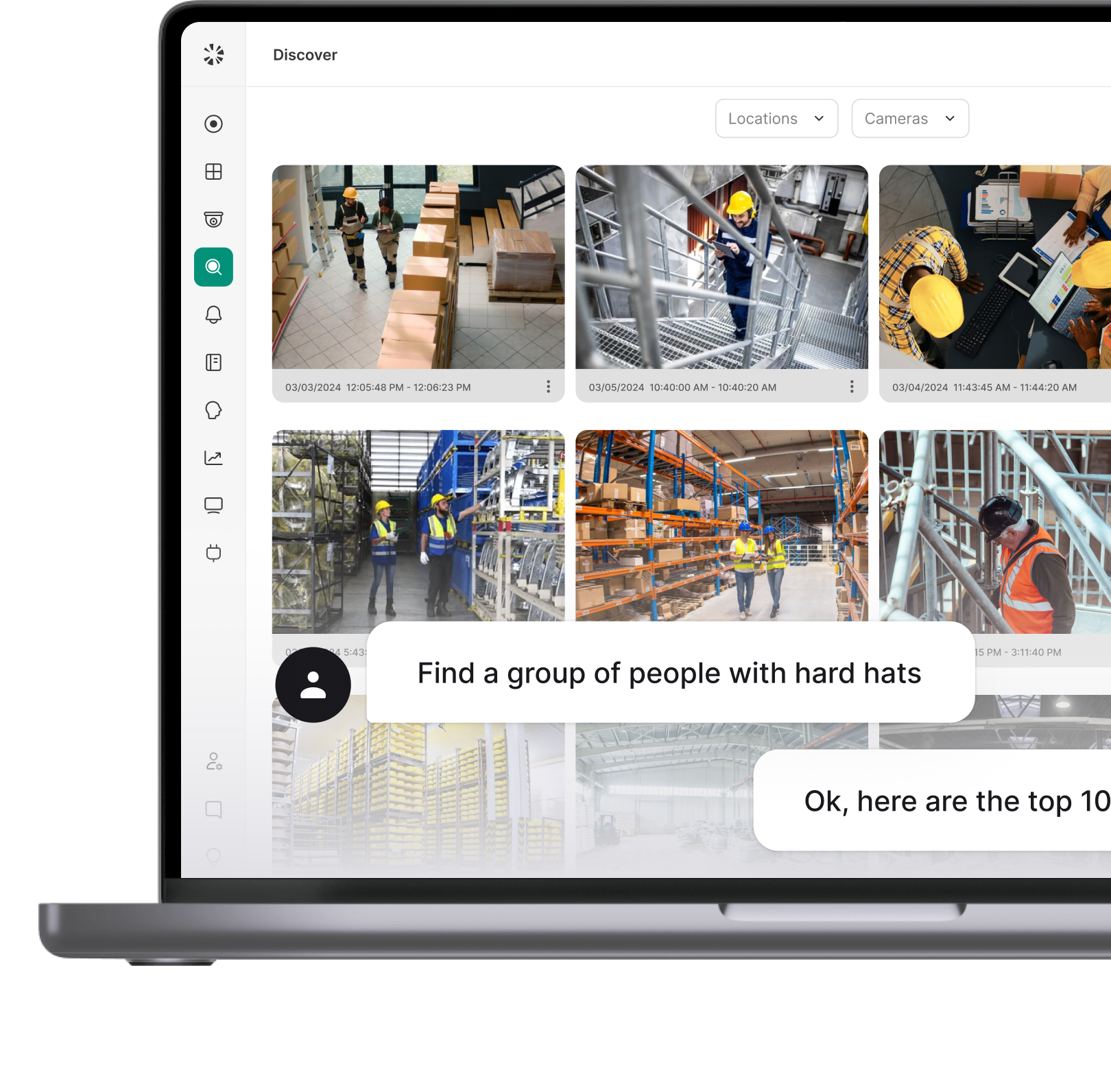
That is where AI monitoring earns its place. Coram's security cameras for schools analyze feeds as they come in rather than only recording them, with detections for firearms, objects, and license plates, and alerts on a defined catalog of events. Discover searches footage in plain language (by description, time window, or location). Journey Path follows a person across cameras. Deep Investigation pulls video, door events, and visitor records into one timeline for the incidents that need a real reconstruction.
On deployment, the question to ask a vendor is what happens to the cameras you own. Coram supports 150+ camera brands over ONVIF or RTSP, so most districts add AI monitoring to existing hardware instead of replacing it. Retention, camera health monitoring, and alert accuracy matter as much as sensor specs when you are choosing a video security platform you will keep for a decade.
Buses are the coverage gap most audits miss, since the fleet sits outside the building footprint entirely. If transportation is in scope, school bus camera systems belong in the same review as the campus cameras.
Weapons and Threat Detection
Entry screening catches weapons at the door. Most K-12 districts do not have screening at every entrance, or at every campus, and the ones that do still have a perimeter with sixty doors in it.
So in practice, the first indication of a weapon is usually a person. A student sees something. A teacher hears about it secondhand. That information then has to travel from a hallway to whoever can act on it, and the travel time is the part nobody plans for.
AI gun detection shortens that path by watching selected camera feeds across the campus rather than only at entrances. When an unholstered or threatening firearm appears, the system notifies designated recipients directly.
What to look for, and what Coram AI gun detection does:
- Detection on the feeds you choose, within seconds. An unholstered or threatening firearm on a selected camera feed triggers a notification to designated recipients within seconds, not after someone places a call.
- Critical Firearm Notifications. Firearm alerts can be configured to override Do Not Disturb, Focus, and silent mode on iOS, so the alert lands even on a muted phone. This applies to firearm alerts specifically.
- No new camera layer. Detection runs on supported existing feeds, which means nobody has to sit and watch video for it to work.
Two questions worth putting to any vendor in this category. First, what is the end-to-end time from appearance to notification, measured on your own network, not in a demo. Second, who receives the alert, and what happens if that person is teaching.
Emergency Communication and Mass Notification
Detection and response are connected only if the right people get the right information fast enough to act on it.
Panic buttons. A staff member needs a way to raise an alarm without making a phone call, because calling is often neither possible nor safe. Wireless panic buttons can be triggered from anywhere on campus and notify designated recipients with the location and the nature of the alert.
Direct connection to 911. This is the requirement most K-12 buyers are looking at when Alyssa's Law comes up in a board meeting. Coram Automatic Dispatch connects an emergency directly to 911 across all 50 states and DC. It is enabled per organization on request, requires a validated location address for each site, and is included in the Emergency Management SKUs. Alyssa's Law requirements differ by state and the list of states grows most legislative sessions, so check the current status against the Make Our Schools Safe tracker rather than a number in an article.
Campus-wide announcement. Broadcasting instructions to everyone at once should not depend on someone reaching a microphone. Most schools already own the hardware for this: IP speakers, a PA head end, digital displays, or a middleware platform like InformaCast or Centegix. Coram Emergency Management fires CAP webhooks that a school routes into that existing system, rather than replacing it.
Family notification. Parents need accurate information early, and administrators are the worst possible bottleneck for it during an active incident. The same webhook path applies: Coram sends CAP messages into the platform a district already uses for parent contact, such as Rave, Everbridge, Alertus, InformaCast, or ParentSquare. If you already pay for one of those, keep it.
First-responder information. When an emergency is activated, Coram shares the emergency details and location with dispatch, plus the triggering video clip when a camera alert started the emergency. Note what that does and does not include: Coram does not provide critical incident mapping, floor plans, or live activation mapping. If your state's version of Alyssa's Law requires mapping, as Georgia's does, that requirement has to be met by another system.
Emergency Preparedness: Drills and Response Plans
A plan in a binder is not preparedness. Preparedness is a substitute teacher knowing what "hold" means.
Start with shared vocabulary. The five actions of the Standard Response Protocol are Hold, Secure, Lockdown, Evacuate, and Shelter. SRP replaced the older term "Lockout" with "Secure" to reduce confusion with "Lockdown," and Shelter is always called with a named hazard and safety strategy (SRP K-12 Operational Guidance). Coram Emergency Management ships with those five as its default emergency types, so the words in a drill match the words in the platform.
Then practice. Drills should be age-appropriate: calm, simple instructions for younger students, and options-based drills for older students that walk through different response strategies. The April 2026 best practice guidance from NASP, NASRO, and Safe and Sound Schools is explicit that sensorial or simulation-based drills should never be conducted with students. Bringing first responders into a drill periodically surfaces the operational problems documents never show: a blocked exit, a radio dead zone, a door that unlocks the wrong way.
Run drills on the same platform you would run a real emergency on. An emergency management system that schedules, documents, and reviews drills in the same interface staff will use under pressure keeps compliance records in one place and removes the learning curve at the worst moment.
For the mechanics of each drill type and how to run one well, see types of school emergency drills and how to run a lockdown drill.
Student Accountability and Reunification
Two questions arrive within minutes of any evacuation: where is every student, and how do we get each one back to their family.
Student accountability is the harder of the two, and it is mostly an operational problem rather than a technology one. Roll call works until students are split across three locations, or a substitute does not know names, or half a class went to the gym before the alert. No platform answers this for you, Coram included: there is no real-time attendance sweep in the product, and roster data exists in Coram only as input to reunification. Whoever owns accountability in your plan needs a method that survives an unpredictable day, and it needs to be practiced.
Reunification is the half a system can carry. Done well, it is a documented handoff. Done without a system, it becomes a crowd in a parking lot and a real chance of releasing a student to an adult who was not authorized to take them.
Student reunification in Coram Emergency Management accounts for students during an emergency and records each release with a timestamp and the guardian selected. The conditions matter as much as the capability, and a district will find them during evaluation anyway:
- It is K-12 only.
- It requires an internet connection. It does not work offline.
- It needs a student roster, either through a Clever integration or a CSV upload. PowerSchool, Skyward, and Infinite Campus are on the roadmap, not in the product.
- Guardian verification is a step in the workflow rather than an enforced gate, so your procedure decides how strict the handoff is.
If reunification is a mandate in your state, ask every vendor these four questions in the same order.
School Climate: Anti-Bullying, Mental Health, and Threat Assessment
Locks, cameras, and plans deal with an incident. School climate decides whether a concern surfaces early enough that there is no incident to deal with. It is the layer with the least equipment attached to it, even though a physical security audit will never measure it.
Three things carry it. Anti-bullying work that lives in everyday practice rather than an assembly, where students know how to report and see reports handled consistently. Access to counselors, psychologists, and social workers, since early intervention needs both a person with capacity and a student who trusts them. And a behavioral threat assessment process that connects climate to security.
The Secret Service's National Threat Assessment Center recommends a multidisciplinary team for that process, drawn from teachers, counselors, coaches, school resource officers, mental health professionals, and administrators (NTAC, Enhancing School Safety Using a Threat Assessment Model, 2018). Requirements vary widely by state. Everytown Research counted 11 states requiring in-school threat assessment teams as of January 2026, while the Learning Policy Institute's October 2025 scan found 45 states with some form of threat assessment policy, requirement, or non-binding guidance.
The point of the process is intervention, not removal. NTAC's guidance is direct that taking a student out of school does not take the risk out of the school community, and randomized studies of the CSTAG model found students assessed under it were more likely to receive counseling and less likely to be suspended long term.
For prevention programs, reporting systems, and how threat assessment fits alongside physical security, see school violence prevention strategies.
Cybersecurity and Student Data Protection
Every measure above now runs on the network. Doors, cameras, alerts, rosters, visitor records. A district that hardens the building and leaves the platform running those systems exposed has moved the risk rather than reduced it, and the technology director usually owns both sides of that.
The practices that matter most:
- Require MFA on staff accounts, including the accounts that administer the security systems themselves. Those are the highest-value credentials in the district and the least likely to be covered by a general policy.
- Vet vendors on evidence, not claims. Ask any security or student-data vendor for a current SOC 2 Type II report and a written NDAA self-attestation. Coram is SOC 2 Type II audited. Note that NDAA compliance is a self-attestation by every vendor in this market; there is no such thing as "NDAA certified."
- Ask who owns the data and where it goes. Retention periods, deletion on contract termination, subprocessors, and whether footage or roster data is used to train anything.
- Train staff on phishing regularly, because the entry point in most district incidents is a person, not a firewall.
- Patch the connected devices too. Cameras, controllers, and NVRs run firmware, and it is the firmware nobody schedules.
- Review accounts quarterly. Disable inactive users, strip permissions from people who changed roles, and check who still has access after a resignation.
- Test the backups. A backup nobody has restored from is a plan, not a capability.
How to Build and Audit a School Safety Plan
A safety plan should shape how the campus operates daily, not sit in a shared drive until the annual review.
Build it with the right people. A plan written by one person reflects one person's view of the building. Effective plans pull in the principal, safety director, facilities manager, IT lead, school resource officer, district administration, local law enforcement, and emergency services. Counselors and mental health staff belong at the table too, because threat assessment and physical security have to connect somewhere, and that somewhere is this document.
Walk the campus as an outsider would. A physical security audit should evaluate the building from the perspective of someone trying to get in. Start at the perimeter and work inward:
- Can someone enter the building without passing a monitored entry point?
- Are all secondary entrances locked and alarmed during school hours?
- Do cameras cover entrances, exits, hallways, and common areas without significant blind spots?
- Can a staff member trigger an alert from any location on campus?
- Do the intercom and PA systems reach every space in the building?
- Are emergency procedures displayed in classrooms and key locations?
- Can classroom doors be secured quickly without a staff member stepping into the hallway?
- When an incident is reported the next morning, how long does it take to find the footage?
Walk-throughs surface things document reviews never do. Run a full walk-through audit annually, and again whenever buildings, technology, or campus layouts change. For the plan document itself, see our emergency operations plan guide.
How to Prioritize the Highest-Risk Gaps
No district closes every gap at once. Rank them by exposure: start with the measures that put the most students at risk if they fail, which is usually entry control, emergency communication, and response plans. Efficiency gains, including faster investigations, come next.
How to Fund the Gaps You Find
For most districts the constraint is not the plan, it is the funding cycle, and funding is often a different person's job than security. Four paths worth mapping before you build a request:
- Federal grant programs. The COPS Office School Violence Prevention Program funds school safety equipment and technology for districts, and FEMA's Nonprofit Security Grant Program covers nonprofit and faith-based organizations, which matters for private and parochial schools. Both run on annual cycles with fixed application windows, so the calendar decides your timeline more than your need does.
- State school safety funds. Most states now run their own grant or matching program, frequently tied to a specific mandate such as panic alert or entry security. These are usually the fastest money to access and the most specific about what it can buy.
- Bond and capital cycles. Anything involving construction, doors, or wiring belongs in a bond package rather than an operating request. That means the conversation starts 12 to 24 months before the work.
- Operating budget and E-rate boundaries. E-rate does not cover physical security. Network upgrades that a security deployment depends on may qualify, which is worth separating in your proposal.
One practical note: write the request around the gap, not the product. A grant reviewer and a board both respond to "sixty exterior doors on one campus, no way to secure them centrally" far better than to a quote.
Review and Improve Continuously
Review the plan after every drill, every real incident, every major facility change, and every technology upgrade. The specific question worth asking each time is not whether the plan is current but whether the layers still connect: did the alert reach everyone, did the doors do what the plan said, did anyone have to switch systems mid-incident?
For districts running this across multiple campuses, improving school safety across a district covers the multi-site version, and school safety issues and solutions works through the problems these measures are meant to fix.
Final Takeaway
No school closes every gap at once, and none needs to. Know where the gaps are, close the most critical ones first, and make sure the layers talk to each other.




.png)