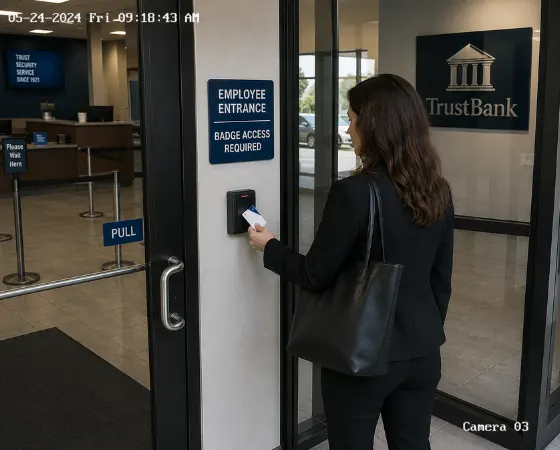
Banks are among the most physically secure environments in any city, and among the most audited. Yet access control is one of the most common areas where documented deficiencies show up during federal examinations, not because doors are unlocked, but because the system behind them can't prove they weren't.
The threat picture reinforces why this matters. Traditional bank robbery is near historic lows: the FBI recorded 1,362 bank crimes in 2023, down 83% from the 1992 peak. ATM crime has moved in the opposite direction. ATMIA documents a 600% increase in ATM incidents between 2019 and 2022, with average losses of approximately $27,000 in stolen cash plus up to $50,000 in equipment replacement per incident. The systems many institutions rely on were designed for the old problem.
This guide covers what access control for banks actually requires: the regulatory frameworks, zone-by-zone design standards, technology requirements, and what a modern system needs to demonstrate to hold up under examiner scrutiny.
TL;DR
- Bank access control spans five zone layers, each with distinct credential requirements and audit obligations — vault and server room controls carry the most regulatory weight.
- Three federal frameworks apply simultaneously: the Bank Protection Act governs physical devices, FFIEC authentication guidance covers logical and physical access convergence, and GLBA mandates minimum-necessary access controls with deprovisioning requirements.
- ATM access control is a separate design problem: vestibule readers, tamper detection, and cellular-connected controllers need to be specified independently of branch door hardware.
- Dual-control enforcement at the hardware level — requiring two credential presentations within a time window — is more defensible than paper logs during FDIC or Federal Reserve examinations.
- FFIEC examiners are increasingly evaluating physical and logical access together, which means access control platforms need API integration with SIEM tools and identity governance systems to satisfy current expectations.
What Is Access Control for Banks?
Access control for financial institutions is a security tool, a compliance instrument, and an audit record — and examiners treat it as all three.
The access control system governs every physical entry point: exterior branch doors and ATM vestibules, teller line barriers and cash handling areas, vault anterooms and cash vault interiors, server rooms and data closets, and back-office spaces. Each zone carries different risk exposure and different regulatory expectations.
The core mechanics are consistent across all of them. A credential is presented, a reader forwards the data, a controller evaluates it against stored permissions, door hardware executes the decision, and software logs the event. In a banking context, that chain must also produce audit trails that satisfy federal examiners and demonstrate that access permissions are actively managed — not just assigned once and forgotten. A door propped open in a server room is not just a security gap; it may be a documented deficiency during an FDIC or Federal Reserve examination. Access logs are regulatory evidence.
Why Legacy Infrastructure Creates Compliance Risk in 2026
68% of banking executives acknowledge that their technology architecture actively hinders operational needs, and two-thirds estimate their oldest code predates 2000. For access control, that translates directly: alarm panels, access controllers, and camera systems from a decade ago were not designed for cloud management, API integration, or AI analytics.
The compliance problem is compounding. Regulatory pressure on physical security has increased as FFIEC examiners have begun evaluating physical and logical access together — meaning a standalone legacy access control system with no logging integration is now an information security gap, even if the door itself is mechanically secure. Institutions that haven't updated their access control infrastructure since their last major examination cycle are likely running systems that can't produce the reports examiners now expect.
The Regulatory Baseline: What U.S. Banks Are Required to Do
Three federal frameworks govern access control in U.S. financial institutions. Each operates on a different layer, and all three apply simultaneously.
Bank Protection Act: The Physical Security Mandate
The Bank Protection Act of 1968 (12 U.S.C. 1882) (BPA) requires every federally insured depository institution to adopt a written security program covering its main office and all branches. The program must be board-approved and administered by a designated security officer.
Supervision is divided by charter type:
- National banks: OCC 12 CFR Part 21
- State non-member banks: FDIC 12 CFR Part 326
- Federal Reserve member banks: 12 CFR Part 208
The Act mandates minimum physical security devices at every banking office: a vault or secure space protecting cash and liquid assets; lighting around vault areas visible from outside during non-business hours; tamper-resistant locks on all exterior doors and operable windows; an alarm system capable of notifying law enforcement of robbery, burglary, or larceny; camera systems recording activity in the banking office; and written procedures for opening, closing, and vault access, including dual-employee controls.
The security officer must submit an annual report to the board covering program effectiveness, incident counts, and corrective actions. This report is an examination item — institutions that can't generate it automatically from their access control platform are creating avoidable administrative risk.
FFIEC: Authentication and Access Management
The FFIEC's 2021 guidance, Authentication and Access to Financial Institution Services and Systems, extends access control requirements into the authentication layer. It applies to employees, contractors, board members, third parties, and automated service accounts.
FFIEC requires institutions to conduct periodic risk-based assessments to determine whether single-factor authentication is adequate for each scenario; to deploy multi-factor authentication (MFA) or equivalent controls where single-factor methods present unacceptable risk; to maintain monitoring, logging, and reporting sufficient to detect and investigate unauthorized access attempts; and to implement layered security controls addressing access risks from customers, employees, and third parties in combination.
Physical access and logical access are increasingly evaluated together during examinations. A physical access control system that can't export logs in a format digestible by your SIEM is an audit gap under current FFIEC expectations.
GLBA Safeguards Rule: Information Access and Customer Data
The Gramm-Leach-Bliley Act's Safeguards Rule (16 CFR Part 314) requires a comprehensive written information security program. The 2023 updated rule mandates access controls limiting data system access to the minimum necessary permissions; physical safeguards for facilities housing customer information systems; annual penetration testing and biennial vulnerability assessments; and a designated qualified individual — a CISO or equivalent — responsible for the program.
The FTC enforces GLBA compliance for non-bank financial institutions; banking regulators enforce it for depository institutions. The deprovisioning requirement is the most commonly overlooked: when an employee leaves or changes roles, their access rights must be removed or reassigned promptly. Systems without automated HR-triggered deprovisioning make this operationally difficult at scale.
Regulatory Mapping Table
Bank Access Zones: Designing Access Control Layer by Layer
Effective bank access control is not a uniform deployment. Each zone carries distinct risk exposure, credential requirements, and audit obligations. The table below captures the full zone map; the sections that follow cover the two areas that draw the most examiner attention.
Vault access warrants specific attention. The Federal Reserve's Regulation H guidance recommends vault logs be initialed by at least two employees, with split credentials so no single individual holds the complete access combination. Electronic systems that enforce dual-presence at the hardware level — requiring two valid credential presentations within a defined time window — are far more defensible during examinations than paper logs that depend on staff compliance.
Server rooms and data closets are the zone most likely to generate FFIEC findings. A data center door controlled by a standalone legacy system with no logging integration is an information security gap under current standards, regardless of whether the door itself is physically secure.
Access Control Technologies Used in Banks
Banks use more credential types than most industries — RFID cards, mobile credentials, biometrics, and PIN-based systems — often within the same branch, assigned by zone and risk level. The right technology mix depends on the zone, the risk level, and the operational volume at each entry point.
Credential and Reader Options
RFID and smart card systems are the most common credential type across branch networks — fast, familiar, and straightforward to provision and revoke. The main operational challenge in large institutions is replacement volume: high turnover combined with multi-branch footprints creates ongoing card management overhead that manual processes handle poorly.
Mobile credentials, delivered via smartphone, reduce physical card management but require device enrollment processes and device policy compliance. They're increasingly common for employees who rotate between branches, where reissuing branch-specific cards at each location is impractical.
Biometric access control — fingerprint and facial recognition — is used at vault anterooms, data centers, and private wealth areas. Adoption in financial services is growing at a CAGR of 19%, driven by demand for stronger authentication at high-risk entry points without creating queue bottlenecks.
Controllers and Infrastructure
Three infrastructure requirements matter most for banking environments. First, offline operation: controllers must maintain local decision-making during network outages. Vault doors and teller barriers cannot become inaccessible if cloud connectivity drops. Second, OSDP support: the Open Supervised Device Protocol provides encrypted, bidirectional reader-controller communication, replacing the legacy unencrypted Wiegand standard. Security-conscious institutions are increasingly making OSDP a procurement requirement. Third, Wiegand compatibility: hardware-agnostic controllers supporting both Wiegand and OSDP card readers allow institutions to modernize management without immediately rewiring every existing branch — a practical necessity for any multi-branch rollout that isn't starting from scratch.
ATM Access Control: A Distinct Security Problem
ATM access control is not a branch door problem with a different lock. It requires a separate design covering three layers.
Physical machine security means tamper-detection sensors that trigger alerts when the machine is moved, tilted, or opened without authorization. For through-wall installations, door alarm systems on the maintenance compartment add a detection layer. Anchor systems and reinforced installation surfaces reduce removal attack vulnerability.
Vestibule access control means smart door readers that restrict after-hours entry to staff and service technicians, logging every credential presentation. Door position sensors detect propped or forced-open vestibule doors. Integration with the building alarm system ensures that forced entries trigger law enforcement notification — a direct Bank Protection Act requirement.
Remote monitoring and cellular failover matter because a service technician credential logged at 2 a.m. means little without camera footage confirming the presentation was legitimate. Cellular-connected controllers allow access event data and tamper alerts to reach the management platform even when the primary network is unavailable. The connection between ATM access events and video security footage is what makes the audit record complete.
Unified Video, Alarms, and Emergency Response for Bank Security
When a door is forced open, an integrated camera system surfaces the video clip from that door at that moment — no manual camera search, no timestamp cross-reference. For a team managing ten or fifty branches, that is the difference between a two-minute investigation and a two-hour one. When a teller triggers a panic button during a robbery, the response needs to be automatic: vault anteroom lockdown, credential restrictions, camera feeds flagged — all without requiring a security officer to manually execute each step.
Emergency management systems that integrate access control with incident workflows enable role-based lockdown commands issued from a single dashboard, restricting specific doors while maintaining egress for customers and staff. Bank security camera systems configured with AI analytics detect tailgating and log it as an access event before it surfaces as an unaddressed gap in the next examination cycle.
Insider Threats and Dual-Control
Employees with legitimate credentials can circumvent perimeter controls entirely. The access control program has to account for this from the start.
Dual-control enforcement at the hardware level is the most defensible approach to vault access. Systems that require two valid credential presentations within a defined time window eliminate single-employee bypass and produce a compliant audit log for every vault entry. Paper logs with manual employee signatures depend on staff compliance; hardware-enforced dual-presence does not.
Role-based access control (RBAC) assigns permissions to roles rather than individuals. When an employee changes positions or leaves, role reassignment cascades across all associated permissions — eliminating the credential accumulation problem where long-tenured staff hold rights from roles they no longer occupy. This is also the mechanism that satisfies GLBA's minimum-necessary access requirement without manual auditing on every personnel change.
Separation of duties at the software permission level is the control that prevents a single administrator from both granting unauthorized access and concealing it in the records. The staff member who provisions credentials should not be the same person who reviews the audit log. Systems that don't enforce this at the permission level leave the compliance documentation vulnerable to exactly the kind of insider manipulation it's meant to prevent.
Cyber-Physical Convergence in Banking
Physical and logical access controls are no longer independent domains. FFIEC examiners are evaluating them together. The access control platform needs to be ready for that scrutiny, which means it has to fit into the broader security architecture — not sit beside it.
A phishing attack targeting a building management system can result in door controllers being reconfigured remotely. A network intrusion reaching the access control software can alter permission schedules, disable alarms, or extract the full credential database. Institutions building toward cyber-physical convergence should verify their access control platform supports API integration with SIEM platforms so physical access events are ingested alongside network events; connects with identity governance systems such as Okta or Microsoft Entra ID for unified deprovisioning; and supports encrypted reader-controller communication via OSDP rather than Wiegand, where possible.
AI-powered search across access events and video footage simultaneously is becoming a meaningful operational differentiator for institutions managing FFIEC investigations — surfacing all entry events by a specific credential across all branches within a date range, paired with associated video, in minutes rather than hours.
Multi-Branch Access Control Rollout Playbook
A structured rollout sequence is the most reliable way to modernize access control across a multi-branch network without fragmenting the compliance program or creating audit log inconsistencies between sites.
Phase 1 — Inventory: Document every access point across all locations: door type, hardware, wiring, and current credential technology. Flag vaults, ATM vestibules, and server rooms as requiring higher-assurance control in the deployment sequence.
Phase 2 — Standardization: Select a controller and reader standard that supports offline operation and both Wiegand and OSDP. Cloud-based management is a non-negotiable requirement.
Phase 3 — Priority deployment: Start with the highest-risk locations — vaults, data centers, ATM vestibules. Establish provisioning workflows and audit log exports before extending to lower-risk doors.
Phase 4 — Migration and training: Run old and new credential systems in parallel during migration. Train branch managers before decommissioning legacy systems so the cutover doesn't create gaps in access documentation.
Phase 5 — Integration and verification: Connect to the camera system, alarm system, and HR directory. Generate the first audit report and verify it meets FFIEC logging requirements before the next examination cycle.
Institutions that select open-architecture systems with REST API support reduce integration costs by 25% to 40% compared to proprietary closed systems — a meaningful TCO difference across a large branch footprint.
Access Control by Bank Type
Requirements and priorities shift depending on institution size, charter type, and branch footprint. Here's how the design decisions break down across the main segments.
Community Banks (1–20 Branches)
Cloud-managed systems that work with existing DVR infrastructure and Wiegand wiring keep deployment costs manageable while producing the audit logs that FDIC and Federal Reserve examiners require. The priority is getting the vault, server room, and ATM vestibule controls onto a modern platform first; branch lobby doors can follow.
Credit Unions
Operating under NCUA Part 748 — which closely mirrors the Bank Protection Act — credit unions must satisfy both NCUA physical security and GLBA Safeguards Rule requirements. Vendor-agnostic platforms avoid lock-in that creates upgrade cost problems for institutions with constrained capital budgets. The deprovisioning requirement under GLBA is where credit unions most often have gaps; automating it through an HR integration is the highest-priority fix.
Regional Banks (20–200 Branches)
Standardization is the primary challenge. Branches running different hardware generations produce fragmented audit logs, and M&A activity compounds this: acquired branches arrive with inherited systems that weren't selected with your compliance program in mind. Cloud platforms with hardware agnosticism enable unified management while the network is progressively standardized — without requiring a full forklift upgrade at every acquired branch.
National Banks (200+ Branches)
At this scale, FFIEC examiner expectations include automated deprovisioning triggered by HR events, real-time access anomaly detection, and centralized reporting surfaceable for any branch without manual extraction. The platform must support open APIs and standard identity protocols — SAML, SCIM, OAuth — or it becomes an integration bottleneck as the institution's identity governance infrastructure evolves.
Private Wealth and Trust Offices
Biometric credentials with appointment-based scheduling allow time-window access to safe-deposit areas rather than persistent permissions. Audit logs for these areas carry heightened sensitivity given the fiduciary relationship with clients; the documentation standard should be treated as equivalent to vault-level logging.
Off-Premises ATMs
Cellular failover is required for access event data to remain accessible independent of primary network connectivity. License plate recognition at drive-through locations provides an identification layer supporting law enforcement investigation when ATM crime incidents occur.
Smart Branches and Digital Banking Locations
AI-based anomaly detection on camera feeds, connected to access event data, compensates for reduced human observation in video teller and self-service environments. These locations have the same regulatory logging requirements as staffed branches with significantly less human oversight — the system has to carry more of the monitoring burden.
Best Practices for Bank Access Control (2026)
Conduct quarterly access rights reviews. Quarterly cycles catch role changes, terminations, and contractor expirations before they become examination findings. Automated reports flagging credentials unused in the past 60 days provide a reliable starting point — manual quarterly reviews of full credential lists at multi-branch institutions are too slow to be reliable.
Enforce minimum necessary access. Permissions should reflect current job function, not historical accumulation. New branches, new hires, and reorganizations should trigger a review rather than automatic carryover of prior permissions. Systems with role-based assignment make this tractable; systems requiring manual permission management at the individual level don't.
Test physical security devices on a scheduled cycle. Annual testing, documented in writing and covering alarm systems, panic buttons, door sensors, and camera recordings, is baseline Bank Protection Act compliance. Higher-risk areas — vaults, server rooms, ATM vestibules — warrant quarterly testing.
Integrate access logs with video. An access event with no associated video is incomplete evidence. Pulling camera footage for any access log entry from within the access control platform eliminates the time and friction that defeats timely investigation — and produces a more complete audit record for examiners.
Maintain offline operation capability. Network outages cannot lock staff out of cash drawers or vault entries. Controllers must store local permission sets and operate autonomously during connectivity disruptions. Verify this in testing, not just in the vendor's documentation.
Document everything for the board. The Bank Protection Act requires an annual security officer report. Access control audit logs, incident counts, device testing results, and identified deficiencies with remediation timelines should feed that report automatically — institutions that generate it manually are creating both an administrative burden and a documentation risk.
How to Choose an Access Control System for Your Bank
Compliance capability is a threshold criterion. If a vendor can't demonstrate it clearly, the conversation should stop.
Start with regulatory fit. The system must produce audit logs satisfying FFIEC examination expectations, support dual-employee vault entry logging, and integrate with your alarm system for Bank Protection Act compliance. Ask vendors to walk through exactly how their platform generates the annual security officer report — not whether it can, but how.
Evaluate hardware architecture for your branch mix. Open-platform systems supporting both Wiegand and OSDP preserve existing wiring during initial deployment while enabling future upgrades. Proprietary systems eliminate flexibility as the branch footprint evolves, and at multi-branch scale, that inflexibility has real cost.
Assess cloud management maturity. The platform should provide centralized user management, real-time alerts, and audit log access for all branches from a single interface, with offline operation guaranteed at each controller. Ask what the behavior is when cloud connectivity drops — the answer reveals how mature the architecture actually is.
Require integration evidence. Request documented API support for your video platform, HR system, and SIEM or SOC tool. Vendor claims about integration are common; working integrations with your specific tools are what matter during actual deployment. Ask for a reference check with a peer institution running the same integration stack.
Calculate five-year total cost of ownership. Include per-door cloud subscription fees, credential replacement costs, installation labor, annual maintenance, and IT staff administration time. Cloud platforms with automated provisioning consistently reduce five-year ownership costs relative to on-premises alternatives — but the savings depend on hardware compatibility; a platform that requires replacing existing readers changes the math significantly.
Verify examiner readiness with references. Ask whether peer financial institutions using the platform have completed FFIEC or federal banking agency examinations successfully. Vendor compliance documentation is a starting point; a reference call with an IT Director at a comparable institution is more reliable.
How Coram Approaches Bank Access Control
Coram is a cloud-native physical security platform that unifies access control and AI video surveillance in a single system.
Coram works with existing locks, readers, and Wiegand wiring — no hardware replacement required to get a modern, cloud-managed access control platform running across an existing branch network. For institutions that have been deferring an access control upgrade because the hardware cost was prohibitive, that's the starting point: branch-by-branch rollout without a forklift infrastructure replacement.
For financial institutions specifically, the operational case centers on three capabilities. First, access-video event pairing: every door event — entry, denied access, forced entry, propped door — is automatically paired with video from the associated camera. Security teams pull video context for any access log entry without switching systems, which matters when an examiner or law enforcement investigator needs to reconstruct an event quickly. Second, centralized multi-branch management: a single dashboard manages users, credentials, schedules, and alerts across all branches, with offline operation maintained at each controller independently of cloud connectivity. Third, AI-powered investigation: natural language queries across access events and video footage surface results across locations in minutes, not hours — relevant for both operational incident response and FFIEC audit support.
Coram is SOC 2 Type II and HIPAA certified, which satisfies the compliance documentation requirements that regulated institutions need from their vendors.
Best for: Financial institutions managing multi-branch operations that need an audit-ready system connecting physical access events with video evidence, without replacing existing door hardware.
Book a demo or start a free trial to walk through a configuration for your environment.
The Standard Bank Access Control Now Has to Meet
The institutions that manage access control well have moved past asking whether their doors are locked. The more useful question is: can we demonstrate, at any moment, who had access to what, when, and what the camera showed?
That's the standard federal examiners are moving toward — and it's achievable with the right architecture, zone-by-zone design, and audit records built to hold up under scrutiny.





.png)