Physical security has changed more in the last three years than in the previous decade. AI has moved from a marketing claim to a functional layer inside security platforms, processing video in real time, flagging incidents before operators notice them, and connecting intelligence across cameras, doors, and sites in ways that manual review never could.
When Flock Safety, Verkada, and Coram land on the same evaluation shortlist, the comparison feels straightforward on paper. All three use AI. All three serve security-conscious organizations. All three have cloud platforms and modern dashboards.
The problem is they were never built for the same job.
That gap only becomes visible when you look past the feature lists and into the architectures underneath. How a platform processes video, how it handles hardware, how it scales across sites, and what kind of intelligence it was actually designed to deliver, those differences determine whether a system fits your environment or fights it.
This guide breaks down all three platforms across the criteria that actually matter: AI capabilities, hardware model, deployment complexity, use case fit, and long-term operational overhead.
The goal is a decision you can defend two years after deployment.
TL;DR
- Flock Safety is a vehicle intelligence platform built around LPR, cross-agency hotlist alerts, and a national network of 5,000+ law enforcement agencies
- Verkada is a single-vendor cloud platform delivering its best experience when the entire stack is Verkada hardware
- Coram is hardware-agnostic and AI-native, unifying video, access control, and detection across any existing IP cameras
- The real comparison is three architectures: vehicle intelligence network, closed hardware ecosystem, and open AI platform
- For modernizing distributed security without replacing infrastructure, Coram is the clearest fit
Quick Comparison: Flock Safety vs Verkada vs Coram
One thing worth noting before going deeper: Flock Safety's strongest capabilities are designed around outdoor vehicle intelligence and law enforcement collaboration.
Verkada and Coram both serve broader enterprise security needs, but through very different architectural approaches. That distinction shapes every section that follows.
The AI Layer: How Flock, Verkada, and Coram Differ
All three platforms use AI, but they were built to solve different problems with it.
Flock Safety applies AI to vehicle tracking and investigation workflows. Verkada applies it to on-device video analytics within its own hardware ecosystem. Coram runs AI continuously across any connected camera, unifying detection, search, and access control in one platform.
Flock Safety: LPR-First, Investigation-Driven AI
Flock Safety built its platform around a specific premise: most crimes involve a vehicle, and license plate intelligence captured at the right moment changes how law enforcement investigates and deters crime.
The result is a public safety ecosystem centered on LPR cameras, vehicle fingerprinting, and a national network connecting over 5,000 law enforcement agencies across 49 states.
Its software suite, FlockOS, Flock FreeForm, Flock Nova, and Flock911, is built around investigation workflows and cross-agency data sharing rather than general-purpose enterprise security management.
Key characteristics:
- Proprietary LPR cameras with Vehicle Fingerprint search across plate, make, model, color, and distinguishing features
- National LPR network shared across 5,000+ law enforcement agencies in 49 states
- Real-time hotlist alerts, convoy detection, and plate swap detection
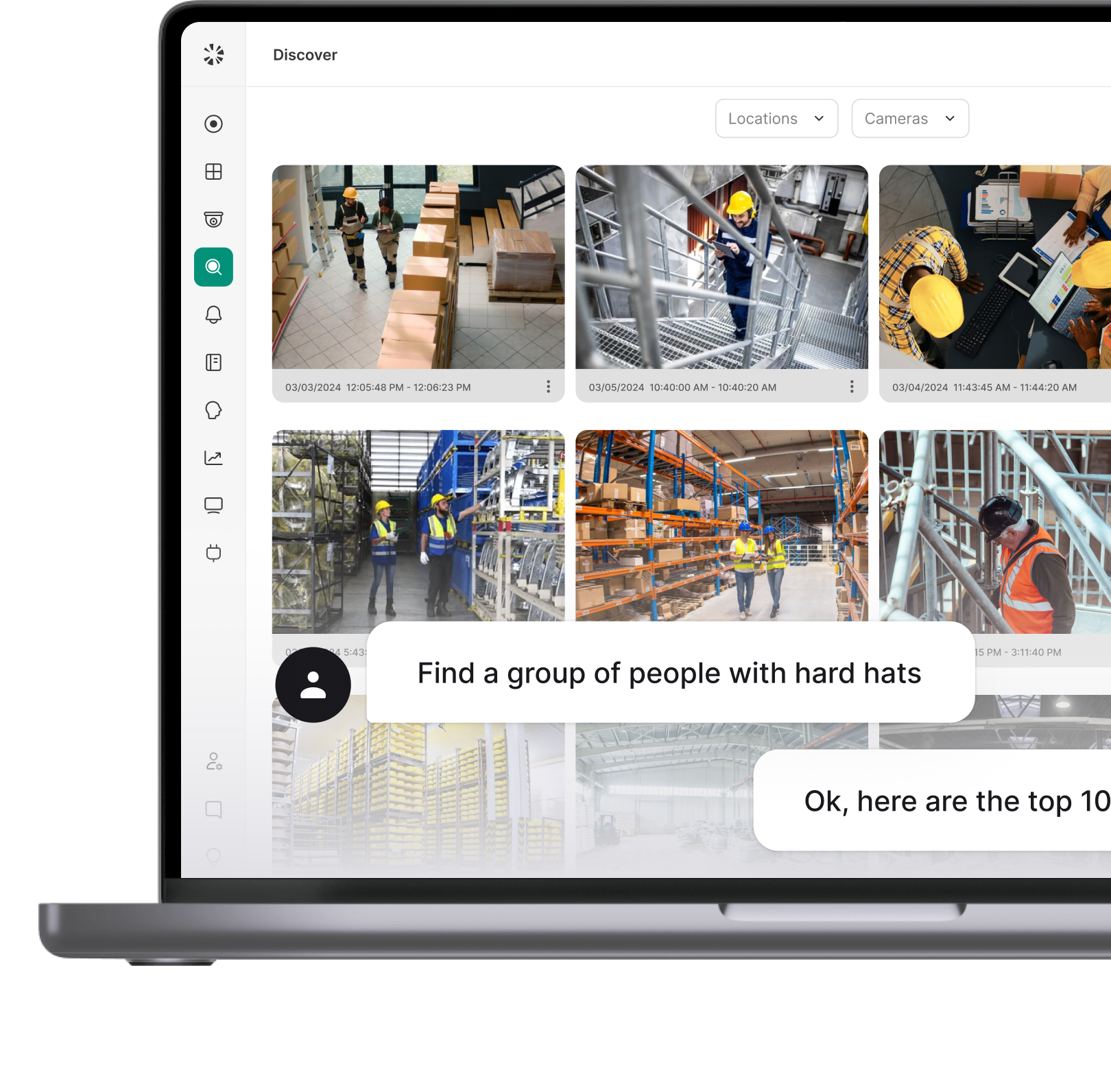
- Natural language video and LPR search via Flock FreeForm
- Drone as First Responder capability for real-time aerial response
- Cloud-managed with automatic updates across all devices
Best for: Cities, law enforcement agencies, and businesses where vehicle intelligence, crime deterrence, and cross-agency collaboration are the primary security objective.
Verkada: On-Device AI Within a Closed Ecosystem
Verkada was built on the conviction that enterprise physical security should work the way modern software does, cloud-managed, automatically updated, and simple enough that security teams don't need dedicated IT specialists to run it.
The platform covers video security, access control, alarms, intercoms, air quality sensors, and workplace management, all managed through Command. Cameras process video at the edge, with footage stored on-device and in the cloud, eliminating NVRs while keeping analytics low-latency.
Key characteristics:
- Proprietary cameras with 30 to 365 days of guaranteed onboard storage
- AI-powered search, person and vehicle attribute lookup, and unified timeline across sites
- Hybrid cloud architecture with edge processing and automatic OTA firmware updates
- Native access control, alarms, and intercoms managed within Command
- Third-party camera connectivity via Command Connector, with reduced native AI functionality
- Trusted by over 30,000 organizations globally
Best for: Enterprises standardizing on a single vendor stack, organizations building out new facilities, and security teams that want a unified cloud platform with minimal IT overhead and strong out-of-the-box analytics.
Coram: One AI Layer Across Video, Access, and Alerts
Coram was built after modern cloud infrastructure and AI vision models had already matured, which means detection, natural language search, and real-time alerting are part of the platform's foundation rather than features added on top of a legacy recording system.
The platform unifies video surveillance, access control, and AI security agents in one cloud dashboard, designed to work with the cameras organizations already have.
Every door event links automatically to video, and AI agents handle gun detection, license plate recognition, facial recognition, safety alerts, and productivity monitoring continuously across all connected sites.
Coram is SOC 2 Type II audited and HIPAA compliant, making it a practical fit for regulated environments including healthcare, education, and financial services.
Key characteristics:
- Hardware-agnostic architecture with full native AI across any standard IP camera
- Unified video, access control, and AI alerts in a single cloud dashboard
- Natural language search across all cameras and sites
- AI agents for gun detection, LPR, facial recognition, safety alerts, and more
- Cloud-managed multi-site operations via Coram Point edge device, with offline continuity
- Unlimited user seats with granular role-based access controls
Best for: Multi-site operations with existing camera infrastructure, organizations that need unified video and access control without a hardware refresh, and security teams managing distributed locations with lean IT support.
Vehicle Intelligence vs Video Intelligence vs AI Monitoring
The type of AI a platform is built around shapes everything from what it can detect, to which hardware it needs, to how useful it is across different environments.
These three platforms represent three distinct AI approaches, and understanding the difference is what makes the buying decision clearer.
Flock Safety: Vehicle Intelligence
Flock Safety's AI is purpose-built around one question: what vehicle was involved, where did it go, and when? Its Vehicle Fingerprint technology captures plate number, make, model, color, and distinguishing features at the moment a vehicle passes a camera.
The national LPR network is where this intelligence compounds. A single plate hit in one jurisdiction can trigger alerts across thousands of connected agencies simultaneously.
What Flock's AI actually does:
- Reads and classifies plates, make, model, color, and distinguishing vehicle features in real time
- Triggers hotlist alerts instantly across connected agencies when a vehicle of interest is detected
- Detects plate swaps, convoy patterns, and repeat vehicle appearances across the network
- Enables natural language search across video and LPR data via Flock FreeForm
- Coordinates drone dispatch and aerial tracking through Drone as First Responder integration
Where Flock's AI has clear boundaries is inside buildings. Interior monitoring, people detection, and access control correlation are outside what the platform was designed to deliver.
Verkada: Video Intelligence
Verkada's AI lives on the camera itself. Onboard processors handle person detection, vehicle attribute lookup, line crossing, motion classification, and occupancy analytics in near real time, without routing everything through a central server first.
For organizations building out new facilities or standardizing a hardware refresh, that approach delivers a clean, low-latency analytics experience across the entire deployment.
Coram: Unified AI Monitoring
Coram's AI runs as a platform-level capability, not a hardware feature. Because the intelligence layer is decoupled from the camera, the same detection models, search functionality, and alerting logic work across any connected IP camera regardless of brand or age.
Gun detection, facial recognition, license plate recognition, safety alerts, and productivity monitoring all operate continuously in the background without requiring camera replacements or model-specific configurations.
What this means in practice: A security team managing ten sites with mixed camera brands gets the same AI detection, the same search accuracy, and the same alert logic across all of them from day one.
When a door event and a camera alert surface simultaneously, they are already correlated in one dashboard. There is no integration work, degraded experience on older hardware, and any separate system to query for access data.
Where Each Platform Performs Best?
The right choice depends less on feature counts and more on what your security operation actually looks like day to day, how many sites you manage, what hardware you already have, and what kind of intelligence you need the system to deliver.
Flock Safety: Public Safety, Law Enforcement, and Crime-Prone Properties
Flock Safety earns its reputation in environments where vehicle movement is the primary security signal, specifically the combination of LPR hardware, real-time hotlist alerts, and the national network connecting over 5,000 agencies.
Cities and law enforcement agencies: A municipality dealing with vehicle theft, carjacking, or organized crime across multiple precincts gets immediate value from Flock's national LPR network.
Cross-jurisdiction alerts, shared hotlists, and real-time drone dispatch create an intelligence layer that no standalone camera system can replicate.
Retail properties and logistics operations: For businesses where organized retail crime or cargo theft is a recurring operational problem, Flock's vehicle fingerprinting and hotlist alert system provides proactive detection before an incident escalates.
Security teams get actionable vehicle data rather than footage to review after the fact.
Residential communities and HOAs: Perimeter vehicle monitoring connected to law enforcement data sharing gives residential communities a direct line between suspicious vehicle activity on their property and the agencies equipped to respond.
The platform handles this without requiring dedicated security staff on site.
Verkada: Enterprises, Campuses, and Single-Vendor Deployments
Verkada performs best when an organization is building out a new facility or executing a planned hardware refresh. The plug-and-play installation, automatic firmware updates, and unified Command dashboard make it operationally straightforward when the entire stack is Verkada.
Corporate campuses standardizing on new hardware: Organizations that want one contract, one support line, and one hardware standard across their entire footprint get a clean, consistent experience with Verkada.
Procurement is straightforward and the analytics suite performs as advertised across every camera on the network.
K-12 schools and higher education: Plug-and-play deployment with centralized management across multiple buildings makes Verkada practical for education environments where IT resources are limited and security staff need a system they can operate without deep technical training.
Healthcare facilities and retail chains: Native access control, alarms, and intercoms unified with video under one platform simplifies vendor management and support accountability for regulated environments that need tight coordination between physical security systems.
Coram: Multi-Site Operations, Mixed Infrastructure, and Distributed Teams
Coram's environment fit is broadest among the three because it does not require organizations to standardize hardware to get the full platform experience. That hardware flexibility changes the economics of a platform upgrade significantly for organizations that have already invested in camera infrastructure.
Multi-site enterprises with existing cameras: Organizations managing ten or fifty locations with cameras already on the wall get full AI capability across every site from day one. There is no hardware replacement requirement, degraded analytics on older devices, or separate system to manage for access control.
School districts and healthcare networks: Unified video, access control, and AI alerts across distributed locations managed from one dashboard reduces the coordination overhead that typically grows with footprint.
Coram's SOC 2 Type II and HIPAA compliance make it a practical fit for regulated environments where data governance is as important as physical security.
Warehouses and logistics operations: Real-time detection, license plate recognition, and multi-site visibility without provisioning local servers per site gives operations teams the security coverage they need without adding IT infrastructure to every location.
Best for Multi-Site AI Monitoring
For organizations evaluating platforms specifically on their ability to deliver AI-powered security across multiple locations, the choice narrows quickly.
Flock Safety manages multiple sites through a centralized dashboard but the intelligence is vehicle-centric and tied to Flock hardware.
Verkada handles multi-site management well through Command, but every site needs Verkada cameras to deliver the full analytics experience, making expansion a hardware procurement decision as much as a software one.
Coram was designed for exactly this scenario. Adding a new location means connecting existing cameras through Coram Point, applying the same AI detection and access control configuration from the cloud dashboard, and having that site operational without on-site infrastructure work.

.png)