A director of engineering and operations at a hospital-owned clinic group described his security program this way: "I've lost 14, 15, 16 security officers in the last year and a half and I have very little security presence."
That is the real starting condition for most hospital weapons detection programs. Not the threat assessment. The roster.
Every screening design you can buy assumes a person standing next to it. Walk-through lanes need officers. Alarms need someone to resolve them. Bag screening needs a trained operator per belt. When the officer count is falling and the campus is not getting smaller, the gap between "entrances we screen" and "areas where something can happen" widens on its own, and no procurement decision closes it.
So coverage becomes the question. A controlled public entrance gives you a clear checkpoint. Emergency access points, staff entrances, loading areas, parking structures, and hospital corridors don't, and a single-entrance program never reaches them. Most technologies in this market cover one part of the hospital rather than the whole campus. Walk-through systems work at controlled entrances. Camera-based detection covers areas beyond a screening chokepoint. Handheld and parcel screening handle secondary checks, and ferromagnetic detection covers the separate safety requirements of MRI zones.
This guide walks through the main detection categories, where each fits across hospital entrances, and what to evaluate on performance, staffing, integration, and cost. If you want the version of this question written for K-12, that's the K-12 version of this question.
The Hospital Constraints That Rule Out Most Screening Designs
Before you shortlist anything, it's worth running a hospital security assessment against the list below. A screening program has to hold up across clinical access, patient flow, multiple entrance types, staffing, and the parts of the campus that don't look like a lobby.
Emergency access: EMTALA requires a medical screening examination for anyone who comes to the emergency department, or onto hospital property, and requests examination or treatment, and CMS is explicit that registration procedures may not delay it. EMTALA does not address security screening. But the same logic governs ED entrance design: whatever you put at the door cannot become the reason care is delayed.
Patients who can't use standard screening: Ambulance arrivals, gurneys, unconscious patients, and implanted devices need an alternate lane.
Clinical equipment affecting nuisance alarms: Wheelchairs, IV poles, oxygen cylinders, and other equipment create a higher metal baseline.
Different operating profiles for each entrance: EDs, main lobbies, staff entrances, loading docks, ambulance bays, and parking all need to be run differently.
Peak throughput: Shift changes and visiting hours spike screening volume fast, and long queues create operational and clinical problems of their own.
Behavioral health needs its own screening posture: Its risk profile and requirements can differ from the rest of the hospital and may warrant a separate approach.
Law-enforcement access: Armed officers and patients in custody require clear policies for screening, firearm handling, and secure storage.
Impact of state law on screening policy: Concealed-carry rules and restrictions on hospital premises vary by state.
Workforce implications of staff screening: Shift-change volume, staffing requirements, workplace policies, and labor relations all factor in.
Clinical privacy and camera coverage: Patient-care areas may restrict camera placement, views, or recording, which affects where camera-based detection can operate.
Patient and family experience is a constraint too, even though it never appears as a line item in the security budget. Friction at the point of care is a facility operations problem.
The Categories of Weapons Detection, and What Each Is For
Six categories, and only one of them works without a place for a line to form.
Ferromagnetic detection matters most in MRI zones, where it addresses projectile hazards that weapons screening was never designed to catch. Camera-based detection plays a similar structural role in areas with no practical chokepoint. If you are evaluating the chokepoint category itself, the screening vendors in this category are compared separately.
Comparison of Screening Approaches for Hospital Environments
Two systems can post the same detection rate and land very differently on your payroll. Read the staffing column first.
Designing Screening Entrance by Entrance
The ED needs the most flexibility of any entrance. Unpredictable arrivals, ambulances, and patients who may not be able to follow a standard screening process rule out a rigid checkpoint. The main lobby is easier to control, but peak visitor traffic turns screening into a bottleneck fast. Staff entrances, behavioral health intake, loading docks, and parking structures usually need a mix of screening, hospital access control, and camera-based detection rather than one approach applied everywhere.
What to Measure When Evaluating a Weapons Detection System
A quote tells you almost nothing on its own. What you need is the threat set tested, the configuration used, and who ran the test.
- What threat set, walking speed, configuration, and test method produced the detection rate?
- What nuisance-alarm rate was measured in a clinical environment, and how much secondary screening did it create?
- What is the realistic people-per-hour throughput per lane at peak volume?
- What staffing is required per lane and across shifts, and what is the annual operating cost?
- For camera-based systems, how do alert time, camera placement, lighting, and occlusion affect performance?
- Can alerts integrate with your video system, access control, mass notification, and dispatch workflows?
- Has the system been independently validated, and can you review the underlying test methodology and results?
These are the parameters that tell you what a system delivers in your building, not in a demo room.
Cost and Funding
The equipment price is the small number. Getting each entrance operational and keeping it staffed is the rest of it.
Build a five-year model with these kept separate, so you can see exactly where the program will need budget:
- Technology: purchase price, licensing, maintenance, and replacement cycle for each system.
- Site work: electrical, networking, construction, lane configuration, entrance modifications.
- Operations: staff to run lanes, handle alarms, conduct secondary screening, and hold coverage across shifts.
- Expansion: additional entrances, buildings, or campus areas that will need coverage later.
Two calendars decide whether this gets funded, and neither one waits for you. Capital cycles close months before the money moves, and the federal grant window is annual. FEMA released the FY 2026 Notice of Funding Opportunity for the Nonprofit Security Grant Program (NSGP) on June 24, 2026, with $300 million in funding for target hardening and physical security enhancements at eligible nonprofit organizations at high risk of terrorist and other extremist attacks, and FEMA's application deadline was July 24, 2026, though many State Administrative Agencies set earlier internal deadlines for nonprofit subapplications. If you are planning against the next cycle, the work starts roughly a quarter before the NOFO drops.
Three things to confirm before you treat any grant as part of the plan:
- Eligibility. NSGP is a 501(c)(3) program. Nonprofit medical facilities appear on state eligibility lists, and for-profit hospitals are explicitly listed as ineligible. Health system structure decides this, not bed count.
- Application route. You do not apply to FEMA. State Administrative Agencies are the only eligible applicants; nonprofit organizations participate as subapplicants and may not apply directly to DHS or FEMA. Several states also run their own parallel programs. Massachusetts, for example, has run a Commonwealth Nonprofit Security Grant Program that names medical and health care facilities among its eligible 501(c)(3) organizations.
- Allowable costs. Target hardening is usually covered. Ongoing staffing usually is not, and staffing is the line most likely to sink a five-year model.
The useful funding plan connects each eligible expense to a specific source rather than assuming one grant covers the program.
Program Elements the Technology Does Not Cover
A detection system handles detection. Everything after the alarm is the security program.
The Joint Commission and OSHA both address these responsibilities as part of workplace violence prevention in healthcare, but they do it in different ways, and the distinction is worth keeping straight. The Joint Commission sets a requirement: EC.02.01.01 EP 17, effective January 1, 2022, requires hospitals to conduct an annual worksite analysis related to the workplace violence prevention program. OSHA does not. OSHA states plainly that there are currently no specific OSHA standards for workplace violence; its instruments are the General Duty Clause, 29 U.S.C. 654(a)(1), and the advisory Guidelines for Preventing Workplace Violence for Healthcare and Social Service Workers (OSHA 3148). The healthcare rulemaking, RIN 1218-AD08, is still pre-rule.
- Policy and posted notice: make screening rules clear, including who is screened, what is prohibited, and how exceptions are handled.
- Staff training: role-specific training for security and relevant clinical staff on prevention, response, reporting, and emergency procedures.
- Secondary screening: who handles an alarm, how the secondary check is conducted, and how exceptions are managed.
- Firearms storage: if armed individuals cannot enter a screened area with their weapons, a documented process for secure storage and retrieval.
- Incident reporting: document incidents and near misses consistently so patterns are visible.
- Worksite analysis: use incident data to identify workplace-violence risks and decide where controls change.
- Drills and exercises: practice the response to an alarm or weapon discovery, including escalation and coordination with law enforcement.
- Workplace violence prevention: keep weapons detection inside the broader program rather than beside it.
Technology is one control among several. It's only as effective as the response behind it. Somebody has to be trained to act on the alarm, and somebody has to write down what happened afterward.
Where Coram Fits
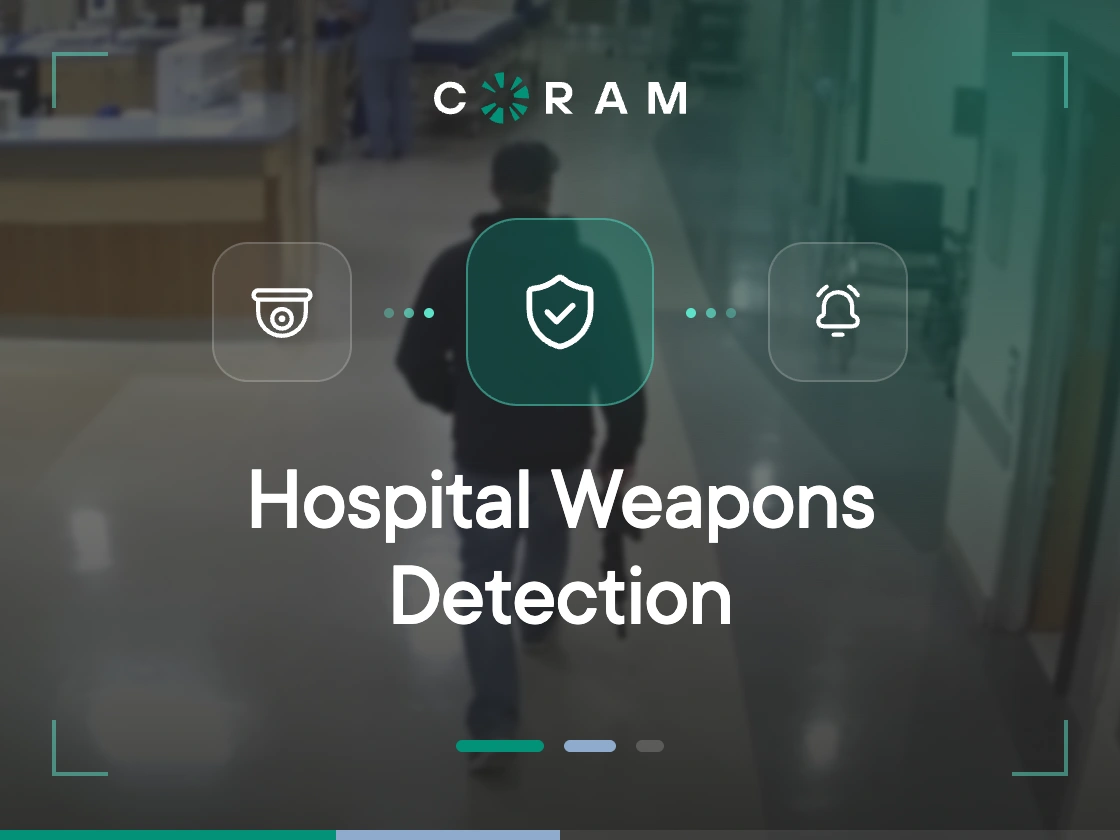
Coram Firearm Detection is a capability of Coram Video Security, part of Coram's AI physical security platform. It analyzes video from a hospital's existing IP cameras and alerts security when it identifies a handgun or long rifle. That's a coverage layer for visible weapons, not a replacement for walk-through screening and not a system for detecting concealed weapons.
The category fit matters less than what Coram doesn't require to deliver it: no camera swap. Coram works with the IP cameras a hospital already has, with Coram Point providing the on-premises processing layer for the detection itself. Coram is SOC 2 Type II audited and HIPAA compliant, which is the relevant standing for a hospital managing protected health information across its camera network. The value shows up in corridors, loading docks, and parking areas, where a new camera install would otherwise be the cost of entry.
On the clinical-privacy constraint from earlier: footage stays on the Coram Point in the building. The cloud handles alerting, metadata, and user information, not video, and raw video is not continuously uploaded. All cloud compute and storage are in the US. Facial recognition is off by default and stores face data only if the customer explicitly turns it on.
Coram also connects Video Security to Access Control, Guest Management, and Emergency Management, so a firearm alert doesn't stay a standalone notification. A firearm detection surfaces to a responder in the Coram mobile app, and one tap escalates it into the emergency workflow, including a linked lockdown. Door events and video can be reviewed together during investigation and response. The full healthcare configuration is on the hospital security page.
What to Verify Before Deployment
Everything below varies by site, which is why it belongs in a pilot rather than a datasheet:
- Which existing cameras can support firearm detection, and whether any need repositioning or upgrades.
- How camera placement, lighting, distance, and occlusion affect detection performance in your environment.
- What the actual alert latency is on your network, and what happens when the system generates a false positive.
- Which video, access-control, and emergency-response integrations are available for your specific configuration.
Coram's firearm detection runs on Coram Point, and confirmed alert data is sent to the cloud for further processing and alert delivery.
Pricing
Coram's firearm detection is licensed per camera, per month. The firearm-detection license is separate and can be added to cameras incrementally, while broader platform pricing depends on the deployment.
What to Do Next
Start with the entrances. How each one is run, where a screening chokepoint is genuinely possible, and where coverage has to extend past that point. Match detection layers to each environment, account for throughput, staffing, and response, and you have a deployment plan grounded in how your hospital actually operates rather than how a product demo runs.
If you want to see how camera-based detection behaves on cameras like yours, request pricing for a per-camera license, or ask for a reference call with a health system already running firearm detection on existing cameras.





.png)