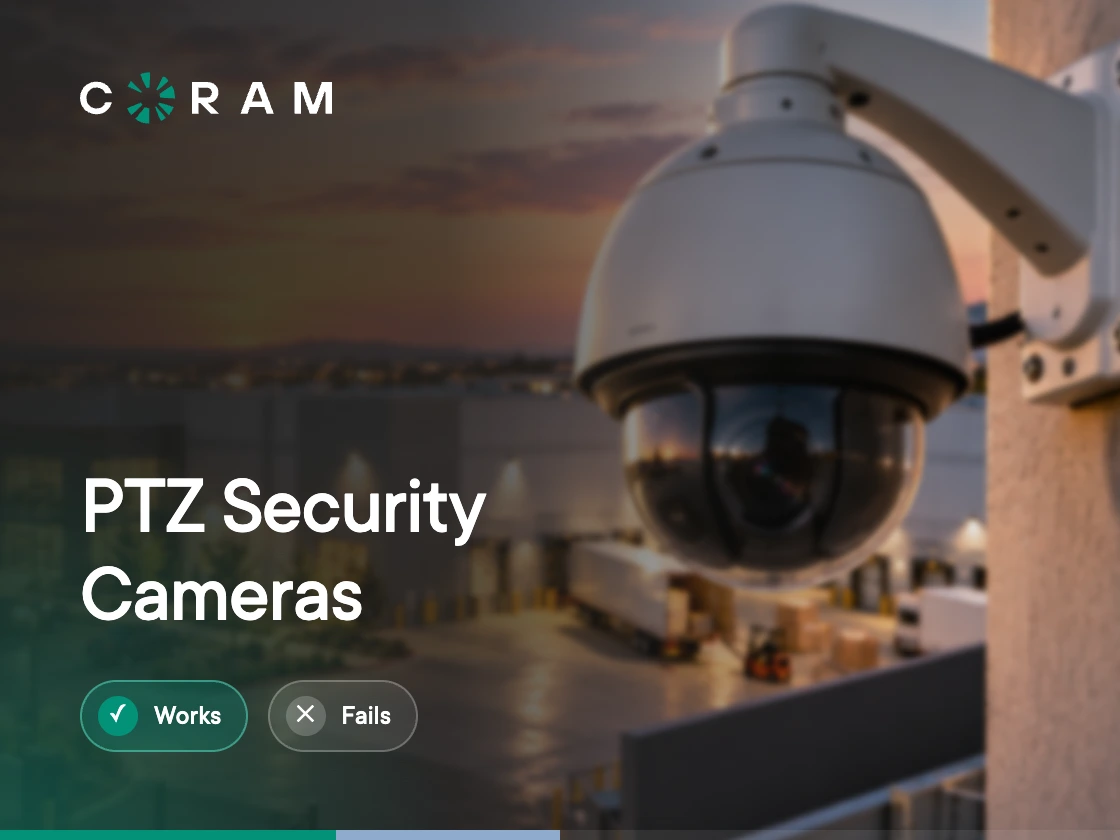
An integrator's proposal lands on your desk with two PTZ cameras covering the main parking lot, and the line item reads like a bargain. Two cameras where the fixed design called for eight. The question worth asking before anyone signs is whether a PTZ security camera gives you coverage of that lot or the appearance of it.
The distinction shows up six months later, when someone reports a break-in at 2:14 a.m. and you pull the footage. A camera that can see the whole lot and a camera that records the whole lot are two different instruments.
The space between them is where most PTZ disappointment lives, and it is a space almost nobody selling PTZ hardware has much reason to describe.
TL;DR
- One PTZ security camera records one view at a time, moving around a larger area.
- A six-preset tour at ten seconds a stop leaves each position unwatched for 50 of every 60 seconds, before transit time.
- Auto-tracking follows one subject and leaves everything else uncovered until the camera returns home.
- PTZ earns its place on optical reach and live verification; fixed and multisensor cameras carry the coverage.
- The operator line decides the business case, because an undriven PTZ is an expensive fixed camera.
The Coverage Problem: What a PTZ Security Camera Records Versus What It Sees
A PTZ security camera records a single field of view at any given moment, and that field of view is wherever the motors last put it.
Everything outside that frame during that second is absent from the recording, permanently, however wide an area the camera can theoretically reach. This is the most important thing to understand about the category, and it is the thing product listings rarely spell out.
One Camera's View, Moved Around a Larger Area
Vendors describe PTZ coverage in terms of pan range, which is usually close to 360 degrees, and that number does real work in a proposal. It reads as though the camera covers a full circle.
What the camera covers is its field of view at the current zoom level. Coram publishes a horizontal field of view of 52.20 degrees at the wide end for its own PTZ model, narrowing to 2.74 degrees at full zoom. At the wide end, that is roughly a seventh of a circle. At full zoom, it is a sliver. The 360-degree figure describes where the camera can look; the field-of-view figure describes what it is looking at, and only the second one ends up in the recording.
Reach and coverage are separate purchases. A proposal that swaps eight fixed cameras for two PTZ units has bought reach and given up coverage, and the trade is rarely stated in those terms.
Preset Tours and Dwell Time
A preset tour cycles the camera through saved positions on a timer. It is the standard answer to the coverage objection, and it turns the question from one of opinion into one of arithmetic.
Take a tour with six presets and a ten-second dwell at each:
- Full cycle time: 60 seconds
- Time any single preset is watched: 10 seconds per cycle
- Time that same preset is unwatched: 50 seconds per cycle
- Share of each minute that any given position is recorded: about 17 per cent
Add transit time between positions, and the watched share drops further. Extend the dwell to fifteen seconds for better usability, and the cycle stretches to ninety seconds, so each position now goes unwatched for a minute and a quarter at a stretch.
Add presets to cover more ground, and the same thing happens. Every adjustment that improves one number degrades the other, because the total is fixed at one view at a time, and plenty of incidents that matter are over in less than the fifty seconds a position spends unwatched.
The Operator Problem
Live operation inverts the tour math without fixing it. When an operator sees something and zooms in, the camera stops covering the area and starts covering the subject, and the recording follows the operator's attention rather than the site's activity.
That is the correct behavior for the operator's purpose. It is also why the recording from a heavily used PTZ often tells you less about a night than the recording from a fixed camera that did nothing all night. The zoomed view is what the system keeps. Whatever else happened in the lot during those four minutes exists nowhere.
A Parking Lot, Worked Through
Consider a lot covered by one PTZ security camera on a six-position tour, with a ten-second dwell and about two seconds of transit between presets. An incident happens at the northeast corner at 2:14 a.m.
- 2:14:02: Two people enter the lot at the northeast corner. The camera is at preset 3, facing the loading dock on the opposite side.
- 2:14:12: The camera arrives at preset 4, the south fence line. Still nothing from the northeast.
- 2:14:24: The camera arrives at preset 5.
- 2:14:31: The pair reaches a vehicle. At 2:14:33, glass breaks. The camera is still at preset 5.
- 2:14:36: The camera arrives at preset 6, which covers the northeast corner, and catches ten seconds of two figures walking away at the edge of the frame, backs turned, at the far end of its zoom range.
- 2:14:48: The tour returns to preset 1.
The recording exists. It contains the aftermath of the incident, filmed from behind, at the range where identification is hardest. Nothing in that clip is a malfunction. The camera did exactly what it was configured to do, and the outcome was decided by where the tour happened to be at 2:14:02.
A fixed camera on that corner would have recorded all of it, from the front, at consistent framing, and would have cost less than the PTZ.
Why This Matters More in 2026 Than It Did in 2010
When PTZ conventions were set, a guard watched a wall of monitors and the recording was a backup. The camera's job was to help a person see something live, and forensic review meant someone scrubbing tape for hours, so a partial record was tolerable because full review was impractical anyway.
Retrospective search changed the economics.
Modern platforms index recorded footage so an investigator can query it directly, which makes the archive the primary investigative surface rather than the fallback. That shift rewards continuous, consistent, well-framed recordings and punishes intermittent ones.
PTZ footage is close to the worst possible input for a search-driven workflow. The answer to "show me the northeast corner at 2:14" depends entirely on whether the camera happened to be facing that way, so the more capable your search layer becomes, the more the gaps in PTZ coverage cost you.
Auto-Tracking, and Why It Does Not Close the Coverage Gap
Auto-tracking detects a moving subject, follows it with the motors, and returns to a home position when the subject leaves the frame. It is the feature most often sold against the coverage objection, and it is a real capability that solves a real problem. It just solves a different problem than the one buyers think they are paying for.
What Auto-Tracking Does, and What It Needs to Work
The camera watches its own frame for motion that matches a target profile, usually a person or a vehicle, locks on, and drives pan, tilt, and sometimes zoom to keep the subject centered. Coram's own implementation documents the standard behavior: Coram-branded PTZ cameras follow moving people and vehicles until they exit the camera's field of view, then return to the home position.
Reliable tracking needs conditions that most commercial sites only partly provide:
- A relatively uncluttered background, so the tracker has something to lock onto
- Adequate light, because tracking degrades with the image
- A subject moving at a speed the motors can match
- Enough separation from other moving objects that the tracker does not swap targets midway
Perimeters at night with almost no activity meet these conditions well. Loading docks at shift change do not.
What Sets It Off by Mistake
Every false trigger costs the same thing: the camera leaves its home position, and the covered area goes dark for the duration. Common sources:
- Vegetation moving in the wind, especially branches within thirty meters of the lens
- Headlights sweeping across a wall or a wet surface at night
- Rain, snow, and insects near an IR illuminator
- Animals, which can trip person and vehicle classifiers at close range
- Fast-moving shadows on bright days with broken clouds
- Flags, banners, and signage that move on a schedule the tracker never learns
A camera that false-triggers a dozen times a night spends a meaningful share of that night pointed at whatever moved, which is rarely the thing you needed recorded.
The Abandonment Window
Auto-tracking guarantees that one subject is well covered and guarantees that everything else is uncovered while it happens. When the tracker locks onto a delivery van in the south yard, the north gate is unwatched, and it stays unwatched until the van exits the frame and the camera drives home.
This is the trade at the center of the feature. On a site where any motion is exceptional, the trade is excellent, because the one thing moving is the one thing worth recording. On a site with routine traffic, the tracker spends its night following forklifts while the fence line goes unrecorded.
Handoff, Target Loss, and the Return Trip
Three failure modes cluster at the edges of the tracked event, and all three widen the window above:
- Target loss at range. As the subject approaches the limit of usable zoom, the tracker's lock degrades and it may drop the subject entirely, often at the exact distance where identification was the goal.
- Handoff gaps. A subject crossing from one camera's coverage into another's is a handoff most systems do not perform automatically, so the second camera picks up the subject only if it was already looking that way.
- Return-to-home delay. After the subject exits, the camera drives back to its home position, and on a long pan that transit is seconds during which the camera is recording the sky, a wall, or a blur.
Where Auto-Tracking Earns Its Place
Large, low-traffic perimeters: rail yards, quarries, storage yards after hours, solar sites, remote depots, anywhere a moving object at 3 a.m. is by definition the event. In those settings the abandonment problem is close to theoretical, because there is nothing else to abandon, and the tracker turns a camera that would have recorded an empty field into one that records an intruder at usable framing.
Deploy it there, and it is one of the better features in physical security. Deploy it over a busy dock, and it becomes an expensive way to film routine operations.
Where a PTZ Security Camera Is the Right Choice
PTZ earns its place wherever the requirement is optical reach or human-directed attention, and where something else already guarantees the baseline recording. A site that runs PTZ well is usually a site that has stopped asking the PTZ to provide coverage.
Operator-driven monitoring deserves a note of its own, because it is the case buyers most often assume and least often staff. A PTZ under active control is a strong instrument. A PTZ on a tour, because nobody is available to drive it, is a fixed camera with motors, a maintenance schedule, and a higher price.
The same staffing question decides whether a dedicated monitoring position makes sense at all, which is what a Global Security Operations Center (GSOC) is built around.
Put simply, PTZ is a verification and reach instrument, and it works best when something else tells it where to look. Design around that and it performs well. Design against it and no amount of tuning recovers the difference.
PTZ Versus Fixed, Multisensor, and Panoramic Cameras
Choosing between these approaches comes down to one question: do you need a guaranteed recording of a defined area, or a controllable view across a large one?
The Hybrid Pattern Most Well-Designed Sites Use
Sites that run PTZ well share a structure. Fixed or multisensor cameras provide guaranteed continuous coverage of everything that matters. One PTZ, sometimes two, provides reach and verification. The PTZ gets pointed because an analytic, a sensor, or an operator flagged something, rather than because a tour timer advanced.
That pattern gives you a complete recording and a close look, and it decouples the two so a failure in one does not remove the other. It also changes what the PTZ is for. The camera stops being responsible for coverage and starts being responsible for detail, which is the job its optics are built for.
The trade-off, stated plainly: playback zoom on a high-resolution fixed camera gives you a guaranteed recording you can magnify after the fact, at the cost of optical reach.
A PTZ security camera gives you reach at the cost of the guarantee. Which one matters depends on whether anyone is watching live at the moment something happens, and at most commercial sites, nobody is watching live at 2:14 a.m.
PTZ Security Camera Specifications Worth Checking
This category carries more inflated numbers per data sheet than almost any other in physical security, and one specification is misrepresented more often than the rest.
Optical Zoom, Digital Zoom, and the Combined Number
- Optical zoom changes the lens focal length, so magnification arrives with full sensor detail intact. A lens spanning 4.8 mm to 120 mm, which is what Coram publishes for its PTZ model, is a 25x optical ratio, and every one of those 25 steps is real glass moving.
- Digital zoom crops the sensor image and scales the crop up to fill the frame. No detail is added. On a high-resolution sensor, a modest digital crop is useful because the pixels were captured and are being displayed larger. Beyond that point, it produces a larger picture of the same limited information.
- Combined zoom multiplies the two together. A 25x optical lens paired with 16x digital becomes "400x zoom" on a specification sheet, and that 400 describes nothing you can identify a face with. When a listing leads with a headline zoom figure well above 60x, the number is almost always combined, and the optical component is buried lower in the sheet or absent.
Ask for the optical ratio and the focal length range in millimeters, in writing. A vendor who will supply both is easy to evaluate. A vendor who supplies only a headline multiplier has told you something useful about the vendor.
Where Spec Sheets Misrepresent the Numbers
Two of these deserve emphasis.
Low-light performance at full zoom is where most PTZ deployments disappoint. The aperture narrows as the lens reaches, so a camera rated impressively at wide angle can be close to useless at the range you bought it for.
ONVIF profile support is where integrations break. A camera and a platform can both claim ONVIF compliance and still fail to exchange PTZ commands, because video streaming and PTZ control are covered by different parts of the standard. Confirm PTZ control specifically against your platform before purchase. ONVIF and RTSP explains how the two protocols divide the work.
On bandwidth, a PTZ on a tour or under auto-tracking generates near-constant frame-to-frame change, which is the condition every video codec handles least efficiently. Storage sizing done from a static-scene assumption will come out low. Get the codec, the bitrate mode, and the assumed motion profile stated before anyone sizes retention.
Five-Year Cost of a PTZ Camera Deployment
Unit price is where the PTZ case looks strongest and where the comparison is least useful. The relevant comparison is one PTZ against however many fixed cameras deliver equivalent guaranteed coverage.
A camera with motors, gearing, and seals has failure modes that a sealed fixed camera does not. That statement needs no number attached to it, and it should shape the replacement cycle you budget for rather than the one on the warranty card.
The operator line decides the whole question. Budget a PTZ that requires driving without budgeting the person to drive it, and you have bought a fixed camera at a premium, pointed wherever it was last left. For camera selection more generally, see how to choose AI security cameras.
How Coram Approaches Wide-Area Coverage
Coram is an AI physical security platform that brings video security, access control, guest management, and emergency management together, and it works with the compatible IP cameras a site already owns. Its position on wide-area coverage follows the pattern above: guaranteed continuous coverage first, optical reach second, with detection on the fixed layer telling operators where to look.
PTZ Control for Cameras You Already Own
Coram supports any ONVIF-compliant PTZ camera, with native pan, tilt, and zoom controls in the web app and in the iOS and Android apps. You can set a home position for a PTZ and send it back there at any time from web or mobile, which restores consistent framing after an operator has moved it.
Coram detects PTZ capability through ONVIF automatically. Where that detection fails, Coram falls back to a standard RTSP video profile and PTZ controls are unavailable, so verify detection during commissioning rather than after.
A PTZ Camera in the Catalog When Reach Is the Requirement
Coram's PTZ model has a 4.8 to 120 mm motorized lens with automatic focus, a 100-meter IR range, IP67 and IK10 ratings, and an operating range of -40°F to 158°F, which covers the pole-mounted perimeter cases where reach cannot be substituted.
Fixed and Multisensor Options for the Coverage Layer
The same catalog carries a four-head multisensor at 5MP per head, a 12MP fisheye, a 4K panoramic bullet at 5120 x 1440 across a 180-degree arc, and 4K fixed domes and bullets. These are the units that make the guarantee the PTZ cannot.
Auto-Tracking on Coram-Branded PTZ Cameras
Auto-tracking is enabled in camera settings. It follows moving people and vehicles until they exit the field of view, then returns to the home position.
The abandonment window described earlier applies here as it does anywhere, which is why auto-tracking belongs on low-traffic perimeters rather than busy yards.
Retrospective Search Across What the Fixed Layer Recorded
Discover accepts plain-language queries against indexed footage. Journey Path follows a person across multiple cameras and stitches the clips into one continuous video. Activity markers flag people, vehicles, and motion directly on the timeline, and region-of-interest search filters events to an area you draw on the frame.
That last capability is the direct answer to the forensic problem.
When the parking lot scenario plays out on a site where fixed or multisensor cameras hold the corners, the 2:14 a.m. question becomes a query rather than a gamble, because footage of that corner exists whether or not anything was pointed at it. Recording also continues on site through an internet outage, since footage is stored on the local Coram Point appliance rather than in the cloud.
The PTZ is then free to do the job it is good at, which is getting a close look at something the fixed layer already found.
Coram works with compatible IP cameras over ONVIF and RTSP, so a site that has inherited PTZ units can bring them onto the platform and add the fixed coverage layer around them rather than replacing what is already on the poles. See how Coram's video security platform handles wide-area sites, or review the full camera range if you are specifying hardware.
What the Recording Will Show
The question was never whether the camera could see the whole lot. It is what the recording will show on the day something happens, and for a PTZ security camera, that answer depends on where the motors happened to be pointing at the moment it mattered.
Design the coverage layer so that the answer is never in doubt, then add PTZ where reach earns its place.
Coram builds that architecture on one platform: guaranteed coverage from fixed and multisensor cameras, native PTZ control over the units you already own, and retrospective search that makes the archive answerable. Book a demo to work through the design for your site.





.png)