Security cameras are already part of how most schools operate today. They monitor entrances, common areas, parking lots, and other shared spaces as part of day-to-day safety planning.
What’s often missing is a clearly documented policy that explains how those cameras are meant to be used.
In 2026, video surveillance in schools involves more than installing hardware. It touches student privacy, staff expectations, data retention, public records requests, and the use of AI-driven video tools. When policies haven’t kept pace with how surveillance is actually used, schools are left making decisions reactively instead of following consistent guidelines.
Federal data shows that over 90% of U.S. public schools now use security cameras. As adoption has increased, so has the need for clear standards around placement, access, storage, and communication with families and staff.
This guide explains what a practical School Video Surveillance Policy & Guidelines for 2026 should cover, outlining legal considerations, camera placement practices, footage access controls, AI usage, and communication expectations so schools can manage surveillance in a way that supports safety while respecting privacy.
What is a School Video Surveillance Policy?
A school video surveillance policy is a written document that defines why cameras are used, where they are placed, how footage is handled, and who is allowed to access it.
To say accurately, the policy exists to create consistency. It sets clear rules so video surveillance supports safety goals without creating uncertainty for students, staff, or families. Instead of decisions being made informally or after an incident occurs, the policy establishes expectations in advance.
A well-defined policy typically covers:
- The purpose of video surveillance and the safety outcomes it supports
- Approved camera locations and restricted areas
- Conditions under which footage can be reviewed, shared, or retained
- Roles and responsibilities for administrators, IT teams, and security staff
Unlike technical documentation, a surveillance policy focuses on governance, not equipment. It applies regardless of whether a school uses basic CCTV, cloud-based systems, or AI-enabled cameras.
In practice, this policy becomes the reference point when questions arise, whether that’s a parent asking how long footage is kept, a staff member requesting access, or an administrator responding to an incident. When written clearly, it protects both the school and the people it serves by aligning safety practices with privacy, legal, and ethical standards.
Why Schools Must Update Policies in 2026
Schools must update their video surveillance policies in 2026 because current policies no longer reflect how surveillance systems are actually used.
Instead of treating this as a general refresh, it helps to look at what has changed in real terms.
1. Surveillance technology has evolved faster than policy language
Most school policies were written when cameras were limited to passive recording.
That assumption no longer holds.
Today’s systems commonly include:
- Remote and cloud-based access to live and recorded footage
- AI-powered search, alerts, and analytics
- Integrations with access control, visitor management, and emergency response tools
When policies don’t explicitly address these capabilities, schools rely on informal judgment rather than documented rules.
2. Legal and compliance questions are now routine, not edge cases
Questions that once came up occasionally are now part of day-to-day operations:
- When does surveillance footage become an education record under FERPA?
- How long should video be retained, and who decides?
- What can be shared with law enforcement, and under what conditions?
- How are public records requests handled when video exists?
Outdated policies rarely provide clear answers, leaving administrators to interpret requirements under pressure.
3. Access to footage involves more roles than before
Surveillance systems are no longer managed by a single person or team.
Access often spans administrators, IT staff, security personnel, and district leadership.
Without updated guidelines:
- Access rules vary by location or individual
- Audit trails become inconsistent
- Accountability weakens when questions arise
A current policy establishes role-based expectations instead of relying on institutional memory.
4. Expectations around transparency have increased
Parents, staff, and communities now expect clearer communication around:
- Where cameras are used
- What they are used for
- How privacy is protected
Policies written years ago often assume implicit understanding. In 2026, clarity is expected, not optional.
Updating a school video surveillance policy brings written guidance back in line with how surveillance actually operates today: technically, legally, and operationally, so schools can act consistently instead of reactively.
Legal Framework: Laws and Regulations Schools Must Know
Schools operate within multiple legal layers at the same time. A policy written for 2026 needs to reflect that reality clearly, without forcing administrators to interpret the law on the fly.
The most reliable way to approach this is to understand how different legal frameworks govern different parts of surveillance use.
How School Surveillance Is Legally Governed
A surveillance policy becomes defensible only when it accounts for all of these layers together.
Framework 1: Where Surveillance Is Legally Appropriate
Camera placement is governed by a reasonable expectation of privacy.
Shared-use areas such as entrances, hallways, cafeterias, parking areas, and outdoor grounds generally permit video monitoring because observation is expected. Private-use spaces, including restrooms, locker rooms, and changing areas, carry a protected expectation of privacy, making surveillance in or into these areas legally prohibited.
A clear policy documents these boundaries so placement decisions remain consistent across campuses.
Framework 2: When Video Becomes a Student Education Record
Surveillance footage is not automatically an education record.
It becomes regulated when it is used to identify, evaluate, or discipline a specific student. Once this threshold is met, access, disclosure, and retention requirements change.
Policies should define this transition clearly so additional safeguards are applied when required.
Framework 3: State Law Variation and Consent Standards
State laws introduce requirements that vary widely.
Some states regulate audio recording, others require parental notice, and several mandate cameras in special education classrooms under specific conditions. These variations affect both system configuration and policy enforcement.
Policies should align with the most restrictive applicable requirement.
Framework 4: Disclosure, Retention, and External Requests
Schools must be prepared to manage access requests once footage exists.
Requests may come from parents, staff, law enforcement, or the public, each carrying different legal obligations depending on footage classification and purpose.
Defined retention periods and approval processes reduce uncertainty during time-sensitive decisions.
Framework 5: Procurement and Technology Compliance
Surveillance governance now includes technology sourcing.
Federal restrictions tied to cybersecurity and vendor eligibility affect which camera systems schools can purchase using public funds. As systems evolve, policies must remain aligned with procurement requirements.
Addressing this ensures the policy remains enforceable as infrastructure changes.
Together, these frameworks define how schools can operate video surveillance responsibly in 2026 by translating legal requirements into clear, consistent operating rules.
Core Components of a School Video Surveillance Policy
A school video surveillance policy should clearly define how surveillance operates across the school environment.
The following components form the minimum structure a policy should include in 2026.
Policy purpose: Defines why video surveillance is used and the safety objectives it supports. This section also establishes limits by clarifying that surveillance is not intended for continuous monitoring or performance evaluation.
Policy scope: Explains where the policy applies and which systems it governs, including school buildings, grounds, transportation areas, and integrated video platforms.
Camera placement standards: Documents the types of locations where cameras are permitted and where they are restricted, using placement principles rather than device-specific lists.
Permitted use of surveillance footage: Specifies the situations in which footage may be reviewed, such as safety incidents, investigations, and emergency response, and sets boundaries on use outside those purposes.
Access and authorization rules: Defines which roles are permitted to view, export, or share footage, with access assigned by responsibility rather than individual name.
Footage retention guidelines: Establishes how long routine footage is stored and when footage must be preserved longer due to investigations, disciplinary actions, or legal requirements.
Disclosure and external requests: Outlines the conditions and approval process for sharing footage with parents, law enforcement, or other external parties.
Privacy and oversight controls: Describes safeguards such as secure storage, access logging, and periodic review to ensure surveillance remains aligned with policy.
Policy review cycle: Sets a defined schedule for reviewing and updating the policy as laws, technology, and school operations change.
School Security Camera Placement Best Practices
Camera placement should be defined by functional zones, rather than individual devices.
Grouping placement by zone allows policies to remain consistent as campuses, layouts, and systems change.
Zone 1: Entry and Exit Points
Entrances and exits are priority locations for surveillance. Cameras in these areas support access visibility, visitor tracking, and incident review. Placement should emphasize clear identification and movement direction.
Zone 2: Interior Common Areas
Hallways, cafeterias, libraries, and other shared spaces may be monitored to support situational awareness and incident documentation. Surveillance in these areas should be limited to safety-related purposes.
Zone 3: Exterior Grounds and Perimeters
Parking lots, playgrounds, athletic fields, and perimeter areas may be monitored to support perimeter security, vehicle activity review, and after-hours protection. Exterior cameras may operate outside instructional hours.
Zone 4: Transportation and Loading Areas
Drop-off zones, bus loops, and loading areas may be monitored during arrival and dismissal periods to document incidents and manage traffic-related safety risks.
Zone 5: Instructional and Semi-Private Spaces
Classrooms and instructional spaces require documented justification tied to safety or legal requirements. Placement in these areas should be limited and subject to additional review.
Restricted areas: Cameras must not be placed in restrooms, locker rooms, or changing areas. These spaces carry a protected expectation of privacy, including protection from indirect or incidental coverage.
Placement principles: Across all zones, cameras should be visible, purpose-driven, and proportionate to the risk of the area being monitored. Placement decisions should be documented and reviewable.
Acceptable Uses of School Surveillance
School video surveillance is used only for defined safety, security, and investigative purposes.
Surveillance is used to:
- Review footage related to reported or suspected safety incidents
- Support emergency response and situational awareness during active events
- Verify timelines and facts when incidents involve students, staff, or visitors
- Preserve evidence connected to investigations, disciplinary actions, or legal matters
- Assist authorized personnel in addressing specific, documented safety concerns
Access to footage begins with a clear reason tied to safety or security.
Surveillance is not used to:
- Continuously monitor students, staff, or classrooms
- Evaluate individual performance or behavior informally
- Conduct generalized observation without a defined trigger
- Replace supervision, judgment, or established disciplinary processes
Footage access without a documented purpose falls outside acceptable use.
That clarity allows schools to use video responsibly without overreach, confusion, or second-guessing later.
Who Can Access Surveillance Footage?
Access to school surveillance footage is restricted, role-based, and tied to a defined purpose. It can be granted by role, responsibility, and reason, not convenience.
To school leadership: Access is limited to individuals responsible for safety oversight and incident response. This typically includes principals, designated administrators, and safety leads. Access exists to make decisions during incidents, not for routine observation.
To security personnel: Security staff may access footage relevant to active monitoring, incident review, or emergency response. Their access aligns with operational duties and is limited to assigned locations or timeframes.
To IT and system administrators: IT access exists to maintain systems, manage permissions, and ensure uptime. It does not include authority to review footage unless required for system troubleshooting and explicitly documented.
To teachers and staff: Teachers and general staff do not have standing access to surveillance footage. Access may be granted temporarily when directly related to an incident they are involved in or responsible for addressing.
To external parties: Law enforcement, legal counsel, or other outside entities receive footage only through formal approval processes and documented requests, consistent with applicable laws and school policy.
Communicating Surveillance Practices to Parents and Staff
Schools should communicate video surveillance practices clearly, consistently, and before issues arise.
A surveillance policy is not effective if it exists only as an internal document. Communication ensures expectations are understood and reduces confusion when footage is referenced or requested.
What schools should communicate
Schools should explain:
- The purpose of video surveillance and the safety goals it supports
- General areas where cameras are used, without disclosing sensitive placements
- How footage is accessed, reviewed, and protected
- The limits placed on surveillance to protect privacy
This information should be shared in plain language, not legal terms.
How communication should occur
Surveillance practices should be communicated through existing channels such as policy handbooks, school websites, parent portals, or annual notices. Updates should be provided when policies change or when new surveillance capabilities are introduced.
Signage should be used where required by law and aligned with what the written policy states.
It matters because: Clear communication prevents misunderstandings during incidents, access requests, or investigations. It helps families and staff understand that surveillance operates within defined boundaries and is governed by written rules rather than individual discretion.
When schools explain how surveillance works, trust is built before questions or concerns arise.
Using AI Video Analytics in Schools
AI video analytics may be used only to support safety-related detection and review, instead of automating decisions or monitoring individuals.
Permitted use
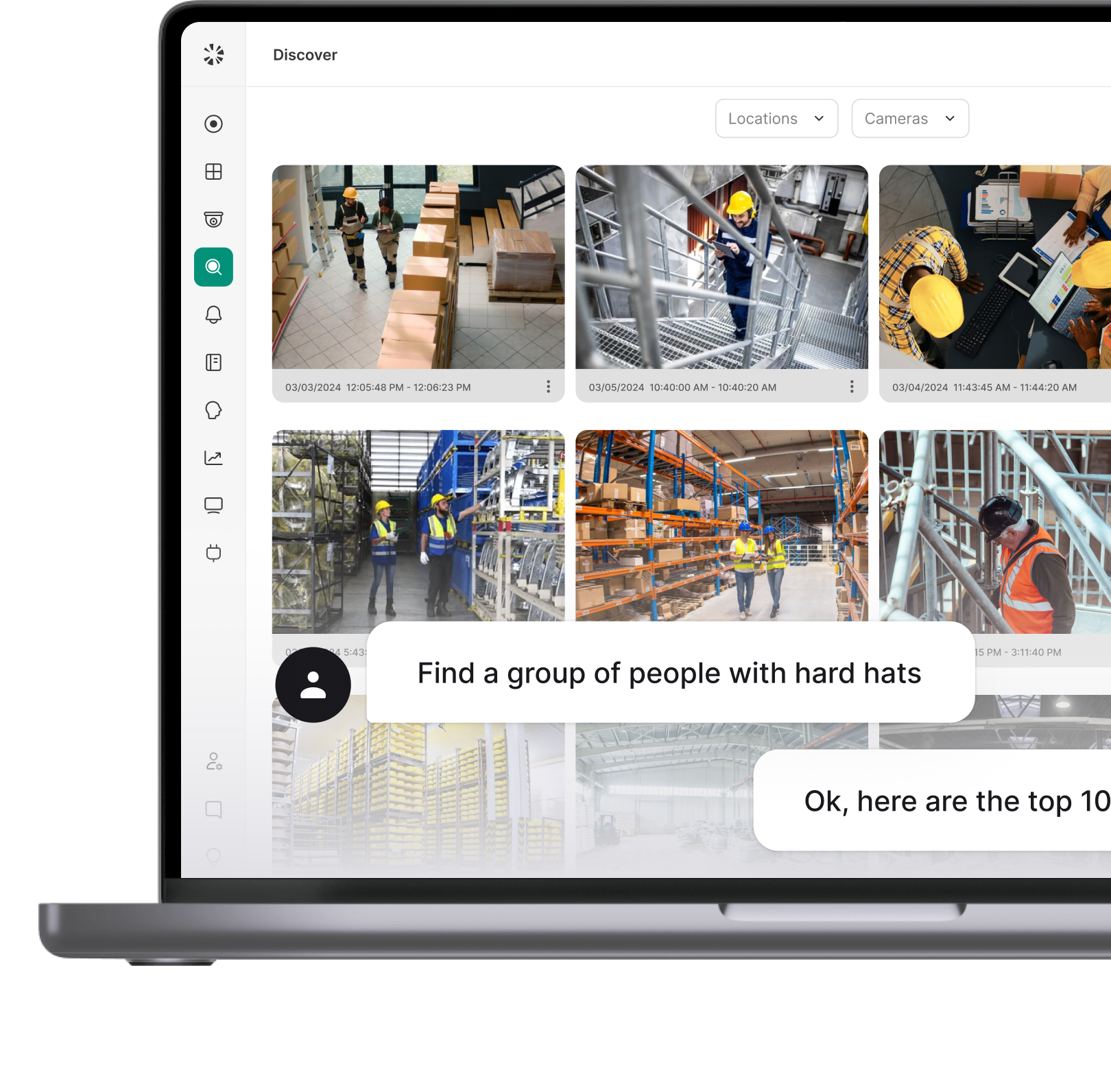
AI analytics may be enabled to help surface video footage related to defined safety conditions, such as unauthorized access, after-hours activity, or incident-related movement patterns. Analytics exist to assist authorized staff in locating relevant footage more efficiently.
Restricted use
AI analytics may not be used to profile students, track individuals over time, assess behavior, or make disciplinary determinations without human review. Automated alerts do not replace judgment or established decision-making processes.
Governance of AI outputs
AI-generated alerts and metadata are treated as indicators rather than evidence. Any action taken based on AI-assisted footage follows the same access, review, retention, and disclosure rules as standard surveillance video.
Bringing School Surveillance Under Clear Governance
A school video surveillance policy is not a formality. It is the framework that determines whether cameras support safety in a consistent, defensible way or create uncertainty when questions arise.
In 2026, schools are expected to manage surveillance with clear rules around placement, access, use, retention, and communication. Policies that do this well remove ambiguity.
They help staff act consistently, help leaders explain decisions confidently, and help families understand how safety and privacy are balanced on campus.
Platforms like Coram support this approach by aligning modern video capabilities with clear governance controls, so technology operates within the boundaries schools define.
When surveillance is governed by written standards instead of ad-hoc decisions, it functions as intended: a safety tool that operates within defined limits.




.png)