You're evaluating Solink. It works. Tens of thousands of locations run on it, the POS integration is strong, and the hybrid cloud architecture is well understood by integrators. Why are you looking for Solink alternatives?
Because Solink isn't the right fit for every multi-site operator. Some teams need sharper AI search. Some need a platform that unifies video and access control without patching two systems together. Some are running environments where Solink's retail and QSR depth is overkill, and what they actually need is a leaner, compliance-ready cloud VMS. And a few are simply doing proper due diligence before a five-figure commitment.
This guide covers nine Solink alternatives worth evaluating in 2026, organized by use case rather than marketing tier. Each entry gets an honest read: what it does better than Solink, where it loses ground, and who it's actually built for.
TL;DR
- Solink's core strength is video-plus-POS intelligence for retail, QSR, and convenience chains. If that's your environment and the price fits, it may already be the right answer.
- Coram is the closest direct peer for organizations wanting Solink-style camera-agnostic cloud VMS with stronger AI search, weapon detection, LPR, and native access control unification.
- Brivo (with Eagle Eye Networks) offers the most camera-compatible open cloud VMS on the market, with a mature reseller channel and battle-tested uptime.
- Rhombus Systems and Verkada are the leading proprietary hardware alternatives if you're open to a full rip-and-replace.
- For enterprise compliance environments, government, or critical infrastructure, Genetec Security Center and Milestone XProtect remain the dominant choices.
Quick Comparison: Solink Alternatives at a Glance
Why Buyers Compare Solink to Alternatives
Solink is a mature, well-positioned platform with a specific thesis: connect your existing cameras to the cloud, layer in POS and operational data, and give loss prevention and operations teams a single place to investigate. For QSR chains, convenience stores, and retail operators, that thesis holds up well. Solink integrates with over 300 business tools, and its Video Alarms add-on turns existing cameras into monitored sensors without replacing infrastructure.
Where teams start looking elsewhere tends to follow a recognizable pattern.
AI depth. Solink's AI capabilities are improving, but the platform was built around data-plus-video correlation rather than AI-native video intelligence. Teams that need natural language video search, on-device foundation model processing, or proactive weapon and threat detection often find the gap meaningful.
Access control unification. Solink integrates with access control systems but does not natively unify them. Organizations that want door events, video context, and access permissions in a single system (not two platforms exchanging data) need a different architecture.
Compliance environments. Healthcare, government, schools, and cannabis operators have specific requirements around data residency, certifications, and audit trails. Solink holds SOC 2 compliance, but regulated buyers often require more, or a different deployment model entirely.
Enterprise or government scale. Solink's sweet spot is the 10-to-500-location commercial operator. When the footprint grows into critical infrastructure territory, or when an organization needs the kind of ALPR and unified physical security management that a platform like Genetec delivers, Solink is no longer the right comparison.
How to Choose: 4 Axes That Narrow the Field
Four buying decisions narrow the Solink alternatives shortlist more than anything else: industry fit, architecture preference, hardware strategy, and pricing model.
Industry fit. POS-heavy chains (restaurants, retail, convenience) get the most specific value from Solink and its closest peers. Compliance-heavy environments (schools, government, cannabis, healthcare) need different certifications and deployment controls. Commercial real estate, manufacturing, and warehousing have their own requirements around occupancy, access, and perimeter intelligence.
Architecture preference. True cloud means your video lives in the cloud, managed remotely with no on-premise servers. Hybrid means a local device handles recording while the cloud handles management, alerts, and remote access. On-premise means everything runs on servers your IT team manages. Each model has cost, compliance, and reliability implications that vary by environment.
Hardware strategy. Keeping existing cameras dramatically reduces upfront cost and deployment complexity. Coram, Brivo, Arcules, Genetec, and Milestone all work with existing IP cameras. Rhombus and Verkada require their own proprietary hardware. This single decision often shapes the entire shortlist.
Pricing predictability. Some platforms publish per-camera subscription rates. Others are quote-only. Some bundle hardware, software, and cloud storage; others separate them. For multi-site deployments, the difference between predictable per-camera pricing and negotiated enterprise quotes can mean significant variance in total cost of ownership.
9 Best Solink Alternatives to Explore in 2026
Each group below maps to a different reason teams move on from Solink.
If You Want Solink's Model, But with Stronger AI
1. Coram: The Closest Direct Peer, Built AI-First
Coram is a cloud-native physical security platform that works with any existing IP camera. No hardware rip-and-replace required. It processes AI on-device via the Coram Point appliance, unifies video surveillance, access control, and emergency management in a single dashboard, and is SOC 2 Type II and HIPAA certified. Founded in 2022 by a team with roots in autonomous vehicle perception, it is one of the few platforms in the category built AI-native from day one rather than layering intelligence onto an existing VMS architecture.
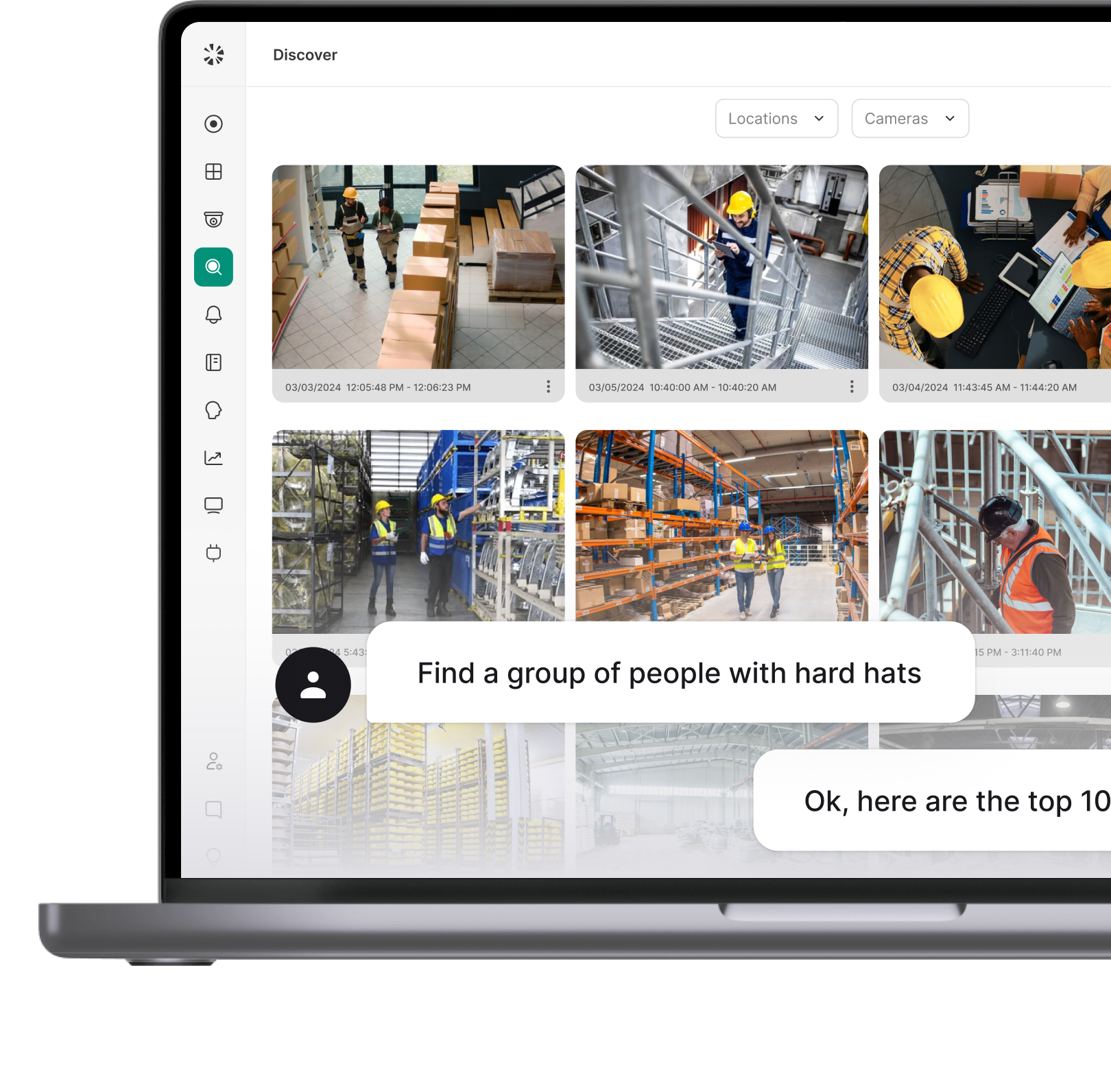
That camera-agnostic foundation is what makes the comparison to Solink direct: both platforms connect existing IP infrastructure to the cloud. Where Coram separates from Solink most clearly is in video search. Coram Discover uses on-device foundation models to index every video frame, then lets investigators search in plain English: "person in a blue jacket near the loading dock," "white sedan at the east entrance after 10 pm." Results surface in seconds across hundreds of cameras. Solink's video search relies on event filters and data correlations; Coram's runs natural language against every frame.
Coram also unifies access control natively, not as an integration. The Coram DC-41 controller and DR-U1 reader work with existing Wiegand and OSDP infrastructure, so door events, access permissions, and video context live in one system rather than two platforms exchanging data.
Best for: Multi-site organizations that want AI-native video intelligence and unified access control on the camera infrastructure they already own.
Strengths:
- Coram Discover natural language video search indexes every frame using on-device foundation models; results surface in seconds across hundreds of cameras
- Journey path provides one-click cross-camera tracking that auto-stitches clips of a person or vehicle across an entire site
- Weapon detection and slip-and-fall alerts are built into the platform, not sold as add-ons
- License Plate Recognition (LPR) on any existing IP camera, with partial plate search and vehicle-of-interest alerts without additional hardware
- Native access control via Coram DC-41 controller and DR-U1 reader, compatible with existing Wiegand and OSDP infrastructure
- Emergency Management System (EMS) with panic alerts, door lockdowns, and real-time team coordination from one dashboard
Limitations:
- Primary workflow is security intelligence and incident response, not POS transaction exception reporting — teams that need register-data correlation will find Solink more purpose-built for that use case
- Newer platform (founded 2022); enterprise buyers evaluating long-term vendor stability may want to assess accordingly
- Requires the Coram Point appliance at each site for on-device AI processing
Pricing: License terms available at 1, 3, 5, and 10 years; specific rates by quote.
See how Coram unifies video and access control for multi-site security teams.
2. Brivo (with Eagle Eye Networks): The Battle-Tested Open Cloud VMS
Brivo is a cloud-managed physical security platform covering access control, video surveillance, visitor management, and intrusion detection. Its merger with Eagle Eye Networks in December 2025 added a full cloud VMS layer to what was previously an access-control-focused platform, creating a combined security suite with support for over 10,000 camera models and a deep global integrator channel.
The merger also deepened AI video capabilities beyond what either platform had independently, adding gun detection, face match, license plate recognition, and precision person and vehicle detection. The resulting platform gives organizations direct control over their security operations without a managed service model, with an open RESTful API ecosystem for third-party integrations.
Where it separates from Solink is in camera compatibility breadth and integrator network maturity. Brivo's reseller and integrator channel is one of the deepest in the industry, which matters for organizations that rely on a trusted local integrator for deployment, support, and ongoing management.
Best for: Organizations that want an open, camera-agnostic cloud security platform with proven uptime at scale, a wide integrator channel, and access control now unified natively through the Eagle Eye combination.
Strengths:
- Supports over 10,000 camera models from virtually every manufacturer — among the broadest compatibility in the category
- Per-camera subscription model priced by resolution and retention period, with predictable costs at scale
- 100% cloud management via bridge or CMVR on-site device; no NVR required
- Open RESTful API ecosystem for third-party analytics and business application integrations
- AI capabilities including video search, object detection, LPR, and gun detection added through the Eagle Eye merger
- Deep global reseller and integrator network with established deployment and support infrastructure
Limitations:
- Cloud-only architecture means functionality degrades during internet outages; organizations with reliability-critical environments should evaluate offline behavior carefully
- AI depth and platform breadth remain narrower than Coram — no emergency management system, no natural language video search at the same level
- Integrator-dependent model can create variability in deployment quality depending on the partner
Pricing: Per camera/month subscription; rates vary by resolution and retention period.
3. Arcules: Cloud VMS for Teams Moving Off Legacy Milestone Infrastructure
Arcules is a Canon company delivering a cloud-native VSaaS platform with three deployment options: pure cloud, hybrid via edge gateway, and camera-to-cloud. It supports over 6,000 camera devices, is SOC 2 Type II compliant, and runs on Google Cloud with a 99.5% uptime SLA.
Its official XProtect plugin makes Arcules a natural migration path for organizations partially on Milestone that want to extend cloud management to distributed sites without replacing their central on-premise infrastructure. That specific integration is what separates Arcules from most alternatives on this list: it's designed to work alongside existing Milestone deployments, not replace them outright.
Against Solink, Arcules competes on deployment flexibility and forensic workflow depth rather than POS or operational data integration. For teams whose primary use case is video investigation and evidence management rather than transaction exception reporting, Arcules is worth a serious look.
Best for: Organizations with existing Milestone deployments extending cloud management to distributed sites, or mid-market buyers wanting a clean VSaaS platform with solid forensic search and straightforward scaling.
Strengths:
- Three deployment modes — pure cloud, hybrid edge gateway, and camera-to-cloud — accommodate mixed infrastructure environments
- Multi-camera forensic video search with dual-layer motion detection combining cloud and on-camera analytics
- Official XProtect plugin for Milestone VMS customers enables parallel operation during cloud migration
- Case management and external evidence sharing via time-limited secure links
- Heatmaps, people counting, and object detection analytics included
- Hosted on Google Cloud with 99.5% uptime SLA
Limitations:
- No native access control — video-only platform outside of third-party integrations
- AI intelligence is competent but not AI-native; lacks natural language search and on-device foundation model processing
- No POS or operational data integration; not a direct Solink replacement for retail or QSR environments
Pricing: Per camera subscription; rates by quote.
If You Want Proprietary Hardware and a Unified Cloud Ecosystem
4. Rhombus Systems: Cloud-Native Cameras at a Lower Price Point Than Verkada
Rhombus Systems is a cloud-native physical security platform built around proprietary cameras, access control hardware, sensors, and alarms, all managed from a single cloud console. Unlike Verkada, its Rhombus Relay (R100N appliance) connects up to 10 existing third-party cameras without additional streaming licensing fees, making the transition less binary for teams that want to preserve some existing infrastructure while moving to a unified cloud platform.
Against Solink, Rhombus competes on unified hardware-plus-cloud simplicity rather than POS data depth. The proposition is straightforward: replace your cameras, get a single vendor relationship, and skip Verkada's price point. Organizations that can justify the hardware cost will find it worth a close look.
Best for: SMB to mid-market organizations wanting a unified cloud-native hardware platform with room to preserve some existing camera infrastructure, at a more accessible price point than Verkada.
Strengths:
- Proprietary cameras, access control, environmental sensors, and alarms unified in one cloud console with no separate recording appliance
- Rhombus Relay (R100N) connects up to 10 existing third-party cameras without streaming licensing fees, partial hardware flexibility in an otherwise proprietary ecosystem
- Bundled subscription pricing covering hardware, software, and cloud services with predictable per-site costs
- AI-powered motion detection, occupancy analytics, and smart search included in the platform
- Real-time alerts and remote multi-site management from a single dashboard
Limitations:
- Hardware-replacement model means significant upfront cost for organizations with large existing camera investments
- AI depth is narrower than Coram or Verkada; natural language search and on-device foundation model processing are not at the same level
- No POS exception reporting; not a functional replacement for Solink in retail or QSR transaction workflows
Pricing: Bundled hardware and subscription; rates by quote.
5. Verkada: The Premium Unified Ecosystem for Enterprise Standardization
Verkada is a cloud-native physical security platform that unifies cameras, access control, alarms, sensors, and visitor management under a single proprietary hardware ecosystem. It made that model mainstream at enterprise scale. Its Command dashboard manages all of those systems in one interface, with edge processing on every device that keeps the system functional during network outages. G2 reviewers rate its AI search at 9.0 and ease of setup at 9.5, consistently above most competitors.
The tradeoff is full hardware replacement. Verkada requires its own proprietary cameras; existing IP camera infrastructure cannot be reused. For organizations where that tradeoff is acceptable, or where starting from scratch is the plan, Verkada's Command dashboard and multi-site scaling hold up well at enterprise volume. Against Solink, Verkada wins on unified platform depth and AI reliability; it has no POS integration and requires a significantly larger hardware investment.
Best for: Enterprise organizations standardizing across cameras, access, and sensors in a single vendor relationship, where operational simplicity and multi-site scalability outweigh hardware flexibility.
Strengths:
- Command dashboard unifies cameras, access control, alarms, sensors, and visitor management in one interface
- Edge processing on every device for offline reliability and reduced bandwidth consumption
- AI Unified Timeline reconstructs the movement of people and vehicles across an entire property on a single map-based view
- Natural language AI search for people, vehicles, and events
- Per-device annual licensing with volume negotiation available for enterprise deployments
- G2 ease of setup rating of 9.5 — among the highest in the category
Limitations:
- Full rip-and-replace deployment model; no support for third-party cameras. Organizations with significant existing camera investments face a meaningful upfront cost.
- No POS or transaction exception reporting; not a direct functional replacement for Solink in retail or QSR environments
- Per-device licensing at scale can make total cost of ownership significantly higher than camera-agnostic alternatives
Pricing: Per-device annual license; enterprise volume negotiation available.
6. Cisco Meraki MV: For Organizations Already Running Meraki Infrastructure
Meraki MV is the surveillance arm of Cisco's cloud-managed networking platform. It consolidates physical security into the same Meraki dashboard as switching, wireless, and MDM, which reduces operational overhead meaningfully for IT teams already administering Meraki day-to-day. Outside a Cisco Meraki environment, the security feature set alone rarely justifies the platform.
Against Solink, Meraki MV competes almost entirely on infrastructure convergence rather than security capability. Organizations not already running Meraki have no compelling reason to choose it over more capable security-first platforms.
Best for: IT-led organizations already heavily invested in Cisco Meraki that want to consolidate physical security into the same management plane as their network infrastructure.
Strengths:
- Proprietary cameras with built-in edge storage; no NVR or recording appliance required
- Single-pane management inside the Meraki dashboard alongside networking, MDM, and switching, a meaningful operational simplification for Meraki shops
- Motion-based search, object detection, and people analytics included
- Tight integration with Meraki networking for bandwidth management and camera health visibility
Limitations:
- Meraki Advantage license required for advanced AI analytics features — adds cost on top of the base camera license
- No support for existing third-party cameras; full hardware replacement required
- AI depth and camera flexibility do not justify the platform outside an existing Meraki environment
- No access control unification or emergency management capabilities
Pricing: Per-camera license plus Meraki Advantage for AI features; rates by quote.
If You've Outgrown Solink and Need Enterprise or Government Compliance
7. Genetec Security Center: The Standard for Regulated and Critical Infrastructure
Genetec Security Center integrates VMS (Omnicast), access control (Synergis), and ALPR (AutoVu) in a single platform, with on-premise, cloud-connected, and Security Center SaaS deployment options. It is the common choice for airports, city surveillance, and large regulated enterprises where cybersecurity posture and auditability are operational requirements, not features.
Against Solink, Genetec competes in an entirely different weight class. The comparison only comes up when an organization's compliance requirements, scale, or integration complexity has pushed past what Solink was designed to handle. The platform requires Genetec-certified integrators and is priced and staffed accordingly. For the environments it's built for, there is no closer peer.
Best for: Government agencies, critical infrastructure operators, and large regulated enterprises where unified VMS, native access control, and ALPR are compliance or operational requirements.
Strengths:
- Unified VMS (Omnicast), access control (Synergis), and ALPR (AutoVu) in one platform, not an integration but a native architecture
- KiwiVision analytics suite for privacy protection, crowd estimation, and behavioral analytics
- NDAA compliant; certified for government and critical infrastructure deployments
- Security Center SaaS for hybrid cloud deployments alongside traditional on-premise options
- Enterprise cybersecurity controls with role-based access, data protection, and audit trails
Limitations:
- Requires Genetec-certified integrators for implementation and ongoing management — not a platform you deploy without a dedicated partner
- Infrastructure complexity and cost make it impractical for organizations under 100 cameras or without compliance mandates driving the requirement
- Not designed for lean IT teams; ongoing administration requires dedicated security engineering resources
Pricing: Per-device plus feature module licensing; enterprise rates by quote.
8. Milestone XProtect: The Open-Platform VMS Backbone
Milestone XProtect is the most widely deployed open-platform VMS globally, with certified compatibility across more than 13,000 camera devices. It is a VMS backbone: stable, camera-agnostic, and deeply extensible via SDK and partner marketplace, not a unified physical security platform. Perpetual per-channel licensing and Care Plus maintenance agreements give organizations predictable long-term cost structures that SaaS-based alternatives don't offer.
Against Solink, Milestone occupies the same "works with existing cameras" position but operates on a fundamentally different architecture: on-premise, server-managed, integrator-driven. Organizations that need the deepest possible hardware compatibility and custom integration depth, and have IT resources to run the infrastructure, will find Milestone's ecosystem unmatched. Organizations that want cloud management and minimal IT overhead will not.
Best for: Integrator-driven enterprise deployments where hardware flexibility and ecosystem openness are the primary requirements, and dedicated IT management of the VMS layer is available.
Strengths:
- Certified compatibility with 13,000+ camera devices — the broadest hardware support in the industry
- Modular XProtect tiers (Essential+, Express+, Professional+, Expert, Corporate) scale from mid-market to large enterprise
- Extensive SDK and partner marketplace for custom integrations and analytics add-ons
- Milestone Kite and Arcules as cloud and hybrid migration paths from on-premise deployments
- On-premise data control with no mandatory cloud dependency — relevant for air-gapped and compliance-sensitive environments
Limitations:
- Server-heavy on-premise architecture requires significant IT infrastructure investment and ongoing management
- AI analytics require BriefCam or third-party add-ons with separate licensing — not AI-native
- Not designed for centralized remote management across distributed sites without substantial configuration
- Cloud management is available via Kite or Arcules, but neither replicates the native cloud experience of purpose-built VSaaS platforms
Pricing: Perpetual per-channel license plus Care Plus maintenance; rates by quote.
9. Avigilon Alta (Motorola Solutions): Deep AI Analytics for Large Campuses and Public Safety
Avigilon Alta is Motorola Solutions' hybrid cloud physical security platform for large campuses, public sector deployments, and organizations with public safety ties. Motorola's ownership gives it integration depth into radio, incident management, and dispatch workflows that no other commercial VMS matches, which is both its strongest differentiator and the clearest signal of who it's actually for.
Against Solink, the comparison only becomes relevant when an organization's requirements include public safety system coordination, large campus AI analytics, or deep Motorola Solutions infrastructure integration. For commercial multi-site operators without those requirements, Avigilon Alta's complexity and cost are rarely justified.
Best for: Large campuses, universities, public sector agencies, and organizations with existing Motorola Solutions infrastructure where public safety coordination and advanced AI analytics are both required.
Strengths:
- Appearance Search and Unusual Motion Detection AI with long deployment histories in enterprise and government settings
- Integration with the Motorola Solutions ecosystem, including PremierOne and CommandCentral, for public safety radio and dispatch coordination
- Hybrid cloud and on-premise deployment options accommodate regulated environments with data residency requirements
- Deep camera analytics for large campus environments at a scale few commercial platforms support
Limitations:
- AI analytics are strongest on Avigilon cameras; third-party hardware limits some analytics capabilities
- Platform complexity and Motorola ecosystem dependency make it impractical outside public safety or large enterprise contexts
- Higher price point and implementation complexity relative to mid-market alternatives
Pricing: Subscription plus hardware; rates by quote.
Choosing Among Solink Competitors: The Right Answer by Use Case
POS and transaction exception reporting in retail or QSR? Solink may already be the answer. The honest comparison at that point is whether Brivo or Arcules could serve the same camera-agnostic architecture at a better total cost for your environment.
Sharper AI video intelligence, natural language search, weapon detection, or unified access control on existing cameras? Coram closes that gap more directly than any other alternative on this list.
Large enterprise standardizing on proprietary hardware with the simplest unified management? Verkada is the answer.
Compliance, government, or critical infrastructure requirements driving the decision? Genetec is the platform the market has validated for those environments.
Most flexible, hardware-agnostic VMS backbone for a complex integrator-driven deployment? Milestone XProtect has built a 13,000-device compatibility list no one else has matched.
For teams that want AI video intelligence, native access control, and cloud management on existing cameras, all from a single dashboard, Coram is the most direct path from where most organizations are today to where physical security is heading. Book a demo to see the platform in action.




.png)