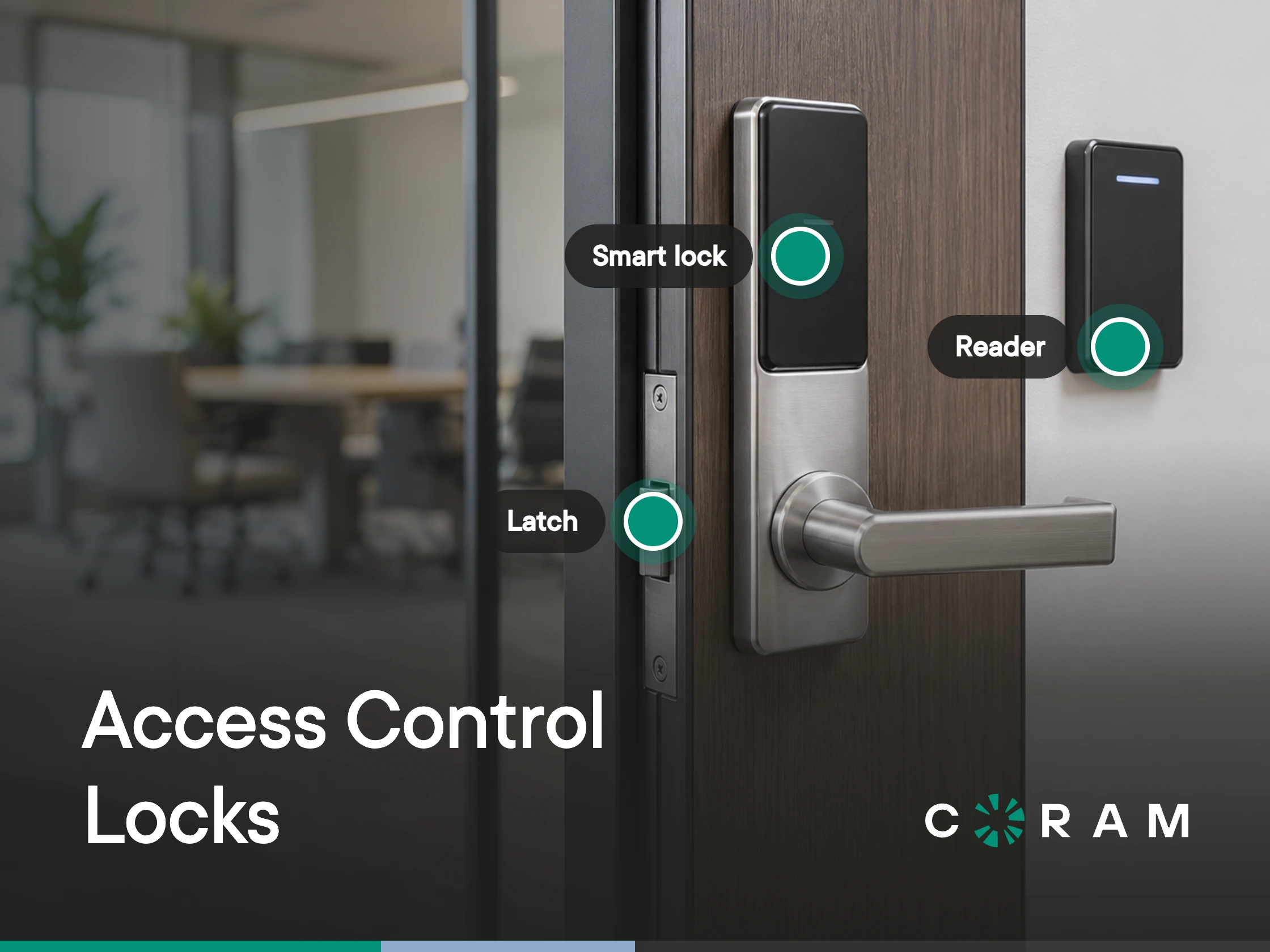
The five categories of commercial access control locks are electric strikes, electromagnetic locks (maglocks), electrified mortise or cylindrical locks, electrified exit devices, and electrified lever or wireless locksets. The right choice depends on the door itself: its existing hardware, construction, egress role, and how much wiring or modification the opening can handle.
TL;DR
- Electric strikes work with existing latch hardware; maglocks hold the door with magnetic force; mortise/cylindrical locks electrify the lock; exit devices suit panic hardware; lever/wireless locksets reduce wiring.
- Fail-safe versus fail-secure is a life-safety decision: fail-safe unlocks when power is lost, while fail-secure stays locked, so the door's role in the egress path matters.
- The panel switches the lock through a relay. Whether that relay also powers the lock (wet) or switches a separate supply (dry) depends on the panel and its configuration, so plan lock power before you order.
- A lock by itself creates no useful audit trail; you'll need door position and request-to-exit inputs to tell normal access from forced entry or a held-open door.
If you are managing doors across multiple sites, you may already have the panel selected (or even installed) and now need to decide what access control hardware belongs where. That decision starts with the door you're working with. An electric strike can work well when you want to keep the existing latch, while a door with panic hardware may point you toward an electrified exit device.
The Five Lock Types Used in Commercial Access Control
The five types of access control locks are not interchangeable versions of the same hardware. Each one changes the door in a different way and works better with certain existing hardware, door constructions, and operating requirements.
They range from small changes to the existing opening to a more involved hardware replacement. Electric strikes usually make the smallest change because they work with the existing latch and are installed in the frame.
Maglocks also avoid modifying the door leaf in many installations, while electrified locksets and exit devices depend more heavily on what hardware is already on the door. Electrified mortise and cylindrical locks can require more door preparation and a way to transfer power into the door. Here's how the five compare:
| Lock type | How it holds the door | Door modification needed | Default failure mode | Best fit | Where it struggles |
|---|---|---|---|---|---|
| Electric strike | Releases existing latch | Frame only | Configurable | Existing locksets | Hardware compatibility |
| Electromagnetic lock (maglock) | Magnetic force | Minimal | Fail-safe | Simple surface-mounted setups | Egress and power-loss requirements |
| Electrified mortise or cylindrical lock | Controls lockset | Moderate | Configurable | Commercial interior doors | Door prep and power transfer |
| Electrified exit device (panic hardware) | Controls exit device | Varies | Configurable | Egress doors with panic hardware | Existing device compatibility |
| Electrified lever and wireless lockset | Controls lockset | Low to moderate | Configurable | Doors where wiring is difficult | Compatibility and battery needs |
Electric Strikes
Electric strikes are often the first option to consider when you're retrofitting an existing commercial door. The existing lockset can usually stay in place, while the electric strike is fitted into the door frame to control when the latch can release.
That makes them a good choice when you already have standard commercial door hardware and don't want to replace the entire lockset. You get controlled access while keeping the door's normal handle or lever operation. The main thing to check is compatibility.
The strike has to match the existing latch, frame, and door hardware, so the right model depends on the opening you are working with. Check the manufacturer's documentation to confirm that fit before you specify the hardware. On fire-rated doors, the strike must be fail-secure and listed for fire door use: a fail-safe strike doesn't keep the door positively latched during a fire, which NFPA 80 requires.
Electromagnetic Locks (Maglocks)
An electromagnetic lock is useful when you want strong holding force without adding a mechanical locking mechanism to the door itself. It has no moving locking parts and releases when power is removed, which makes it inherently fail-safe.
That sets maglocks apart from the other options in this list. You can often mount the hardware without modifying the door leaf, which can simplify certain existing-door installations. Because power loss releases the door, egress, fire alarm release, and other life-safety requirements need to be considered before choosing one.
Electrified Mortise and Cylindrical Locks
With an electrified mortise or cylindrical lock, the locking hardware stays in the door itself. From the user's perspective, the door can still look and operate much like a conventional commercial door, while access is controlled electronically.
This can be a good choice when you want a more traditional lockset without any surface-mounted hardware. It is also a good fit for offices, meeting rooms, classrooms, and other commercial spaces where the appearance and normal operation of the door are critical.
The trade-off here is the work required inside the opening. The door may need preparation for the electrified lock, and a wired installation also needs a way to transfer power from the frame into the door, such as a power transfer hinge.
Electrified Exit Devices (Panic Hardware)
If a door already uses panic hardware, the access control hardware needs to work with that exit arrangement without any interference. Electrifying the exit device lets you control who can enter while keeping the push bar available for people exiting the building.
This is why electrified exit devices are mostly used on controlled doors that also need panic hardware. The access side can remain controlled while the exit side continues to provide a quick way out.
The main question here is compatibility with the existing door assembly. The exit device, door, frame, and power transfer method all need to work together, so this option should be selected as a complete door-hardware setup rather than as an isolated lock.
Electrified Lever and Wireless Locksets
Electrified lever locksets give you electronic access control while keeping the familiar lever-style hardware people already use. They work well when you want a cleaner retrofit without adding a separate locking device to the door.
Wireless locksets reduce the wiring needed at the door even further. Commercial wireless systems typically use a wireless connection between the lock and a hub, while the hub connects to the access control system. That is different from a consumer Wi-Fi lock.
Less wiring comes with more to check: the door and lockset, the wireless communication method, battery requirements, and how the lock connects back to the access control system. For Coram specifically, the controllers drive a wired lock relay at each door, and WiFi locks are not supported.
Fail-Safe vs Fail-Secure: The Decision That Life Safety Turns On
When power is lost, a fail-safe lock unlocks, but a fail-secure lock stays locked. When you're choosing between the two for your electronic access control, weigh what each door has to do during an outage:
- Egress door: If people rely on electrical release to leave during an emergency, a fail-secure lock could prevent that release when power is lost. Use a fail-safe lock, or one that provides mechanical free egress. (Confirm the specific requirements for the opening with the authority having jurisdiction, or AHJ.)
- Server room: A fail-safe lock could release the door during a power outage, leaving a normally restricted area accessible when the building loses power.
Fail-secure does not automatically mean people are trapped inside. Many commercial electrified locks still provide mechanical free egress from the inside regardless of the electrical failure mode. The problem happens when a fail-secure arrangement relies on electrical release for the direction of egress that people need.
The opposite mistake is choosing fail-safe simply because releasing the door sounds safer. For a door whose primary job is to protect a sensitive space, unlocking every time the building loses power may be the wrong tradeoff. Requirements for these conditions vary by application and jurisdiction, so always confirm them with the AHJ and the code or standard adopted for the project. For a closer look at the two modes, see our guide to fail-safe vs. fail-secure locks.
What Your Access Control Panel Needs From the Lock
While choosing the lock, match it to what the access control panel can actually control, including its electrical requirements and how the lock gets power. Before ordering, you need to know what the panel switches, what the lock requires, and where the lock's power comes from.
Voltage and Current Draw
First, check whether the lock's electrical requirements match what your access control system supports. Confirm the specified voltage and current requirements in the manufacturer's documentation before ordering, and make sure whatever powers the lock (the panel or a separate supply) can deliver them.
Dry Contact vs Wet Contact
A dry contact relay acts as a switch for power supplied by another source, while a wet contact output provides power through the output itself. If the panel doesn't provide the power the lock needs, you'll need an appropriate external power supply, and the relay must control that power.
Either way, when you specify a door, treat the door controller, relay connection, lock, and lock power supply as separate parts of the same electrical setup.
Matching the Lock to the Door
The door itself usually narrows down the lock choices before you get to electrical specifications or the rest of the access control system components. Start with the door material, the existing hardware, whether the opening is part of an egress path, and how much modification it can take:
| Door type | Lock type that fits | Failure mode to specify | What to check before ordering |
|---|---|---|---|
| Glass storefront door | Electric strike, maglock, or electrified lever lockset (if the stile allows) | Per the door's egress role; maglocks are always fail-safe | Existing frame and lock hardware, available mounting space, and how power will reach the lock |
| Hollow metal door in a steel frame | Electric strike or electrified mortise/cylindrical lock | Per the door's security vs. egress role | Existing latch and frame preparation, lock compatibility, and power transfer requirements |
| Fire-rated door | Electrified mortise/cylindrical lock, electrified exit device, or an electric strike listed for fire door use | Electrified mortise/cylindrical locks may be fail-safe or fail-secure if positive latching is maintained; electric strikes must be fail-secure and listed for fire door use | Existing door hardware, required door assembly, failure behavior, and applicable requirements |
| Door with panic hardware in an egress path | Electrified exit device | Per the egress release method; electric latch retraction is fail-secure | Existing panic hardware, door and frame compatibility, power transfer, and required emergency behavior |
| Interior office or classroom door | Electrified mortise/cylindrical lock or electrified lever lockset | Per the door's security vs. egress role | Existing lockset, door preparation, wiring route, and desired door operation |
| Exterior perimeter door | Electric strike or electrified mortise/cylindrical lock | Fail-secure keeps the perimeter locked in an outage; confirm egress | Existing hardware, frame, environmental conditions, power transfer, and failure behavior |
| Gate or barrier | Electric strike or other compatible electronic locking mechanism | Per the gate's security vs. egress role | Gate hardware, mounting arrangement, available power, and compatibility with the access control relay |
Once you have that starting point, let the existing door hardware rule out an otherwise suitable lock if the latch, frame, or mounting arrangement does not match. For a multi-site rollout, group openings by door type and existing hardware first, then verify the exact lock, failure mode, and electrical requirements for each group before ordering.
The Sensors That Make the Lock Auditable
A lock can control access, but by itself it cannot tell you what happened at the door. A door position indicator (DPI) detects whether the door is physically open or closed. It is required for door-held-open and forced-entry events.
That difference is important if you're reviewing an event after the fact. Without door position information, the system can record an unlock action, but it can't tell whether the door actually opened or whether someone opened it without a valid access event. The DPI adds that physical state to the access record.
A request-to-exit (REX) device provides another piece of context for normal exits. Depending on the system and how it's set up, a REX either unlocks the door or tells the system the opening was a legitimate exit. On Coram, pressing the REX opens the door, bypassing schedules and access level restrictions. Either way, it separates an authorized exit from an opening that needs investigation. Once the lock, DPI, and REX are connected to the access control system, those events become part of the audit trail.
Fire Alarm Release and Code Compliance
Once a door is connected to the building's fire and life-safety systems, the way your lock behaves during an alarm has to be considered as part of the overall door setup. The exact requirement depends on the opening, the building, and the AHJ. A fire marshal or fire prevention official may be involved with fire and life-safety requirements, a building official or inspector with building and egress requirements, and an electrical inspector with the electrical installation.
Maglocks show how much the release method matters. When a maglock is released by a motion sensor, the International Building Code requires it to unlock on loss of power, from a manual push button by the door, and when the building's fire alarm system activates (where one is provided). In the 2021 IBC, that's the sensor release provision in Section 1010.2.12. A maglock released by a switch in door-mounted hardware, such as a panic bar, falls under a different provision with different triggers, and section numbers vary by code edition, so check the edition your jurisdiction has adopted.
Before you finalize the lock and controller setup, confirm the requirements for releasing the access-controlled door during a fire alarm in the project's jurisdiction. This is particularly important for doors on an egress path, fire-rated doors, and any installation where the access control system will interface with the fire alarm system.
For a broader look at how the different parts of a commercial access control system fit together, see our access control systems buyer's guide.
How Coram Access Control Drives Door Locks
Coram's Access Control works with most existing locks and readers, so the lock choices above rarely mean replacing hardware that already works. Each door is wired to an electronic locking mechanism controlled through a relay output on the controller, and that relay connects the controller's access decision to the lock.
Both Coram controllers, the four-door DC-41 and the single-door DC-11, have a three-position switch on each door relay: 12V, 24V, or dry. In wet mode the controller powers the lock directly, up to 800 mA at 12V or 350 mA at 24V per relay on the DC-41, and up to 700 mA at 12V or 350 mA at 24V on the DC-11. In dry mode the relay switches a separate supply, which is the route for a lock that draws more than that. Coram Access Control supports most standard 12V DC and 24V DC locks.
Fire alarm release works differently on the two models. The DC-41 has a fire alarm interface that cuts power to its wet-mode locks when the fire alarm panel triggers it, and it can be set to keep them released until someone resets it. The DC-11 has no fire alarm interface, so plan fire release for those doors, and for any lock on a separate supply, in the lock's power circuit.
The lock also works alongside the other door hardware to give you a record of what happened at the opening. You can view event logs of every unlock attempt, door open/close, REX press, and forced entry, with a video clip of the event wherever a camera is paired with the door. Alerts cover doors held open, doors forced open, tailgating (on doors with a linked camera), tamper, and controller status, including power loss. That turns the lock from a device that simply controls the door into part of a record you can actually review.
From there, the controller and door hardware form part of the wider access control system, alongside Coram door readers and the access permissions that determine who can enter.
Start With the Door
The deciding variable is the door and what it needs to do: its existing hardware, its egress requirements, and how it should behave during a power loss or emergency. Get those right, and the lock, the failure mode, and the wiring largely follow. Before you order, inventory the existing hardware on each door, establish which openings sit in an egress path and what the AHJ requires there, and confirm each lock's voltage and current against the controller or supply that will power it. If you want to look at the rest of the access control hardware stack, see our access control technologies guide.