Most security teams evaluating Ambient.ai competitors and alternatives aren't questioning whether it works. They're questioning whether it's the right shape of platform for their organization: their camera footprint, their team size, their budget, and how much of the security stack they want to own under one vendor. That's a different question, and it's the one this guide answers.
Nine platforms are doing real work in this category in 2026. Some are intelligence layers that sit on top of existing infrastructure. Some are full-stack replacements. Some are built for Fortune 500 GSOCs; others for mid-market security teams running lean across a dozen sites. What follows is an honest read on each one, including where Ambient.ai remains the right call.
TL;DR
- Ambient.ai is the strongest fit for Fortune 1000 GSOC operations, but its edge-appliance model and enterprise pricing leave real room for alternatives at the mid-market and below.
- Coram leads this list because it unifies AI video and access control in one cloud platform, works with any existing IP camera without a hardware swap, and deploys in days rather than weeks.
- Verkada and Rhombus dominate the cloud-native, hardware-first segment for teams starting from scratch.
- ZeroEyes is the most credible pick when firearm detection is the primary concern.
- The right alternative depends on your camera footprint, team size, and how much of the security stack you want under one vendor.
What Is Ambient.ai?
Ambient.ai is an enterprise physical security platform built around a Vision-Language Model called Ambient Pulsar that reasons about video in real time to flag actual threats, not motion events. Founded in 2016 by two Stanford AI researchers, it operates as an intelligence layer on top of existing camera and access control infrastructure, with AI processing running on edge appliances at each site and a cloud console for monitoring, multi-site management, and analytics. It supports 200+ ONVIF-compliant cameras, holds SOC 2 Type II, and does not use facial recognition or store PII.
Where it fits best is in organizations with mature GSOC operations: 1,000+ cameras, dedicated analysts, and the infrastructure to take full advantage of behavioral threat libraries and agentic video walls. Cisco, ServiceNow, Adobe, and TikTok are among the names running on it. The platform processes over 200 million video hours and 10 billion events a day.
Why Security Teams Evaluate Ambient.ai Alternatives
- Pricing is enterprise-tier. Mid-market teams running 50 to 300 cameras often find the economics don't work, even when the technology is a strong match.
- Deployment depends on edge appliances. AI processing runs on dedicated hardware installed at each site — the right architecture at scale, but real overhead for teams that need to be live in days.
- It's an intelligence layer, not a full stack. For teams already satisfied with their cameras, VMS, and access control, that's an advantage. For teams trying to consolidate legacy systems under one vendor, it means the rest of the stack still needs to be sourced separately.
- The most powerful features assume a mature GSOC. Agentic video walls and behavioral threat libraries presume a 24/7 operations center with analysts watching feeds. Smaller security teams running lean don't always have the headcount to extract that value.
- Camera compatibility is broad but not universal. The platform supports 200+ ONVIF cameras, which is generous. It still requires checking your specific models against the supported list before signing.
None of this diminishes Ambient for the buyer it's designed for. A security director at a 600-camera, 12-site mid-market company just has different constraints, and the list below reflects that.
What to Look for in an Ambient.ai Alternative
Five criteria actually determine fit in this category. AI architecture matters first: Vision-Language Models handle open-ended reasoning; computer vision is faster and cheaper; rules-based analytics are predictable but rigid. Deployment model shapes everything downstream, with cloud-native, edge-appliance, and hybrid options each carrying different tradeoffs in setup time and ongoing IT burden. Camera compatibility is often the single biggest cost variable: whether the platform works with existing IP cameras or requires you to buy proprietary hardware determines whether you're looking at a software cost or a full hardware refresh. Stack breadth decides how many vendors you're managing, from video-only platforms to full systems covering VMS, access control, emergency management, and visitor management. And buyer profile fit cuts across all of it: mid-market, enterprise, K-12, healthcare, and corporate campuses have different constraints that most platforms don't serve equally well.
Ambient.ai Competitors: Comparison Table
A quick scan across all nine platforms on the dimensions that matter most:
9 Best Ambient.ai Competitors in 2026
The entries below are arranged by buyer fit, starting with the platforms most relevant to mid-market and multi-site teams and moving toward more specialized or enterprise-specific options.
1. Coram
Coram is an AI-native physical security platform that connects to any existing IP camera and manages video surveillance, access control, and emergency management from a single cloud dashboard. Unlike Ambient.ai, which operates as an intelligence layer requiring separate VMS and access control infrastructure, Coram replaces that entire stack (or layers on top of it) without requiring a single camera swap.
That hardware-agnostic foundation is the starting point for most buyers who choose Coram over Ambient or other alternatives. It works with 1,000+ ONVIF-compatible IP camera models including Axis, Hikvision, and Dahua, and if you want to standardize on new hardware, Coram's own camera lineup is available. The result is a migration path that looks like connecting existing cameras to Coram's local edge device, not a rip-and-replace project.
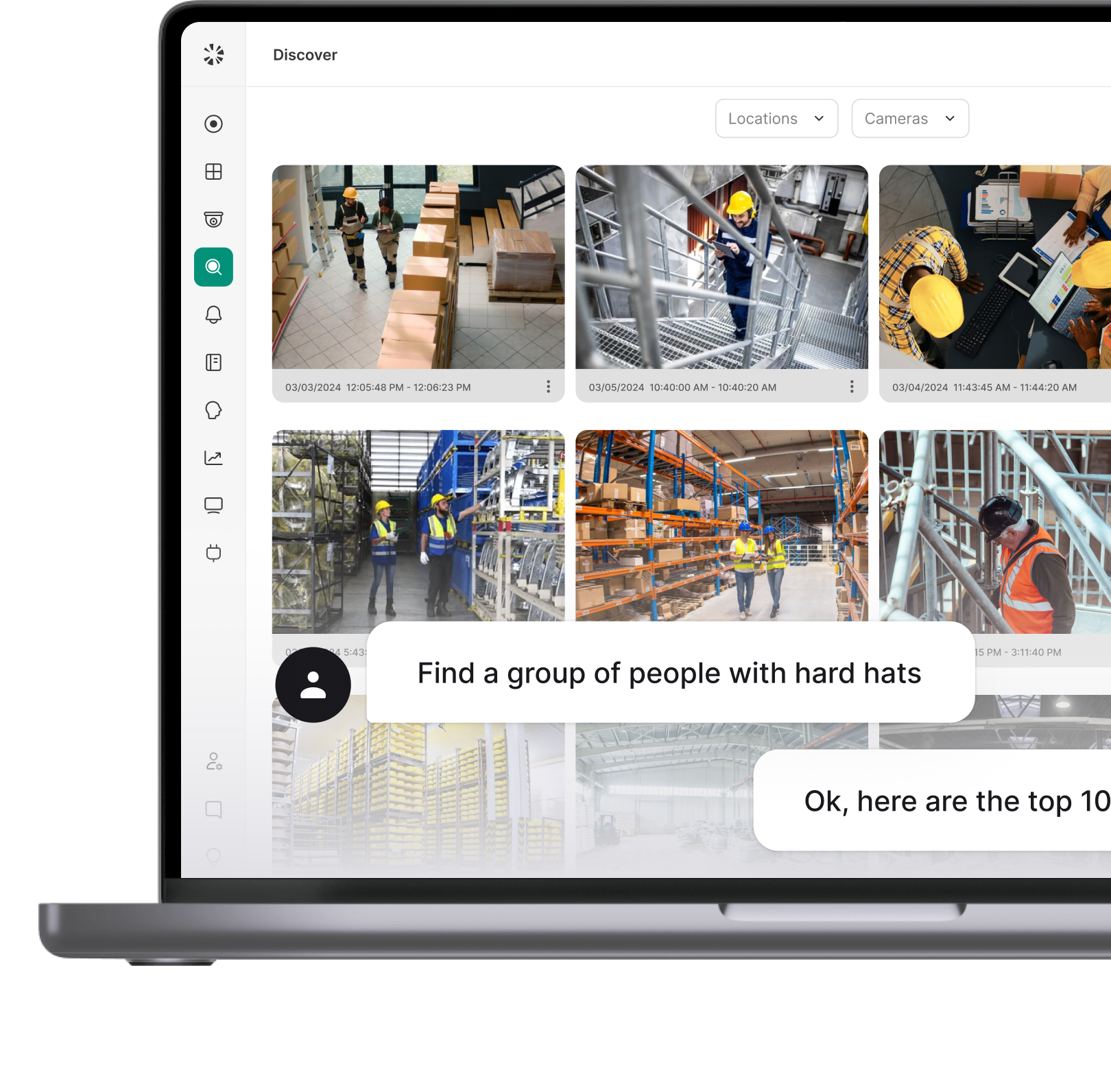
The AI layer is native, not bolted on. Natural language video search lets anyone on a lean security team find footage by describing what happened — "someone in a red jacket near the loading dock around 3pm" — without calling IT or scrubbing through hours of recordings. Real-time detection covers firearms, slip-and-fall events, PPE violations, and custom alert creation in plain English. Access control events (entry, denied access, propped door, forced entry) automatically pair to video clips, giving a unified incident record instead of two separate systems to cross-reference. The emergency management system adds panic buttons, real-time coordination, and lockdown. All on the same platform.
Deployment is measured in days, not weeks, because there's no edge appliance procurement cycle. One customer reported being live with 100+ cameras in 10 minutes. The platform is SOC 2 Type II and HIPAA certified, with on-premises AI processing available for privacy-sensitive environments.
Where Coram is a weaker fit: organizations with Fortune 500-scale GSOCs that need Ambient-style behavioral threat signature libraries and agentic video wall capabilities. At that scale and operational sophistication, Ambient or Avigilon are worth a serious look.
Best for: Mid-market and growing enterprise teams (schools, healthcare facilities, warehouses, multi-site operators) that want a unified platform for AI video and access control, the flexibility to keep existing cameras, and deployment speed measured in days.
Strengths:
- Works with any existing ONVIF-compatible IP camera, no rip-and-replace required, which is Coram's single largest practical advantage over proprietary-hardware competitors
- AI video, access control, emergency management, and visitor management on one platform and one login, eliminating the vendor-management overhead of point solutions
- Natural language video search and real-time detection available to lean IT teams without dedicated security engineers
- Deploys in days with no edge appliance procurement; offline mode keeps cameras and doors running through internet outages
- G2-rated 4.9/5 with 9.5/10 ease of use; SOC 2 Type II and HIPAA certified
Limitations:
- Custom pricing means no instant budget estimate; requires a sales conversation.
Pricing: Custom pricing based on camera count, sites, and feature set. Get a quote or start a free trial.
2. Verkada
Verkada is the largest cloud-managed physical security platform on the market, covering cameras, access control, alarms, intercoms, and environmental sensors in one tightly integrated hardware-plus-software ecosystem. Its hybrid architecture combines on-camera storage with cloud backup, and the Command dashboard is one of the cleanest management interfaces in the category.
The trade-off is hardware lock-in. Verkada cameras are proprietary, and while a Command Connector NVR allows some third-party cameras to connect, the platform is designed and optimized for Verkada hardware. That's a real constraint for organizations with substantial existing camera investments. Where Ambient.ai works with your infrastructure and Coram works with your cameras, Verkada works best when you buy its cameras.
For a greenfield deployment (a new building, a new campus, or an organization replacing everything at once), that trade-off often makes sense. The UX is polished, the AI capabilities (face matching, license plate recognition, occupancy trends) are solid, and the operational overhead is low. For organizations that can't or won't replace existing cameras, Verkada is an expensive fit.
Best for: Organizations greenfielding a new deployment who want a unified hardware-plus-software experience and are willing to commit to a single vendor's camera ecosystem.
Strengths:
- On-camera storage and processing eliminate the need for separate NVRs, reducing infrastructure overhead
- Command dashboard widely regarded as one of the best UIs in the category
- Broad platform coverage across cameras, access, alarms, intercoms, and environmental sensors
- Native identity provider integrations (Okta, Microsoft Entra ID) for enterprise IT environments
- Automatic firmware updates and 24/7 support included in licensing
Limitations:
- Proprietary camera hardware is required for full functionality. No meaningful reuse of existing IP cameras without the Command Connector add-on
- 10-year camera lifecycle model with per-camera annual licensing adds up quickly at scale
- Premium pricing across the board; hardware alone runs $599 to $999+ per camera before installation and licensing
Pricing: Cameras range from roughly $599 to $999+ depending on model, plus annual per-device licensing. Command Connector NVRs for third-party cameras start at $2,999. Most pricing finalized through authorized partners.
3. Spot AI
Spot AI is a camera-agnostic video intelligence platform built around a Dual-Drive Intelligent Video Recorder (IVR) that connects to existing IP cameras, modern or legacy, including analog DVRs. The AI layer adds searchable video, object detection, and automated incident clip generation on top of whatever camera infrastructure is already in place.
The platform's appeal is narrow but real: if you have a large, settled camera investment, want cloud-managed AI video without touching the hardware, and handle access control separately, Spot AI is a real option. It's closer to Ambient.ai in positioning (an AI layer rather than a full stack) but targets a lower market segment and doesn't require an edge appliance from the vendor.
Best for: Mid-market security teams with substantial existing camera investments who want a cloud-managed AI video layer without replacing hardware, and who are comfortable managing access control through a separate system.
Strengths:
- Works with a broad range of existing IP cameras, including older analog systems via DVR
- Plug-and-play IVR setup deploys in days with no proprietary camera requirement
- AI agents watch specific scenes for specific behaviors and surface them automatically
Limitations:
- Video-only platform; access control requires a separate vendor, adding operational complexity
- No emergency management, visitor management, or unified incident response
- Less AI depth than Ambient.ai for GSOC-scale operations or behavioral threat detection
Pricing: Subscription model based on camera feeds, locations, storage duration, and license term. Spot AI NVR starts at $2,199 per location including hardware and one year of software license.
4. Rhombus
Rhombus is a cloud-managed physical security platform similar in architecture to Verkada, with smart cameras, on-device AI processing, hybrid storage, and a web-based management console. The differentiator is its open API and stronger third-party integration posture, making it a better fit for IT-driven organizations that need security to connect with broader business systems.
Like Verkada, Rhombus requires its own camera hardware for full functionality. It's a proprietary ecosystem play, and the economics reflect that.
Best for: Mid-market and enterprise teams that prioritize API-driven integration with their broader IT stack and are willing to invest in proprietary hardware for a unified cloud platform.
Strengths:
- Open API with strong third-party integration support (Okta, Slack, identity providers) beyond what most camera vendors offer
- IoT sensor support for environmental monitoring alongside cameras and access control
- Cross-camera people and vehicle search across multi-site deployments
- Channel-driven sales with certified partners for implementation support
Limitations:
- Proprietary camera hardware required for full functionality, same constraint as Verkada
- No public pricing; final numbers require a reseller conversation
- Smaller market presence than Verkada; integration ecosystem not as mature
Pricing: Hardware plus annual per-device licensing, negotiated through resellers. No public pricing.
5. ZeroEyes
ZeroEyes is a specialized AI gun detection platform that integrates with existing security cameras to identify visible firearms and alert law enforcement before an incident escalates. Every alert is verified by a human analyst at the ZeroEyes Operations Center before going out, which is why false positives are essentially zero. Detection typically happens within 3 to 5 seconds.
This is a point solution, not a platform. ZeroEyes does one thing and does it better than any general-purpose security platform. It holds a DHS SAFETY Act Designation, the first AI-based gun detection technology to earn it, and is trusted by the US Department of Defense, K-12 districts, universities, and Fortune 500 campuses. It has since expanded into knife detection, suspect tracking, and intruder analytics, but firearm detection remains its core value.
Best for: K-12 schools, universities, government buildings, and commercial campuses where firearm detection is the dominant security concern and existing cameras are already in place.
Strengths:
- Human-verified detection at ZeroEyes' operations center keeps false positives near zero, the key differentiator from software-only detection systems
- DHS SAFETY Act Designation, the most credible external validation in the category
- Integrates with existing IP cameras; no proprietary hardware required
- No facial recognition or biometric data collection
Limitations:
- Point solution: handles weapon detection only; requires a separate VMS, access control, and emergency management stack
- Not a fit for organizations whose primary concern is broader operational security beyond firearms
- No unified incident management or multi-site dashboard for general security operations
Pricing: Custom pricing based on camera count and deployment scope.
6. Actuate
Actuate is a software-only AI video analytics platform focused on weapons and intruder detection, using computer vision models trained specifically for firearms, knives, and unauthorized presence in restricted areas. It runs on existing cameras and commodity hardware. No proprietary devices, no appliances.
It competes with ZeroEyes on price and simplicity. The trade-off is that Actuate lacks ZeroEyes' human verification layer, which means faster alerting but higher false-positive risk in complex environments.
Best for: Organizations that want a software-only computer vision threat detection layer on existing cameras, with a focus on weapons and intruder detection in transit, education, or corporate environments.
Strengths:
- Software-only deployment on existing cameras; no appliances, no proprietary hardware, low deployment cost
- Real-time computer vision detection for firearms, knives, and intruders
- Strong adoption in schools, transit systems, and corporate campuses
- Runs on commodity hardware or in the cloud
Limitations:
- No human verification layer; false-positive risk is higher than ZeroEyes in ambiguous environments
- Point solution; no VMS, access control, or broader security platform capabilities
- Less external validation than ZeroEyes (no SAFETY Act designation)
Pricing: Custom quotes based on camera count and deployment scope.
7. Volt.ai
Volt.ai is a real-time video intelligence platform built around a digital twin approach. Rather than analyzing each camera feed in isolation, it unifies feeds into a 3D environmental model and tracks people and objects across multiple cameras simultaneously. The result is cross-camera intelligence that's more contextually aware than traditional single-feed analysis.
Every alert is human-verified at Volt's SOC before going out. The platform targets education and corporate security teams, and roughly 25% of its client base is in higher education.
Best for: Education and corporate security teams that want real-time video intelligence with strong cross-camera tracking and a 3D map view, layered on top of existing camera infrastructure.
Strengths:
- Digital twin technology creates a unified 3D model of the environment for cross-camera tracking, which is a different approach from single-feed analytics platforms
- Detects weapons, fights, medical emergencies, unauthorized access, and crowd anomalies
- Human verification eliminates false positives
- Privacy-first design with no facial recognition or biometric data collection
- Transparent per-camera pricing model available on the website
Limitations:
- Intelligence layer only; requires separate VMS, access control, and emergency management
- Smaller platform presence than the major enterprise players; integration ecosystem is limited
- The 3D digital twin setup adds complexity to the initial deployment
Pricing: Per-camera transparent pricing available on the Volt.ai website. Custom quotes for larger deployments.
8. Avigilon (Motorola Solutions) / BriefCam
Avigilon, owned by Motorola Solutions, is one of the largest enterprise video security vendors globally. It offers hybrid cloud and on-premises deployment, an extensive proprietary camera lineup, and AI-powered analytics including appearance search, object classification, license plate recognition, and unusual motion detection. BriefCam, also part of the Motorola Solutions portfolio, condenses hours of footage into short reviewable clips for forensic review.
The platform's AI is strong, but optimized for Avigilon's own cameras. Third-party hardware limits analytics performance, which is the same hardware dependency that affects Verkada and Rhombus. For organizations already running Avigilon infrastructure, the analytics are strong. For organizations evaluating it as a new system, the proprietary camera ecosystem and premium pricing are the primary constraints.
Best for: Large enterprises, government agencies, and critical infrastructure operators that need a vertically integrated video security stack with hybrid cloud and on-premises deployment options and strict data residency requirements.
Strengths:
- Appearance search, self-learning detection, and BriefCam video synopsis for forensic review; strong AI capabilities for investigations
- Hybrid deployment options covering cloud, on-premises, and air-gapped environments for strict compliance requirements
- Tight access control integration through the broader Motorola Solutions portfolio
- Backed by Motorola Solutions' enterprise support and global integrator network
Limitations:
- Top AI features are optimized for Avigilon cameras; third-party hardware degrades analytics performance noticeably
- Premium pricing tier; cameras and licensing typically exceed $200 per camera before installation
- More complex to deploy and administer than mid-market platforms; requires dedicated security staff or integrator support
- Not built for fast rollouts or lean IT teams
Pricing: Channel-driven through resellers and integrators. No public pricing.
9. Brivo
Brivo is a cloud-managed physical security platform covering access control, video surveillance, visitor management, intrusion detection, and monitoring from one interface. Brivo merged with Eagle Eye Networks in 2024/2025, adding a full cloud VMS and AI video layer to what was previously an access-control-focused platform. The combined platform now includes gun detection, face match, license plate recognition, and precision person and vehicle detection.
The merger makes Brivo a more direct full-stack competitor than it was a year ago, though the integrated platform is still maturing relative to Coram or Verkada in terms of AI depth and emergency management capabilities.
Best for: Multi-site organizations that want direct internal control over their security operation (access control and video under one vendor) without a managed service model.
Strengths:
- Full platform coverage across access control and cloud video surveillance post-merger, with direct internal control rather than a managed service model
- Open API for integration with existing IT systems
- AI video capabilities (gun detection, face match, license plate recognition) now available natively post-Eagle Eye merger
- Scales well for distributed multi-site operations
Limitations:
- Cloud-only architecture; functionality degrades during internet outages, a meaningful constraint for sites with unreliable connectivity
- Not fully camera-agnostic; works best with Brivo/Eagle Eye compatible hardware
- Less AI depth than Coram; no natural language search, no emergency management, no unified incident response
- Combined platform is still post-merger; integration depth and stability are maturing
Pricing: Through resellers. No public pricing.
Which Ambient.ai Alternative Should You Pick?
Four questions determine the right fit.
How big is your camera footprint? Under 100 cameras, Verkada or Rhombus make sense for a greenfield deployment; Spot AI or Coram are better for organizations with existing hardware. Between 100 and 1,000 cameras across multiple sites is Coram's core territory. Above 1,000 cameras with a mature GSOC, Ambient.ai and Avigilon become the serious considerations.
Do you want a unified stack or just an AI layer? For one vendor covering cameras, NVR, VMS, AI, access control, and emergency management, Coram or Verkada is the shortlist. For an AI intelligence layer on top of existing infrastructure, Ambient.ai, Spot AI, Volt.ai, or ZeroEyes fit that model.
Is firearm detection the primary concern? Then ZeroEyes is the specialist answer. Its human-verified detection and DHS SAFETY Act designation are purpose-built for exactly that problem in schools, universities, government buildings, and commercial campuses.
How fast do you need to be live? Cloud-native platforms (Coram, Verkada, Rhombus, Spot AI) deploy in days. Edge-appliance platforms like Ambient.ai and large enterprise systems like Avigilon can take weeks to months depending on site complexity.
For most mid-market and growing enterprise security teams, Coram covers the widest range of those criteria in a single platform: existing cameras, fast deployment, unified AI video and access control, and a price point that doesn't require Fortune 500 procurement cycles. For Fortune 500 operations with mature GSOCs and existing infrastructure, Ambient.ai often remains the right answer.
Book a demo or start a free trial to see how Coram unifies video, access, and AI in a single platform.




.png)