Choosing the right access control turnstile comes down to five factors: security level, throughput, available space, accessibility, and the experience people have every time they walk through your entrance.
If you need fast, high-volume entry with a professional lobby experience, an optical speed gate is usually the right starting point.
If perimeter security is the priority and tailgating tolerance is low, a full-height turnstile is typically the better choice.
Most facilities land somewhere between those two extremes, which is why the type that fits your building depends on weighing all five factors together rather than picking whichever option looks most secure, or most polished, on a spec sheet.
How to Choose an Access Control Turnstile
Before comparing hardware specifications or prices, evaluate these five factors to determine which type of access control turnstile best fits your facility.
Security Level Needed
This is the first filter. Full-height turnstiles physically prevent climbing and are the right choice when unauthorized entry is a genuine threat and there's no monitoring staff to respond to alarms. Optical speed gates detect tailgating and alert security, but they don't physically stop a determined intruder. Tripod and waist-high turnstiles sit between the two: they provide a physical barrier but can still be bypassed with enough effort.
The security level you need should match your actual threat model, not the most impressive-looking option in a vendor brochure. If you haven't mapped that threat model yet, a physical security risk assessment is the place to start.
Throughput (People per Minute)
Throughput determines how many entry lanes you'll need during peak periods and which turnstile types are viable for your traffic window. Tripod turnstiles process approximately 20 to 40 people per minute. Optical speed gates process 40 to 60 people per minute. Full-height turnstiles process only 15 to 25 people per minute, a result of their physical mass and rotation cycle.
As a general guideline, plan for one tripod or optical lane for every 250 to 300 people during peak-hour traffic, while full-height turnstiles typically require one lane for every 100 to 150 people. Count actual arrivals during your busiest 30-minute window rather than relying on total building occupancy.
Indoor vs. Outdoor Installation
The installation environment influences both hardware selection and long-term reliability. Optical speed gates are generally designed for indoor environments, where their glass barriers and optical sensors stay protected from weather. Tripod turnstiles in stainless steel with IP-rated enclosures can handle covered outdoor locations, and full-height turnstiles are available in weather-resistant configurations built for perimeter security.
Footprint matters too. Full-height units take significantly more floor space than a waist-high tripod, and optical speed gates need a clear sight line for their sensor systems to work accurately.
ADA Accessibility
No standard tripod turnstile meets ADA requirements on its own. Every tripod or full-height installation needs a separate accessible swing gate; optical speed gates can sometimes avoid that requirement by specifying a wider lane instead. The full ADA specifications and trade-offs are covered later in this guide, but accessibility should factor into your hardware decision from the start, since it affects both the equipment spec and the total lane count in your entry footprint.
Integration with Your Existing Access Control System
Access control turnstiles accept credentials through readers mounted on or adjacent to the turnstile body. Those readers connect to the turnstile controller via Wiegand or OSDP, the same protocols used by standard door readers, so a turnstile lane can plug into a system that already manages credentials and access rules for doors elsewhere in the building without requiring a separate credential database. The access events it generates, badge number, timestamp, grant or deny, feed into the same platform managing the rest of the facility.
Before selecting hardware, confirm protocol compatibility with your existing readers and controllers, particularly if you're integrating with a legacy deployment. Wiegand is more widely supported by older systems; OSDP adds two-way communication and encryption between reader and controller.
Access Control Turnstiles: Quick Comparison
The five main types differ across five decisions that matter most to buyers: security level, throughput, footprint, cost, and best-fit use case.
Types of Access Control Turnstiles
Which type fits your facility depends on the level of physical security you need, the number of people passing through the entrance, available space, accessibility requirements, and budget.
Tripod Turnstiles
Tripod turnstiles are the most widely deployed access control turnstile for facilities that need reliable credential verification without the cost of higher-security barriers. Their compact footprint, straightforward installation, and compatibility with standard Wiegand and OSDP readers make them a practical choice for many commercial environments. Stainless steel models with IP-rated enclosures can also handle covered outdoor locations.
Best suited for:
- Gyms and fitness centers (see our guide to gym access control)
- Schools and universities
- Construction sites
- Budget-conscious office entrances
- Facilities with moderate pedestrian traffic
Limitations:
- Can be bypassed by climbing over or crawling underneath
- Throughput is typically limited to 20–40 people per minute
- Requires a separate ADA-accessible swing gate
- Functional design may not suit premium corporate environments
Typical installed cost: $2,000–$5,500 per lane, depending on hardware, readers, installation, and integration requirements.
Waist-High Turnstiles and Flap Barriers
Waist-high turnstiles and flap barriers offer a balance between affordability, throughput, and appearance. Compared with tripod turnstiles, they provide smoother operation and a cleaner aesthetic while supporting higher pedestrian volumes. In warehouses and industrial facilities, they're a common choice for general employee access where throughput matters more than maximum security, while restricted operational or inventory areas often justify the stronger barrier of a full-height turnstile instead. Our warehouse access control guide goes deeper on securing these sites.
Best suited for:
- Commercial office buildings
- Transit stations
- Parking facilities
- Hospitals and healthcare facilities
- Medium-traffic public entrances
Limitations:
- Tailgating protection depends on sensor configuration and manufacturer
- Requires a separate ADA-accessible lane
- More moving components increase maintenance requirements
- Most standard models are designed for indoor use
Typical installed cost: $3,000–$7,500 per lane, including standard installation.
Full-Height Turnstiles
Among all access control turnstiles, full-height turnstiles provide the highest level of physical security. At seven to eight feet tall with a rotating column of horizontal bars, they create a complete floor-to-ceiling barrier that prevents climbing, making them well suited for facilities where unauthorized entry is a genuine concern. Weather-resistant configurations with IP65 or higher ratings are available for exposed outdoor installations and perimeter security.
In stadiums and large venues, full-height turnstiles are typically used at perimeter entries alongside optical speed gates at premium or VIP access points, pairing anti-climb protection with faster flow where it's needed. In data centers and other critical infrastructure, they're often paired with access control vestibules for an added layer of authentication, since these environments have virtually no tolerance for tailgating.
Best suited for:
- Stadium perimeters
- Warehouses and industrial facilities
- Data centers
- Utilities and critical infrastructure
- Correctional and government facilities
Limitations:
- Lowest throughput at approximately 15–25 people per minute
- Large footprint requires additional installation space
- Creates a more institutional appearance than other turnstile types
- Requires a separate ADA-accessible gate
- Installation often involves concrete foundations and additional site work
Typical installed cost: $4,600–$14,350 per lane, depending on configuration, materials, and installation complexity.
Optical Turnstiles and Speed Gates
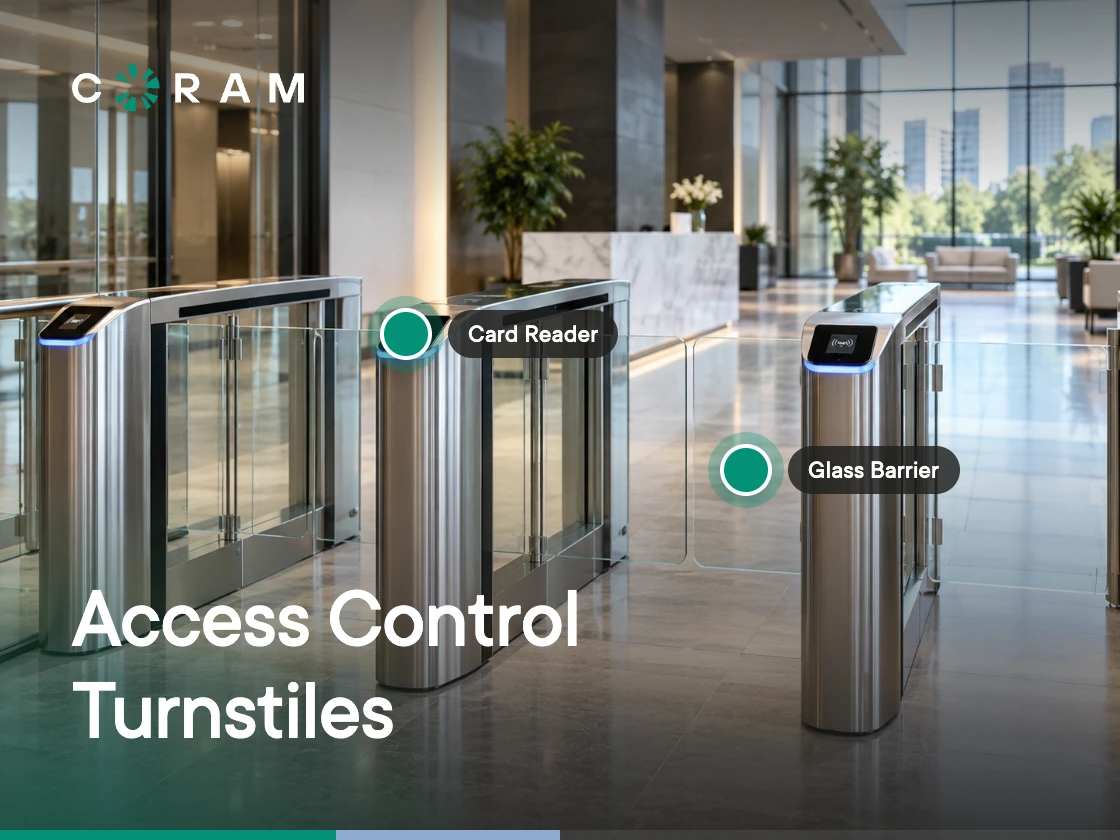
Optical turnstiles, commonly referred to as speed gates, prioritize throughput, user experience, and architectural appearance. Rather than relying on a physical barrier alone, they combine retractable glass panels with infrared sensors and access control rules to detect tailgating and unauthorized entry. They offer the fastest pedestrian flow of any access control turnstile while maintaining a professional appearance for premium facilities.
Best suited for:
- Corporate headquarters
- Office lobbies
- Airports
- Transit hubs
- Universities
- Hospitals and healthcare facilities
Limitations:
- Detect tailgating but do not physically stop a determined intruder
- Depend on security staff or video monitoring to respond to alarms
- Standard configurations are intended for indoor environments
- Highest hardware and installation costs
- Sensor systems require periodic calibration and maintenance
Typical installed cost: $8,000–$23,000+ per lane, depending on lane width, sensors, finishes, and integration requirements.
Swing Gates and ADA Access Lanes
Swing gates are designed to provide accessible entry alongside other access control turnstiles. A hinged panel swings open when a valid credential is presented, creating a wider passage for wheelchair users, visitors, staff carrying equipment, deliveries, and anyone who can't comfortably use a standard turnstile lane. Most installations using tripod or full-height turnstiles require at least one dedicated ADA-compliant swing gate.
Best suited for:
- ADA-compliant entrances
- Wheelchair and mobility device access
- Visitor and delivery access
- Accessible lanes alongside multi-lane turnstile installations
Limitations:
- Provide minimal physical deterrence when used alone
- Should not be relied upon as the primary security barrier
- Wider lanes require additional floor space
- Benefit from monitoring through access control and video systems
Typical installed cost: $2,500–$6,500 per lane, depending on hardware and installation.
How Turnstiles Integrate with Your Access Control System
A turnstile is only one part of the access control system. The reader verifies credentials, the controller authorizes entry, and the access control platform manages users, permissions, schedules, and event logs. Understanding how these pieces work together determines whether a new turnstile integrates with your existing infrastructure or requires additional hardware and software.
Readers and Credentials
Every access control turnstile uses one or more credential readers mounted on or beside the lane, which verify the user's identity before signaling the controller to release the turnstile. Most commercial systems support standard reader protocols such as Wiegand and OSDP, allowing them to integrate with a wide range of access control platforms. Our OSDP vs. Wiegand guide explains the differences in greater detail.
The reader, controller, and credential database are the three core access control system components behind every turnstile lane. The turnstile itself is the physical barrier; these components determine who can enter, when access is granted, and how every event is recorded.
Depending on the reader and platform, access control turnstiles can support multiple credential types:
- RFID keycards and key fobs
- PIN codes
- Mobile credentials via BLE or NFC
- Biometric authentication
The turnstile itself doesn't determine which credential is used; the reader and access control platform do.
Controllers and the Access Control Platform
The door controller authorizes entry: once a credential is verified, it receives the request and unlocks the turnstile if the user has the right permissions. In most commercial installations, that controller connects to an access control platform that manages the credential database, access rules, schedules, and event logs across the entire facility, letting doors, elevators, and turnstile lanes operate within the same system.
The reader hardware at a turnstile lane communicates with controllers using the same protocols and credential formats as a reader at a standard door, which lets organizations extend existing credentials, permissions, and schedules to turnstile lanes without maintaining a separate user database or platform.
Coram Access Control is a fully integrated door management system that manages physical access across sites, buildings, and rooms through a central platform. It supports RFID keycards compatible with both Wiegand and OSDP readers, and users can be assigned one or more access methods, including physical keycards and app-based remote unlock, with permission granted to specific entry points. The same credential structure applies consistently across doors and compatible turnstile entry points.
Event Logging and Video Verification
Every credential presented at a turnstile generates an access event: whether access was granted or denied, the time of the request, and the entry lane used. When integrated with a central platform, these events appear alongside door activity, creating a complete audit trail across the facility.
Coram records every unlock attempt, door open and close event, request-to-exit, and forced entry, with video linked to each event, so administrators can move directly from an access event to the corresponding footage without searching multiple systems. Linking access events with recorded video this way lets teams investigate incidents faster, verify activity at each entry point, and maintain a complete audit trail without switching between systems.
What to Confirm Before Specifying Hardware
Before selecting an access control turnstile, confirm the following with your access control vendor:
- Does the platform support the reader protocol the turnstile manufacturer specifies: Wiegand, OSDP, or dry contact?
- Will access events from the turnstile controller appear in the same log as door events, or in a separate system?
- Is the turnstile controller compatible with your existing credential formats and reader hardware (card format, bit length, or facility code)?
- Can the platform manage turnstile permissions, schedules, and users from the same interface as the rest of your access control system?
Confirming these details before procurement helps prevent compatibility issues, unexpected hardware costs, and deployment delays later in the project.
What Access Control Turnstiles Cost
The total cost of an access control turnstile extends well beyond the hardware itself. Turnstile type is the biggest driver: optical speed gates generally cost more than tripod or waist-high turnstiles, while full-height turnstiles require additional structural installation. Beyond that, cost scales with the number of lanes, since more lanes multiply hardware, installation, and integration costs, and with the installation environment, since outdoor deployments often require weatherproof hardware, trenching, concrete foundations, and additional electrical work. Credential readers, controllers, and integration with your existing platform may also be priced separately from the turnstile itself, and labor costs vary depending on site preparation, power availability, cabling, and floor anchoring requirements.
Typical Installed Cost by Turnstile Type
The ranges below reflect typical North American installed costs in 2026, including standard hardware and installation. Reader hardware, access control software licensing, and major site-specific construction work are generally quoted separately.
Budgeting Tip
Compare total project cost rather than hardware price alone. Installation, integration, maintenance, site preparation, and future expansion often have a greater impact on long-term costs than the initial purchase price.
Tailgating, Anti-Passback, and How AI Video Closes the Gap
One of the biggest reasons organizations invest in access control turnstiles is to reduce tailgating and piggybacking. By allowing only one authorized entry per credential, turnstiles create a controlled entry point that's far more secure than an open doorway: they physically limit one person per credential, reduce opportunities for unauthorized entry through uncontrolled doors, support anti-passback rules that prevent a credential from being reused until a valid exit has been recorded, and work with existing access control policies rather than requiring a separate system.
No turnstile eliminates the risk entirely, though. A determined individual may still attempt to follow an authorized user through the lane before the barrier closes, especially during heavy pedestrian traffic. Even optical speed gates, which detect tailgating and trigger alarms, rely on security personnel to respond; they don't physically stop every unauthorized entry. Anti-passback rules close part of that gap by preventing a credential from being reused until a corresponding exit has been recorded, which reduces credential sharing, improves occupancy tracking, and makes repeated unauthorized access more difficult.
How AI Video Closes the Gap
Coram Access Control doesn't replace the turnstile. It works alongside compatible readers and controllers to manage users, permissions, door schedules, and access events from a central platform, using the same credential setup described above.
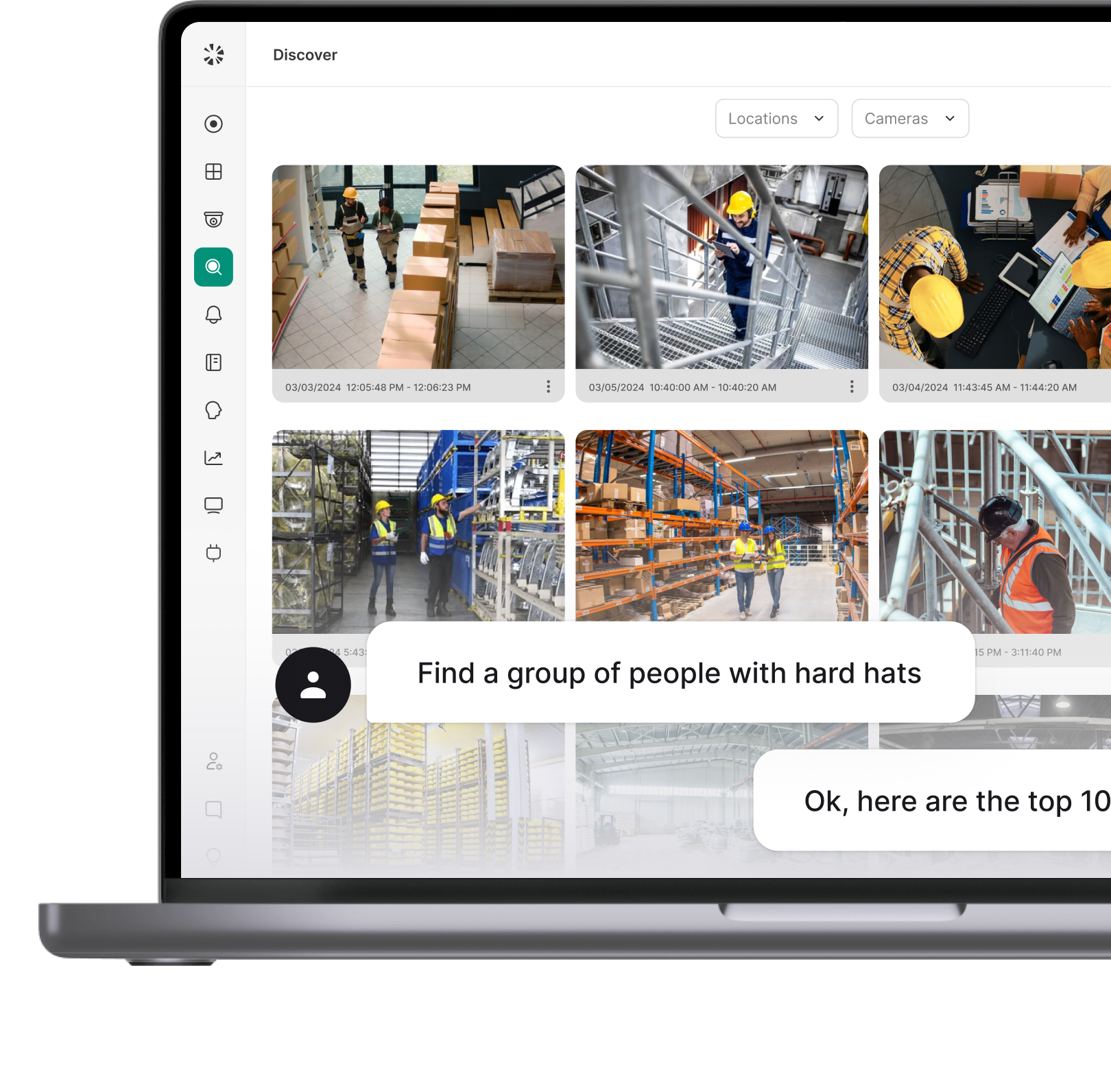
The greatest operational benefit comes when access control turnstiles are combined with AI video that runs on your existing camera infrastructure. With a camera covering the turnstile lane and video linked to every access event, security teams can review a grant, deny, or alarm alongside the recorded footage of who actually passed through. Instead of relying only on an alarm or access log, staff can see what happened, identify who was involved, and respond with confidence.
Access control turnstiles manage authorized entry. Coram links that entry data to video, giving teams the visibility to investigate and respond when someone attempts to bypass that control.
ADA Compliance, Installation, and Maintenance
Getting a turnstile installation right involves more than picking hardware. Accessibility, site preparation, and upkeep all shape whether the entrance works the way it's supposed to once it's live.
ADA Compliance
Every installation that includes tripod, waist-high, or full-height turnstiles should also include at least one ADA-compliant accessible lane within the same entry cluster. Under the 2010 ADA Standards for Accessible Design, turnstiles can't be part of an accessible route (Section 404.2.1), so the accessible lane has to be a gate or door instead. That gate needs a minimum 32-inch clear width, and its hardware must be usable with one hand without tight grasping, pinching, or twisting. The standards don't require the gate to be power-operated, though many facilities add automatic operation for convenience. Standard tripod and full-height turnstiles don't meet this on their own, so they're typically paired with a separate swing gate; some optical speed gates can be specified with wider lanes (900mm or more) that accommodate wheelchairs within the main installation instead, eliminating the need for a separate lane in some configurations. Always confirm the manufacturer's specifications before treating a speed gate as ADA compliant.
The accessible lane deserves the same security attention as the rest of the entry. Without camera coverage or staff supervision, it can become the weakest point in an otherwise secured entry, so monitoring matters just as much as the hardware itself.
What Installation Actually Involves
Installing access control turnstiles involves much more than placing a barrier at the entrance. Several factors influence both installation complexity and project cost:
- Floor anchoring: Most commercial turnstiles are secured to a concrete floor. Outdoor installations may require additional foundation or concrete pad work.
- Power supply: Turnstiles, controllers, and readers require a dedicated power source. Extending power or conduit to the installation point increases labor and material costs.
- Reader integration: Credential readers communicate with controllers using protocols such as Wiegand or OSDP. Compatibility with the existing access control system should be confirmed before installation.
- Network connectivity: Cloud-managed access control platforms require network connectivity for controllers, event logging, and remote management.
- System testing: Before commissioning, credentials, access permissions, event logs, anti-passback rules, and emergency release functions should all be tested to confirm the system operates as expected.
Professional installation typically adds $500–$3,000 per lane, depending on site conditions. Projects involving outdoor installations, foundation work, long conduit runs, or complex system integrations generally fall at the higher end of the range. If you're still choosing a partner, our roundup of access control system installers is a useful starting point.
Ongoing Maintenance
Commercial-grade turnstiles are designed for millions of operating cycles, but routine maintenance is essential to keep them performing reliably. Regular maintenance typically includes:
- Inspecting and lubricating moving components such as rotating arms, flap barriers, and hinges
- Cleaning and calibrating sensors on optical turnstiles and speed gates to maintain accurate detection
- Applying firmware and software updates for controllers and connected access control platforms
- Testing readers, credentials, anti-passback rules, and emergency release functions
- Replacing worn mechanical or electronic components before they affect daily operation
The lowest-cost turnstile isn't always the most economical over its lifetime. Selecting the right turnstile for the environment and maintaining it properly typically delivers a lower total cost of ownership than investing in a more complex system that exceeds the facility's operational requirements.
Final Takeaway
The right turnstile for your building isn't necessarily the most secure option or the most affordable one; it's the one that matches your actual threat model, peak throughput, physical environment, and the access control infrastructure already in place. Full-height turnstiles prioritize physical security, optical speed gates prioritize throughput and visitor experience, and tripod or waist-high turnstiles balance security with affordability. Which trade-off matters most depends on how people actually move through your facility.
The most effective entry strategy combines the right turnstile, a compatible access control platform, and video verification. Planning for compatibility from the start helps create an entrance that's secure, efficient, and easier to manage as your facility and security requirements evolve.




.png)