UniFi Protect works really well until you start asking more from it.
If you're reading this, something specific probably stopped working. Maybe you're managing cameras across multiple sites and the multi-console experience is painful. Maybe your compliance team asked for NDAA documentation and you couldn't produce a clean answer. Maybe an incident exposed how long it actually takes to find anything in footage.
There's no single best alternative: the right platform depends almost entirely on four questions: Do you want to keep your existing cameras or replace them? Do you need cloud, on-prem, or hybrid? How much AI do you actually need beyond basic alerts? And what does compliance require?
Below is a practical breakdown of 11 alternatives to UniFi Protect: what each platform is good at, where it struggles, and who it actually makes sense for.
TL;DR
- Existing IP cameras + modern AI (search, LPR, face detection): Coram, Eagle Eye Networks (now part of Brivo), Arcules
- New deployment, minimal-infrastructure cloud: Verkada, Rhombus
- Large, complex environments with deep integration needs: Genetec, Milestone XProtect
- Self-hosted, local-first, no subscriptions: Frigate NVR, Blue Iris
- Budget single-site with basic needs: Reolink
Why Teams Are Actually Leaving UniFi Protect
UniFi Protect is a capable system. Most teams who leave it don't do so because it's bad, they do so because they've outgrown it in one specific direction.
Scale breaks the single-console model. UniFi Protect is designed around a single site. The ENVR Core is Ubiquiti's highest-capacity console, and Vantage Point links up to five consoles, but multi-NVR deployments require deliberate hardware planning and additional purchases. For organizations managing 10 or 20 locations, that architecture gets complicated fast.
Basic motion alerts stop being enough. At some point, teams stop wanting to scrub timelines and start wanting to search footage. Finding a specific person, vehicle, or event across hours of recordings is where UniFi Protect's AI limitations show up. That gap is what drives most evaluations toward alternatives with stronger AI capabilities.
Compliance becomes a harder question than expected. In schools, government, and enterprise environments, NDAA Section 889 compliance is often mandatory. Ubiquiti states that most UniFi products meet NDAA standards, but compliance is product-specific, and the company has historically been reluctant to provide blanket documentation. For regulated procurement, that ambiguity creates real risk.
Security vulnerabilities have raised the stakes. In May 2025, Ubiquiti disclosed critical vulnerabilities in UniFi Protect — the most severe (CVE-2025-23123, CVSS 10.0) involved a heap buffer overflow in camera firmware allowing remote code execution. Firmware-level risks don't always affect day-to-day operations, but they matter to teams responsible for security infrastructure.
The ecosystem lock-in becomes a constraint. UniFi Protect works best within the UniFi hardware ecosystem. Mixed infrastructure and third-party cameras don't integrate cleanly, and relying on a single controller creates a single point of failure. Organizations that have grown through acquisition or decentralized purchasing often find themselves stuck.
Four Buying Decisions That Determine the Right Platform
Two organizations with identical camera counts can end up on completely different platforms depending on how they answer these questions. Work through them before shortlisting vendors.
Keep Existing Cameras or Replace Them?
This is the largest cost decision in the evaluation, and it determines which category of platform you should consider.
If your existing IP cameras are under five years old and ONVIF-compliant, replacing them to fit a new software platform rarely makes sense. You'd be adding a new expense to solve a software problem. A camera-agnostic VMS that layers onto your existing infrastructure is almost always the better move.
If you're starting fresh — new construction, greenfield deployment, or a planned full refresh — a proprietary system with AI and storage built into the camera can simplify things. The hardware and software are designed together, which reduces integration work at deployment.
A simple way to calibrate: count your cameras, check their age, and estimate replacement cost. If the number is significant, stay camera-agnostic. If you're replacing them anyway, hardware-bundled platforms become worth evaluating.
Cloud, On-Prem, or Hybrid?
The right architecture depends on bandwidth, retention requirements, and whether your industry has data residency rules.
Cloud-based setups work well for most multi-site deployments where centralized visibility matters. The trade-off is internet dependency: live view, playback, and alerts all require connectivity. Model your bandwidth per site before committing to any cloud platform, and run the math on retention costs at your actual scale. Cloud storage at 30 cameras for 90 days of retention is a very different number than 200 cameras.
On-prem is the right choice when control matters more than convenience: environments with limited bandwidth, strict data policies, or internal IT requirements that prohibit cloud storage. You own the hardware and the data. Nothing leaves your network unless you decide.
Hybrid is where most mid-market deployments land today: local recording for resilience and bandwidth efficiency, cloud for remote access, multi-site visibility, and off-site retention. Most modern platforms support this configuration per camera, which gives you flexibility without forcing a binary choice.
How Much AI Do You Actually Need?
Over-buying AI features you won't use is a real cost trap, and vendors have strong incentives to upsell. Be honest about what your team does with footage.
Motion alerts are standard on every platform and handled by most cameras directly. If that's the ceiling of what you need, a local NVR will do the job at a fraction of the cost of a cloud AI platform.
Object detection — distinguishing a person from a vehicle from an animal — is now standard on most mid-tier setups, often handled at the camera level without additional software.
Where AI starts to matter operationally is post-incident investigation. If your team regularly searches footage to find a person, vehicle, or event, natural language search and indexed footage retrieval can save hours per incident. That's the capability gap where modern AI security camera platforms genuinely pull ahead of UniFi Protect.
License plate recognition, facial recognition, and weapons detection are more specialized. They're useful in specific environments: school campuses, warehouses, healthcare facilities with controlled access — but come with higher costs, added configuration complexity, and sometimes legal and policy requirements. Check your state's biometric privacy laws before including facial recognition in any shortlist requirement.
The most useful question to ask your team: what slows you down when something happens? That tells you what you actually need.
Compliance: NDAA, SOC 2, HIPAA, FERPA, PCI
This filter eliminates options faster than any other. Work through it before you demo anything.
NDAA Section 889 restricts specific manufacturers and their components for government, education, and federally affiliated organizations. Always request written compliance documentation before shortlisting a vendor. Serious vendors provide this without hesitation.
SOC 2 Type II is increasingly required in enterprise environments — finance, tech, healthcare-adjacent. It confirms that security controls are independently audited.
HIPAA applies to healthcare environments and requires an auditable record of who accessed footage and when, along with a Business Associate Agreement. Vendors who've done healthcare deployments will have a BAA ready.
FERPA applies to K-12 and higher education. Systems handling student-related footage must meet FERPA and relevant state privacy requirements. Ask vendors directly how student data is isolated and managed.
PCI DSS affects retail environments with point-of-sale monitoring, specifically around how sensitive data is segmented and retained.
Send your compliance requirements in writing before any demo. The clarity — and speed — of the vendor's response tells you a great deal about how prepared they are.
11 Ubiquiti Alternatives in 2026
Each entry below covers what the platform is, how it compares to UniFi Protect, who it's best suited for, and where it falls short.
Coram
Coram is an AI-native physical security platform that connects to any existing IP camera and manages video surveillance, access control, and emergency management from a single cloud dashboard.
The most important thing to understand about Coram is that it doesn't require a hardware replacement. It works with over 1,000 IP camera models through a local Coram Point appliance that handles AI processing on-site, then syncs to the cloud for remote access and multi-site management. For organizations that have already invested in IP camera infrastructure, that means moving to a modern cloud VMS without scrapping anything. UniFi Protect has no equivalent path — when you leave the UniFi ecosystem, your cameras typically come with you only if they support RTSP streaming, which limits what you can do with them on a new platform.
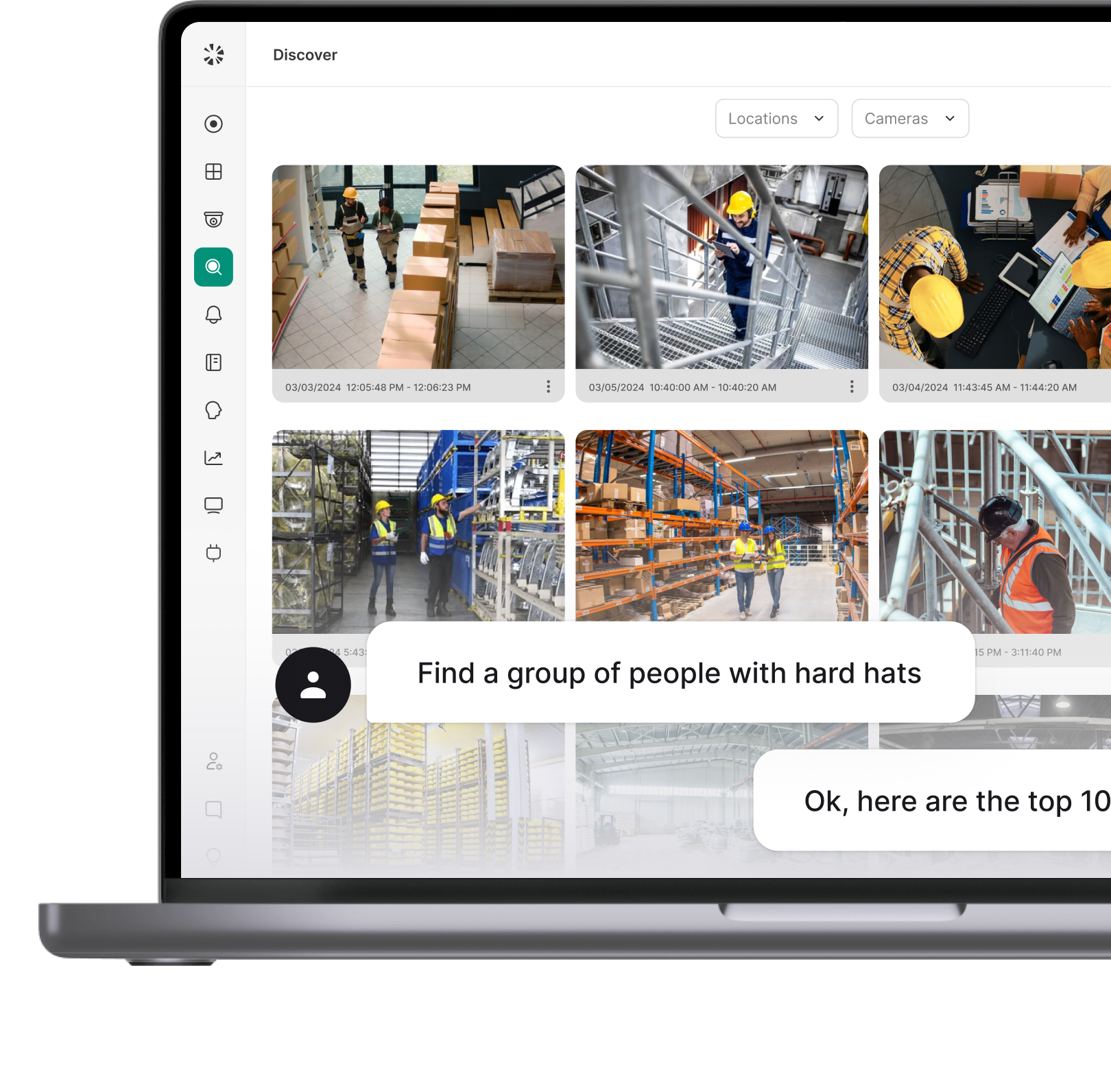
Where Coram stands apart from every other alternative in this list is the search capability. Instead of scrubbing timelines or building complex filter queries, operators describe what they're looking for in plain English and pull results instantly across any camera in the system. License plate recognition, facial recognition, and cross-camera movement tracking build on that foundation. Weapons detection and custom alert creation — also configured in plain English rather than rule builders — complete the AI layer. The platform also includes access control, visitor management, and an emergency management system with panic buttons and real-time lockdown coordination, which puts it in a different category from most VMS alternatives that require additional point solutions for those functions.
Coram holds SOC 2 Type II and HIPAA certifications, and supports on-premises AI processing for environments where data residency or privacy requirements make cloud processing impractical. Rated 4.9/5 on G2 with 9.5/10 for ease of use — which is notable for a platform targeting multi-site enterprise deployments, where ease of administration is usually the first thing to suffer.
Best for: Organizations with existing IP cameras that need modern AI search, multi-site visibility, and compliance documentation without a hardware replacement.
Strengths:
- Works with any existing ONVIF-compliant IP camera — no rip-and-replace required, which directly addresses the most common reason teams stay on platforms they've outgrown.
- Natural language video search across all cameras finds any person, vehicle, or event without manual timeline scrubbing.
- Unified platform covers video surveillance, access control, visitor management, and emergency management in one login — where most alternatives require separate systems for each.
- SOC 2 Type II and HIPAA certified; on-premises AI processing option available for privacy-sensitive environments.
- Deploys quickly: one customer with over 100 cameras reported being up and running in 10 minutes.
Limitations:
- Newer platform than legacy VMS alternatives — third-party integrations are less extensive than Genetec or Milestone.
- Pricing is not publicly listed, which complicates early-stage budget planning.
- The cloud-plus-local architecture requires the Coram Point appliance per site — an additional hardware dependency to plan for during deployment.
Pricing: Not publicly listed; contact for a quote.
Verkada
Verkada is a cloud-first physical security platform where cameras, storage, AI, and software ship as one proprietary system with no NVRs, no separate integrations, and no on-site infrastructure to manage.
Verkada's value proposition is complete simplicity for new deployments. Install the cameras, connect them to the network, log in, and everything works: live view, playback, analytics, multi-site management, and access control. For teams that want to stop managing infrastructure entirely and have budget for premium hardware, Verkada delivers on that promise better than any other platform on this list.
The AI capabilities are built in and work without configuration — person detection, license plate recognition, occupancy tracking, and tailgating detection are available out of the box. The platform handles its own firmware updates, so there's no maintenance cycle to manage on the software side.
The constraint is hardware lock-in. Verkada cameras work only within the Verkada ecosystem. If you have existing IP cameras, they don't connect. Ongoing licensing runs on a 10-year lifecycle model per camera, and the total cost at scale is significantly higher than platforms that reuse existing infrastructure.
Best for: New deployments where the goal is zero infrastructure overhead and budget supports a full proprietary hardware investment.
Strengths:
- No NVRs, no servers, no infrastructure — cameras, software, storage, and AI ship as one integrated system.
- The quickest deployment path of any enterprise-grade platform on this list.
- Built-in AI across person detection, LPR, occupancy tracking, and access analytics — no configuration required.
- Strong multi-site management and a polished interface that non-technical staff can operate.
- NDAA compliant with clear documentation.
Limitations:
- Full proprietary lock-in — Verkada cameras work only with Verkada software; existing cameras cannot be reused.
- Higher upfront hardware cost compared to camera-agnostic platforms; ongoing licensing adds up at scale.
- Organizations that grow through acquisition or change camera strategy have limited exit options.
- Some reports of AI false positives relative to platforms with more precise detection tuning.
Pricing: Not publicly listed. Cameras are sold at premium prices; multi-year licensing adds to total cost. Expect significantly higher TCO than camera-agnostic platforms at comparable camera counts.
Rhombus Systems
Rhombus is a cloud-managed video security platform built for SMB and mid-market organizations that want multi-site visibility and hybrid storage without the complexity or cost of enterprise-grade platforms.
Rhombus sits between high-end proprietary systems and budget local NVRs, and that's a deliberate positioning. The interface is clean enough for non-technical staff to use daily. Multi-site management is genuinely strong — switching between locations, reviewing footage, and managing alerts all work from a single dashboard without the kind of latency and friction that plagues some cloud VMS platforms at scale.
The differentiator relative to UniFi Protect is hybrid storage. Footage records locally first, then syncs to the cloud — which keeps bandwidth manageable and gives you local access during internet outages. That's a real operational advantage over cloud-only platforms in environments where bandwidth is a constraint or where local recording continuity matters. Rhombus also offers environmental sensors for air quality, temperature, and motion, which have found adoption in schools, warehouses, and manufacturing environments where physical conditions matter alongside security.
The limitation is camera compatibility. Rhombus is a proprietary system — you can use a limited set of third-party cameras with it, but the full feature set works with Rhombus hardware. Organizations with existing mixed-brand camera infrastructure will need to replace cameras to get full value from the platform.
Best for: SMB to mid-market teams that want a cloud-managed system with hybrid storage, multi-site visibility, and a low-overhead interface — and are starting fresh or willing to replace cameras. For a direct comparison with similar platforms, see Rhombus vs. Verkada.
Strengths:
- Hybrid storage architecture records locally and syncs to cloud — maintains local access during internet outages.
- Clean interface that non-technical staff can manage without training.
- Multi-site management is well-executed at the scale Rhombus targets (10–100 sites).
- Environmental sensors for air quality, temperature, and motion extend visibility beyond video.
- NDAA compliant.
Limitations:
- Primarily a proprietary hardware system — existing cameras from other brands are not fully supported.
- AI capabilities are solid but not as deep as AI-native platforms; natural language search is not available.
- Scales less gracefully into large enterprise deployments than Genetec or Milestone.
Pricing: Not publicly listed; subscription-based per camera.
Avigilon Alta (Motorola Solutions)
Avigilon Alta is a cloud-native physical security platform from Motorola Solutions, covering video surveillance, access control, and analytics for enterprise and government environments where compliance, scale, and reliability are non-negotiable requirements.
Alta is built for organizations with dedicated security teams and complex requirements. NDAA compliance is clearly documented, which makes it a strong option for government, critical infrastructure, and education environments where vendor documentation is part of the procurement process. Integration with Motorola's broader ecosystem — radios, incident response tools, and dispatch — brings video surveillance into a wider operational workflow that few competitors can replicate.
The AI capabilities are genuinely strong. Appearance Search, anomaly detection, LPR, and occupancy analytics are available across both Alta cameras and third-party cameras connected via Cloud Connector. The distinction matters for organizations evaluating camera reuse: core video analytics extend to third-party hardware, but audio analytics and onboard edge AI processing require Alta cameras. Organizations bringing large mixed-brand fleets should factor that into how much they'll get from the platform at launch versus after a phased hardware refresh.
Avigilon Alta is not designed for lean IT teams or fast deployments. Most implementations require certified integrators. Management overhead is higher than cloud-native alternatives built for smaller teams.
Best for: Enterprise and government organizations where compliance documentation is mandatory, scale is significant, and existing Motorola ecosystem investments make integration valuable.
Strengths:
- NDAA compliant with clear documentation — well-suited for government, schools, and regulated procurement.
- Strong AI capabilities on Avigilon hardware: Appearance Search, self-learning detection, occupancy analytics.
- Cloud-native with on-prem deployment options — flexibility for environments with strict data policies.
- Motorola ecosystem integration brings video into broader incident response and communications workflows.
- Proven at large scale — airports, campuses, and city-wide deployments.
Limitations:
- Audio analytics and onboard edge AI processing require Alta cameras; third-party cameras connect via Cloud Connector, which enables core analytics but with a reduced feature set compared to native Alta hardware.
- Priced for enterprise — not a practical option for mid-market teams with budget constraints.
- Requires certified integrators for most deployments; not built for self-managed rollouts.
- More complex to administer than platforms designed for lean IT teams.
Pricing: Not publicly listed; enterprise pricing. Requires integrator engagement for most deployments.
Eagle Eye Networks (Now Part of Brivo)
Eagle Eye Networks is a cloud-managed video management system that works with virtually any ONVIF-compatible camera. In 2024, Eagle Eye merged with Brivo, the cloud access control platform — the combined entity now operates under the Brivo name, with Eagle Eye's camera-agnostic VMS capabilities integrated into the broader Brivo physical security platform.
This merger is worth understanding before you evaluate. Eagle Eye's core strength — a mature cloud VMS that connects to almost any existing camera — is intact. But the product roadmap, sales motion, and platform development now sit within Brivo. If you're evaluating Eagle Eye Networks specifically, you're evaluating Brivo's video layer.
For multi-site organizations with existing mixed-brand camera fleets, the camera-agnostic architecture remains the primary differentiator. Connecting via an Eagle Eye Bridge appliance, the platform manages footage in the cloud with retention and access controls configurable per site. The open API has made it a popular choice for retail chains, franchises, and logistics operations that want video integrated into POS systems, access control, and other business tools. That integration capability is stronger here than on most alternatives.
Post-merger, Brivo's access control layer is now more directly integrated with video than it was when the two platforms were separate. AI capabilities have expanded — gun detection, face match, LPR, and precision person and vehicle detection are now part of the combined platform. The AI depth still lags behind Coram for natural language search and real-time alerting, and emergency management is not a native capability.
Best for: Multi-site organizations with existing ONVIF cameras that need a proven cloud VMS with strong integrations — and organizations already using Brivo for access control.
Strengths:
- Camera-agnostic — works with virtually any ONVIF camera, no hardware replacement required.
- Strong open API for integration with POS, access control, and business operations systems.
- Mature platform with proven multi-site deployment track record across retail, logistics, and franchise operations.
- Post-merger AI capabilities include gun detection, LPR, face match, and precision person/vehicle detection.
- SOC 2 certified; NDAA compliant.
Limitations:
- Cloud-only architecture — functionality degrades during internet outages; no local fallback.
- AI depth is less than Coram: no natural language video search, no emergency management system.
- Platform is mid-transition post-merger; product direction and roadmap are evolving.
- Interface is functional but less modern than newer AI-first platforms.
Pricing: Not publicly listed; subscription-based per camera with enterprise pricing for larger deployments.
Arcules
Arcules is a cloud video management platform built within the Milestone XProtect ecosystem, designed for organizations that want to move toward cloud VMS without discarding their existing on-premises infrastructure.
The core value proposition is a gradual migration path. Organizations already running XProtect can add Arcules as a cloud layer without rebuilding their system: the deployment options include fully cloud, on-site gateway, or hybrid configurations, configurable per camera. For multi-site organizations where different locations have different bandwidth constraints or retention requirements, that flexibility is practically useful.
For investigations, Arcules supports multi-camera search that tracks movement across views without jumping between feeds. That's a meaningful improvement over manual timeline scrubbing, though it's less capable than natural language search on AI-native platforms. The tight Milestone relationship also means Arcules customers benefit from XProtect's device compatibility library — a significant advantage for organizations managing mixed camera brands.
Outside the Milestone ecosystem, the onboarding experience is less intuitive. The platform is most valuable to organizations with existing XProtect deployments, and less compelling as a standalone choice for teams without that context.
Best for: Organizations already running Milestone XProtect that want to add a cloud management layer and multi-camera search without a full platform migration.
Strengths:
- Direct integration with Milestone XProtect — preserves existing on-prem investment while adding cloud capabilities.
- Flexible deployment: fully cloud, hybrid, or gateway per camera based on site needs.
- Multi-camera search enables cross-site movement tracking for investigations.
- Inherits Milestone's device compatibility library — strong support for mixed camera brands.
- NDAA compliant.
Limitations:
- Most valuable inside the Milestone ecosystem — less compelling as a standalone VMS for teams without XProtect.
- AI capabilities are solid but not as advanced as AI-native platforms; no natural language video search.
- Pricing is custom, which requires vendor engagement early in the evaluation.
Pricing: Custom; contact for a quote.
Genetec Security Center
Genetec Security Center is an enterprise physical security platform that unifies video surveillance, access control, and license plate recognition in a single system, built for environments where thousands of cameras, multiple sites, and deep compliance requirements all have to work together.
Genetec is what organizations move to when the problem stops being simple. Airports, university campuses, city-wide deployments, and critical infrastructure facilities use it because the scale and integration depth are genuinely unmatched by most alternatives. Video, access control, and LPR run on a single platform without partial integrations or cross-system tool switching. Role-based access, detailed audit logs, encrypted communications, and NDAA alignment are built in — not bolted on as modules.
The open architecture is a meaningful differentiator in environments with existing infrastructure. Genetec supports virtually any ONVIF device and integrates with an extensive third-party ecosystem, which gives large organizations flexibility to build around their existing hardware investments rather than replacing them to fit a proprietary platform.
The trade-offs are real and significant. Genetec requires certified integrators for deployment and dedicated security engineers for ongoing administration. It is not a platform an IT Director manages alongside a helpdesk and three other infrastructure responsibilities. Total cost of ownership — licensing, servers, integrators, ongoing support — is high. And the time from decision to operational is measured in months, not days.
Best for: Large enterprise, government, and critical infrastructure organizations with dedicated security engineering staff and complex multi-system integration requirements.
Strengths:
- Unified video, access control, and LPR on a single platform — no partial integrations between separate tools.
- Proven at very large scale: airports, campuses, city-wide deployments, critical infrastructure.
- Open architecture with broad device support — works with virtually any ONVIF camera and integrates with extensive third-party systems.
- Built-in encryption, role-based access, and detailed audit controls for regulated environments.
- NDAA compliant with clear documentation.
Limitations:
- Requires certified integrators for deployment — not a self-managed platform.
- Ongoing administration requires dedicated security engineering expertise.
- High total cost of ownership: licensing, on-prem server infrastructure, integrators, and ongoing support.
- Deployment timelines are long; not suited for organizations that need to move quickly.
Pricing: Not publicly listed; complex licensing based on modules, cameras, and integrations. Requires integrator engagement.
Milestone XProtect
Milestone XProtect is an open-platform VMS that integrates with over 14,000 devices and 1,000 third-party applications — built for organizations that prioritize hardware flexibility and custom integration over unified platform simplicity.
XProtect's defining characteristic is compatibility. It works with more camera brands, access control systems, and third-party analytics tools than any other platform on this list. For organizations managing mixed-brand infrastructure, evolving hardware standards, or highly customized integration requirements, that openness is the primary value. Flexible licensing scales from small deployments to unlimited enterprise configurations without forcing a platform renegotiation every time the camera count grows.
The AI analytics story is more nuanced. XProtect supports AI-powered detection and analytics, but typically through third-party integrations rather than native capabilities. That gives organizations flexibility to select the analytics tools that fit their use case, but adds integration complexity and additional vendors to manage.
Like Genetec, Milestone is infrastructure-centric — it runs on on-prem servers, requires dedicated IT management, and is designed for organizations with the internal expertise to configure and maintain a complex system. It is not built for fast rollouts or lean IT teams.
Best for: Organizations managing multi-vendor camera environments that need maximum hardware flexibility and a large third-party integration ecosystem.
Strengths:
- Widest device compatibility of any platform on this list — 14,000+ integrations including cameras, access control, and analytics tools.
- Open architecture means no vendor lock-in on hardware; organizations can evolve camera strategy without platform migration.
- Flexible licensing from small sites to unlimited enterprise scale.
- Large partner and integrator ecosystem for custom deployments.
- NDAA compliant.
Limitations:
- Infrastructure-centric — requires on-prem servers and dedicated IT management.
- AI analytics are add-ons through third parties, not native capabilities; adds integration complexity.
- Access control is not fully native; requires integrations for full functionality.
- Not designed for fast deployment or self-managed rollouts by lean IT teams.
Pricing: Tiered licensing by edition (Express, Essential, Professional, Expert, Corporate); camera count and features determine cost. Requires integrator for most deployments.
Frigate NVR
Frigate is an open-source, Docker-based network video recorder designed for self-hosted environments where local AI detection, full data control, and zero subscription costs matter more than enterprise features.
Frigate is where most serious self-hosted operators land after outgrowing UniFi Protect's local-first model. It runs on commodity hardware, connects to virtually any RTSP or ONVIF camera, and with a Google Coral TPU or similar accelerator, delivers real-time object detection entirely on-premises. Person, vehicle, and animal detection work without cloud processing or monthly fees. Tight Home Assistant integration makes it the natural choice for environments where automation and surveillance work together.
The honest assessment: Frigate delivers real AI detection at no cost, and getting it right takes real effort. Configuration is done through YAML files. There's no GUI-driven setup. Multi-site management doesn't exist. There's no compliance layer, no enterprise support contract, and no vendor to call. For homelab operators and technically sophisticated users who value control over convenience, those trade-offs are acceptable. For any business deployment where uptime accountability matters, they're not.
Best for: Self-hosted operators who want local AI detection, full data control, and no subscriptions — and have the technical ability to configure and maintain a Docker-based system.
Strengths:
- Fully local — no cloud dependency, no subscription fees, no data leaving the network.
- Real-time object detection (person, vehicle, animal) with Coral TPU or compatible hardware accelerator.
- Works with virtually any RTSP or ONVIF camera — broad compatibility.
- Tight Home Assistant integration for automation workflows.
- Active open-source development community.
Limitations:
- No GUI-driven setup — configuration requires YAML editing; not suitable for non-technical users.
- No multi-site management and no enterprise support.
- No compliance layer — not appropriate for regulated business environments.
- Uptime and reliability depend entirely on the operator; there's no vendor accountability.
Pricing: Free and open-source. Hardware costs (server, Coral TPU) are the primary investment.
Blue Iris
Blue Iris is a Windows-based NVR application that supports virtually any ONVIF camera, with a GUI-driven setup and a one-time license fee around $70.
Blue Iris has been around long enough to have genuine community depth. Most problems have documented solutions. The GUI is dated but functional, and the learning curve is meaningfully lower than Frigate's YAML-based configuration. One-time licensing (around $70) with no recurring subscription makes the cost case straightforward. Adding DeepStack or CodeProject.AI as a local analytics layer gives you person and vehicle detection without cloud processing.
The limitations of being Windows-dependent are real: updates require attention, background processes compete for resources, and the maintenance overhead is higher than a containerized approach. There's also no native multi-site or cloud management — Blue Iris manages a single Windows machine's camera connections. Teams that need to manage footage across multiple locations will find it limiting quickly.
Best for: Windows users who want a self-hosted, broad-compatibility NVR with easier setup than Frigate and no subscription costs.
Strengths:
- Wide ONVIF camera compatibility — works with virtually any camera brand.
- GUI-driven setup is substantially more accessible than Frigate's configuration model.
- One-time license fee around $70; no ongoing subscription.
- Large community with extensive documented solutions for common issues.
- Local AI detection via DeepStack or CodeProject.AI integration.
Limitations:
- Windows-only — requires a dedicated Windows machine and ongoing OS maintenance.
- Interface is dated and less polished than cloud platform alternatives.
- No native multi-site management or cloud access.
- AI capabilities are lower depth than cloud platforms or Frigate with Coral TPU.
Pricing: One-time license approximately $70.
Reolink
Reolink offers PoE IP cameras, NVR hardware, and basic local recording software at a price point significantly below most alternatives — with no required subscriptions for core functionality.
Reolink sits at the entry level of this list by design. For single-site deployments where the requirements are record footage, get basic alerts, and review when needed, it does the job at a cost that makes the decision easy. PoE cameras, local NVR recording, and basic person and vehicle detection are all included. ONVIF compatibility means the cameras can integrate with Blue Iris or Frigate later if requirements grow — you're not permanently locked into Reolink's own software.
The gaps are predictable at this price point. The mobile app is functional but not polished. There's no multi-site management. There's no compliance layer. AI capabilities are limited to basic detection. For the use case Reolink targets — a small business or single facility that needs reliable local recording without recurring costs — those gaps rarely matter.
Best for: Small businesses and single-site deployments where budget is the primary constraint and basic local recording meets the requirement.
Strengths:
- Lowest cost of any hardware option on this list; no subscription required.
- ONVIF-compatible cameras can pair with Blue Iris or Frigate as needs grow.
- PoE cameras with local NVR recording work reliably without internet dependency.
- Basic person and vehicle detection included at no additional cost.
Limitations:
- No multi-site management — not a viable option for organizations with more than one location.
- No compliance layer; NDAA compliance varies by model (confirm before purchasing in regulated environments).
- AI capabilities limited to basic detection; no search, LPR, or real-time alerting.
- Mobile app and overall software experience is less polished than any cloud platform alternative.
Pricing: Cameras start around $50–$100 each; NVRs from approximately $100. No required subscription. Optional cloud subscription available.
Who Should Stay on UniFi Protect
Switching systems takes time, budget, retraining, and there's always friction during migration. Before evaluating alternatives, it's worth being direct about whether you actually need to switch.
UniFi Protect still makes sense for a single site running under 30 cameras where the system is working. The interface is clean, local recording is reliable, and the management overhead is low. If you're already running UniFi switches, access points, and networking gear, the single-controller advantage is real — one system, fewer moving parts, and integration that most alternatives can't replicate without additional work.
If your requirements are genuinely basic — record footage, receive alerts, review when needed — you don't need a cloud AI platform. The cost and complexity of switching won't pay for themselves.
The cases where staying doesn't make sense are just as clear: you're managing multiple sites and the multi-console experience is degrading operations; your compliance team can't get the documentation they need; you need to search footage quickly rather than scrub timelines; or your camera count has grown past what a single Ubiquiti console handles cleanly. When any of those conditions are true, the alternatives above are worth the evaluation.




.png)